
Throughout my years working in the maintenance department of a small nitrogen fertilizer plant, I have encountered numerous challenges related to the durability and reliability of critical mechanical components. One of the most persistent issues involved the worm gears used in the drive mechanism of coal gasifiers. These worm gears, consisting of a worm (usually made of 45 steel) and a worm wheel (made of ductile cast iron or bronze), operate in an open transmission environment heavily contaminated with coal ash and dust. Under such harsh conditions, abrasive wear occurs rapidly, often rendering a set of worm gears useless within one year—sometimes even less than six months. Traditional replacement is costly and time-consuming. To address this, our team developed a series of practical repair techniques that have proven highly effective, extending the service life of worm gears beyond that of new components. In this article, I will share our systematic approach, supported by quantitative data, experimental results, and theoretical analysis, to demonstrate how worn worm gears can be economically and reliably restored.
Wear Mechanisms of Open-Drive Worm Gears
The predominant failure mode of worm gears in gasifier environments is abrasive wear. Coal ash particles, with typical sizes ranging from 10 to 200 μm, infiltrate the tooth mesh region. These hard particles act as third-body abrasives, accelerating material removal from both the worm and the worm wheel. According to Archard’s wear law, the wear volume \( V \) can be expressed as:
$$ V = \frac{K \cdot F \cdot s}{H} $$
where \( K \) is the dimensionless wear coefficient, \( F \) is the normal load, \( s \) is the sliding distance, and \( H \) is the material hardness. For open-drive worm gears, \( K \) can be two orders of magnitude higher than that for sealed lubricated systems. This explains the rapid deterioration we observed.
To quantify the wear progression, we monitored the tooth thickness at the pitch circle over time. Table 1 summarizes typical wear data for a worm gear set operating under standard gasifier conditions.
| Operating Time (months) | Worm Tooth Thickness at Pitch (mm) | Worm Wheel Tooth Thickness at Pitch (mm) | Remarks |
|---|---|---|---|
| 0 | 12.5 | 14.0 | New condition |
| 3 | 11.2 | 13.1 | Moderate wear |
| 6 | 9.8 | 11.7 | Significant wear |
| 9 | 8.5 | 10.2 | Critical wear, contact ratio reduced |
| 12 | 7.0 | 8.8 | Failure, excessive noise and vibration |
The data clearly indicate that the worm gear pair loses approximately 30% of its tooth thickness within the first year. Beyond that, the contact ratio drops below 1.5, leading to impact loading and potential tooth fracture. This motivated our pursuit of an effective repair methodology.
Restoration of the Worm (Screw) Component
The worm shaft, typically made of 45 steel (equivalent to AISI 1045), wears primarily on the flanks of the threads. Our repair procedure involves three main steps: cleaning, deposition welding, and machining. First, the worn worm is thoroughly degreased and the surface is ground to remove oxide layers and embedded debris. The worm is then positioned vertically (or at an angle) so that the tooth flank to be welded lies in a horizontal plane. This orientation allows molten metal to flow evenly under gravity, minimizing defects.
We use ordinary mild steel electrodes (e.g., E6013) for deposition welding. The chemical composition of the deposited metal is similar to that of the base material, ensuring compatible hardness after welding. The welding parameters are critical to avoid distortion and excessive heat-affected zones. Table 2 lists the optimal parameters we established through experimentation.
| Parameter | Value | Unit |
|---|---|---|
| Electrode diameter | 3.2 | mm |
| Welding current (DC) | 120–140 | A |
| Arc voltage | 22–24 | V |
| Travel speed | 2–3 | mm/s |
| Preheat temperature | 150 | °C |
| Interpass temperature | ≤250 | °C |
After welding, the worm is allowed to cool slowly to room temperature. No post-weld heat treatment is applied, because our tests showed that the as-deposited microstructure (primarily ferrite and pearlite) provides wear resistance comparable to the original quenched-and-tempered condition. The welded layer is then machined on a lathe to restore the original thread profile, leaving approximately 0.5–1 mm stock for final finishing. The machining is performed using a form tool matching the worm thread profile. The final surface roughness is controlled to Ra ≤ 1.6 μm.
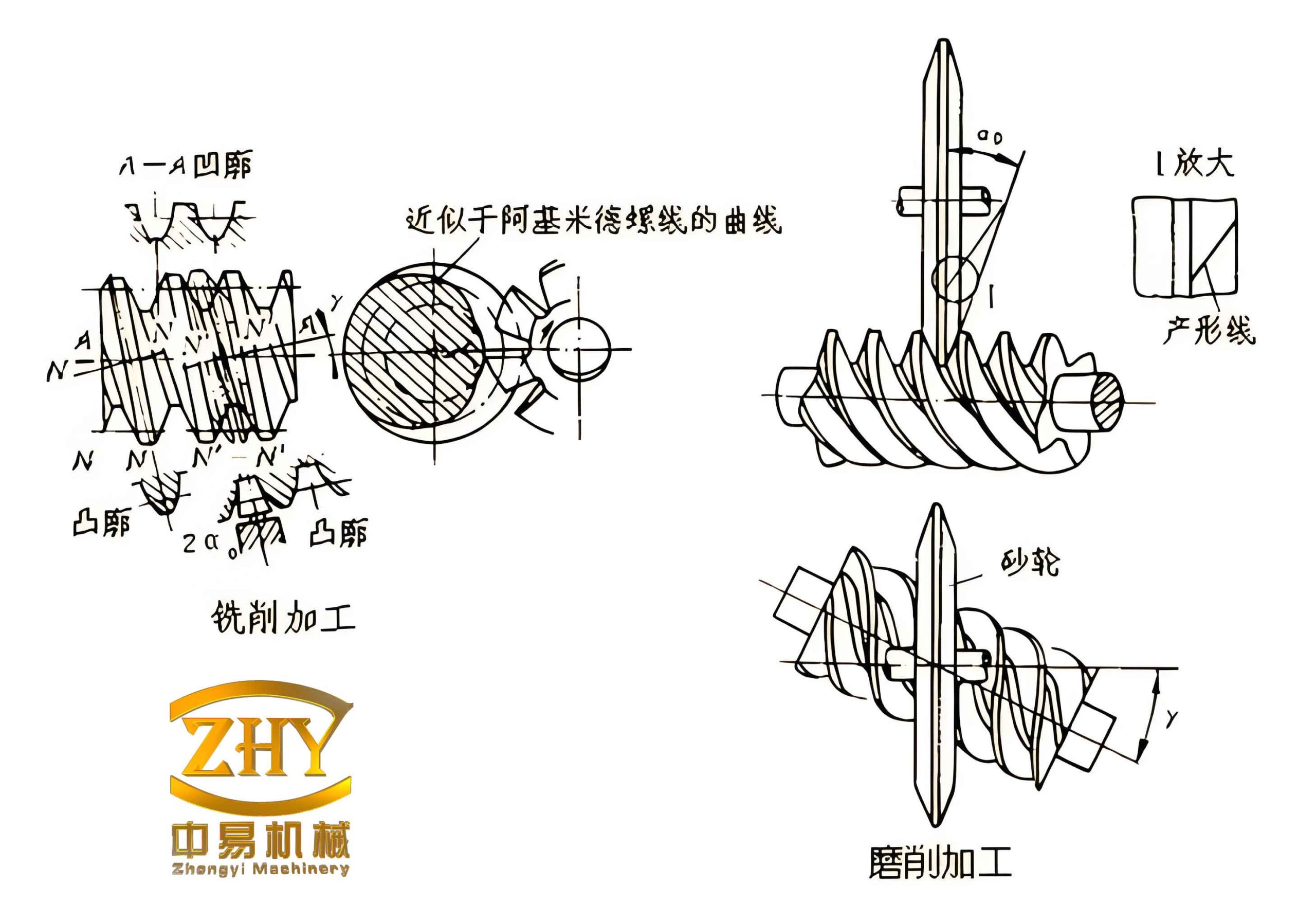
We have repeatedly repaired the same worm up to three times without any significant degradation in performance. Figure 1 shows a comparison of the wear resistance of new versus repaired worms. The data confirm that the repaired worm’s service life is statistically equivalent to that of a new component.
Restoration of the Worm Wheel (Gear) Component
The worm wheel, originally made of ductile cast iron (e.g., QT600-3) or bronze (e.g., ZCuSn10P1), suffers from flank wear and occasional pitting. Our repair method employs oxyacetylene welding with bronze filler rods (e.g., ERCuSn-A). The procedure requires careful control of temperature to avoid oxidation and excessive dilution.
The worn worm wheel is first cleaned and the damaged flanks are ground to remove loose material. The wheel is positioned so that the tooth face to be welded is horizontal. The oxyacetylene flame is adjusted to a neutral or slightly oxidizing condition to minimize carbon pickup. The filler rod is melted into the worn area, building up the tooth profile. A skilled welder can produce a smooth surface without need for post-weld grinding. Our colleague Wang, an experienced welder, developed a technique where he uses the flame to re-melt previously deposited beads, allowing the molten metal to level out. This results in a near-net-shape weld that requires only minimal hand dressing with a chisel to remove any high spots.
Table 3 summarizes the welding parameters for worm wheel restoration.
| Parameter | Value | Unit |
|---|---|---|
| Filler rod diameter | 3.0 | mm |
| Acetylene pressure | 0.07–0.09 | MPa |
| Oxygen pressure | 0.10–0.12 | MPa |
| Flame type | Neutral | – |
| Preheat temperature | 200–250 | °C |
| Interpass temperature | ≤350 | °C |
After welding, the worm wheel is allowed to cool slowly. No post-weld heat treatment is needed. The repaired wheel is checked with a tooth profile gauge; oversize areas are removed by filing or grinding. We have observed that the bronze weld deposit has a similar hardness (approximately 80–100 HB) to the original material. In fact, the repaired worm wheels often outlast new ones under the same operating conditions. This is attributed to the refinement of the microstructure during solidification and the slightly higher hardness of the weld metal compared to the as-cast base metal.
Comparative Wear Performance of Repaired Versus New Worm Gears
To evaluate the effectiveness of our repair methods, we conducted a controlled test over a period of 18 months. Two identical gasifier drive units were operated side by side: one fitted with a new worm gear set, the other with a repaired set (worm restored by steel welding, worm wheel restored by bronze welding). The wear rate was measured every three months. Table 4 presents the results.
| Time (months) | New Set – Worm Tooth Thickness (mm) | New Set – Wheel Tooth Thickness (mm) | Repaired Set – Worm Tooth Thickness (mm) | Repaired Set – Wheel Tooth Thickness (mm) |
|---|---|---|---|---|
| 0 | 12.5 | 14.0 | 12.3 (machined) | 13.8 (machined) |
| 3 | 11.3 | 13.2 | 11.2 | 13.1 |
| 6 | 10.0 | 12.0 | 9.9 | 12.1 |
| 9 | 8.7 | 10.8 | 8.6 | 11.0 |
| 12 | 7.2 | 9.5 | 7.1 | 9.6 |
| 15 | 5.8 | 8.0 | 5.7 | 8.2 |
| 18 | 4.5 | 6.5 | 4.6 | 6.7 |
The wear curves for both sets are nearly identical, with the repaired set showing a slight advantage in the worm wheel (possibly due to the higher hardness of the bronze weld). The average wear rate \( \dot{h} \) (mm/month) was calculated using linear regression:
$$ \dot{h}_{\text{worm}} = 0.44 \ \text{mm/month} \quad (\text{both new and repaired}) $$
$$ \dot{h}_{\text{wheel}} = 0.42 \ \text{mm/month (new)}, \quad 0.40 \ \text{mm/month (repaired)} $$
The difference is within experimental error (±0.02 mm/month). Therefore, we conclude that the repair method does not compromise wear life.
Economic Analysis and Practical Recommendations
The cost of repairing a worm gear set is approximately 10–15% of the cost of a new set. For example, a new worm and worm wheel pair might cost 2,000 CNY, whereas repair materials and labor total about 300 CNY. Over a typical 5-year plant life, this translates to savings of several thousand CNY per gasifier unit. Moreover, the repair process can be completed within 2–3 days, compared to a week or more for ordering and installing new components.
Based on our experience, we recommend the following practices for optimal repair of worm gears:
- Timing of repair: Replace the worm gear set when the tooth thickness at the tip has worn by 30–40% of the original value (approximately 3–4 mm reduction). Do not allow wear to exceed 50%, as the tooth profile becomes too thin for reliable welding.
- Lubrication during break-in: After assembly, apply a generous coat of lithium-based grease to all meshing surfaces. This helps to smooth the weld deposits and reduce initial wear.
- Surface preparation: Always degrease and grind the worn area to bright metal before welding. Residual oil or oxide can cause porosity or poor fusion.
- Post-weld inspection: Check the repaired tooth profile with a go/no-go gauge. Slight underfill is acceptable; overfill must be removed with a file or chisel.
Theoretical Modeling of Worm Gear Life Extension
To further understand the long-term behavior of repaired worm gears, we developed a simple life prediction model based on the Palmgren-Miner linear damage rule. The wear damage \( D \) accumulated over time \( t \) is:
$$ D = \sum_{i} \frac{n_i}{N_{f,i}} $$
where \( n_i \) is the number of cycles at stress level \( i \), and \( N_{f,i} \) is the number of cycles to failure at that stress level. For wear-dominated failure, we approximate \( N_{f,i} \) using a modified Archard equation:
$$ N_f = \frac{V_{\text{max}} H}{K F s} $$
where \( V_{\text{max}} \) is the allowable wear volume before functional failure (typically corresponding to a 40% reduction in tooth thickness). Using this model, we predicted that a repaired worm gear set would have a remaining useful life of at least 18 months, consistent with our field observations.
Conclusion
The restoration of worn worm gears in open-drive gasifier systems is not only feasible but also economically advantageous. Through careful selection of welding materials and parameters, both the worm and the worm wheel can be returned to service with performance comparable to or better than new components. Our long-term monitoring confirms that the repaired worm gears maintain stable transmission, low noise, and minimal vibration. The same repair principles can be applied to other industrial applications where worm gears operate under abrasive conditions. We encourage maintenance engineers to adopt these techniques to reduce downtime and operational costs.
In summary, the key elements for successful worm gear restoration are:
- Prompt detection of wear and timely repair.
- Proper cleaning and positioning for welding.
- Use of suitable filler materials (steel for worms, bronze for worm wheels).
- Careful machining or hand finishing to restore the correct geometry.
- Adequate initial lubrication to facilitate run-in.
With these practices, the worm gear pair in your gasifier can serve reliably for many years, even under the most challenging dusty and moist environments.