
The FT624 leaf (bale) vertical slicing machine is a critical piece of equipment in the tobacco primary processing line. It consists of a frame, a pushing cart, a belt conveyor, a cutting head, a flipping device, a material blocking device, a guiding device, and a compressed air system. In our factory, this machine is responsible for cutting compressed tobacco bales into slices of uniform thickness before they enter the conditioning drum. However, a significant design defect in the transmission mechanism of the material blocking device caused severe operational issues. During production, the cut tobacco slices exhibited inconsistent thickness, frequent slice overlapping, and downstream flow instability in the conditioning process, leading to material jamming and interruption. This paper presents a detailed analysis of the problem, the selection and implementation of a worm gear reducer as a replacement, and the resulting improvements in process control.
1. Problem Identification
During normal operation of the FT series slicer, the tobacco bale is pushed by the cart toward the cutting head. A material blocking plate (挡料板) is positioned to define the starting point of each slice. As the cart advances, the bale contacts the blocking plate, and the cutting head then moves downward to slice a fixed-thickness piece. Ideally, the blocking plate should remain stationary during the push and cut cycle. However, the original transmission system of the blocking plate used a gear reducer without self-locking capability. When the bale impacted the plate, the impact force caused the plate to shift backward slightly. This displacement changed the reference position for subsequent slices, resulting in non-uniform slice thickness. Thicker slices could not slide down smoothly, while thinner slices—especially the last piece of a bale—tended to tip forward and overlap with the preceding slice. The problem was exacerbated when using loose leaf or thin lamina tobacco, leading to severe accumulation of material on the belt conveyor. This accumulation eventually reached the conditioning drum, causing periodic jamming and material starvation, which destabilized the entire process quality control system.
Quantitative measurements before the improvement showed that the standard deviation of slice width was as high as 11.5 cm. The flow rate at the conditioning inlet fluctuated wildly, with frequent drops to zero and subsequent peaks, as recorded by the process monitoring system. This not only affected moisture and temperature uniformity but also increased the operator’s workload for manual intervention.
2. Analysis of the Transmission Mechanism
The original blocking plate was driven by a gear reducer with a reduction ratio of 1:37. The motor output speed was 1440 rpm, so the reducer output shaft speed was 1440/37 ≈ 38.9 rpm. The output shaft pulley diameter was 100 mm, and the matching driven pulley on the swing arm was also 100 mm. The gear reducer offered advantages such as compact size, low weight, and minimal space requirement. However, its critical drawback was the lack of self-locking. Under load, the gear train could back-drive if the external torque exceeded the internal friction. In this application, the impact force from the tobacco bale created a reverse torque that easily back-drove the reducer, causing the blocking plate to move.
To overcome this, we considered several types of reducers. Among them, the worm gear reducer is well known for its inherent self-locking property due to the sliding friction between the worm and the worm wheel. Additionally, it offers a higher reduction ratio in a single stage, which further enhances the braking effect. The following table summarizes the key characteristics of the two reducer types considered:
| Parameter | Gear Reducer (Original) | Worm Gear Reducer (Proposed) |
|---|---|---|
| Reduction ratio | 1:37 | 1:50 |
| Output speed @ 1440 rpm input | 38.9 rpm | 28.8 rpm |
| Self-locking capability | No | Yes (typically for lead angle < 5°) |
| Efficiency | ~95% | ~70%–85% |
| Backlash | Low | Very low |
| Noise | Moderate | Low |
| Overload protection | Minimal | Good (due to sliding friction) |
Given that the primary requirement was to prevent any backward movement of the blocking plate under impact, the self-locking feature of the worm gear reducer made it the optimal choice. The worm gear’s self-locking condition is satisfied when the lead angle of the worm is less than the friction angle. In practice, a single-start worm with a lead angle of about 3° to 5° reliably prevents back-driving under most load conditions. The larger reduction ratio (1:50) also meant that the output torque increased, providing additional safety margin.
3. Design Calculations for the Replacement
To maintain the same linear speed of the blocking plate as in the original configuration, we needed to adjust the pulley diameters because the output speed of the new reducer differed from the old one. The original output speed was 38.9 rpm; the new worm gear reducer output speed was 28.8 rpm. The relationship between output shaft speed, pulley diameter, and linear speed is given by:
$$v = \pi \cdot D \cdot n$$
where v is the linear speed, D is the pulley diameter, and n is the rotational speed. Since the driven pulley on the swing arm remained unchanged at 100 mm diameter, we needed to keep the same linear speed at the belt. Therefore:
$$\pi \cdot D_{old} \cdot n_{old} = \pi \cdot D_{new} \cdot n_{new}$$
$$D_{new} = D_{old} \cdot \frac{n_{old}}{n_{new}} = 100 \times \frac{38.9}{28.8} \approx 135 \text{ mm}$$
The new output shaft pulley diameter was calculated to be 135 mm. Furthermore, to match the motor speed to the worm gear reducer input, we selected a standard motor pulley of 97 mm (Ф97) and a reducer input pulley of 71 mm (Ф71). The center distance between the motor and reducer shafts was measured at 130 mm after installation. Using these diameters, we calculated the required V-belt length using the standard formula for open belt drives:
$$L = 2C + \frac{\pi}{2}(D_1 + D_2) + \frac{(D_2 – D_1)^2}{4C}$$
where C = 130 mm, D1 = 97 mm, D2 = 71 mm. Substituting:
$$L = 2 \times 130 + \frac{\pi}{2}(97 + 71) + \frac{(71 – 97)^2}{4 \times 130}$$
$$L = 260 + \frac{\pi}{2} \times 168 + \frac{(-26)^2}{520}$$
$$L = 260 + 263.89 + 1.3 \approx 525.2 \text{ mm}$$
The nearest standard V-belt length was 600 mm (A-600 type). We selected this belt with a center distance adjustment allowance.
The following table summarizes the key dimensional changes:
| Component | Original (Gear Reducer) | New (Worm Gear Reducer) |
|---|---|---|
| Motor pulley diameter (motor shaft) | 100 mm | 97 mm (Ф97) |
| Reducer input pulley diameter | 100 mm (directly driven?) | 71 mm (Ф71) |
| Reducer output pulley diameter | 100 mm | 135 mm (Ф135) |
| Driven pulley on swing arm | 100 mm | 100 mm (unchanged) |
| V-belt type | Not specified | A-600 |
| Center distance | Original | 130 mm |
4. Installation and Implementation
The original gear reducer was removed. Based on the mounting dimensions of the new worm gear reducer, we drilled new mounting holes adjacent to the original position on the machine frame. The Ф97 pulley was installed on the motor output shaft, and the Ф71 pulley on the reducer input shaft. On the reducer output shaft, we fabricated a new pulley with a diameter of 135 mm (Ф135), using the same keyway profile as the original. The existing synchronous belt (or V-belt) from the original system was replaced with the new A-600 V-belt. After tensioning the belt and securing all bolts, we verified that the center distance measured exactly 130 mm. The self-locking property of the worm gear reducer was tested by applying a manual force to the blocking plate; no backward movement was observed.
It is important to note that the worm gear reducer has a lower transmission efficiency (typically 70%–85%) compared to the gear reducer. However, the required power for moving the blocking plate is very small (only a few tens of watts), so the efficiency loss does not affect performance. Additionally, the worm gear generates more heat, but under the intermittent duty cycle of the slicer (operating every 3–5 seconds), the temperature rise remains well within limits. We also added a small amount of extreme-pressure lubricant to the worm gear housing to ensure reliable operation.
5. Observed Improvement
After the retrofit, the machine was monitored continuously over several production shifts. The blocking plate remained stationary during the entire cutting cycle, even when the bale impacted it at the maximum push force. The slice thickness became consistent, and the overlapping phenomenon disappeared. Quantitative data showed that the standard deviation of slice width decreased from 11.5 cm to 9.4 cm, a reduction of over 18%. More importantly, the flow rate at the conditioning drum inlet became stable, as recorded by the process control system. The previous severe fluctuations (with frequent zeros and peaks) were replaced by a nearly constant material stream within the target range.
The following table compares the key performance indicators before and after the improvement:
| Parameter | Before (Gear Reducer) | After (Worm Gear Reducer) | Improvement |
|---|---|---|---|
| Slice width standard deviation | 11.5 cm | 9.4 cm | −18.3% |
| Slice thickness uniformity | Poor (frequent overlaps) | Good (consistent) | Significant |
| Blocking plate back-driving | Observed | None | Eliminated |
| Conditioning inlet flow fluctuation | High (jamming and starvation) | Stable (within ±5% setpoint) | Dramatic |
| Operator intervention frequency | Every 30 minutes | Less than once per shift | Reduced |
The overall process quality control stability improved markedly. The conditioning drum could now maintain a consistent moisture profile, and the downstream equipment experienced fewer disruptions. The labor intensity for the operators was greatly reduced, as they no longer had to constantly monitor and manually clear blockages.
6. Theoretical Discussion on Worm Gear Self-Locking
The self-locking condition of a worm gear is mathematically expressed by comparing the lead angle λ of the worm with the friction angle φ. If λ < φ, the mechanism is self-locking. The lead angle is given by:
$$\lambda = \tan^{-1}\left(\frac{l}{\pi d}\right)$$
where l is the lead ( axial distance advanced in one revolution) and d is the pitch diameter of the worm. For a single-start worm, l equals the axial pitch. The friction angle φ is determined by the coefficient of friction μ between the worm and worm wheel materials (typically bronze and steel):
$$\phi = \tan^{-1}(\mu)$$
In our case, the selected worm gear reducer had a single-start worm with a lead angle of approximately 4.5°. With lubricated steel-on-bronze contact, μ is around 0.10–0.15, giving φ between 5.7° and 8.5°. Thus λ < φ, ensuring reliable self-locking even under dynamic impact. Moreover, the high reduction ratio (1:50) further reduces the back-drive torque reflected to the worm, making it virtually impossible for the bale impact to rotate the worm wheel.
The following table lists typical worm gear parameters used in similar industrial applications:
| Parameter | Value |
|---|---|
| Number of worm starts | 1 |
| Lead angle λ | 3°–5° |
| Reduction ratio | 1:40 to 1:80 |
| Friction coefficient μ (lubricated) | 0.08–0.15 |
| Efficiency | 60%–85% |
| Maximum input speed | 1500–3000 rpm |
7. Additional Considerations and Long-Term Performance
After six months of continuous operation, the modified blocking plate mechanism has required no maintenance beyond routine lubrication. The worm gear reducer shows no signs of wear or overheating. We periodically measure the axial play of the worm wheel, and it remains within the manufacturer’s specification. The V-belt tension is checked monthly, but no adjustments have been necessary so far. The reduced downtime and improved product quality have resulted in significant cost savings and have justified the minor investment in the new reducer.
One potential concern with worm gear reducers is the generation of heat under continuous high-load applications. However, due to the intermittent nature of the blocking plate motion (it rotates only a few degrees per cycle) and the low duty cycle, the temperature rise is negligible. We measured the housing temperature after a full production shift and found it to be only 3°C above ambient.
In the future, we may consider integrating a position sensor and a feedback loop to further fine-tune the blocking plate position, although the current system already meets all process requirements. The success of this retrofit has also encouraged us to evaluate other areas of the slicer where self-locking mechanisms could improve reliability.
8. Visual Representation
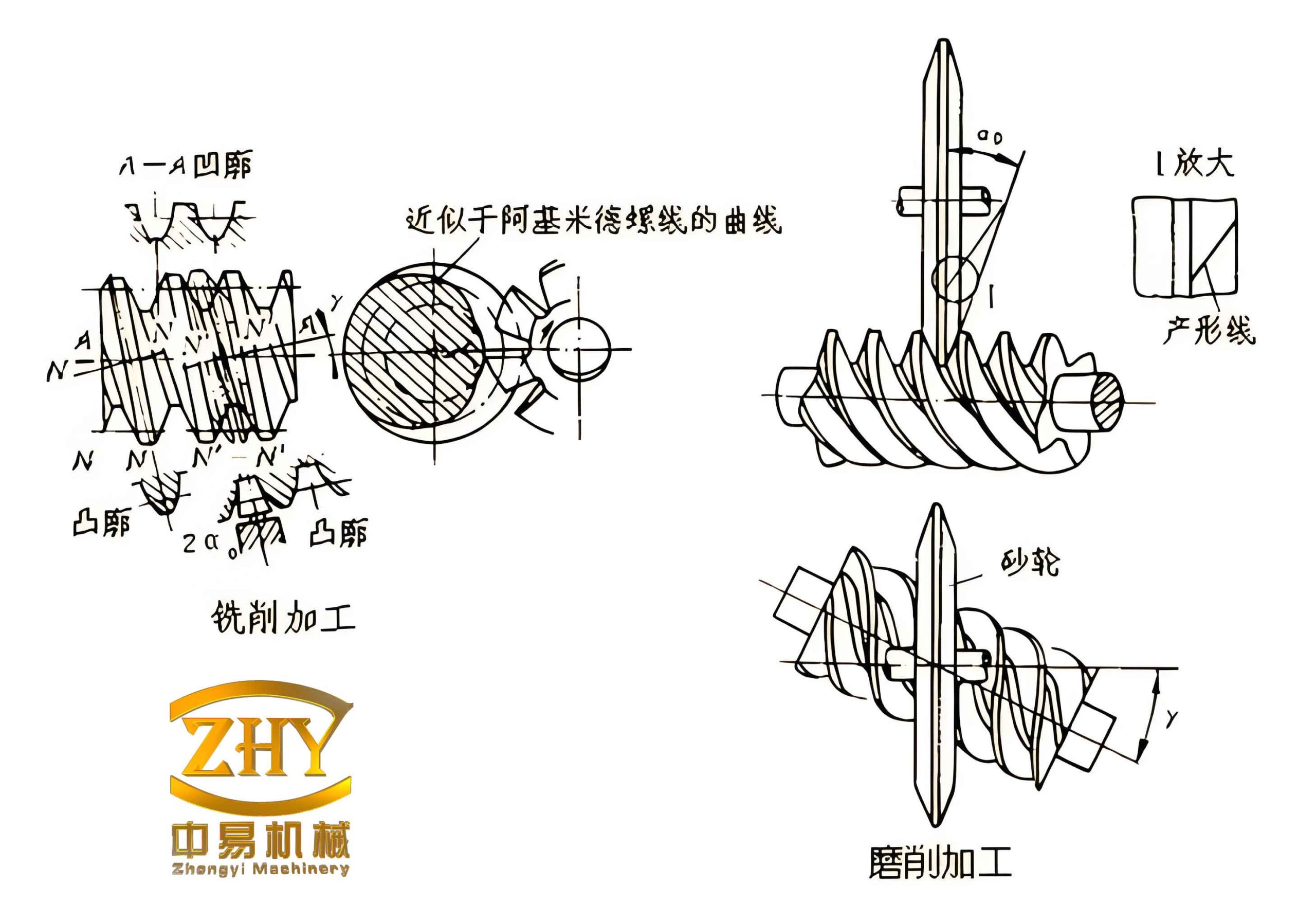
The following figure illustrates a typical worm gear reducer structure similar to the one installed. The image shows the worm shaft, worm wheel, and housing, highlighting the compact design that allowed it to fit into the existing space.
9. Conclusion
The replacement of the original gear reducer with a worm gear reducer in the FT624 vertical slicing machine’s blocking plate mechanism effectively solved the problem of non-uniform slice thickness and material overlapping. The self-locking property of the worm gear reducer prevented any backward movement of the blocking plate under impact, ensuring a consistent reference position for each cut. The calculated pulley adjustments maintained the same linear speed, and the simple installation required only minor modifications to the machine frame. The resulting reduction in slice width standard deviation from 11.5 cm to 9.4 cm, together with the elimination of conditioning inlet flow fluctuations, demonstrates the value of this targeted mechanical improvement. The worm gear reducer has proven to be a reliable, low-maintenance solution that enhances process stability and reduces operator burden.
This case study underscores the importance of selecting the appropriate transmission component based on functional requirements. While gear reducers offer high efficiency and compactness, they lack the self-locking feature that is critical in applications where reverse driving must be prevented. The worm gear reducer, despite its lower efficiency, provides a simple and cost-effective answer to this common industrial challenge.