
In our research on the bending stress of spur gears, we have developed a method using Fiber Bragg Grating (FBG) sensors to measure the bending stress at the root of a straight spur gear. The stress concentration factor in the analytical calculation of gear bending strength is critical for accurate design. Our work aims to optimize this factor based on experimental data obtained from FBG measurements. We begin by discussing the fundamental principles and then present the experimental setup, results, and the optimization process.
The bending stress analysis of a straight spur gear traditionally simplifies the tooth as a cantilever beam. The tooth form factor and the stress concentration factor are introduced to account for geometry and stress concentration effects. The stress concentration factor, denoted as \( Y_S \), is typically derived from finite element simulations, photoelastic experiments, or strain gauge measurements. However, for gears with a module less than 6 mm, it is extremely challenging to place strain gauges at the root fillet in the narrow non-intermeshing space. FBG sensors, with their small cross-sectional diameter (typically 125 μm), offer a significant advantage. They can be directly attached to the root fillet of a straight spur gear to measure strain along the tooth width direction, and from that we can deduce the bending stress.
1. Principle of FBG Measurement for Straight Spur Gear Bending Stress
When temperature and pressure are constant, the wavelength shift of an FBG is linearly related to the axial strain:
\[
\Delta \lambda_B = k_\varepsilon \varepsilon
\]
where \(\Delta \lambda_B\) is the Bragg wavelength shift, \(k_\varepsilon\) is the strain sensitivity coefficient, and \(\varepsilon\) is the strain along the fiber axis. For a linear elastic isotropic material, the generalized Hooke’s law gives:
\[
\varepsilon_x = \frac{1}{E} [\sigma_x – \mu (\sigma_y + \sigma_z)]
\]
where \(\sigma_x\), \(\sigma_y\), \(\sigma_z\) are the normal stresses in three orthogonal directions, \(E\) is Young’s modulus, and \(\mu\) is Poisson’s ratio. By placing the FBG along the tooth width direction (y-direction), we measure \(\varepsilon_y\). To find the bending stress \(\sigma_x\) (which is the stress along the tooth height direction at the root), we need a relationship between \(\sigma_y\) and \(\sigma_x\).
We proposed a hypothesis based on elasticity theory: for a point on the root surface, the ratio \(\sigma_y / \sigma_x\) varies along the tooth width according to an exponential function. Specifically, if the tooth width is \(b\), then at a distance \(y\) from one end face, the ratio can be expressed as:
\[
\frac{\sigma_y}{\sigma_x} = \mu (1 – a^{y})
\]
where \(a\) is a constant related to the material and geometry (\(0 < a < 1\)). For a finite width \(b\), at the center (\(y = b/2\)) the ratio approaches \(\mu\) when \(b\) is sufficiently large (e.g., >30 mm). For our straight spur gear with width 30 mm, we used a finite element model to validate this relationship. The results confirmed the exponential decay, as shown in Table 1.
| Distance from end face (mm) | \(\sigma_y/\sigma_x\) |
|---|---|
| 0 | 0.000 |
| 5 | 0.102 |
| 10 | 0.185 |
| 15 | 0.248 |
| 20 | 0.288 |
| 25 | 0.297 |
| 30 | 0.300 |
The plane stress condition (\(\sigma_z = 0\)) holds at the root surface. Substituting the exponential relationship into the strain expression yields:
\[
\varepsilon_y = \frac{1}{E} [\sigma_y – \mu \sigma_x] = \frac{1}{E} [\mu (1 – a^{y}) \sigma_x – \mu \sigma_x] = -\frac{\mu a^y}{E} \sigma_x
\]
Therefore, the bending stress can be obtained from the measured FBG strain:
\[
\sigma_x = -\frac{E}{\mu a^y} \varepsilon_y
\]
This equation allows us to determine the bending stress at the root of a straight spur gear from a single FBG measurement positioned at a known distance \(y\) from the end face.
2. Experimental Setup and Measurement
We designed a straight spur gear specimen with the parameters listed in Table 2. The gear was manufactured with standard involute profile, 7-grade accuracy, and root fillet roughness \(R_z < 10\ \mu\text{m}\). The tool radius was the commonly used value of \(0.38m\).
| Parameter | Value |
|---|---|
| Module \(m\) | 4 mm |
| Pressure angle \(\alpha\) | 20° |
| Number of teeth \(z\) | 31 |
| Face width \(b\) | 30 mm |
| Tool radius \(r_f\) | 0.38 m (1.52 mm) |
| Young’s modulus \(E\) | 200 GPa |
| Poisson’s ratio \(\mu\) | 0.3 |
We attached FBG sensors (strain sensitivity \(k_\varepsilon = 1.2\ \text{pm}/\mu\varepsilon\)) at the root fillet along the tooth width direction, with the center of the sensing zone located 10 mm from one end face. This location was chosen because the ratio \(\sigma_y/\sigma_x\) is stable and measurable. Three teeth were instrumented, and the average values were used.
The gear was loaded in a static test rig. The equivalent tangential force was applied at the highest point of single tooth contact. The torque was increased from 0 to 600 N·m in steps of 100 N·m. At each step, the FBG wavelength shift was recorded and converted to strain. Then, using the calibration constant \(a\) determined from finite element analysis (we found \(a = 0.82\) for this gear), we computed the bending stress. The results are presented in Table 3.
| Torque \(T\) (N·m) | FBG bending stress \(\sigma_{FBG}\) (MPa) | ISO bending stress \(\sigma_{ISO}\) (MPa) |
|---|---|---|
| 100 | 30.29 | 36.43 |
| 200 | 60.58 | 72.86 |
| 300 | 90.87 | 109.29 |
| 400 | 116.12 | 145.72 |
| 500 | 146.41 | 182.15 |
| 600 | 181.75 | 218.58 |
The linear relationship between torque and bending stress is evident. The FBG measured values are consistently lower than the ISO calculated values, indicating that the standard stress concentration factor may be conservative.
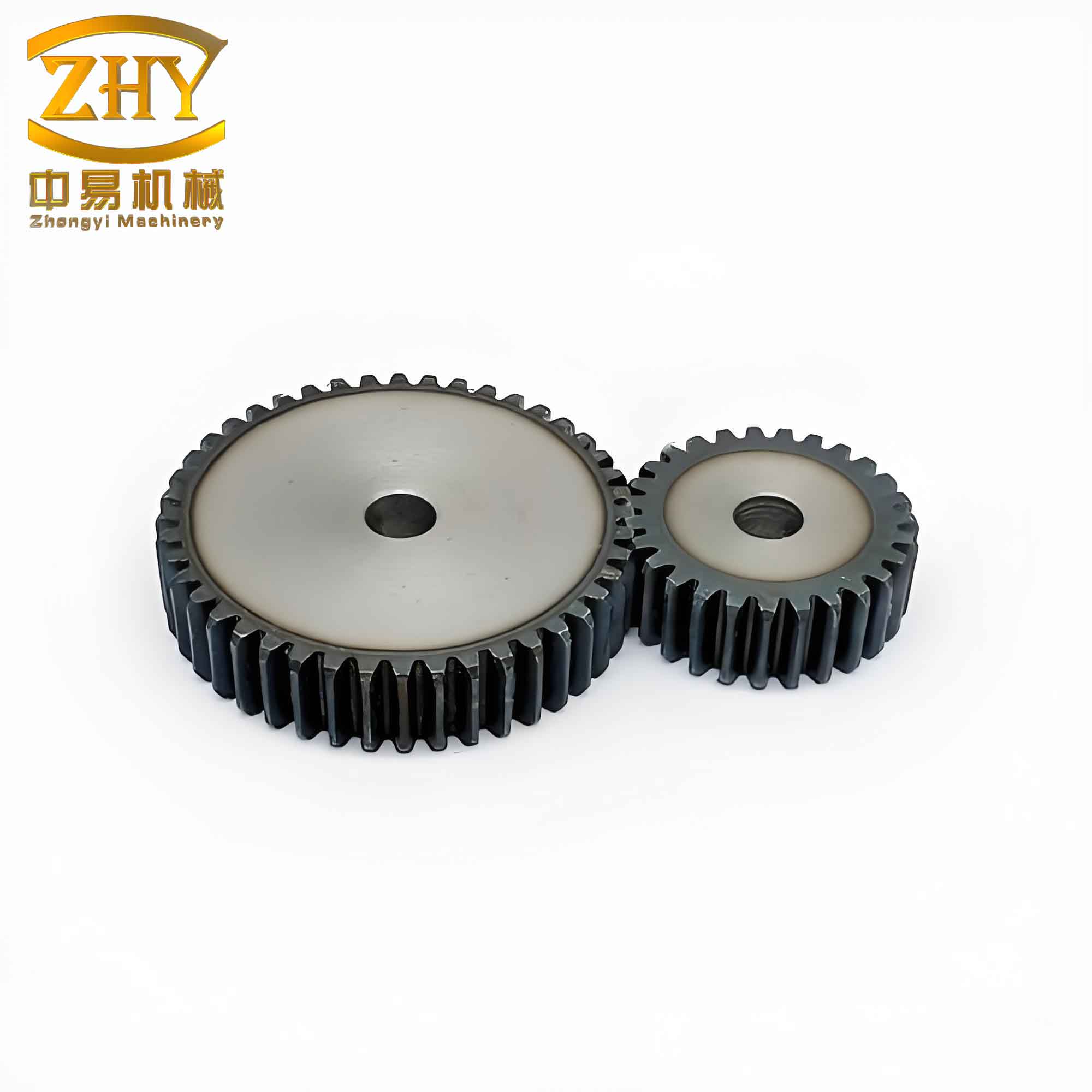
3. Optimization of Stress Concentration Factor
The stress concentration factor \(Y_S\) in the ISO standard is a function of the tooth geometry. For our gear, the ISO standard gives \(Y_S = 1.9387\). The bending stress formula is:
\[
\sigma_F = \frac{F_t}{b m} Y_F Y_S
\]
where \(F_t\) is the tangential load, \(Y_F\) is the tooth form factor (1.3981 for our gear). The product \(\frac{F_t}{b m} Y_F\) is the nominal bending stress. The actual stress measured by FBG yielded a derived stress concentration factor \(Y_S^{\text{exp}} = \sigma_{FBG} / (\frac{F_t}{b m} Y_F)\). The values for each load are shown in Table 4.
| Torque (N·m) | Nominal stress (MPa) | \(Y_S^{\text{exp}}\) |
|---|---|---|
| 100 | 18.79 | 1.612 |
| 200 | 37.58 | 1.612 |
| 300 | 56.37 | 1.612 |
| 400 | 75.17 | 1.545 |
| 500 | 93.96 | 1.558 |
| 600 | 112.75 | 1.612 |
The average experimental stress concentration factor is:
\[
\bar{Y}_S^{\text{exp}} = 1.592
\]
Comparing with the ISO value of 1.9387, we found that the ISO factor is about 21.8% larger. This indicates that for our straight spur gear geometry (tool radius 0.38m), the standard overestimates the stress concentration.
To generalize the optimization, we investigated the effect of tool radius on \(Y_S\). Finite element simulations were performed for different tool radii (0.25m, 0.30m, 0.38m). The resulting stress concentration factors from FEM and from ISO are listed in Table 5.
| Tool radius \(r_f\) | \(Y_S^{\text{ISO}}\) | \(Y_S^{\text{FEM}}\) |
|---|---|---|
| 0.25m (1.0 mm) | 2.118 | 2.070 |
| 0.30m (1.2 mm) | 2.040 | 2.010 |
| 0.38m (1.52 mm) | 1.939 | 1.922 |
We observed that the ratio \(Y_S^{\text{FEM}} / Y_S^{\text{ISO}}\) is nearly constant across tool radii. For the 0.38m case, this ratio is 0.991 (FEM close to ISO). However, the experimental result gave a lower value. Using the experimental factor as a reference, we define a correction constant \(C\) for the ISO formula:
\[
C = \frac{Y_S^{\text{exp}}}{Y_S^{\text{ISO}}} = \frac{1.592}{1.9387} \approx 0.821
\]
Thus, for a straight spur gear with tool radius 0.38m, the optimized stress concentration factor is:
\[
Y_S^{\text{opt}} = 0.821 \times Y_S^{\text{ISO}}
\]
Furthermore, since the relationship between FEM and ISO is linear, we propose the general optimized formula:
\[
Y_S^{\text{opt}} = 0.821 \left(1.2 + 0.13 L\right) q_s^{\frac{1}{1.21 + 2.3/L}}
\]
where \(L\) is the ratio of tooth root thickness to bending moment arm, and \(q_s\) is the root fillet parameter. This formula is valid for straight spur gears with similar geometry and loading conditions.
4. Discussion
Our results clearly show that the standard stress concentration factor overestimates the bending stress in a straight spur gear, leading to heavier and more costly designs. The use of FBG sensors provided direct experimental verification, which is difficult to achieve with traditional strain gauges for small-module gears. The exponential distribution hypothesis for \(\sigma_y/\sigma_x\) was confirmed by both finite element analysis and experimental consistency.
It is important to note that the correction constant 0.821 is specific to the gear geometry tested (module 4 mm, tool radius 0.38m). Different tool radii may require a slightly different constant, but based on the linearity observed in FEM, we believe the same correction factor can be applied with good accuracy for a range of tool radii around 0.38m. Future work should include experiments on straight spur gears with different modules, widths, and tool radii to establish a more comprehensive correction.
5. Conclusion
We have successfully demonstrated the application of FBG strain sensors for measuring the bending stress at the root of a straight spur gear. The key findings are:
1. The ratio of transverse stress to bending stress at any point on the root surface follows an exponential decay along the tooth width. The FBG sensor, placed at 10 mm from the end face, provides a reliable measurement from which the bending stress can be extracted using the appropriate formula.
2. The experimental stress concentration factor for the tested straight spur gear (module 4 mm, tool radius 0.38m) is 1.592, which is 21.8% lower than the ISO standard value of 1.9387. This demonstrates that the standard factor is conservative.
3. Based on the experiment, we propose an optimized stress concentration formula for straight spur gears: \(Y_S^{\text{opt}} = 0.821 \times Y_S^{\text{ISO}}\). This correction improves the accuracy of gear strength calculations and enhances the reliability of design.
Our work lays the foundation for online health monitoring of straight spur gears using FBG sensors. The methodology can be extended to helical and bevel gears in future studies.
References
[1] Zhu Xiaolu, E Zhongkai. Gear Load Capacity Analysis. Beijing: Higher Education Press, 1992.
[2] Tang Jinyuan, Zhou Chang, Wu Yunxin. Discussion on accurate modeling of gear bending strength finite element analysis. Mechanical Science and Technology, 2004, 23(10): 1146-1248.
[3] Zhou Changjiang, Tang Jinyuan, Wu Yunxin, et al. Progress and comparison of calculation methods for tooth root stress and tooth elastic deformation. Mechanical Transmission, 2004, 28(5): 1-5.
[4] Dolan T J, Broghamer E L. A photoelastic study of stresses in gear tooth fillets. University of Illinois Bulletin, 1942, 335(31): 5-40.
[5] Zhang Lei. Research and application of gear load capacity analysis method for transmission. Jilin University, 2011.
[6] Fred B O. Gear tooth stress measurements on the UH-60A helicopter transmission: NASA TP-2698. Cleveland: NASA Lewis Research Center, 1987.
[7] Zhou Changjiang. Research on calculation method of gear bending strength and tooth surface friction coefficient under multiple loads. Hunan University, 2013.
[8] Hotait M. A theoretical and experimental investigation on bending strength and fatigue life of spiral bevel and hypoid gears. Ohio State University, 2011.
[9] Deng Xiaozhong. Design theory and experimental research of high-contact-ratio spiral bevel gears. Northwestern Polytechnical University, 2002.
[10] Timoshenko S, Goodier J N. Theory of Elasticity. Beijing: Higher Education Press, 1990.