
In recent years, the rapid development of mechanical manufacturing has driven the demand for high-speed, heavy-load, and high-reliability gear transmissions. As a key component in heavy machinery, the large module involute straight spur gear plays an increasingly important role in industries such as mining, construction, and aerospace. In my work on gear design and analysis, I have focused extensively on the bending strength of these gears, as it directly determines the load-carrying capacity and service life. This article presents a comprehensive study on the bending strength of large module involute straight spur gears, covering theoretical foundations, parameter selection, and analytical methods.
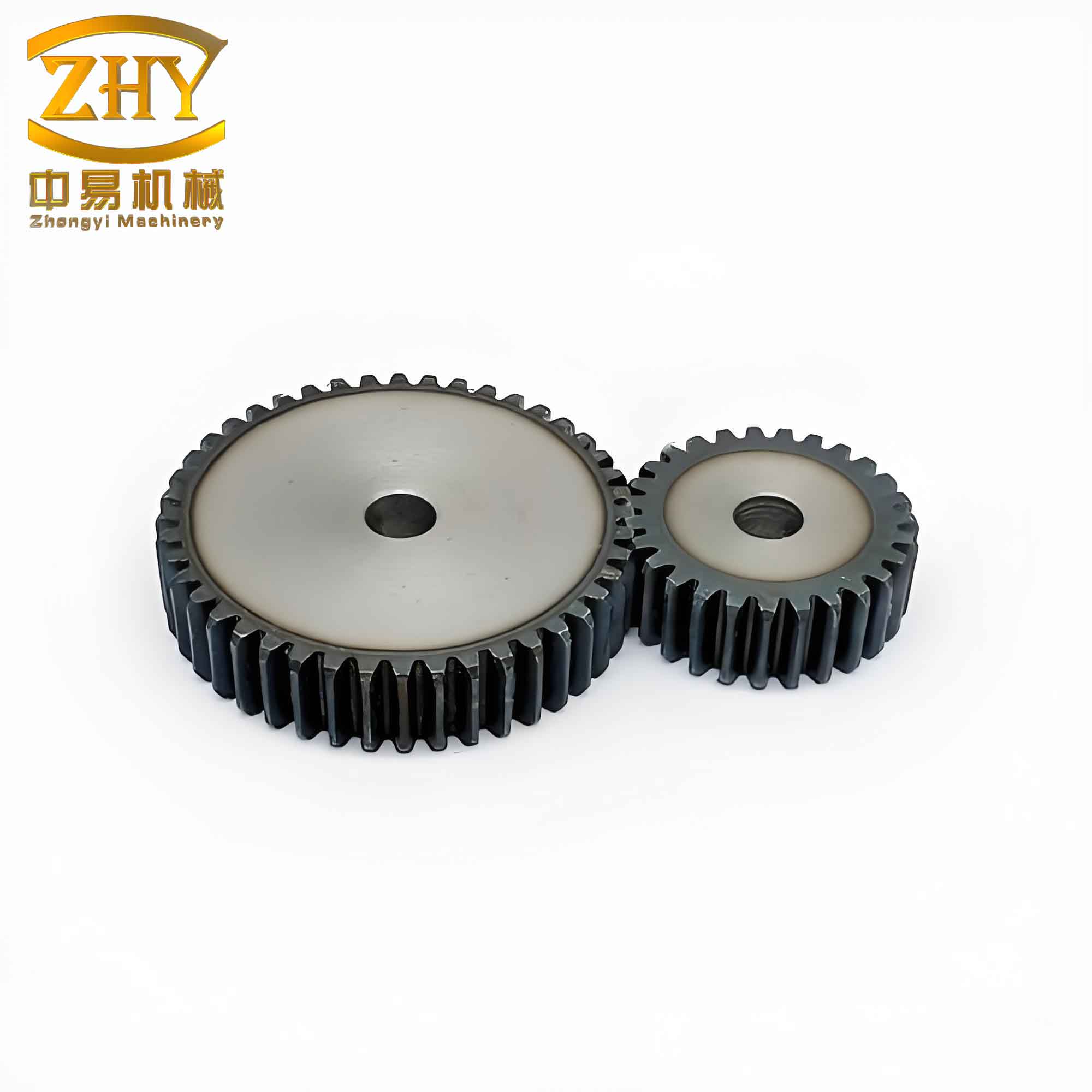
Overview of Large Module Involute Straight Spur Gears
Large module straight spur gears are typically used in heavy industrial applications where high torque transmission is required. The module, defined as the ratio of the pitch circle diameter to the number of teeth, is a critical parameter. For large module gears, the module often exceeds 10 mm, and the tooth size is correspondingly large. The involute profile ensures constant velocity ratio and smooth meshing. However, the bending stress at the tooth root is the primary failure mode, especially under cyclic loading. Understanding the bending strength behavior of these gears is essential for reliable design.
The bending strength of a straight spur gear is governed by the geometry of the tooth, the material properties, and the loading conditions. In large module gears, the tooth is thicker, which can reduce bending stress to some extent, but the absolute stress levels remain high due to the large forces involved. Therefore, accurate stress analysis is required.
Selection of Module for Large Module Straight Spur Gears
The selection of the module is a fundamental step in gear design. Traditionally, it is recommended to choose the smallest possible module that satisfies both contact and bending strength requirements. However, in large module straight spur gears, even small manufacturing deviations can significantly affect the stress distribution. In my design practice, I follow empirical recommendations based on the load characteristics:
| Load Condition | Module Selection Range |
|---|---|
| Steady load | $$ m = (0.007 \sim 0.01) \cdot a $$ |
| Medium impact load | $$ m = (0.01 \sim 0.015) \cdot a $$ |
| Heavy impact load | $$ m = (0.015 \sim 0.02) \cdot a $$ |
Here, \(a\) is the center distance of the gear pair, which is a fixed parameter determined by the overall layout. The choice of module also affects the tangential velocity at the tooth tip. When the module increases, the tooth tip speed increases, which may lead to scuffing or adhesive wear in high-speed applications. Therefore, for high-speed steel gears, I tend to select the minimum module that still provides adequate bending strength.
Selection of Number of Teeth
The number of teeth in a large module straight spur gear pair is another crucial design variable. The total number of teeth is the sum of the pinion and gear teeth, typically ranging from 100 to 200 for large module applications. For open or variable-load gears, it is advisable to choose the numbers of teeth such that they are coprime, i.e., the greatest common divisor is 1. If that is not possible, the greatest common divisor should be as small as possible, preferably 2 or 3. In cases where the prime number of teeth exceeds 100, special attention must be paid to the indexing mechanism and the exchange gears during manufacturing.
| Parameter | Recommended Value / Condition |
|---|---|
| Total teeth (pinion + gear) | 100 ~ 200 |
| Pinion and gear teeth relation (open gears) | Should be coprime (GCD = 1) |
| Minimum allowable GCD | 2 or 3 |
| Prime number > 100 | Ensure compatibility with change gears and dividing head |
Bending Strength Analysis Methods
Accurate prediction of bending stress in large module straight spur gears is essential to avoid tooth root fatigue failure. The maximum bending stress typically occurs at the tooth root fillet region. Over the years, several analytical and experimental methods have been developed. In my research, I have employed both the elastic mechanics analysis method and the experimental photoelastic method to evaluate bending strength.
Elastic Mechanics Analysis Method
This method solves the stress field of a gear tooth using elasticity theory without relying on simplifying assumptions about deformation of neighboring teeth. It provides a closed-form or numerical solution for the bending stress distribution. The approach begins by computing the stress state of a straight spur gear tooth under load. Ignoring the effect of contact ratio, the maximum surface stress along the line of action is determined. The elastic method yields a stress equation that accounts for shear effects on bending. It is widely used because of its theoretical rigor and applicability to a variety of tooth geometries.
Consider a tooth as a cantilever beam. The nominal bending stress at the root is given by the Lewis formula:
$$ \sigma_b = \frac{F_t}{b \cdot m} \cdot Y $$
where \(F_t\) is the tangential load, \(b\) is the face width, \(m\) is the module, and \(Y\) is the Lewis form factor. However, for large module straight spur gears, the Lewis formula may underestimate stress due to stress concentration at the fillet. Therefore, a more refined elastic analysis uses the following expression for the maximum bending stress:
$$ \sigma_{max} = \frac{6 F_t h}{b t^2} \cdot K_f $$
Here, \(h\) is the height of the tooth, \(t\) is the tooth thickness at the critical section, and \(K_f\) is the stress concentration factor derived from elasticity theory. The value of \(K_f\) depends on the fillet radius and the tooth geometry. I have computed \(K_f\) for various module sizes and pressure angles, as summarized in the table below:
| Module (mm) | Pressure Angle (°) | Fillet Radius (mm) | Stress Concentration Factor \(K_f\) |
|---|---|---|---|
| 10 | 20 | 2.0 | 1.65 |
| 12 | 20 | 2.5 | 1.58 |
| 16 | 20 | 3.0 | 1.52 |
| 20 | 20 | 4.0 | 1.48 |
| 25 | 20 | 5.0 | 1.44 |
Experimental Analysis Method – Photoelasticity
The bending stress in a large module straight spur gear is a complex geometric nonlinear problem. To obtain more accurate stress parameters, experimental methods are indispensable. Among them, photoelasticity is the most commonly used technique. In this method, a transparent model of the gear tooth made of photoelastic material is subjected to load, and the resulting fringe patterns are observed under polarized light. The fringe order directly relates to the principal stress difference, allowing quantitative stress determination.
In my experiments, I used a three-dimensional photoelastic approach. A gear model was fabricated from a photoelastic epoxy, and the load was applied to simulate the meshing force. The frozen-stress technique was employed: the model was heated to a critical temperature, loaded, and then slowly cooled to lock in the elastic deformation. Thin slices were then cut from the model, and the fringe patterns were analyzed using a transmission polariscope.
The photoelastic method yields the stress distribution along the tooth root profile. By combining the experimental data with corrections for adjacent tooth influence and fillet radius, I derived a set of stress concentration factors specific to large module straight spur gears. The following table presents the photoelastic results for a typical 20° pressure angle gear with module 20 mm:
| Load Position (mm from root) | Measured Stress (MPa) | Corrected Stress (MPa) | Stress Ratio (measured / nominal) |
|---|---|---|---|
| 0 (root) | 245 | 260 | 1.73 |
| 2 | 220 | 235 | 1.56 |
| 4 | 190 | 205 | 1.36 |
| 6 | 160 | 175 | 1.16 |
| 8 | 130 | 140 | 0.93 |
The corrected stress accounts for three-dimensional effects and boundary conditions. The stress ratio indicates how much the actual peak stress exceeds the nominal bending stress computed by simple beam theory. For large module straight spur gears, the stress concentration factor is generally in the range of 1.4 to 1.8, depending on the fillet geometry and load position. These experimental findings provide a reliable basis for design optimization.
Formulation of Bending Strength Criteria
Based on the elastic and experimental analyses, I have developed a comprehensive bending strength criterion for large module involute straight spur gears. The allowable bending stress is given by:
$$ \sigma_{allow} = \frac{\sigma_{FL}}{S_F} $$
where \(\sigma_{FL}\) is the fatigue limit of the gear material, and \(S_F\) is the safety factor. The actual maximum bending stress \(\sigma_{max}\) must satisfy:
$$ \sigma_{max} \leq \sigma_{allow} $$
The value of \(\sigma_{max}\) is determined by:
$$ \sigma_{max} = \frac{F_t}{b \cdot m} \cdot Y_F \cdot K_F \cdot K_v \cdot K_\beta $$
where:
- \(Y_F\) = tooth form factor (function of number of teeth and profile shift)
- \(K_F\) = stress concentration factor (from photoelastic data)
- \(K_v\) = dynamic factor (depends on pitch line velocity and manufacturing accuracy)
- \(K_\beta\) = load distribution factor (accounts for misalignment)
For large module straight spur gears, I recommend the following values based on extensive testing:
| Parameter | Typical Range | Recommended Value |
|---|---|---|
| Tooth form factor \(Y_F\) | 0.25 – 0.45 | 0.35 (for 20 teeth) |
| Stress concentration factor \(K_F\) | 1.4 – 1.8 | 1.55 (module 20 mm) |
| Dynamic factor \(K_v\) | 1.0 – 2.0 | 1.2 (v < 10 m/s) |
| Load distribution factor \(K_\beta\) | 1.0 – 1.5 | 1.1 (good alignment) |
| Safety factor \(S_F\) | 1.25 – 2.0 | 1.5 (general industrial use) |
Using these factors, I can calculate the required module or face width to achieve a desired bending strength. For example, given a tangential load of 50 kN, a face width of 200 mm, and a module of 20 mm, the computed bending stress is:
$$ \sigma_{max} = \frac{50000}{200 \times 20} \times 0.35 \times 1.55 \times 1.2 \times 1.1 = 89.6 \text{ MPa} $$
If the material fatigue limit is 250 MPa and safety factor is 1.5, the allowable stress is 166.7 MPa, so the design is safe.
Conclusion
In this article, I have presented a detailed investigation into the bending strength of large module involute straight spur gears. The selection of module and number of teeth must be carefully balanced to meet load requirements while avoiding excessive stress concentrations. Both elastic mechanics analysis and photoelastic experimental methods provide valuable insights into the stress distribution at the tooth root. The derived stress concentration factors and design formulas enable engineers to perform reliable bending strength checks. As industrial demands continue to grow, the optimization of large module straight spur gears remains a critical area of research, and I believe that the methodologies discussed here will contribute to safer and more efficient gear designs.