
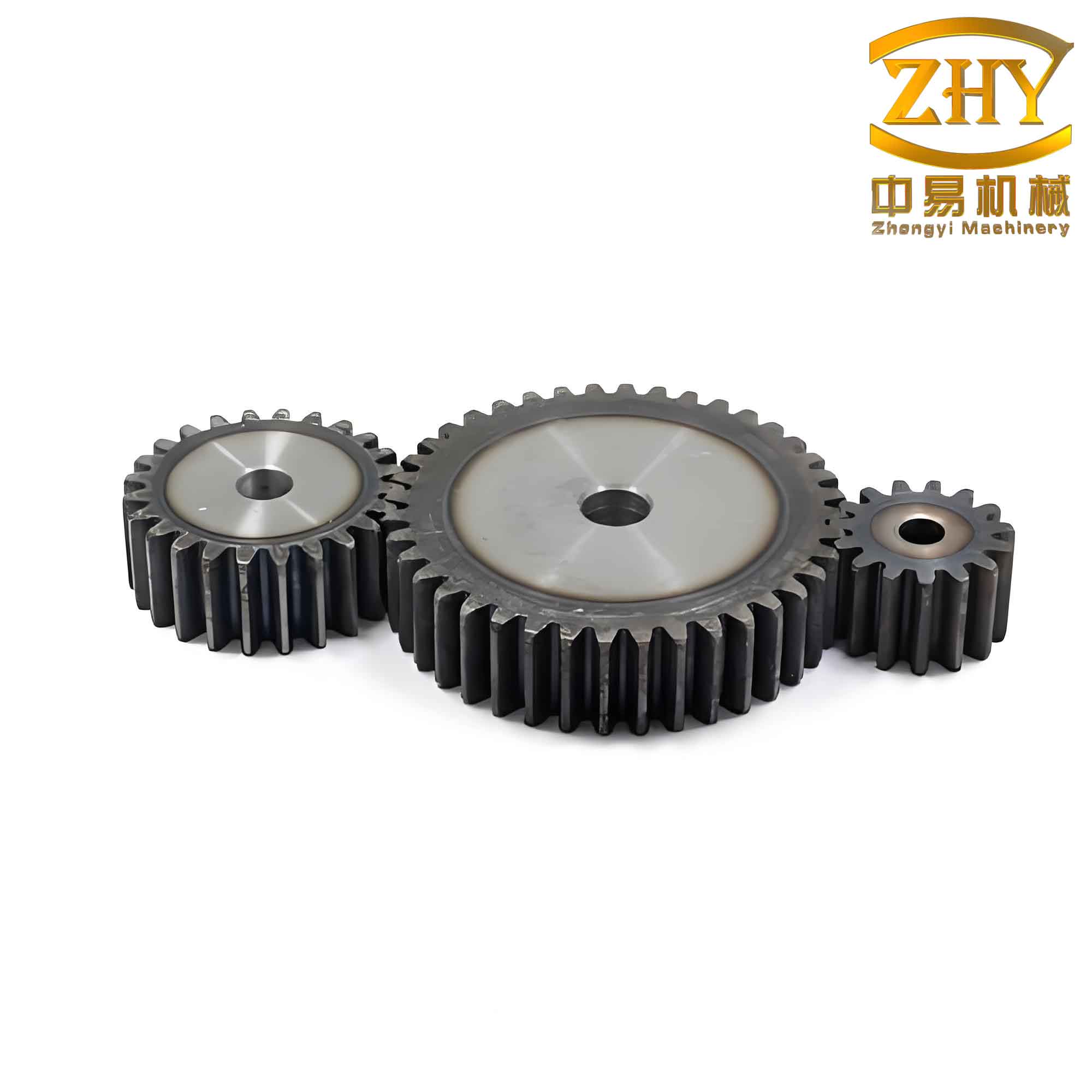
As a fundamental component for transmitting motion and power, the straight spur gear is widely used in the mechanical industry. Traditional manufacturing methods, such as cutting or hot forging combined with machining, suffer from high production cost, low efficiency, poor strength, and inferior wear resistance. In this study, I adopted closed-die forging at room temperature to directly form the straight spur gear using the plastic flow of the metal. This process eliminates or minimizes subsequent machining, preserves the integrity of the tooth fiber flow, and significantly improves both mechanical properties and production efficiency. Based on rigid-plastic finite element theory, I utilized the three-dimensional finite element analysis software DEFORM-3D to investigate the closed-die forging process of a straight spur gear at room temperature. The objective is to analyze the metal flow behavior and provide theoretical guidance for industrial production.
1. Finite Element Model Setup
To simplify the analysis, I treated the tools as rigid bodies and the billet as a rigid-plastic material. The material assigned to the billet was AISI-1045 steel (corresponding to 45 steel). The friction condition was defined as shear friction with a coefficient of 0.12. Temperature effects were neglected, and both the die and billet were set to a constant temperature of 20°C. The geometric parameters of the straight spur gear are listed in Table 1.
| Parameter | Symbol | Value |
|---|---|---|
| Module | \( m \) | 2 mm |
| Number of teeth | \( z \) | 18 |
| Pressure angle | \( \alpha \) | 20° |
| Tooth height coefficient | \( h_a^* \) | 1.0 |
| Clearance coefficient | \( c^* \) | 0.25 |
| Pitch circle diameter | \( d = m z \) | 36 mm |
| Tip circle diameter | \( d_a = d + 2 m \) | 40 mm |
| Root circle diameter | \( d_f = d – 2.5 m \) | 31 mm |
The billet outer diameter was chosen slightly smaller than the root circle diameter (approx. 30 mm) to facilitate die insertion. The billet height was calculated based on the constant volume principle:
\[
V_{\text{billet}} = V_{\text{gear}} + V_{\text{flash}}
\]
Since the process is closed-die without flash, the gear volume was computed using the gear geometry. For a straight spur gear, the approximate volume of a single tooth segment is:
\[
V_{\text{tooth}} = \frac{1}{2} m^2 z \left( \frac{\pi}{2z} + \tan\alpha \right) \cdot \text{face width}
\]
In this study, I considered one-fifth of the full gear circumference (sector of 72°) to reduce computational cost while retaining the tooth profile. The face width was set to 12 mm. The corresponding billet height was determined to be approximately 14.5 mm. I employed a floating die configuration: both the upper punch and the floating lower die moved downward at a constant speed of 300 mm/s. Figure 1 illustrates the finite element model (the image link is inserted below).
2. Simulation Results and Discussion
During metal forming, the distributions of effective strain and effective stress are critical indicators of material flow behavior and die filling quality. I extracted data at three representative stages of the forming process: initial, intermediate, and final. The results are summarized in the following sections.
2.1 Effective Strain Distribution
Table 2 lists the effective strain values at the tooth root fillet region (the most critical area) for the three stages. The strain values are dimensionless.
| Stage | Punch Displacement (mm) | Effective Strain (max) |
|---|---|---|
| Initial | 1.5 | 0.6 |
| Intermediate | 5.0 | 2.1 |
| Final | 10.0 | 6.2 |
At a punch displacement of 1.5 mm, the material began to flow into the die cavity. The strain concentrated near the cavity corners due to the abrupt change in geometry. As the displacement reached 5 mm, the flow intensified, and the strain in the tooth root fillet increased to about 2.1. During the final stage (displacement ~10 mm), the tooth profile was fully filled, and the maximum effective strain reached 6.2 at the fillet, indicating severe deformation. The strain evolution can be approximated by the following logarithmic relation:
\[
\bar{\varepsilon} = \ln\left( \frac{A_0}{A_f} \right)
\]
where \( A_0 \) is the initial cross-sectional area of the billet and \( A_f \) is the final cross-sectional area at the tooth root. However, due to the complex three-dimensional flow, a simple analytical expression is insufficient; the finite element results provide a more accurate description.
2.2 Effective Stress Distribution
The effective stress distribution closely followed the strain pattern. Table 3 shows the maximum effective stress at the same locations.
| Stage | Punch Displacement (mm) | Effective Stress (MPa) |
|---|---|---|
| Initial | 1.5 | 320 |
| Intermediate | 5.0 | 480 |
| Final | 10.0 | 780 |
The peak stress of 780 MPa occurred at the final forming stage, correlating with the high strain and the constrained material flow. The von Mises yield criterion was used:
\[
\sigma_{\text{eff}} = \sqrt{ \frac{1}{2} \left[ (\sigma_1 – \sigma_2)^2 + (\sigma_2 – \sigma_3)^2 + (\sigma_3 – \sigma_1)^2 \right] }
\]
In the confined cavity, a triaxial compressive stress state developed, which required high forming forces to overcome the hydrostatic pressure. This explains the steep load increase in the final stage.
2.3 Load-Stroke Curve
The forming load as a function of punch displacement is plotted in Table 4 (representative points).
| Displacement (mm) | Load (kN) |
|---|---|
| 0 | 0 |
| 1.0 | 45 |
| 2.0 | 85 |
| 3.0 | 110 |
| 4.0 | 130 |
| 5.0 | 145 |
| 6.0 | 155 |
| 7.0 | 170 |
| 8.0 | 210 |
| 9.0 | 320 |
| 10.0 | 580 |
The load-stroke curve can be divided into three distinct phases:
- Phase I (0–2 mm): The load increased nearly linearly, corresponding to a simple upsetting-like deformation. The billet outer diameter was slightly smaller than the die cavity, so initial contact was limited.
- Phase II (2–8 mm): The load rose gradually as material began flowing into the tooth cavities. The free surface area reduced, and the flow resistance increased, but the slope remained moderate.
- Phase III (8–10 mm): A sharp exponential rise occurred. In this final filling stage, only a small amount of material remained unfilled. The entire billet was under severe triaxial compression, and the cavity corners acted as bottlenecks. The load increased from 210 kN to 580 kN in just 2 mm of stroke, indicating extremely high pressure requirements.
The total forging load \( F \) can be approximated by:
\[
F = \sigma_y \cdot A \cdot \left( 1 + \frac{\mu}{h} \right)
\]
where \( \sigma_y \) is the flow stress, \( A \) is the projected area, \( \mu \) is the friction coefficient, and \( h \) is the current billet height. However, due to the complex geometry of the straight spur gear, a simplified analytical model is inadequate, and finite element analysis is essential for accurate load prediction.
3. Discussion on Metal Flow and Die Filling
The most difficult region to fill during closed-die forging of a straight spur gear is the tooth root fillet (corner of the die cavity). The material must overcome the sharp corner to completely fill the tooth profile. The strain and stress concentrations at this location increase the risk of underfill or excessive wear. To improve die life, the following strategies can be considered:
- Optimize the punch and die geometry with larger fillet radii.
- Use a lower forming speed to reduce strain rate and improve flow.
- Apply effective lubrication to lower friction and reduce the load.
- Consider preforming steps to distribute material more evenly.
Furthermore, the floating die design used in this simulation helped to reduce the required load by allowing the material to flow more uniformly. The simultaneous downward movement of both the punch and the floating die reduced the hydrostatic pressure compared to a conventional fixed die setup.
4. Conclusions
In this work, I performed a finite element analysis of the closed-die forging process of a straight spur gear at room temperature. The following conclusions were drawn:
- Finite element simulation greatly enhances the design efficiency for metal forming processes, particularly for complex shapes like a straight spur gear.
- The tooth root fillet is the hardest-to-fill area. The maximum effective strain reaches 6.2 and the effective stress reaches 780 MPa at the final stage.
- The load-stroke curve exhibits a sharp increase in the final forming stage due to triaxial compression. The maximum load exceeds 500 kN for a small sector model; for a full gear, the load would be proportionally higher.
- The floating die configuration helps to reduce the forming load, but the high load peak in the final stage still poses challenges to die life. Further optimization of process parameters is needed for industrial application of straight spur gear forging.
These findings provide a theoretical reference for the practical production of straight spur gears via closed-die forging. Future work will focus on experimental validation and die design improvements to minimize load and enhance tool durability.