
In my research, I focused on the tooth surface contact characteristics and tooth profile modification of a straight spur gear used in the output stage of a transport aircraft reducer. The primary goal was to optimize the gear contact design by applying trapezoidal thinning at both ends of the tooth and drum-shaped modification. I conducted a comparative analysis of the contact stress distribution, instantaneous contact temperature, and oil film thickness ratio before and after modification. The results demonstrated that appropriate tooth surface modification can significantly reduce the axial load distribution coefficient, lower the contact stress, decrease the instantaneous contact temperature, and increase the oil film thickness ratio, thereby enhancing the load-carrying capacity of the straight spur gear.
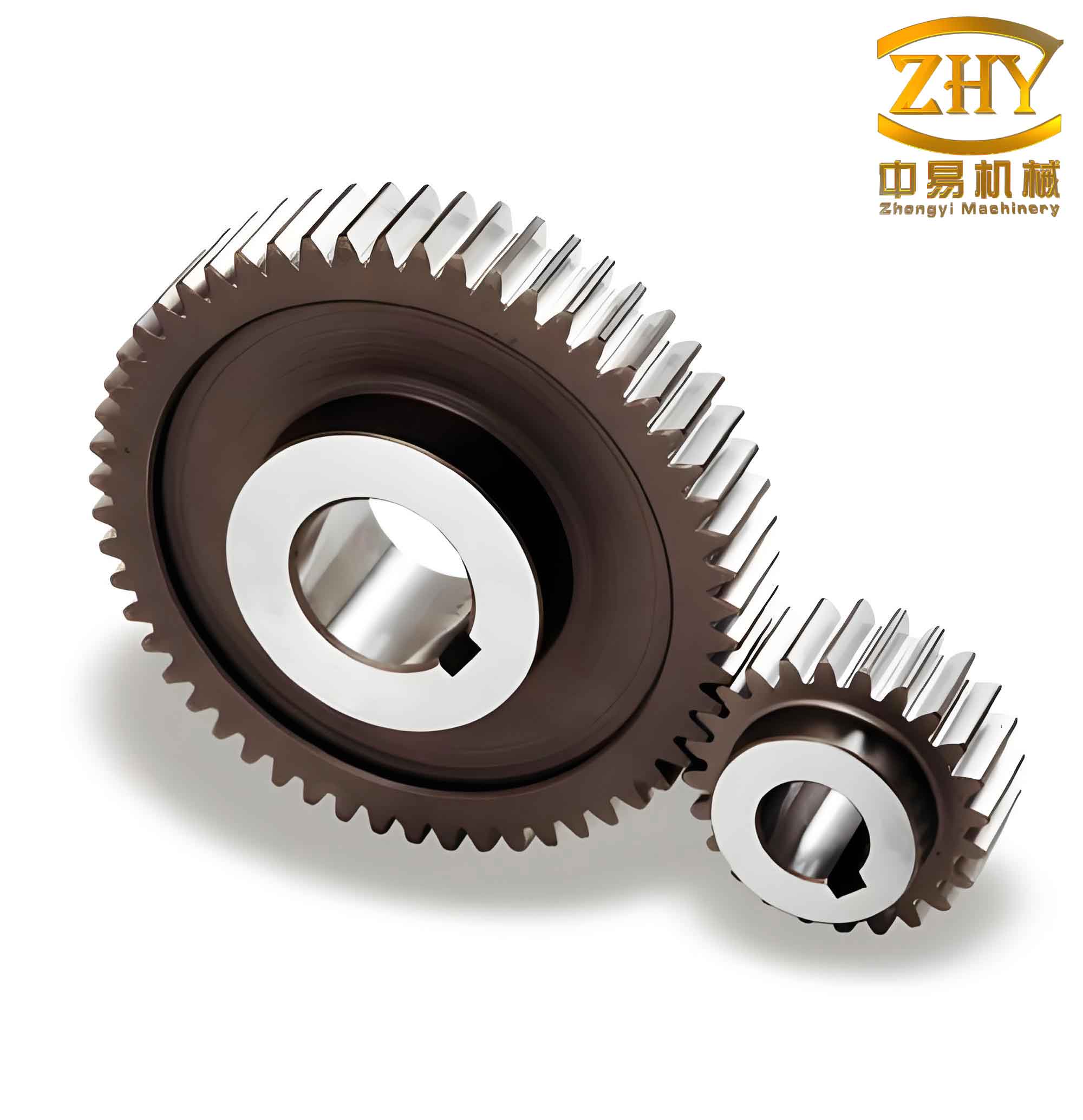
1. Introduction
The transmission accuracy and stability of a reducer are critical to the performance of a transport aircraft. The straight spur gear, as a key component in the reducer, requires precise control of parameters such as contact stress, instantaneous contact temperature, oil film thickness ratio, and lubricant viscosity. High contact temperature and excessive contact stress can lead to gear failures such as scuffing and plastic deformation. Previous studies have shown that proper gear modification can improve the meshing condition. In my work, I used KISSsoft software to optimize the tooth surface modification of the output-stage straight spur gear pair, exploring the effects of modification on contact stress, temperature, and lubrication.
2. Gear Modification Methods
Gear modification is generally divided into two types: profile modification and lead modification. For the straight spur gear, lead modification is particularly effective in reducing the adverse effects of bending and torsional deformation under load. I adopted two lead modification methods:
- Trapezoidal thinning at both ends: Suitable for cases with moderate load misalignment.
- Drum-shaped modification: Suitable for cases with significant load misalignment or heavy loads.
2.1 Modification Quantity Determination
The maximum drum modification quantity Cc was determined according to ISO 6336-1:2006 standard:
$$ C_c = 0.5 (f_{sh} + f_{ma}) $$
where:
- f_{sh} = 7.8632 µm (mesh error)
- f_{ma} = 8.8459 µm (manufacturing and assembly error)
The calculated drum modification quantity was Cc = 8.355 µm. For comparison, the trapezoidal thinning quantity was set to the same value. The gear parameters used in my analysis are summarized in Table 1.
| Parameter | Pinion (Gear 1) | Gear (Gear 2) |
|---|---|---|
| Module (mm) | 6 | 6 |
| Number of Teeth | 17 | 82 |
| Addendum Modification Coefficient | 0.4600 | 0.0584 |
| Face Width (mm) | 120 | 120 |
| Center Distance (mm) | 300 | 300 |
3. Contact Analysis and Results
I performed contact analysis using KISSsoft software for three cases: unmodified, trapezoidal thinning, and drum-shaped modification. The modification data and key results are presented in Table 2.
| Modification Type | Modification Quantity (µm) | Axial Load Distribution Coefficient K_{Hβ} | Maximum Contact Stress (MPa) |
|---|---|---|---|
| Unmodified | 0 | 1.4095 | 1254.03 |
| Trapezoidal Thinning | Cc = 8.355 | 1.0894 | 1128.82 |
| Drum-shaped | Cc = 8.355 | 1.0928 | 1114.36 |
3.1 Contact Stress Distribution
From Table 2, the axial load distribution coefficient K_{Hβ} decreased from 1.4095 (unmodified) to 1.0894 and 1.0928 for trapezoidal and drum-shaped modifications, respectively, representing reductions of 22.7% and 22.5%. The maximum contact stress decreased by 125.21 MPa and 139.67 MPa for the two modification types. The unmodified straight spur gear showed severe edge loading, with a stress difference of over 400 MPa across the face width. After drum-shaped modification, the contact stress became uniformly distributed along the face width, with the maximum load occurring near the center of the tooth. The drum-shaped modification provided the best improvement, eliminating stress concentration at the tooth ends.
3.2 Instantaneous Contact Temperature
The instantaneous contact temperature is influenced by the contact stress magnitude and distribution. The unmodified straight spur gear exhibited a peak instantaneous temperature of 113°C at the single-tooth contact zone. After trapezoidal and drum-shaped modifications, the peak temperatures reduced to 102.5°C and 97.5°C, respectively. The drum-shaped modification achieved a reduction of 15.5°C, significantly improving the meshing condition. The temperature distribution showed sharp transitions at the engagement and disengagement points, which were smoothed by modification.
3.3 Oil Film Thickness Ratio
The oil film thickness ratio λ is defined as the ratio of the minimum oil film thickness to the composite surface roughness. At the initial engagement point, the unmodified straight spur gear had λ = 0.109. After trapezoidal and drum-shaped modifications, λ increased to 0.131 and 0.148, representing improvements of 20.2% and 35.8%, respectively. The drum-shaped modification provided the highest λ, indicating better lubrication and lower power loss. The oil film thickness ratio was smallest in the single-tooth contact zone due to higher load, while it was larger in the double-tooth contact zones.
4. Theoretical Background and Formulas
To further understand the contact behavior, I considered the Hertzian contact theory for straight spur gear teeth. The maximum contact stress σ_H is given by:
$$ \sigma_H = \sqrt{\frac{F_t}{b d_1} \cdot \frac{u+1}{u} \cdot Z_E Z_H Z_{\epsilon} Z_{\beta}} $$
where:
- F_t: Tangential load
- b: Face width
- d_1: Pitch diameter of pinion
- u: Gear ratio
- Z_E: Elasticity factor
- Z_H: Zone factor
- Z_ε: Contact ratio factor
- Z_β: Helix angle factor (1 for straight spur gear)
The instantaneous contact temperature flash temperature T_flash can be estimated using the Blok theory:
$$ T_{flash} = \frac{0.83 \mu W |V_r|}{\sqrt{2k \rho c b}} $$
where:
- μ: Coefficient of friction
- W: Normal load per unit width
- V_r: Relative sliding velocity
- k: Thermal conductivity
- ρ: Density
- c: Specific heat
- b: Half-width of Hertzian contact
The oil film thickness h_min for elastohydrodynamic lubrication (EHL) in a straight spur gear can be approximated by the Dowson-Higginson formula:
$$ h_{min} = 2.65 \alpha^{0.54} (\eta_0 u)^{0.7} R^{0.43} E’^{-0.03} w^{-0.13} $$
where:
- α: Pressure-viscosity coefficient
- η_0: Dynamic viscosity at atmospheric pressure
- u: Entraining velocity
- R: Equivalent radius of curvature
- E’: Effective elastic modulus
- w: Load per unit width
The oil film thickness ratio λ is then:
$$ \lambda = \frac{h_{min}}{\sqrt{R_{a1}^2 + R_{a2}^2}} $$
where R_{a1} and R_{a2} are the surface roughness values of the two gear teeth.
5. Discussion
My analysis of the straight spur gear pair clearly demonstrates the benefits of lead modification. The drum-shaped modification, in particular, provided the most uniform stress distribution, the lowest peak temperature, and the largest oil film thickness ratio. The trapezoidal thinning also improved performance but introduced stress concentration at the transition corners. The results confirm that proper modification can reduce manufacturing and assembly errors, reduce the need for extensive running-in, and improve the overall efficiency and life of the transmission. The use of CNC grinding machines can accurately produce the drum-shaped profile, making it a practical solution for industrial applications.
6. Conclusion
I have systematically analyzed the tooth surface contact characteristics of a straight spur gear and evaluated two lead modification methods. The key conclusions are:
- The axial load distribution coefficient K_{Hβ} was reduced by over 22% for both modification methods.
- The maximum contact stress decreased by up to 139.67 MPa with drum-shaped modification.
- The instantaneous contact temperature peak dropped by up to 15.5°C.
- The oil film thickness ratio increased by up to 35.8%, enhancing lubrication and reducing wear.
- Drum-shaped modification outperformed trapezoidal thinning in all aspects, providing optimal contact performance for the straight spur gear.
These findings offer valuable guidance for the design and optimization of straight spur gear transmissions, improving reliability and longevity in demanding applications such as aircraft reducers.