
We conducted an experimental study on the squeeze casting of a standard straight spur gear made from 6082 aluminum alloy, with a module of 3 and 17 teeth. The gear was produced under varying forming pressures and subsequently subjected to solution and aging heat treatment. The effects of these parameters on the forming quality, microstructure, and mechanical properties of the straight spur gear were systematically analyzed. Our results demonstrate that increasing the forming pressure not only enhances melt fluidity and improves the macro-forming quality of the straight spur gear—eliminating solidification defects such as shrinkage porosity and incomplete filling—but also refines the microstructure and promotes uniformity in both microstructure and mechanical properties across the straight spur gear. At an actual forming pressure of 230 MPa, we obtained a straight spur gear with excellent forming quality, uniform microstructure, and mechanical properties. After T6 heat treatment, the ultimate tensile strength reached 335 MPa with an elongation of 11.8%.
Aluminum alloy components, characterized by high specific strength and good corrosion resistance, are key materials for lightweighting in machinery, electronics, automotive, and aerospace industries. For complex components such as the straight spur gear, traditional methods like gravity casting and low-pressure casting can produce intricate shapes but often suffer from defects like shrinkage, porosity, and misruns, while high costs limit their application. Plastic deformation processes (e.g., forging and extrusion) followed by machining result in low material utilization and may cut metal flow lines, degrading mechanical performance. Squeeze casting combines the advantages of conventional casting and forging by applying high pressure to the molten metal in the mushy zone, eliminating casting defects and inducing plastic deformation. This yields a finer microstructure and higher mechanical properties, making it suitable for near-net-shaping of complex aluminum alloy components like wheel hubs, control arms, and engine mounts. For straight spur gear applications, the 6xxx series aluminum alloys exhibit excellent corrosion resistance and age-hardening capability, but their poor fluidity, wide crystallization range, and tendency toward segregation and hot tearing pose challenges during squeeze casting. Moreover, non-uniform pressure and temperature fields in the die often lead to inhomogeneous microstructure and properties across the straight spur gear. Therefore, controlling the forming defects and uniformity of microstructure and mechanical properties in 6xxx series aluminum alloy squeeze-cast straight spur gears has become a critical issue. In our study, we focus on a standard straight spur gear produced by squeeze casting, investigating the effects of forming pressure on macro-quality, microstructure, and mechanical properties, and establishing the relationship between aging treatment and performance. This work aims to achieve integrated control of shape and properties for complex aluminum alloy components, providing a reference for near-net-shaping of straight spur gears.
| Si | Fe | Cu | Mn | Mg | Cr | Zn | Ti | Al |
|---|---|---|---|---|---|---|---|---|
| 1.0 | 0.5 | 0.1 | 0.65 | 0.9 | 0.25 | 0.2 | 0.1 | Balance |
The target straight spur gear has a module of 3, 17 teeth, pressure angle 20°, pitch circle diameter 50.1 mm, root circle diameter 43.6 mm, addendum circle diameter 57.0 mm, and zero profile shift. We used a 1000 kN hydraulic press (YQ32-100T) as the forming equipment. The mold design employed a floating die structure with a die sleeve and insert. During forming, the punch moved downward, contacting the floating die and driving it synchronously, improving melt filling. The die was preheated to 300°C using electric heating rods, and graphite emulsion was sprayed on the punch and cavity as lubricant. A 240 g 6082 aluminum alloy billet was melted in a graphite crucible heated to 740°C in a resistance furnace at 4°C/s, held for 20 min. Then 2.4 g of C₂Cl₆ degassing agent wrapped in aluminum foil was pressed into the melt bottom, stirred at 60 rpm for 1 min for degassing and impurity removal, and the melt was returned to the furnace at 740°C for 5 min. After holding, the melt was quickly poured into the preheated mold. The punch descended at 10 mm/s initially, then at 2 mm/s after contact, with a dwell time of 3 s. Forming loads of 100, 200, 300, 400, 500, and 600 kN were applied, corresponding to nominal pressures of about 50, 100, 150, 200, 250, and 300 MPa respectively. The actual forming pressure was corrected by subtracting the elastic support pressure from the springs. The spring elastic support pressure Pspring was calculated as:
$$P_{\text{spring}} = \frac{nkl}{S}$$
where n = 4 groups of springs, k = 350 N/mm (spring constant), l = compression stroke, S = gear cross-sectional area. The spring elastic support pressure was 20 MPa. Hence, the net forming pressures were 30, 80, 130, 180, 230, and 280 MPa respectively. After holding at the target pressure for 30 s, the punch retracted, and the ejector rod reset the floating die, completing demolding.
Microhardness was measured at six positions (center, edge, etc.) using a Vickers microhardness tester (HMAS-D1000Z) with 0.98 kN load and 10 s dwell. Specimens for microstructure observation were ground, polished, and electrolytically polished in a solution of 90% C₂H₅OH + 10% HClO₄ at 0°C, 22 V for 25 s. An Olympus DX-510 optical microscope was used, and average grain size was measured by the intercept method. For the gear formed at 230 MPa, we performed homogenization annealing at 560°C for 6 h, solution treatment at 545°C for 50 min, both followed by water quenching, and artificial aging at 160°C for 2, 4, 6, and 8 h. Tensile samples were cut from the gear center along the longitudinal direction; tensile tests were conducted at a strain rate of 0.05 s⁻¹. Fracture surfaces were examined using Zeiss Merlin Compact SEM.
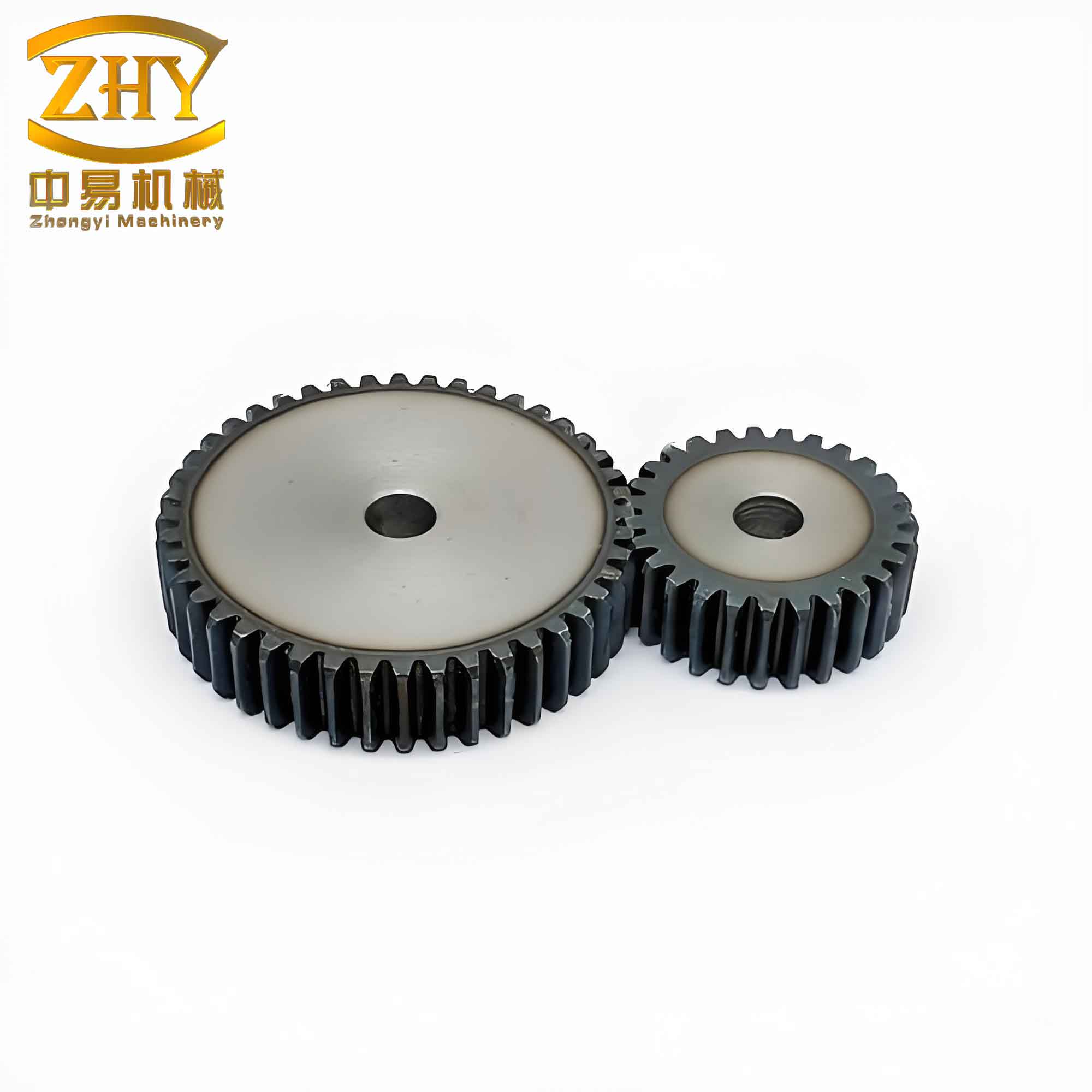
Effect of Forming Pressure on Macro-Quality of Straight Spur Gear
We observed the macro-appearance of straight spur gears formed at different pressures. At 30 MPa, a large shrinkage cavity existed at the center of the gear end face, and some tooth corners were incompletely filled. As the pressure increased to 130 MPa, most solidification defects were eliminated, and the tooth profile became clear and complete. Further increasing to 280 MPa resulted in excellent macro-quality. The reasons lie in improved melt fluidity under higher pressure, facilitating liquid feeding and compensating for solidification shrinkage. The pressure also promoted plastic deformation (solid feeding), effectively feeding the solidifying shell. At low pressure, the melt could not fill the complex tooth cavity completely, and limited feeding could not offset internal shrinkage, leading to defects. At 130 MPa, most shrinkage and microcracks were eliminated, and the gear profile was well formed.
Effect of Forming Pressure on Microstructure of Straight Spur Gear
We examined the microstructure at the center (position 5) and edge (position 6) of the straight spur gear. At low pressure, both regions exhibited coarse dendritic structures with a few microcracks. Increasing pressure refined the grains and eliminated defects. At 130 MPa, grains became noticeably finer with no obvious micro-defects. Further increase to 230 MPa and above did not change the morphology significantly. The edge region always had finer grains than the center. The average grain size measured at different pressures is summarized in Table 2.
| Forming pressure (MPa) | Center (pos.5) | Edge (pos.6) |
|---|---|---|
| 30 | 127.1 | 123.1 |
| 80 | 120.5 | 115.3 |
| 130 | 107.2 | 102.0 |
| 180 | 99.8 | 96.4 |
| 230 | 96.8 | 94.9 |
| 280 | 96.5 | 94.7 |
Grain refinement with increasing pressure is attributed to the rise in undercooling, as described by the Clausius-Clapeyron equation:
$$\frac{\Delta T_m}{\Delta p} = \frac{T_m (V_m^L – V_m^S)}{\Delta H_m}$$
where Δp is pressure change, ΔTm is change in phase transformation temperature, ΔHm is latent heat, Tm is equilibrium solidification temperature at standard pressure, VmL and VmS are molar volumes of liquid and solid. Higher pressure increases the solidification temperature (undercooling), raising nucleation rate and reducing critical nucleation radius. Additionally, pressure enhances interfacial heat transfer between the solid shell and die, increasing cooling rate. The solid shell also undergoes plastic deformation, breaking dendrites and providing more nucleation sites. However, when pressure exceeds 230 MPa, the grain size stabilizes because the melt fully contacts the die cavity, and the heat transfer rate reaches a limit. The center region has coarser grains than the edge due to lower heat transfer and slower cooling.
Effect of Forming Pressure on Mechanical Properties of Straight Spur Gear
Microhardness of the straight spur gear at center and edge increased with forming pressure (Table 3). From 30 to 230 MPa, the hardness (HV) at the center increased from 41.3 to 56.5, and at the edge from 46.2 to 61.9, improvements of 36.8% and 34.0%, respectively. Further pressure increase had little effect. Edge hardness was always higher than center, consistent with finer grains according to the Hall-Petch relationship. The plastic deformation at the edge also contributed via work hardening.
| Forming pressure (MPa) | Center (pos.5) | Edge (pos.6) |
|---|---|---|
| 30 | 41.3 | 46.2 |
| 80 | 44.9 | 50.1 |
| 130 | 49.2 | 55.0 |
| 180 | 53.1 | 59.3 |
| 230 | 56.5 | 61.9 |
| 280 | 56.8 | 62.3 |
For the straight spur gear formed at 230 MPa, we measured hardness at six specific positions (1 through 6). Positions 1 and 3 exhibited the highest values (60.6 and 60.7 HV), while positions 2 and 5 were lower. The maximum difference was 5.2 HV. Positions near the die cavity (edges and near top/bottom surfaces) had finer grains and thus higher hardness. Position 2, although near the cavity, showed lower hardness because it was the last to solidify due to melt flow, resulting in coarser grains.
Since 6082 aluminum alloy is age-hardenable, we performed T6 heat treatment. After homogenization (560°C for 6 h), solution (545°C for 50 min), and aging at 160°C for various times, we tested the tensile properties of the straight spur gear samples. Table 4 shows the results.
| Aging time (h) | Ultimate tensile strength (MPa) | Elongation (%) |
|---|---|---|
| 2 | 305 | 13.5 |
| 4 | 322 | 12.6 |
| 6 | 335 | 11.8 |
| 8 | 318 | 10.2 |
The strength first increased then decreased with aging time, while elongation continuously decreased. The peak strength of 335 MPa with 11.8% elongation was achieved at 6 h. The precipitation sequence in 6082 alloy is: supersaturated solid solution → atomic clusters → G.P. zones → coherent metastable β″ → semi-coherent metastable β′ → incoherent equilibrium β. The β″ phase is most effective for strengthening due to its coherence and high strain energy. At 6 h, the number of β″ precipitates reaches maximum, giving peak aging. Prolonged aging transforms β″ to β′ and then to β, reducing strength. Fracture surfaces of the straight spur gear in peak-aged condition showed numerous dimples, indicating ductile fracture, while over-aging (8 h) exhibited fewer dimples and some cleavage facets due to coarser precipitates.
Conclusions of the Straight Spur Gear Study
- Increasing squeeze casting pressure improves the forming quality of the 6082 aluminum alloy straight spur gear, eliminating shrinkage, porosity, and hot cracking. It also refines the grain structure and enhances mechanical properties. When the forming pressure increased from 30 to 230 MPa, the average grain size at the center and edge decreased by 23.8% and 22.9%, respectively, and the Vickers hardness increased by 36.8% and 34.0%.
- Higher forming pressure enhances interfacial heat transfer by increasing the actual contact area between the melt and the complex tooth cavity, and provides both liquid feeding and plastic deformation (solid feeding) during solidification, effectively compensating shrinkage and improving uniformity of microstructure and properties across the straight spur gear.
- At a forming pressure of 230 MPa, we obtained a straight spur gear with excellent forming quality and good uniformity. After homogenization (560°C × 6 h), solution treatment (545°C × 50 min), and aging at 160°C for 6 h, the ultimate tensile strength reached 335 MPa with an elongation of 11.8%, approaching the level of forged components.