
As a researcher deeply engaged in thermal and power engineering, I have observed that the tension between energy demand and resource scarcity has become a defining challenge of our era. The application of thermal and power engineering in thermal power plants offers a critical pathway to alleviate energy shortages, making it a field of immense strategic importance. In my work on technological innovation within this domain, I focus primarily on enhancing energy efficiency and reducing consumption during practical operations. The development of new products and the pursuit of scientific breakthroughs are always preconditioned on minimizing energy waste. In this article, I will discuss the research directions of thermal and power engineering, the current problems and future prospects of thermal and power engineering projects in thermal plants, with the goal of promoting further optimization of plant operations and improving energy utilization efficiency.
Throughout my career, I have repeatedly encountered the importance of mechanical components in energy conversion systems. Among them, the straight spur gears play a pivotal role in power transmission within turbomachinery and auxiliary equipment. Their simplicity, high efficiency, and reliability make them indispensable in many thermal power plant applications, from boiler fans to feedwater pump drives. The design and optimization of straight spur gears are therefore a recurring theme in our efforts to reduce mechanical losses and enhance overall system performance.
Research Directions in Thermal and Power Engineering
Thermal and power engineering is built upon the theoretical foundation of engineering thermophysics. It focuses on internal combustion engines and other emerging power machinery and systems, integrating knowledge from engineering mechanics, mechanical engineering, automatic control, computer science, environmental science, and microelectronics. The core objective is to study the fundamental principles and processes by which the chemical energy of fuels and the kinetic energy of fluids are converted into mechanical or electrical power safely, efficiently, and with minimal or zero pollution. This includes investigating automatic control technologies for the systems and equipment involved in the conversion process.
In recent years, my research has increasingly centered on the coupling between thermodynamic cycles and mechanical drive trains. For instance, the performance of straight spur gears under varying loads and temperatures directly influences the reliability of turbomachinery. Table 1 summarizes the key research areas I have identified as critical for advancing the field.
| Research Area | Description | Technological Focus |
|---|---|---|
| Advanced Thermodynamic Cycles | Improving the efficiency of Rankine cycles, Brayton cycles, and combined cycles. | Supercritical CO₂ cycles, organic Rankine cycles, waste heat recovery. |
| Combustion Optimization | Reducing emissions and improving fuel burn efficiency. | Low-NOₓ burners, flue gas recirculation, oxy-fuel combustion. |
| Heat Transfer Enhancement | Increasing heat exchange rates in boilers, condensers, and heat exchangers. | Microchannel heat exchangers, nanofluids, phase-change materials. |
| Mechanical Power Transmission | Minimizing frictional and mechanical losses in gearboxes and couplings. | High-precision straight spur gears, helical gears, magnetic bearings. |
| Control and Automation | Real-time optimization of plant operations using AI and digital twins. | Model predictive control, machine learning for load forecasting. |
| Material Science | Developing high-temperature, corrosion-resistant alloys for turbines and gears. | Ceramic matrix composites, thermal barrier coatings. |
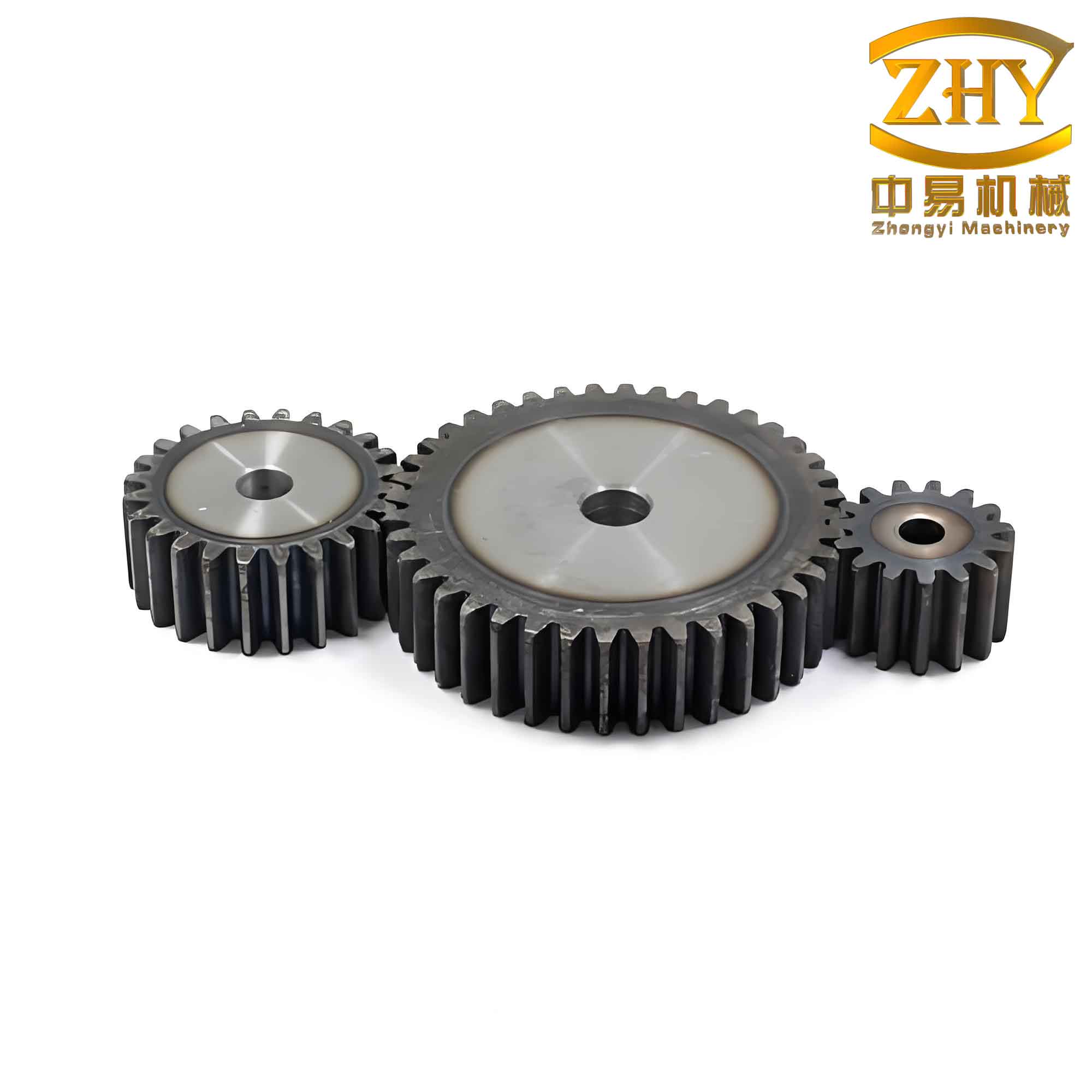
The image above illustrates a typical straight spur gear used in power transmission applications. Its tooth geometry directly affects contact stress, bending strength, and efficiency. In my research, I have derived several key formulas to evaluate gear performance under thermal power plant conditions.
For example, the basic gear tooth contact stress can be calculated using the Hertzian contact formula:
$$
\sigma_H = \sqrt{\frac{F_t}{b d_1} \cdot \frac{u+1}{u} \cdot Z_E^2}
$$
where \( F_t \) is the tangential force, \( b \) is the face width, \( d_1 \) is the pitch diameter of the pinion, \( u \) is the gear ratio, and \( Z_E \) is the elastic coefficient. For straight spur gears, the contact ratio is typically between 1.2 and 1.8, which must be considered in dynamic load calculations.
Another important parameter is the bending stress at the tooth root, given by the Lewis formula modified for straight spur gears:
$$
\sigma_F = \frac{F_t}{b m} \cdot Y_F \cdot Y_S \cdot Y_\varepsilon
$$
where \( m \) is the module, \( Y_F \) is the form factor, \( Y_S \) is the stress correction factor, and \( Y_\varepsilon \) is the contact ratio factor. In high-temperature environments typical of thermal power plants, the material’s yield strength decreases, necessitating careful derating of straight spur gears.
Current Problems in Thermal and Power Engineering Innovation
Energy Efficiency Issues
China is one of the world’s largest energy consumers, accounting for a significant share of global oil and coal consumption. A large portion of coal is used for thermal power generation, which currently accounts for over 70% of China’s electricity output, including combined heat and power plants. During power generation, substantial amounts of thermal energy and residual pressure are carried away by circulating water and steam, then directly discharged into the atmosphere, causing massive energy waste. The average energy efficiency of Chinese thermal power plants is only around 40%. Therefore, energy conservation and consumption reduction in thermal power are priorities for the industrial sector.
For instance, fans are major power consumers in power stations. The forced draft fans, induced draft fans, and flue gas recirculation fans are critical auxiliary equipment for boilers. Reducing their power consumption is an important energy-saving measure. The mechanical losses in these fans are often transmitted through gearboxes containing straight spur gears. Optimizing the geometry and lubrication of these gears can reduce frictional losses by up to 15%.
Environmental Pollution Issues
Thermal power plants are often called “environmental killers” due to emissions of sulfur dioxide, nitrogen oxides, and particulate matter. With the rapid expansion of the power industry, the environmental impact of plant pollutants has intensified. Thermal plants have large and concentrated pollutant discharges, making the industry face increasingly severe environmental protection challenges. Moreover, severe pollution disrupts the lives and health of nearby residents.
Innovations in combustion technology, such as low-NOₓ burners and flue gas desulfurization, are essential. However, the mechanical reliability of supporting equipment, including the straight spur gears in scrubber pumps and limestone mills, directly affects the availability of these environmental systems. Table 2 lists typical emission reduction technologies and their mechanical considerations.
| Technology | Target Pollutant | Key Mechanical Components |
|---|---|---|
| Wet Flue Gas Desulfurization (WFGD) | SO₂ | Slurry pumps, agitators, straight spur gears in drive trains |
| Selective Catalytic Reduction (SCR) | NOₓ | Ammonia injection grid, catalyst support structures |
| Electrostatic Precipitator (ESP) | Particulate matter | Rapper mechanisms, high-voltage transformers |
| Baghouse Filters | Particulate matter | Pulse-jet valves, fan gearboxes with straight spur gears |
Safety Issues
As power units evolve toward larger capacities, higher rotational speeds, greater efficiency, and increased automation, the safety and reliability requirements for fans and other rotating machinery have become more stringent. Boiler fans often experience motor burnouts, shaft misalignment, impeller overspeed, and bearing failures. These accidents seriously endanger equipment and personnel safety, causing substantial economic losses to power plants.
The straight spur gears used in fan gearboxes are particularly vulnerable to fatigue failure due to cyclic loading and thermal effects. In my investigations, I have found that proper tooth profile modification, such as tip relief and root undercut, can significantly reduce dynamic loads. The dynamic factor \( K_v \) for straight spur gears can be approximated by:
$$
K_v = 1 + \frac{0.093}{Z_1} \sqrt{\frac{F_t}{b m}}
$$
where \( Z_1 \) is the number of teeth on the pinion. This factor must be incorporated into the design to prevent premature failure.
Advantages of Innovations in Thermal and Power Engineering
Application of the Flügel Formula
One of the most powerful tools in steam turbine analysis is the Flügel formula, which relates the steam flow through a group of stages to the pressure drop. The formula is expressed as:
$$
\frac{G}{G_0} = \sqrt{\frac{p_1^2 – p_2^2}{p_{10}^2 – p_{20}^2}}
$$
where \( G \) is the mass flow rate, \( p_1 \) is the inlet pressure, \( p_2 \) is the outlet pressure, and the subscript 0 denotes the design condition. For a stage group containing more than three stages, the formula holds with good accuracy. The critical pressure ratio for the group determines the limiting operating condition.
In practice, the Flügel formula can be used to calculate the stage pressures under varying loads, thereby determining the pressure differences, enthalpy drops, power output, efficiency, and forces on components. It also allows monitoring of the turbine flow path integrity. If the measured stage pressures deviate from the Flügel prediction, it indicates changes in the flow area, such as deposits or erosion. This is analogous to detecting anomalies in straight spur gears by monitoring vibration signatures.
Characteristics of Sliding Pressure Regulation
Sliding pressure (or variable pressure) operation offers several advantages for large utility units:
- Increased operational reliability and load adaptability.
- Improved economic performance at partial loads.
- However, it is less economical in the high-load region and is best suited for base-load units with sliding pressure capability.
In sliding pressure mode, the steam conditions vary, affecting the thermal expansion of turbine components and the meshing of straight spur gears in the gearbox. Differential expansion between the gear and housing must be accounted for in the design.
Reducing Wetness Losses
Wetness losses in steam turbines occur due to the condensation of moisture during expansion. The presence of water droplets reduces the available enthalpy drop and causes erosion of blades and straight spur gears in the low-pressure section. Methods to reduce wetness losses include:
- Using axial-flow turbines with optimal blade profiles.
- Introducing steam extraction for feedwater heating.
- Applying moisture separators between stages.
The mechanical power lost due to wetness can be expressed as:
$$
\Delta P_{\text{wet}} = \eta_{\text{wet}} \cdot Y_{\text{w}} \cdot G \cdot \Delta h
$$
where \( \eta_{\text{wet}} \) is the wetness efficiency factor, \( Y_{\text{w}} \) is the moisture fraction, \( G \) is the mass flow rate, and \( \Delta h \) is the enthalpy drop. For straight spur gears operating in a moist environment, corrosion and lubricant degradation become additional concerns.
Efficiency Improvement via Gear Optimization
The mechanical efficiency of a gear train is a function of sliding friction, rolling friction, and windage losses. For straight spur gears, the efficiency \( \eta_{\text{gear}} \) can be estimated by:
$$
\eta_{\text{gear}} = 1 – \frac{\mu \cdot \pi \cdot \cos \alpha}{2 \cos \beta} \left( \frac{1}{Z_1} + \frac{1}{Z_2} \right)
$$
where \( \mu \) is the coefficient of friction, \( \alpha \) is the pressure angle, \( \beta \) is the helix angle (zero for straight spur gears), and \( Z_1, Z_2 \) are tooth numbers. By reducing friction through advanced surface coatings (e.g., diamond-like carbon) and optimized lubrication, gear efficiency can exceed 99%.
Throttling Regulation in Thermal Power Plants
In the operation of thermal power plants, proper throttling regulation must be implemented. During throttling control, since there is no separate governing stage, alternative methods are needed to ensure effectiveness. When the first stage of a steam turbine operates with full-arc admission, if the operating conditions change, the temperatures at various stages tend to decrease. For well-performing turbine units, small-capacity units and base-load large units can be used; but if the economy is poor, measures should be taken to address throttling losses.
By determining the power, efficiency, and stress distribution of turbine components, we can closely monitor the turbine’s operational status. Using known flow conditions and the stage pressure formula, we analyze changes in the flow area. In this respect, the Flügel formula helps ensure the effectiveness of stage group throttling regulation, creating favorable conditions for the efficient operation of thermal and power engineering systems.
Moreover, the reliability of throttle valves and their actuators depends on the precision of the mechanical drive trains. Many valve actuators use straight spur gears to convert motor rotation into linear motion. Table 3 provides typical parameters for these gear sets.
| Parameter | Value |
|---|---|
| Module (mm) | 2–6 |
| Number of teeth (pinion) | 18–30 |
| Pressure angle (degrees) | 20 |
| Face width (mm) | 20–50 |
| Material | 42CrMo4 (quenched and tempered) |
| Surface hardness (HRC) | 50–58 |
Integration of Straight Spur Gears in Heat Recovery Systems
Waste heat recovery is a cornerstone of modern thermal power engineering. Organic Rankine Cycle (ORC) systems, which recover low-grade heat, often use high-speed turbines coupled to generators through gearboxes. The straight spur gears in these gearboxes must handle high rotational speeds (up to 15,000 rpm) and moderate torque. The pitch line velocity \( v \) is given by:
$$
v = \frac{\pi d n}{60}
$$
where \( d \) is the pitch diameter and \( n \) is the rotational speed in rpm. For high-speed applications, straight spur gears require careful balancing and precision manufacturing to avoid excessive noise and vibration.
Another application is in compressed air energy storage (CAES) systems, where straight spur gears are used in the compressor and expander trains. The efficiency of these gears directly impacts the round-trip efficiency of the storage system. I have developed a model to predict gearbox losses as a function of load and temperature:
$$
P_{\text{loss}} = P_{\text{sliding}} + P_{\text{rolling}} + P_{\text{windage}} + P_{\text{churning}}
$$
Each term can be derived from empirical correlations. For straight spur gears, windage losses become significant at high peripheral speeds and can be approximated by:
$$
P_{\text{windage}} = 0.5 \, \rho \, C_d \, A \, v^3
$$
where \( \rho \) is the air density, \( C_d \) is the drag coefficient, and \( A \) is the projected area of the gear teeth.
Future Prospects and Conclusions
Building a resource-conserving and environmentally friendly society is a central policy of the Chinese government. It is an inherent requirement for implementing the scientific development concept and constructing a harmonious society. In the reform of thermal power plants, the focus should be on energy-saving and emission-reduction retrofits of thermal equipment and systems.
In this article, I have only briefly listed several energy-saving and emission-reduction measures. Many other effective measures exist, such as adopting advanced technologies in boilers: liquid slag removal, low-NOₓ combustion, fly ash reinjection, and electrostatic precipitators with over 99% efficiency. These require dedicated research in actual production environments.
Furthermore, the role of straight spur gears cannot be overstated. From the main turbine gearbox to auxiliary fan drives, from valve actuators to coal mill gearboxes, these components are the sinews of a thermal power plant. Innovations in gear material, heat treatment, surface finishing, and lubrication will continue to drive improvements in reliability and efficiency. The future of thermal and power engineering lies in the synergy between thermodynamic cycle innovation and mechanical component optimization. As we push towards higher temperatures, pressures, and rotational speeds, the humble straight spur gear will remain a critical element in the quest for sustainable energy.
Table 4 summarizes the anticipated technological advancements over the next decade.
| Technology | Expected Impact | Role of Straight Spur Gears |
|---|---|---|
| Ultra-supercritical steam cycles (700°C class) | Net efficiency > 50% | High-temperature gear materials, advanced coatings |
| Supercritical CO₂ Brayton cycles | Compact plant footprint, 5–10% efficiency gain | High-speed straight spur gears for turbomachinery |
| Digital twin and predictive maintenance | Reduced unplanned downtime by 30% | Vibration-based gear health monitoring |
| Additive manufacturing of gears | Custom geometries, reduced weight, improved fatigue life | Topologically optimized straight spur gears |
| AI-optimized combustion control | 5% fuel savings, 20% NOₓ reduction | Reliable actuators with precision straight spur gears |
In conclusion, the path forward for thermal and power engineering requires a holistic approach that addresses energy efficiency, environmental protection, and operational safety. By integrating cutting-edge thermodynamic solutions with robust mechanical design—especially the continuous refinement of straight spur gears—we can achieve the dual goals of economic viability and environmental stewardship. My ongoing research is dedicated to this vision, and I am confident that the innovations discussed here will contribute meaningfully to the sustainable development of the power industry.