
In modern mechanical engineering, the demand for high load capacity, endurance, cost efficiency, and prolonged service life has driven innovations in gear design. Traditional gear transmission systems often operate under unidirectional loading. However, in specialized applications such as wind turbine gearboxes, gears experience multi-directional loads. To accommodate these complex operating conditions, asymmetric involute straight spur gears have emerged as a promising solution. My research focuses on the dynamic behavior of such gears, leveraging gear geometry theory and system dynamics to establish a comprehensive computational model. Through numerical simulations using MATLAB and finite element analysis with Abaqus, I have investigated key parameters including meshing stiffness, dynamic factors, transmission errors, and bending stresses. This article presents a first-person account of my study, detailing the methodology, results, and insights gained.
1. Dynamic Modeling of Asymmetric Involute Straight Spur Gears
To understand the dynamic behavior of asymmetric straight spur gears, I began by developing a dynamic model for a pair of meshing gears. The gears are treated as free bodies during contact, and the equations of motion are derived from fundamental principles. For a gear pair, the rotational dynamics of the large gear (index g) and small gear (index p) are given by:
$$J_g \ddot{\theta}_g = r_{bg}(F_1 + F_2) \pm \rho_{g1} u_1 F_1 \pm \rho_{g2} u_2 F_2 – r_{bg} F_D$$
$$J_p \ddot{\theta}_p = r_{bp} F_D – r_{bp}(F_1 + F_2) \pm \rho_{g1} u_1 F_1 \pm \rho_{g2} u_2 F_2$$
Here, $J_g$ and $J_p$ are the polar moments of inertia, $F_1$ and $F_2$ are the contact loads, $u_1$ and $u_2$ are instantaneous friction coefficients, $\theta_g$ and $\theta_p$ are angular displacements, $r_{bg}$ and $r_{bp}$ are base circle radii, $\rho_{g1}$ and $\rho_{g2}$ are radii of curvature. The sign convention depends on the relative rotational speeds: positive if the small gear rotates much faster than the large gear, negative otherwise.
The static contact force $F_D$ is derived from the applied torque:
$$F_D = \frac{T_g}{r_{bg}} = \frac{T_p}{r_{bp}}$$
where $T_g$ and $T_p$ are the torques on the large and small gears, respectively.
To simplify analysis, I converted angular coordinates into linear displacements along the line of action. Assuming negligible gear deformation, the displacements are:
$$y_g = r_g \theta_g$$
$$y_p = r_p \theta_p$$
The relative displacement, velocity, and acceleration become:
$$x_r = y_p – y_g$$
$$\dot{x}_r = \dot{y}_p – \dot{y}_g$$
$$\ddot{x}_r = \ddot{y}_p – \ddot{y}_g$$
The equivalent masses of the gears are defined as:
$$M_g = \frac{J_g}{r_{bg}^2}$$
$$M_p = \frac{J_p}{r_{bp}^2}$$
Using gear dynamics theory, the equation of motion for the meshing pair including viscous damping is:
$$\ddot{x}_r + 2\omega\xi \dot{x}_r + \omega x_r = \omega^2 x_s$$
$$\omega^2 = \frac{K_1 (S_{p1} M_g + S_{g1} M_p) + K_2 (S_{p2} M_g + S_{g2} M_p)}{M_g M_p}$$
$$\omega^2 x_s = \frac{F_D (M_g + M_p) + K_1 \lambda_1 (S_{p1} M_g + S_{g1} M_p) + K_2 \lambda_2 (S_{p2} M_g + S_{g2} M_p)}{M_g M_p}$$
Here, $x_s$ is the loaded transmission error, $\omega$ is the angular frequency, $\xi$ is the damping coefficient (taken as 0.18 in this study), $K_1$ and $K_2$ are equivalent meshing stiffnesses, $S_{g1}, S_{p1}, S_{g2}, S_{p2}$ are friction-related expressions, and $\lambda_1, \lambda_2$ are tooth profile errors of the large and small gears, respectively.
Substituting the expression for $\omega^2$ into the equation for $\omega^2 x_s$, the loaded static transmission error is obtained:
$$x_s = \frac{F_D (M_g + M_p) + K_1 \lambda_1 (S_{p1} M_g + S_{g1} M_p) + K_2 \lambda_2 (S_{p2} M_g + S_{g2} M_p)}{K_1 (S_{p1} M_g + S_{g1} M_p) + K_2 (S_{p2} M_g + S_{g2} M_p)}$$
The equivalent meshing stiffness for each tooth pair is calculated by considering the individual tooth stiffnesses:
$$K_1 = \frac{k_{p1} k_{g1}}{k_{p1} + k_{g1}}$$
$$K_2 = \frac{k_{p2} k_{g2}}{k_{p2} + k_{g2}}$$
where $k_{g1}, k_{p1}, k_{g2}, k_{p2}$ are the individual tooth meshing stiffnesses.
The friction force expressions for each gear are:
$$S_{g1} = 1 \pm \frac{u_1 \rho_{g1}}{r_{bg}}$$
$$S_{p1} = 1 \pm \frac{u_1 \rho_{p1}}{r_{bp}}$$
$$S_{g2} = 1 \pm \frac{u_2 \rho_{g2}}{r_{bg}}$$
$$S_{p2} = 1 \pm \frac{u_2 \rho_{p2}}{r_{bp}}$$
The sign is positive for forward rotation and negative for reverse rotation. The friction coefficients $u_1$ and $u_2$ are computed using the Dowson and Higginson model:
$$u_{1,2} = 18.1 \, v^{-0.15} \left( \frac{v_{g1,2} + v_{p1,2}}{|v_{g1,2} – v_{p1,2}|} \right)^{-0.15} (|v_{g1,2} – v_{p1,2}|)^{-0.5} \left( \frac{\rho_{g1,2} \rho_{p1,2}}{\rho_{g1,2} + \rho_{p1,2}} \right)^{-0.5}$$
Here, $v$ is the lubricant viscosity, and $v_{g1,2}, v_{p1,2}$ are surface velocities (mm/s) given by:
$$v_{g1,2} = V \left( -\frac{L_{g1,2} \cos\alpha_d}{r_{bg}} + \sin\alpha_d \right)$$
$$v_{p1,2} = V \left( -\frac{L_{p1,2} \cos\alpha_d}{r_{bp}} + \sin\alpha_d \right)$$
where $L_{g1,2}$ and $L_{p1,2}$ are distances from the pitch point to the contact points along the line of action, $V$ is the tangential velocity at the pitch circle, and $\alpha_d$ is the pressure angle on the driving side of the asymmetric straight spur gears.
The dynamic contact loads are expressed as functions of relative displacement and profile errors:
$$F_1 = K_1 (x_r – \lambda_1)$$
$$F_2 = K_2 (x_r – \lambda_2)$$
These equations are valid only when the gears are in contact. If separation occurs, the dynamic load drops to zero, and the motion is governed by:
$$T \ddot{x}_r = F_D$$
where $T$ is the applied torque.
During meshing, due to the contact ratio, there are intervals of single-tooth and double-tooth contact. The meshing stiffness is therefore time-varying. To compute the equivalent stiffness, I first determined the individual tooth stiffnesses based on the gear geometry and applied load. The tooth stiffness is defined as:
$$k_{g1} = \frac{F}{\delta_{g1}}, \quad k_{p1} = \frac{F}{\delta_{p1}}$$
$$k_{g2} = \frac{F}{\delta_{g2}}, \quad k_{p2} = \frac{F}{\delta_{p2}}$$
where $F$ is the applied force, and $\delta$ represents the tooth deformation along the loading direction. These deformations were computed using finite element analysis with Abaqus, considering the gear geometry and material properties.
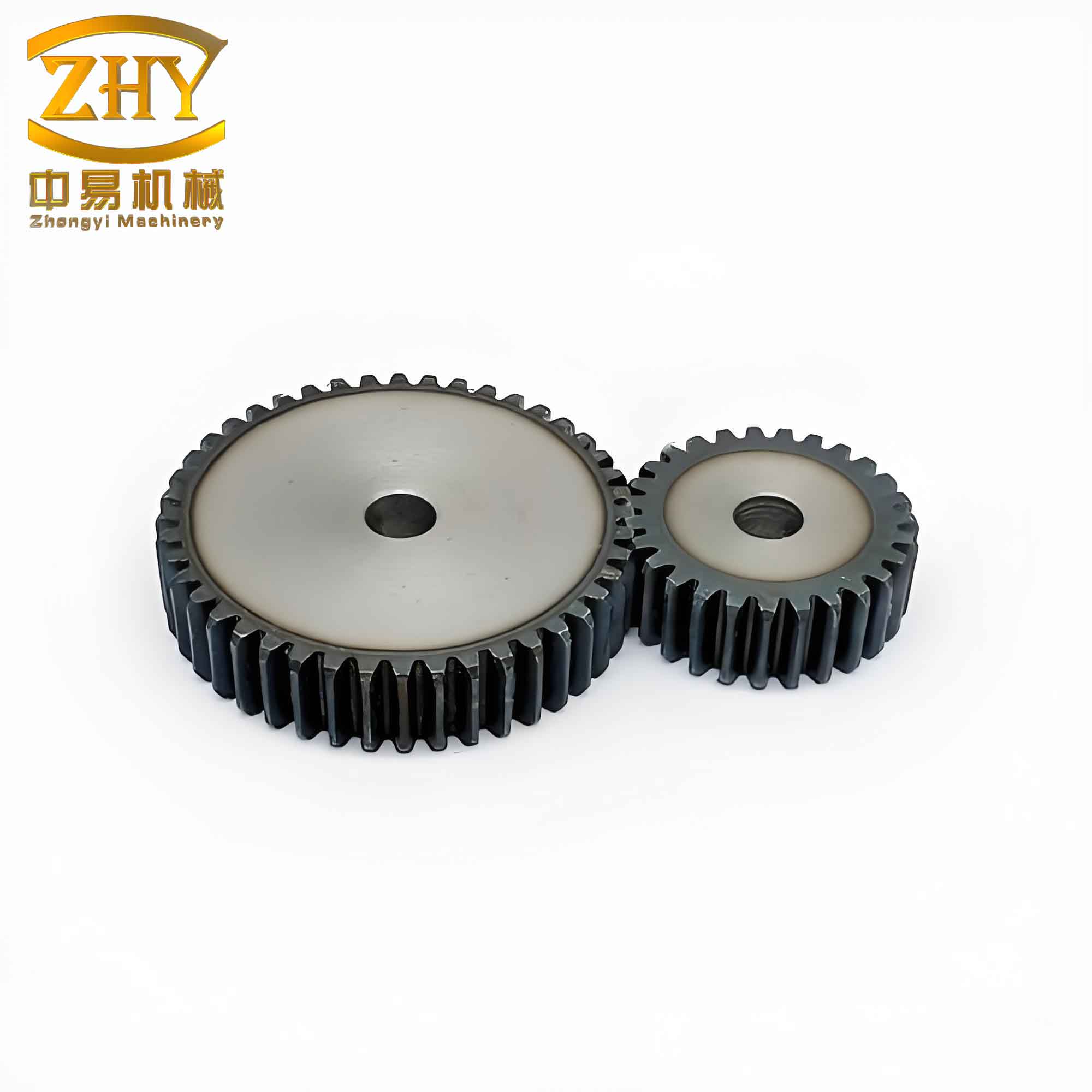
2. Numerical Implementation and Gear Parameters
I implemented the dynamic model in MATLAB, following a computational flowchart that integrates the gear geometry, friction, stiffness, and dynamics. The process involves initializing parameters, computing time-varying stiffness, solving the differential equation, and extracting dynamic responses. The gear parameters used in the simulation are summarized in Table 1.
| Parameter | Gear Pair 1 | Gear Pair 2 | Gear Pair 3 |
|---|---|---|---|
| Module (mm) | 3 | 3 | 3 |
| Pinion teeth | 32 | 32 | 32 |
| Coast side pressure angle (°) | 20 | 20 | 20 |
| Drive side pressure angle (°) | 20 | 30 | 35 |
| Transmission ratio | 2 | 2 | 2 |
| Pinion mass (kg) | 1.2 | 1.2 | 1.2 |
| Gear mass (kg) | 2.4 | 2.4 | 2.4 |
| Material | Steel | Steel | Steel |
| Kinematic viscosity (cSt) | 100 | 100 | 100 |
| Damping ratio | 0.17 | 0.17 | 0.17 |
| Face width (mm) | 25.4 | 25.4 | 25.4 |
| Backlash | 0 | 0 | 0 |
| Addendum coefficient | 1 | 1 | 1 |
| Contact ratio | 1.68 | 1.36 | 1.28 |
Gear Pair 1 represents a symmetric straight spur gear (both sides 20°), while Pairs 2 and 3 are asymmetric with increased drive-side pressure angles. All other parameters are kept identical to isolate the effect of asymmetry.
3. Results and Discussion
3.1 Dynamic Factor vs. Rotational Speed
The dynamic factor is defined as the ratio of the maximum dynamic load to the static load. Figure 4 (described in the original but not shown here) illustrates the variation of dynamic factor with rotational speed for the three gear pairs. I observed that Gear Pair 2 and 3 exhibited peak dynamic factors at the resonance speed of 10,000 rpm, while Gear Pair 1 (symmetric) showed a peak at half the resonance speed (5,000 rpm). The maximum dynamic factor decreased from Pair 1 to Pair 3, indicating that asymmetric straight spur gears have lower dynamic factors compared to symmetric ones. This reduction is attributed to the increased pressure angle on the drive side, which reduces the contact ratio and thereby diminishes the dynamic amplification. Additionally, the higher single-tooth meshing stiffness of asymmetric gears allows the system to pass through the contact region more quickly, limiting the build-up of dynamic response.
3.2 Meshing Stiffness
I computed the time-varying meshing stiffness for Gear Pairs 1 and 3, as shown in Table 2. The results demonstrate that the meshing stiffness of Gear Pair 3 (asymmetric, 35° drive side) is consistently higher than that of Gear Pair 1 (symmetric, 20°) during both single-tooth and double-tooth contact phases. However, the duration of double-tooth contact is shorter for the asymmetric gear due to its lower contact ratio.
| Parameter | Gear Pair 1 (Symmetric) | Gear Pair 3 (Asymmetric) |
|---|---|---|
| Single-tooth contact stiffness (N/mm) | $2.1 \times 10^5$ | $2.8 \times 10^5$ |
| Double-tooth contact stiffness (N/mm) | $3.8 \times 10^5$ | $4.5 \times 10^5$ |
| Double-tooth contact duration (normalized) | 0.40 | 0.28 |
3.3 Transmission Error
Transmission error is a key indicator of gear noise and vibration. I analyzed the static transmission error under identical operating conditions for all three gear pairs. The results are summarized in Table 3. It is evident that as the drive-side pressure angle increases, the transmission error decreases. Asymmetric straight spur gears (Pairs 2 and 3) exhibit smaller transmission errors compared to the symmetric Pair 1. This is because higher stiffness in asymmetric gears reduces elastic deformation, leading to lower transmission error.
| Gear Pair | Maximum transmission error (μm) | Mean transmission error (μm) |
|---|---|---|
| 1 (20°/20°) | 4.2 | 3.1 |
| 2 (20°/30°) | 3.6 | 2.6 |
| 3 (20°/35°) | 3.1 | 2.2 |
3.4 Bending Stress at Tooth Root
Tooth root bending stress is critical for gear fatigue life. I evaluated the bending stress distribution along the tooth root for different pressure angles and root distances. The results, presented in Table 4, show that bending stress decreases with increasing pressure angle and with increasing distance from the root fillet. Asymmetric straight spur gears with larger drive-side pressure angles experience lower bending stresses, which enhances their load-carrying capacity.
| Root distance (normalized) | Pressure angle 20° | Pressure angle 30° | Pressure angle 35° |
|---|---|---|---|
| 0.2 | 280 | 245 | 215 |
| 0.4 | 250 | 220 | 195 |
| 0.6 | 220 | 195 | 175 |
| 0.8 | 190 | 170 | 155 |
| 1.0 | 160 | 145 | 135 |
4. Conclusions
In this study, I have systematically investigated the dynamic characteristics of asymmetric involute straight spur gears using a combined analytical and numerical approach. The key findings are summarized as follows:
- Asymmetric straight spur gears exhibit higher meshing stiffness but lower dynamic factors compared to symmetric gears. The dynamic factor decreases with increasing drive-side pressure angle due to reduced contact ratio and faster passage through resonance.
- Transmission error is significantly reduced in asymmetric gears. Higher pressure angles lead to smaller elastic deformations and hence lower transmission errors, which is beneficial for noise and vibration reduction.
- Tooth root bending stress decreases with increasing pressure angle and with distance from the root. Asymmetric gears with larger pressure angles on the drive side offer improved bending fatigue resistance.
These results provide valuable guidelines for the design of high-performance straight spur gears in applications where unidirectional or bidirectional loading occurs. The dynamic model developed here can be extended to include profile modifications, manufacturing errors, and variable operating conditions to further optimize gear performance.