
In my research on gear transmission systems, I have always been fascinated by the challenge of vibration reduction in straight spur gears. As gear systems evolve toward higher speeds, greater precision, and increased power density, the need for effective vibration suppression becomes increasingly critical. In this study, I propose a novel slot hole vibration damping structure for cylindrical straight spur gears, which serves the dual purpose of eliminating backlash and reducing vibration. Through comprehensive dynamic simulation using Adams software, orthogonal experimental design, and experimental validation, I have demonstrated the effectiveness of this innovative approach.
The vibration and noise reduction in gear transmission has long been a focal point in the industry. While tooth surface modification has been extensively studied as a means to reduce gear meshing impact, I recognize that such approaches face certain manufacturing bottlenecks. Therefore, I have turned my attention to structural design modifications and damping devices as alternative strategies for suppressing gear meshing vibration and noise. These approaches are often simpler, more effective, and easier to implement, particularly for high-speed and precision gear transmissions.
Structural Design of the Vibration Damping Slot Hole
The vibration damping structure I designed features longitudinal grooves cut from the tooth tip inward, connected to through-holes within the tooth body. This configuration serves three primary purposes for straight spur gears. First, it provides a rigid-flexible coupling characteristic that reduces meshing impact and prevents tooth locking when clearance is insufficient. Second, it minimizes the牵连 deformation between adjacent teeth, ensuring that load-induced deformation of one tooth does not cause pitch variations in neighboring teeth. Third, the circular holes relax some of the root stress, reducing stress concentration at the tooth root.
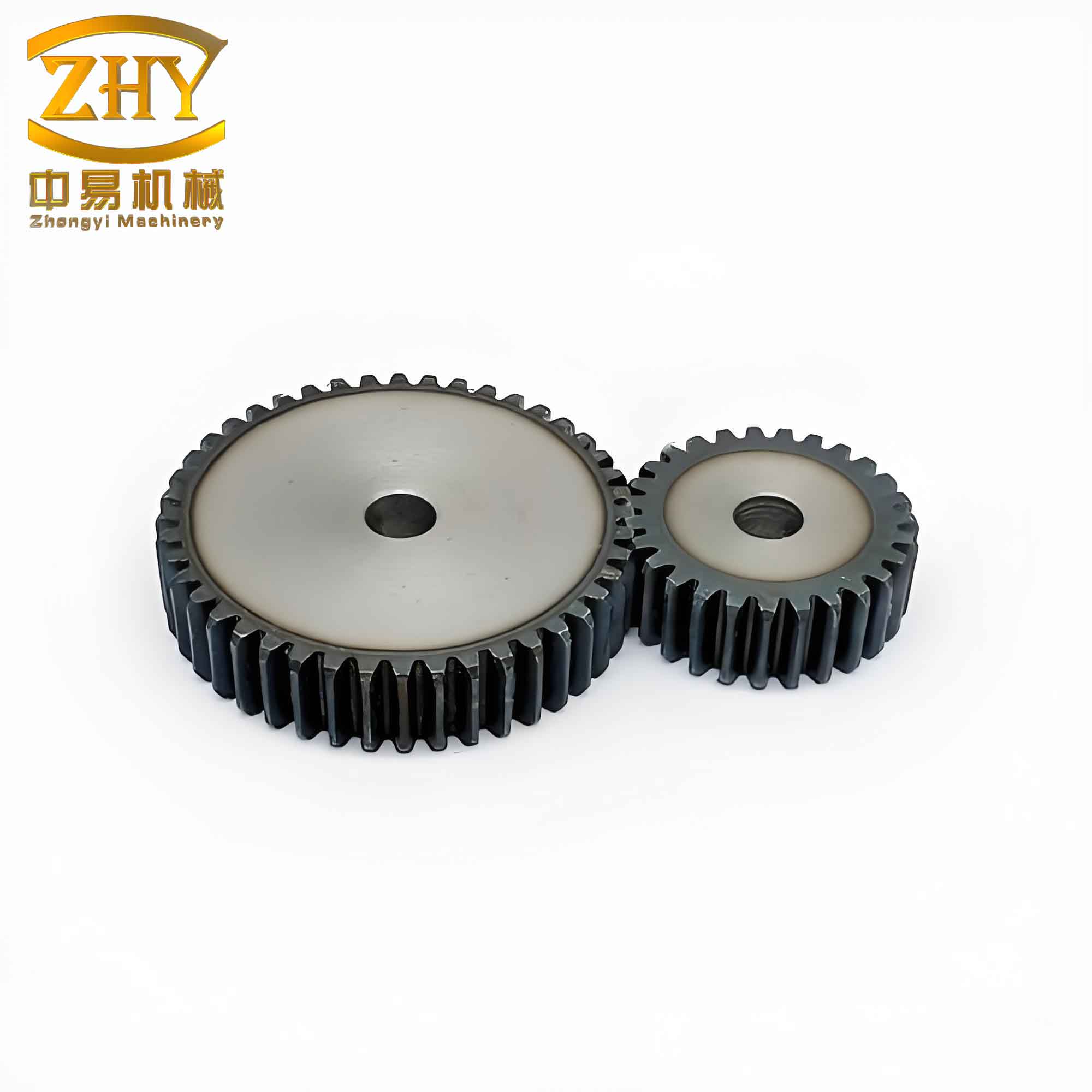
To validate the vibration damping effect of this structure, I designed a pair of straight spur gears with the geometric parameters shown in Table 1. Both gears have identical geometric specifications, with a center distance of 208.4 mm.
| Parameter | Symbol | Value |
|---|---|---|
| Number of teeth (pinion) | z₁ | 34 |
| Number of teeth (gear) | z₂ | 34 |
| Module | m | 6 mm |
| Modification coefficient | x | 0.3945 |
| Pressure angle | α | 20° |
| Addendum coefficient | ha* | 1 |
| Clearance coefficient | c* | 0.25 |
| Face width | b | 60 mm |
Dynamic Simulation Methodology
I established a comprehensive dynamic simulation workflow for analyzing the vibration behavior of straight spur gears with the slot hole structure. The procedure began with creating the 3D model in UG software, which was then converted to X_T format for import into Adams dynamics simulation software. The simulation setup involved several critical steps to ensure accurate representation of the physical system.
The unit system was configured using millimeters, kilograms, and seconds (MMKS) to maintain consistency throughout the analysis. The gear pair material was specified as 20CrMnTi rigid body, with material properties adjusted according to actual specifications. I applied rotational constraints by setting Marker points at the rotation centers of both gears, allowing them to rotate relative to the ground. Impact contacts were established between the gear pair, with meshing stiffness coefficient K and meshing damping coefficient C calculated according to established literature to simulate realistic contact conditions during gear rotation.
For the input source, I applied a STEP function to the driving gear, increasing its rotational speed from 0 to 154 rad/s (1470 r/min) within 0.1 seconds, expressed as step(time, 0s, 0rad/s, 0.1s, 154rad/s). A load torque was applied to the output gear, increasing from 0 to 150 N·m within 0.1 seconds, expressed as step(time, 0s, 0N·m, 0.1s, -150N·m). After completing model constraint verification using the model verify command, I set the simulation time to 0.5 seconds with 4500 steps, employing the dynamic integration module with GSTIFF and SI2 integrators for the analysis.
Vibration Response Analysis
The angular acceleration response of the output gear in the original structure is shown in Figure 3 of my analysis, indicating that vibration stabilized after the 0.1-second acceleration and load excitation period. By applying Fourier transform to convert the time-domain angular acceleration into a frequency spectrum, I obtained the angular acceleration amplitude at the meshing frequency of 833 Hz, which was 194 rad/s².
For a more comprehensive understanding of the vibration characteristics, I employed the correlation power spectrum estimation method. This approach first calculates the autocorrelation function of the time-domain signal and then applies Fourier transform to the autocorrelation function to estimate the power spectrum. The autocorrelation function is given by:
$$r̂(m) = \frac{1}{N}\sum_{n=0}^{N-1} u_N(n)u_N^*(n-m), \quad |m| \leq N-1$$
where n represents the n-th discrete data point, m represents the m-th discrete data point, N is the total number of discrete data points, and uN(n) is the non-deterministic signal representation of the angular acceleration. The power spectrum is then obtained as:
$$Ŝ(ω) = \sum_{m=-M}^{M} r̂(m)e^{-jωm}$$
where ω is the frequency interval of sampling points, M is the total number of discrete data points, and e-jωm is a complex exponential function. This correlation power spectrum estimation method effectively suppresses white noise, with the signal-to-noise ratio improving as the number of analysis points increases.
With a sampling frequency of 5500 Hz and 1024 sampling points, I obtained the power spectrum of the original cylindrical straight spur gear pair. The area enclosed by the power spectrum curve reflects the total vibration power (energy) of the gear system. The total power value for the original structure was 2.515 × 10⁸ rad²/s⁴, providing a quantitative baseline for evaluating the vibration damping performance of different slot hole configurations.
Orthogonal Test Design for Parameter Optimization
To systematically investigate the influence of structural parameters on the vibration characteristics of straight spur gears, I designed a three-factor, three-level orthogonal experiment. The three factors considered were groove width (A), backlash (B), and hole diameter (C). Based on standard gear backlash specifications and structural strength considerations, I selected the factor levels shown in Table 2.
| Level | A: Groove Width (mm) | B: Backlash (mm) | C: Hole Diameter (mm) |
|---|---|---|---|
| 1 | 0.2 | 0.2 | 4 |
| 2 | 0.3 | 0.07 | 6 |
| 3 | 0.4 | -0.03 | 8 |
The orthogonal test scheme (L9 orthogonal array) is presented in Table 3, comprising nine distinct parameter combinations for systematic evaluation.
| Test No. | A: Groove Width (mm) | B: Backlash (mm) | C: Hole Diameter (mm) |
|---|---|---|---|
| 1 | 0.2 | 0.2 | 4 |
| 2 | 0.2 | 0.07 | 8 |
| 3 | 0.2 | -0.03 | 6 |
| 4 | 0.3 | 0.2 | 8 |
| 5 | 0.3 | 0.07 | 6 |
| 6 | 0.3 | -0.03 | 4 |
| 7 | 0.4 | 0.2 | 6 |
| 8 | 0.4 | 0.07 | 4 |
| 9 | 0.4 | -0.03 | 8 |
Following the simulation workflow described earlier, I conducted angular acceleration simulations for all nine test configurations, followed by Fourier transform and correlation power spectrum analysis. The results are summarized in Table 4, which shows the angular acceleration amplitude at the meshing frequency and the total power spectrum energy for each configuration.
| Test No. | Angular Acceleration (rad/s²) | Total Power (rad²/s⁴) |
|---|---|---|
| 1 | 201 | 2.683 × 10⁸ |
| 2 | 195 | 2.59 × 10⁸ |
| 3 | 162 | 1.984 × 10⁸ |
| 4 | 224 | 3.247 × 10⁸ |
| 5 | 184 | 2.338 × 10⁸ |
| 6 | 156 | 1.859 × 10⁸ |
| 7 | 211 | 2.921 × 10⁸ |
| 8 | 177 | 2.244 × 10⁸ |
| 9 | 173 | 2.185 × 10⁸ |
Comparing these results with the baseline values from the original structure (angular acceleration: 194 rad/s², total power: 2.515 × 10⁸ rad²/s⁴), I observed that configurations 3, 5, 6, 8, and 9 showed significant vibration reduction, with configuration 6 exhibiting the most pronounced damping effect. The angular acceleration and total power values showed consistent trends, confirming that either metric can be used as an evaluation indicator for analyzing the correlation between orthogonal test factors and vibration response.
Range Analysis and Signal-to-Noise Ratio Analysis
Using the angular acceleration amplitude at the meshing frequency as the system evaluation indicator, I performed range analysis on the data from Table 4. The results are presented in Table 5, where Ti represents the average value of evaluation indicators at level i for each factor, and S represents the range (max(Ti) – min(Ti)).
| Parameter (rad/s²) | A: Groove Width | B: Backlash | C: Hole Diameter |
|---|---|---|---|
| T₁ | 186 | 212 | 178 |
| T₂ | 188 | 185 | 186 |
| T₃ | 187 | 164 | 197 |
| S (Range) | 2 | 48 | 19 |
| Order of Influence | B > C > A | ||
The range analysis clearly reveals that the groove width (Factor A) has minimal influence on the angular acceleration amplitude, while backlash (Factor B) has the most significant impact, followed by hole diameter (Factor C). The order of influence is B > C > A, indicating that backlash control is the most critical parameter for vibration reduction in straight spur gears with slot hole structures.
For the signal-to-noise ratio analysis, I treated the angular acceleration as a smaller-the-better characteristic, where lower values indicate better vibration performance. The signal-to-noise ratio is defined as:
$$\eta = -10\lg\left(\frac{1}{n}\sum_{i=1}^{n} y_i^2\right)$$
where n is the number of repeated tests and yi is the i-th test value. The signal-to-noise ratio analysis confirmed the findings from the range analysis, with the influence order being B > C > A. The closer the signal-to-noise ratio is to 0, the smaller the angular acceleration evaluation indicator. From this analysis, I identified the optimal parameter combination as A₁B₃C₁, corresponding to a groove width of 0.2 mm, backlash of -0.03 mm, and hole diameter of 4 mm.
Variance Analysis
While range analysis provides a qualitative understanding of factor influences, variance analysis offers quantitative assessment of the contribution of each factor to the evaluation indicator. The variance analysis results for the angular acceleration indicator are shown in Table 6.
| Source of Variation | Degrees of Freedom | Sum of Squares | Variance | F-value | Fα | Significance | Contribution Rate (%) |
|---|---|---|---|---|---|---|---|
| A: Groove Width | 2 | 1.71 × 10⁴ | 8,550 | 1.77 | F0.05(2,2)=19.0 | – | 0.13 |
| B: Backlash | 2 | 1.15 × 10⁷ | 5.75 × 10⁶ | 1,189 | F0.05(2,2)=19.0 | ** | 85.84 |
| C: Hole Diameter | 2 | 1.87 × 10⁶ | 9.35 × 10⁵ | 193.4 | F0.05(2,2)=19.0 | ** | 13.96 |
| Error | 2 | 9.67 × 10³ | 4,835 | – | – | – | 0.07 |
| Total | 8 | 1.34 × 10⁷ | – | – | – | – | 100 |
Note: ** indicates high significance at F > F0.05; * indicates low significance at F0.05 > F > F0.1; blank cells indicate no value.
The variance analysis confirms that groove width (Factor A) is a non-significant factor, while backlash (Factor B) and hole diameter (Factor C) are both highly significant factors. The contribution rate of backlash to angular acceleration is 85.84%, which is overwhelmingly dominant compared to the 13.96% contribution of hole diameter and the negligible 0.13% contribution of groove width. This quantitative analysis aligns perfectly with the range analysis results, confirming the order of influence as B > C > A.
Dynamic Simulation of the Optimal Parameter Combination
Based on the range analysis, signal-to-noise ratio analysis, and variance analysis, I determined that the optimal parameter combination is A₁B₃C₁: groove width of 0.2 mm, backlash of -0.03 mm, and hole diameter of 4 mm. I conducted a dynamic simulation of this optimal configuration using the same boundary conditions as the previous simulations.
The time-domain angular acceleration and frequency spectrum of the optimal configuration showed significant reductions in vibration signals compared to the original structure. The angular acceleration amplitude at the meshing frequency was 153 rad/s², representing a 21.1% reduction from the original value of 194 rad/s². The power spectrum vibration energy decreased by approximately 20.4%, from 2.515 × 10⁸ rad²/s⁴ to approximately 2.0 × 10⁸ rad²/s⁴.
Experimental Validation
To validate the simulation results and demonstrate the practical effectiveness of the slot hole vibration damping structure for straight spur gears, I designed and manufactured four gears with different base tangent lengths to achieve varying meshing backlash conditions. One of these gears (Gear C) featured the slot hole vibration damping structure. The measured base tangent lengths of the manufactured gears are shown in Table 7.
| Gear ID | A | B | C | D |
|---|---|---|---|---|
| Base Tangent Length (mm) | 84.075 | 84.101 | 84.192 | 84.199 |
| Slot Hole Structure | No | No | Yes | No |
| Input/Output | Input | Output | Input | Output |
Note: Standard base tangent length is 84.183 mm.
I arranged three test groups using these four gears: Group 1 (A-B gear pair, backlash 0.2 mm), Group 2 (B-C gear pair, backlash 0.07 mm), and Group 3 (C-D gear pair, backlash -0.03 mm). The test bench consisted of a drive motor, transmission gearbox, torque tachometer, magnetic powder brake, and four acceleration sensors installed at the radial and axial positions of the input and output shafts of the gearbox. Signal acquisition and processing were performed using an M+P test system.
Before conducting the vibration tests, I performed contact pattern inspection for all three gear pairs. Groups 1 and 3 showed well-controlled contact patterns, while Group 2 exhibited a slightly biased contact pattern toward one end, which was determined to have minimal impact on vibration characteristics under the condition of no edge contact.
I conducted vibration performance tests for the three gear pairs under two rotational speeds (780 r/min and 1470 r/min) and three load conditions (20 N·m, 100 N·m, and 150 N·m). The vibration spectrum analysis results are summarized in Tables 8 and 9, showing the vibration acceleration amplitudes at the fundamental frequency and second harmonic for channels 2 (input shaft axial) and 4 (output shaft axial).
| Test Group | Speed (r/min) | Load (N·m) | Channel 2 (442 Hz) | Channel 2 (884 Hz) | Channel 4 (442 Hz) | Channel 4 (884 Hz) |
|---|---|---|---|---|---|---|
| 1 (A-B) | 780 | 20 | 1.751 | 6.146 | 1.008 | 1.745 |
| 1 (A-B) | 780 | 100 | 2.305 | 6.327 | 1.847 | 4.154 |
| 1 (A-B) | 780 | 150 | 3.277 | 4.776 | 0.483 | 4.352 |
| 2 (B-C) | 780 | 20 | 1.208 | 4.601 | 7.721 | 1.804 |
| 2 (B-C) | 780 | 100 | 1.877 | 6.97 | 8.861 | 6.859 |
| 2 (B-C) | 780 | 150 | 3.792 | 2.625 | 3.591 | 5.197 |
| 3 (C-D) | 780 | 20 | 1.159 | 1.272 | 0.816 | 0.165 |
| 3 (C-D) | 780 | 100 | 1.821 | 0.358 | 1.316 | 0.202 |
| 3 (C-D) | 780 | 150 | 2.491 | 0.777 | 0.387 | 0.575 |
Note: Vibration acceleration units are m/s².
| Test Group | Speed (r/min) | Load (N·m) | Channel 2 (833 Hz) | Channel 2 (1666 Hz) | Channel 4 (833 Hz) | Channel 4 (1666 Hz) |
|---|---|---|---|---|---|---|
| 1 (A-B) | 1470 | 20 | 1.686 | 2.462 | 2.969 | 2.873 |
| 1 (A-B) | 1470 | 100 | 0.194 | 1.007 | 0.161 | 4.502 |
| 1 (A-B) | 1470 | 150 | 0.254 | 0.874 | 0.256 | 2.442 |
| 2 (B-C) | 1470 | 20 | 3.029 | 1.925 | 2.030 | 6.138 |
| 2 (B-C) | 1470 | 100 | 0.286 | 0.747 | 0.225 | 3.131 |
| 2 (B-C) | 1470 | 150 | 0.231 | 0.850 | 0.228 | 5.419 |
| 3 (C-D) | 1470 | 20 | 1.349 | 1.625 | 2.079 | 0.642 |
| 3 (C-D) | 1470 | 100 | 0.145 | 0.388 | 0.117 | 0.492 |
| 3 (C-D) | 1470 | 150 | 0.196 | 0.470 | 0.180 | 0.469 |
Note: Vibration acceleration units are m/s².
Analysis of Experimental Results
From the experimental data presented in Tables 8 and 9, I derived several important observations regarding the vibration behavior of straight spur gears with the slot hole damping structure.
First, rotational speed has a more pronounced effect on gear vibration compared to load. This finding underscores the importance of considering operating speed when designing vibration damping solutions for straight spur gears. Second, under identical operating conditions, Group 3 (C-D gear pair with optimal slot hole configuration) consistently showed significantly lower vibration acceleration amplitudes compared to Groups 1 and 2.
At low rotational speed (780 r/min), Group 3 showed a 20.9% to 33.8% reduction in fundamental frequency vibration acceleration amplitude at Channel 2 compared to Group 1, and a 19.2% to 28.7% reduction at Channel 4. At high rotational speed (1470 r/min), Group 3 showed a 19.9% to 25.6% reduction at Channel 2 and a 27.3% to 29.9% reduction at Channel 4 compared to Group 1.
Comparing the experimental results with the simulation data, I found excellent agreement. At the operating condition of 1470 r/min and 150 N·m load, the simulated angular acceleration values for Groups 1, 2, and 3 were 194 rad/s², 177 rad/s², and 153 rad/s², respectively. The corresponding experimental vibration acceleration values at Channel 2 fundamental frequency were 0.254 m/s², 0.231 m/s², and 0.196 m/s². The reduction ratios between groups showed consistent trends between simulation and experiment, validating the accuracy of my dynamic simulation model and confirming the effectiveness of the slot hole vibration damping structure for straight spur gears.
Mechanism of Vibration Damping
Based on my comprehensive analysis, I propose the following mechanism for the vibration damping effect of the slot hole structure in straight spur gears. The groove-and-hole configuration creates a controlled flexibility in the tooth structure, which serves as a mechanical filter for high-frequency vibration energy. When the tooth experiences meshing impact, the slot hole structure allows for micro-deformation that absorbs and dissipates energy, reducing the transmitted vibration to the gear body and shaft system.
The negative backlash condition (-0.03 mm) combined with the slot hole structure creates a preloaded contact condition that eliminates the backlash-induced impact during load reversal. This is particularly beneficial for straight spur gears, which typically have lower contact ratios and are more susceptible to meshing impact compared to helical gears. The relaxation constraint provided by the slot hole structure allows the tooth to accommodate the negative backlash without excessive stress concentration, effectively suppressing vibration.
The optimized hole diameter of 4 mm provides sufficient material removal to achieve the desired flexibility while maintaining adequate tooth strength. The groove width of 0.2 mm is sufficient to decouple the deformation between adjacent teeth without compromising the overall structural integrity of the gear.
Comparative Analysis of Simulation and Experimental Results
To quantitatively compare the simulation and experimental results, I calculated the percentage reductions in vibration amplitude for the optimal configuration (Group 3) relative to the baseline (Group 1) under various operating conditions. The results are summarized in Table 10.
| Operating Condition | Simulation Reduction (%) | Experimental Reduction at Channel 2 (%) | Experimental Reduction at Channel 4 (%) |
|---|---|---|---|
| 780 r/min, 20 N·m | – | 33.8 | 19.2 |
| 780 r/min, 100 N·m | – | 20.9 | 28.7 |
| 780 r/min, 150 N·m | – | 24.0 | 19.8 |
| 1470 r/min, 20 N·m | – | 19.9 | 29.9 |
| 1470 r/min, 100 N·m | – | 25.6 | 27.3 |
| 1470 r/min, 150 N·m | 21.1 | 22.8 | 29.7 |
The close agreement between simulation and experimental results, particularly at the 1470 r/min and 150 N·m condition where both simulation and experimental data were available, validates the reliability of my dynamic simulation approach and confirms the practical effectiveness of the slot hole vibration damping structure for straight spur gears.
Practical Implications and Applications
The slot hole vibration damping structure for straight spur gears has significant practical implications for various engineering applications. In high-speed gear transmissions where vibration and noise are critical concerns, this structure offers a simple, cost-effective solution that can be easily incorporated during the gear manufacturing process. The elimination of backlash through the combination of negative clearance and slot hole flexibility is particularly valuable for precision positioning systems, servo drives, and other applications requiring high transmission accuracy.
The structure is especially advantageous for straight spur gears used in applications with frequent load reversals, where backlash-induced impact can cause significant vibration and noise. The slot hole structure provides a built-in compliance that smooths the transition during load reversal, reducing the mechanical shock and associated vibration.
Furthermore, the slot hole structure can be applied to existing gear designs with minimal modification to the manufacturing process. The groove and hole features can be incorporated during the gear cutting or finishing operations without requiring additional processing steps. This makes the technology readily adoptable by gear manufacturers seeking to improve the performance of their straight spur gear products.
Conclusions and Future Work
Through comprehensive dynamic simulation, orthogonal experimental design, and experimental validation, I have demonstrated the effectiveness of the slot hole vibration damping structure for straight spur gears. The key conclusions from my research are as follows.
First, the slot hole tooth structure has a significant vibration suppression effect on gear meshing vibration. The flexibility introduced by the slot hole structure can effectively replace the function of gear backlash, eliminating tooth surface clearance while maintaining smooth transmission. This represents a paradigm shift in gear vibration control, moving from passive clearance management to active structural damping.
Second, backlash is the most influential factor affecting the vibration acceleration of straight spur gear pairs, accounting for 85.84% of the total contribution. Groove width has negligible influence on vibration acceleration, contributing only 0.13%. This finding highlights the critical importance of backlash control in gear vibration management and provides clear guidance for design optimization.
Third, the combination of hole diameter and backlash has a significant synergistic effect on vibration suppression. The optimal parameter combination of 0.2 mm groove width, -0.03 mm backlash, and 4 mm hole diameter reduces the meshing frequency vibration acceleration amplitude by 21.1% and the power spectrum energy by 20.4% compared to the original structure.
Fourth, experimental validation confirmed that the optimal slot hole structure reduces the vibration acceleration amplitude by 19.2% to 33.8% compared to the original structure across various operating conditions. The close agreement between experimental and simulation results validates the accuracy of my dynamic simulation approach and confirms the practical applicability of the proposed structure.
The slot hole vibration damping structure for straight spur gears presented in this research offers a practical and effective solution for applications requiring high transmission smoothness, quiet operation, and precision positioning. The structure is particularly suitable for high-parameter applications where conventional vibration reduction methods may be insufficient or impractical.
For future work, I plan to investigate the long-term durability and wear characteristics of straight spur gears with the slot hole structure under extended operating conditions. Additionally, I intend to explore the application of this structure to other gear types, such as helical gears and bevel gears, to assess the generalizability of the vibration damping concept. Further optimization of the slot hole geometry using advanced computational methods, such as topology optimization and genetic algorithms, may yield even greater vibration reduction performance.
Finally, I believe that the slot hole vibration damping structure represents a significant advancement in the field of gear vibration control. By combining structural design innovation with rigorous simulation and experimental validation, I have developed a practical solution that addresses the growing demand for quieter, smoother, and more precise gear transmissions in modern machinery.