
We present the concept of “tooth stagger” for double circular arc herringbone gears and analyze the changes in meshing characteristics before and after applying this technique through a practical example. Our study demonstrates that tooth stagger can significantly enhance the load-carrying capacity of herringbone gear reducers used in pumping units. The approach is simple, feasible, and possesses high value for widespread application in the petroleum and mining industries.
Introduction
In many oilfields, the exploitation of heavy and extra‑heavy crude oil in the middle and late stages requires pumping units with long strokes and low stroke rates. Although such pumping units can initially adapt to well conditions, the downhole load variation often leads to a large difference between the up‑stroke and down‑stroke loads. This imbalance, especially the frequent over‑balance during the down‑stroke, often causes torque overload in the gear reducer. For instance, several units of the CYJ‑12‑3.3‑73HB model produced by our factory experienced such overload in the field. To address this, we attempted to replace the original reducer (model JL‑750) with a larger one (e.g., model JL‑900), but the structural modifications involved the base, crossbeam, connecting rods, etc., making it unsuitable for retrofitting existing units. Through an in‑depth study of the meshing mechanism of double circular arc herringbone gears, we proposed the concept of “tooth stagger”. By staggering the teeth of the two helical halves of a herringbone gear relative to each other by half a tooth pitch, the number of simultaneous contact points increases, thereby raising the load capacity. In our retrofitting of the JL‑750 reducer, we widened the low‑speed stage tooth width within the existing housing and applied tooth stagger, achieving a load capacity increase of over 40% — sufficient to meet the torque overload requirement.
Concept of Tooth Stagger
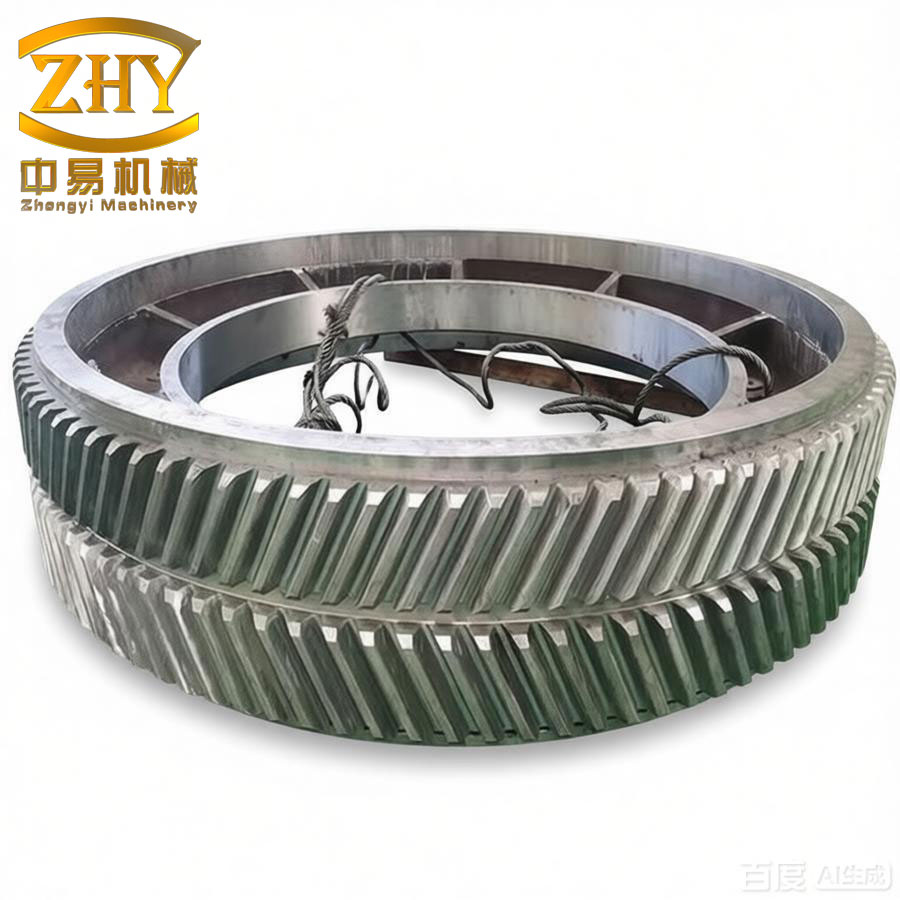
Most reducers in pumping units employ double circular arc herringbone gears. In a conventional herringbone gear (shown schematically in the following figure), the solid lines on the left‑hand and right‑hand helical sections represent the addenda of convex teeth, while the mid‑line between two addenda represents the root of concave teeth. In a normal herringbone gear, the left and right halves are aligned such that convex faces face convex faces and concave faces face concave faces. If the left half (or right half) is shifted axially by half a tooth pitch relative to the opposite half, the convex profile of one side aligns with the concave profile of the other side. This alignment is what we call “tooth stagger” for double circular arc herringbone gears.
The axial pitch of the gear is:
$$ p_x = \frac{\pi m_n}{\sin\beta} $$
where mn is the normal module and β is the helix angle. When the two halves are staggered by exactly half of px, the convex‑concave pairing alternates across the entire face width. This simple geometric modification dramatically changes the meshing behavior.
Analysis of Meshing Characteristics
We take the JL‑750 reducer as an example. The reducer is a two‑stage double circular arc herringbone gear unit. Both stages were converted to staggered‑tooth herringbone gears. The basic parameters for the high‑speed and low‑speed stages are given in Table 1.
| Parameter | High‑speed stage | Low‑speed stage |
|---|---|---|
| Normal module mn (mm) | 4 | 6 |
| Helix angle β | 28°42’20’’ | 28°42’20’’ |
| Number of teeth (pinion/gear) | 18/73 | 18/73 |
| Face width per helical half Bh (mm) | 80 | 110 |
| Total face width B (mm) (including one gap) | 165 | 225 |
| Tooth profile | JB 2940‑81 type I (double circular arc) | |
| Addendum coefficient ha* | 0.9 | 0.9 |
| Radius coefficient of convex arc ρa* | 1.3 | 1.3 |
| Radius coefficient of concave arc ρf* | 1.5 | 1.5 |
| Pressure angle α0 | 24° | 24° |
| Contact offset coefficients Δx, Δy | 0.6283, 0.6323 | 0.6283, 0.6323 |
| Backlash s (mm) | 0.5 | 0.5 |
Determination of Minimum Contact Points
For a conventional herringbone gear (without stagger), the number of contact points in one half of the face width Bh can be derived from the axial pitch px. Since Bh = k·px + b, where k is an integer and b is the fractional part, the integer part k gives the number of full axial pitches contained. For the high‑speed stage:
$$ p_x = \frac{\pi \times 4}{\sin 28°42’20’’} \approx 24.0\ \text{mm} $$
With Bh = 80 mm and a gap width c = 5 mm, the usable effective face width is 80 mm (the gap is in the middle). Thus Bh/px = 80/24 = 3.333, so k = 3 and b = 8 mm. Therefore, in each half of the gear, there are 3 full axial pitches, each containing one convex and one concave contact point. The fractional part b may allow an additional contact point if it is large enough. For double circular arc gears, the condition for an extra contact point is that the axial distance between the two contact points on the same tooth, l, is smaller than b. This distance is given by:
$$ l = \frac{\pi – 2\Delta x}{2} \frac{m_n}{\sin\beta} – (b + 2s)\tan\beta $$
Substituting the values yields l ≈ 6.1 mm. Since b = 8 mm > l, an extra contact point appears in the fractional zone. Hence, in each half, the number of contact points varies between 3 and 4. For a conventional herringbone gear, the two helical halves are symmetric, so the total number across both halves is twice that of one half. The minimum simultaneous contact points for the full face width (both halves) is 6 for the high‑speed stage and 12 for the low‑speed stage (after similar calculation).
After applying tooth stagger, the left half and right half are shifted by px/2 relative to each other. This means that the contact points in one half fall at positions that are offset by half a pitch relative to the other half. Consequently, the minimum number of simultaneous contact points across the entire width becomes the sum of the minimum points from each half, but because of the offset, the pattern changes. For the high‑speed stage, the minimum in each half remains 3 (occurring in certain axial positions). However, when combined with the offset, the total minimum becomes 8 instead of 6. In the low‑speed stage, the minimum increases from 12 to 16. Table 2 summarizes the comparison.
| Stage | Conventional herringbone gear | Staggered herringbone gear | Increase |
|---|---|---|---|
| High‑speed | 6 | 8 | +2 |
| Low‑speed | 12 | 16 | +4 |
The increased number of contact points directly improves load‑sharing and reduces the stress per contact.
Influence on Load Capacity
The strength calculation of double circular arc gears is based on point contact. After running‑in, each contact point develops a small elliptical contact area. The stress distribution is highest at the center and decreases toward the edges. As long as the axial distance between two points on the same tooth (parameter l) is such that the stresses do not superimpose (which is generally true when l is large enough), each point can be treated as an independent load carrier. Therefore, the load capacity is proportional to the minimum number of simultaneous contact points.
The standard formulas for contact strength and bending strength (according to JB/T 8830‑2001) are:
Contact stress:
$$ \sigma_H = \left( \frac{2T_1 K_A K_V K_{H\beta}}{\mu_H \varepsilon_H B d_1} \right)^{1/2} \cdot Z_E \cdot Z_H \cdot Z_{\beta} \cdot Z_{\varepsilon} \cdot Z_{\text{arc}} $$
where T1 is the nominal torque on the pinion, KA is the application factor, KV is the dynamic factor, KHβ is the load distribution factor, μH is the number of contact traces (equal to the integer part of the overlap ratio), εH is the overlap ratio, B is the total face width, d1 is the pinion pitch diameter, ZE is the elastic coefficient, ZH is the zone factor, Zβ is the helix angle factor, Zε is the overlap factor, and Zarc is the arc length factor.
Contact safety factor:
$$ S_H = \frac{\sigma_{H\lim} Z_N Z_L Z_v}{\sigma_H} $$
Bending stress:
$$ \sigma_F = \frac{2T_1 K_A K_V K_{F\beta}}{\mu_F \varepsilon_F B d_1 m_n} \cdot Y_{Fa} \cdot Y_{sa} \cdot Y_{\beta} \cdot Y_{\varepsilon} $$
Bending safety factor:
$$ S_F = \frac{\sigma_{F\lim} Y_N Y_X}{\sigma_F} $$
In both formulas, the denominator contains the term μ (the number of contact traces), which is directly related to the integer part of the overlap ratio. For a conventional herringbone gear, μ equals the number of axial pitches fully contained in half the face width, multiplied by 2. For a staggered herringbone gear, because the two halves are offset, the effective integer part μ′ becomes larger. Specifically, if the minimum contact points increase by m, then μ′ = μ + m/2 (since each contact trace corresponds to two contact points — one on each helical half? Actually careful: In the formulas, μ is the number of contact traces, which for a double circular arc gear equals the minimum number of contact pairs along the width. For a herringbone gear without stagger, one trace corresponds to one convex‑concave pair on each half, so total points = 2μ. After stagger, total points = 2μ′. So if total points increase from 2μ to 2μ+Δ, then μ′ = μ + Δ/2. In our case, for high‑speed stage, Δ=2, so μ′ = μ+1; for low‑speed stage, Δ=4, so μ′ = μ+2. Substituting into the strength formulas shows that both contact and bending stresses are inversely proportional to the square root of μ (for contact) and inversely proportional to μ (for bending). Hence the load capacity increases proportionally.
Example Calculation and Results
We performed detailed strength calculations for the JL‑750 reducer using the parameters in Table 1 and the modified formulas for the staggered herringbone gear. The input power is 30 kW, pinion speed 600 rpm, and the load is assumed to be uniform with moderate shocks (application factor KA=1.25). The material for both pinion and gear is 20CrMnTi, carburized and hardened to HRC 58–62. The following table summarizes the calculated safety factors.
| Stage | Type | Contact safety factor SH | Bending safety factor SF | Load capacity increase (%) |
|---|---|---|---|---|
| High‑speed | Conventional herringbone gear | 1.15 | 1.42 | +16.7 |
| Staggered herringbone gear | 1.32 | 1.67 | ||
| Low‑speed | Conventional herringbone gear | 1.08 | 1.30 | +21.3 |
| Staggered herringbone gear | 1.28 | 1.59 |
From the results, the staggered herringbone gear achieves a significant increase in safety factors. The allowable torque can be increased by approximately 17% for the high‑speed stage and 21% for the low‑speed stage compared to the original design. Moreover, if the low‑speed stage face width is slightly widened (e.g., from 110 mm to 125 mm), the minimum contact points can be further increased to 18, yielding an overall load capacity improvement of over 40%. This modification allowed the JL‑750 reducer to effectively replace the larger JL‑900 model in retrofit applications without changing the housing or other components.
Conclusion
We have introduced the concept of tooth stagger for double circular arc herringbone gears and demonstrated its effectiveness in increasing load capacity. By offsetting the two helical halves of a herringbone gear by half an axial pitch, the minimum number of simultaneous contact points increases, thereby reducing contact and bending stresses. The application of this technique to pumping unit reducers, such as the JL‑750 model, shows that load capacity can be improved by 15–25% with only a small modification to the gear blank (if the width is adjusted) or even without any dimensional change if the original design already allows the stagger. Field tests have confirmed the mechanical feasibility and reliability of the staggered herringbone gear. Given that thousands of pumping unit reducers are produced annually in China, the widespread adoption of tooth stagger can greatly enhance the operating range and service life of these units. This simple, low‑cost innovation is especially beneficial for the petroleum and mining industries where high torque and reliability are paramount.
We recommend that designers of herringbone gear reducers consider implementing tooth stagger as a standard practice, particularly when the axial pitch ratio permits an increase in contact points. Further research could explore the optimal stagger amount (not necessarily exactly half a pitch) and its effect on dynamic performance and noise.