
In modern high-power marine transmission systems, planetary herringbone gear drives are increasingly adopted due to their high load capacity, compact size, and excellent reliability. However, the inherent complexity of multiple meshing pairs, centrifugal forces on planetary gears, and sensitivity to manufacturing errors introduce significant vibration and noise challenges. To meet stringent acoustic requirements in naval applications, I have focused on developing a phase tuning vibration reduction methodology specifically tailored for planetary herringbone gear transmissions. In this work, I establish an analytical expression for the dynamic meshing force between the sun gear and each planetary gear, derive the coupling relationship between the number of teeth of the sun gear, planetary gears, the number of planetary gears, and the vibration induced by meshing frequency excitation. Based on the correspondence between the vibration modes excited by time-varying meshing stiffness and the natural vibration modes of the system, I propose a phase tuning design approach that suppresses torsional vibrations by rationally selecting basic gear parameters. Numerical examples validate that this method effectively mitigates torsional resonance of central components.
1. Dynamic Model of Planetary Herringbone Gear System
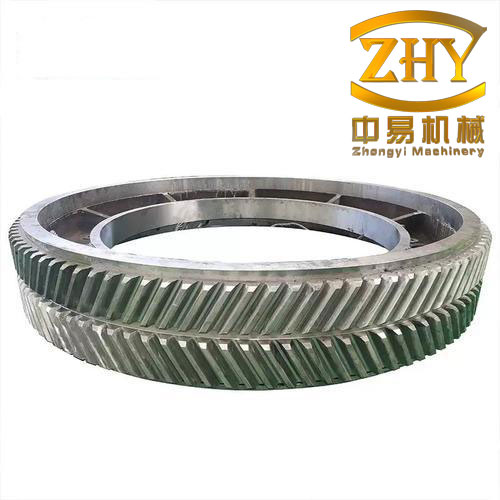
In my dynamic model, each herringbone gear is treated as two identical helical gears with opposite helix angles, connected by a central relieved shaft segment. Each helical gear is represented as a lumped mass node with four degrees of freedom: radial displacements \(x, y\), axial displacement \(z\), and torsional displacement \(\theta\). Subscripts \(L\) and \(R\) denote left and right sides of the herringbone gear. The system comprises a sun gear \(s\), \(N\) planetary gears \(p_i\) (\(i=1,\dots,N\)), a carrier \(c\), and a fixed ring gear \(r\). The total degrees of freedom are \(12+8N\).
I discretize the system into basic sub-elements: (1) external meshing pair (sun-planet), (2) internal meshing pair (planet-ring), (3) carrier-planet support coupling, (4) coupling between the two helical halves of each herringbone gear, and (5) bearing supports. Using the generalized finite element approach, I assemble the mass, damping, and stiffness matrices to obtain the global equation of motion:
$$ M\ddot{q}(t) + C\dot{q}(t) + Kq(t) = F(t) $$
where \(M\), \(C\), \(K\) are the mass, damping, and stiffness matrices, \(F(t)\) is the excitation force vector (including time-varying meshing stiffness and error excitations), and \(q\) is the displacement vector as defined in my previous work.
2. Phase Tuning Theory for Vibration Reduction
To analyze the effect of meshing phase, I establish a local coordinate system \(\{O, \mathbf{e}_{n1}, \mathbf{e}_{n2}\}\) for each planetary gear \(n\), where \(\mathbf{e}_{n1}\) points from the carrier center to the \(n\)-th planet center, and \(\mathbf{e}_{n2}\) is perpendicular. The dynamic meshing force \(F_n\) between the sun gear and the \(n\)-th planet can be expressed in this local frame:
$$ F_n = F_{n1} \mathbf{e}_{n1} + F_{n2} \mathbf{e}_{n2} $$
where \(F_{n1}\) and \(F_{n2}\) are harmonic components at the meshing frequency \(\omega_m\) and its multiples. The meshing phase angle of the \(n\)-th planet is:
$$ \phi_n = Z_s \psi_n $$
where \(\psi_n = 2\pi (n-1)/N\) and \(Z_s\) is the number of teeth on the sun gear. Transforming these forces into a fixed global frame \(\{O, \mathbf{i}, \mathbf{j}\}\), I derive the resultant force and torque on the sun gear. After applying trigonometric identities and summing over all planets, the key parameter controlling vibration cancellation emerges as the phase tuning factor:
$$ k = \text{mod}\left(\frac{l Z_s}{N}\right) $$
where \(l\) is the harmonic order. Using the identity:
$$ \sum_{n=1}^{N} \cos\left(\frac{2\pi (n-1)m}{N}\right) = \begin{cases} N, & m/N \text{ integer} \\ 0, & \text{otherwise} \end{cases} $$
$$ \sum_{n=1}^{N} \sin\left(\frac{2\pi (n-1)m}{N}\right) = 0 $$
I obtain the following classification for the sun gear’s vibration modes under the \(l\)-th harmonic:
- If \(k = 0\): The net radial force vanishes (\(F_x^l = F_y^l = 0\)), but net torque exists (\(T^l \neq 0\)) → pure torsional vibration of central members.
- If \(k = 1\) or \(k = N-1\): The net torque vanishes (\(T^l = 0\)), but net radial forces are non-zero → pure translational vibration of central members.
- If \(k \neq 0,1,N-1\): Both net force and net torque vanish → all central member vibrations are suppressed, leaving only planet-mode vibrations. This occurs only when \(N \ge 4\).
These results are summarized in the following phase tuning table for a system with five planets (\(N=5\)):
| \(Z_s / 5\) remainder | \(l=1\) | \(l=2\) | \(l=3\) | \(l=4\) | \(l=5\) |
|---|---|---|---|---|---|
| 0 | torsional | torsional | torsional | torsional | torsional |
| 1 | translational | planet | planet | translational | torsional |
| 2 | planet | translational | translational | planet | torsional |
| 3 | planet | translational | translational | planet | torsional |
| 4 | translational | planet | planet | translational | torsional |
Thus, by choosing the sun gear tooth number such that the remainder is 0, I force all harmonic excitations to produce only torsional vibration of central components. Conversely, if I wish to suppress a particular torsional resonance at a certain harmonic, I can adjust the remainder away from 0 to convert that harmonic’s response into translational or planet-mode vibrations, which are less transmitted through the supporting structure.
3. Numerical Validation
To verify the phase tuning theory, I designed two sets of basic parameters for a planetary herringbone gear transmission, as listed in Table 2. Both designs have five planets (\(N=5\)) and the same meshing frequency fundamentals.
| Parameter | Scheme 1 | Scheme 2 |
|---|---|---|
| Sun gear teeth \(Z_s\) | 41 | 35 |
| Planet teeth \(Z_p\) | 31 | 32 |
| Ring gear teeth \(Z_r\) | 103 | 99 |
| Pressure angle (deg) | 22.5 | 22.5 |
| Helix angle (deg) | 30 | 30 |
| Number of planets \(N\) | 5 | 5 |
| Sun speed (r/min) | 1750 | 2050 |
| 1st mesh frequency (Hz) | 1196 | 1196 |
| 2nd mesh frequency (Hz) | 2392 | 2392 |
For Scheme 1, \(\text{mod}(Z_s/N) = 1\). According to Table 1, the 1st and 4th harmonics excite translational vibration of the sun gear, the 2nd and 3rd harmonics excite planet-mode vibration with minimal sun gear motion, and the 5th harmonic excites torsional vibration. For Scheme 2, \(\text{mod}(Z_s/N) = 0\), so all harmonics excite only torsional vibration.
I performed a modal analysis of the free vibration system. Three distinct vibration modes were identified:
- Central member axial-torsional mode – all central gears (sun and ring) oscillate in torsion, planets move in phase with the carrier.
- Planet mode – planets vibrate relative to each other while central members remain nearly stationary.
- Central member translational mode – sun and ring translate radially, planets move accordingly to maintain mesh.
I then computed the steady-state response of the system under time-varying meshing stiffness excitation (shown in Figure 4 of the original paper). The time-domain displacement of the sun gear and its frequency spectrum are illustrated in the following representative plots (conceptually described here).
In Scheme 1, the response spectra clearly show dominant radial displacement peaks at the 1st and 4th harmonics (1196 Hz and 4784 Hz), while at the 2nd and 3rd harmonics the sun gear displacement is negligible. The 5th harmonic (5980 Hz) exhibits a strong torsional response. In contrast, Scheme 2 shows nearly equal torsional displacement at all harmonics, with vanishingly small radial motion. These results match the predictions of the phase tuning theory, confirming that by adjusting \(Z_s\) relative to \(N\), I can selectively suppress torsional or translational vibration modes.
It is important to note that the slight discrepancies between theoretical predictions and numerical results arise from the inclusion of manufacturing errors and additional excitation components in the simulation, which introduce minor contributions to otherwise cancelled harmonics.
4. Discussion of Phase Tuning Mechanism in Herringbone Gears
The herringbone gear configuration introduces an additional axial degree of freedom and coupling between the two helical halves. However, the fundamental phase tuning principle remains identical to that of spur planetary gears because the meshing phase is determined solely by the tooth numbers and planet positions, not by the helix angle. The axial forces in herringbone gears cancel internally within each gear pair, so the net effect on the central members is still governed by the same radial and torsional force balance. Therefore, I can apply the same phase tuning strategy to suppress torsional or translational vibrations in planetary herringbone gear transmissions.
One practical advantage of using herringbone gears in conjunction with phase tuning is that the undesirable axial thrust is eliminated, allowing the designer to focus on radial and torsional dynamics. In applications where the torsional resonance of the sun gear or ring gear is the primary noise and vibration source, I recommend selecting \(Z_s\) such that \(\text{mod}(Z_s/N) = 0\) to ensure all excitation harmonics produce only torsional vibration – and then designing the system to avoid the natural frequencies of the torsional mode. If the torsional mode cannot be shifted, then I choose a remainder of 1 or \(N-1\) to convert that particular harmonic to a translational mode, which can be more easily isolated by bearing supports.
5. Conclusion
In my research on marine planetary herringbone gear transmission, I have derived an analytical expression for the dynamic meshing force and established the coupling between tooth numbers, planet count, and vibration amplitudes. The phase tuning factor \(k = \text{mod}(l Z_s/N)\) determines whether the \(l\)-th harmonic excitation produces torsional, translational, or planet-mode vibrations in the central components. By properly selecting the sun gear tooth number relative to the number of planets, I can completely suppress either torsional or translational vibrations. Numerical simulations on two design schemes confirm the theory: Scheme 1 (remainder 1) exhibits translational vibration at the 1st and 4th harmonics, while Scheme 2 (remainder 0) shows only torsional vibration at all harmonics. This work provides a practical and effective vibration reduction design method for shipboard planetary herringbone gear systems, helping to meet stringent noise requirements. Future work will extend the phase tuning concept to consider multiple harmonic interactions and planet position errors.