
In this study, I present a comprehensive analysis of the lubrication and friction characteristics of a modified herringbone gear based on thermal elastohydrodynamic lubrication (TEHL) theory. The herringbone gear, widely used in advanced geared turbofan (GTF) engines due to its high load-carrying capacity, excellent transmission stability, and negligible axial force, requires a thorough understanding of its lubrication performance to prevent scuffing and wear. I focus on a crowned (barrel-shaped) modification applied to the tooth surface, which effectively reduces misalignment-induced transmission errors and vibration. The analysis progresses from contact mechanics to TEHL numerical simulation and friction coefficient prediction, revealing the time-varying behavior of oil film parameters along the meshing line. The results highlight the significant influence of operating conditions and modification amount on film pressure, thickness, temperature rise, and friction, providing useful guidance for the design of reliable herringbone gear transmissions.
The herringbone gear under investigation has the following basic geometric parameters: number of teeth on the driving gear Z1 = 44, on the driven gear Z2 = 41, normal module mn = 3.5 mm, normal pressure angle αn = 22.5°, face width B = 60 mm, and helix angle β = 28.019°. The nominal operating condition is an input torque M1 = 80 N·m and driving gear speed n1 = 300 r/min. A crowned modification with a modification amount of 20 μm is applied to each tooth flank.
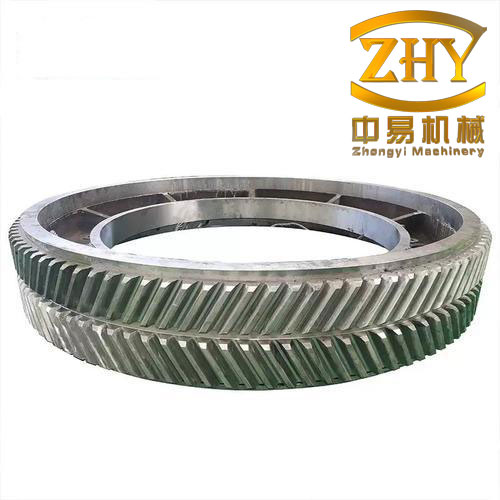
Tooth Surface Contact Analysis of the Herringbone Gear
The contact analysis of the herringbone gear begins with the determination of time-varying contact lines. Due to the unique structure of the herringbone gear, I analyze one side (equivalent to a helical gear) and then extrapolate to the full gear. The instantaneous contact line length li for a single tooth pair varies as it moves through the engagement zone. The calculation depends on the relationship between the transverse contact ratio εα and the axial contact ratio εβ. For the herringbone gear studied here, εα < εβ, so the evolution of li follows the second case:
$$l_i = \begin{cases}
s_i / \sin\beta_b, & 0 \le s_i < \varepsilon_\alpha p_{bt} \\
\varepsilon_\alpha p_{bt} / \sin\beta_b, & \varepsilon_\alpha p_{bt} \le s_i < \varepsilon_\beta p_{bt} \\
– s_i + b \tan\beta_b + L_0 / \sin\beta_b, & \varepsilon_\beta p_{bt} \le s_i < (\varepsilon_\alpha + \varepsilon_\beta) p_{bt} \\
0, & (\varepsilon_\alpha + \varepsilon_\beta) p_{bt} \le s_i < \lceil \varepsilon_\alpha + \varepsilon_\beta \rceil p_{bt}
\end{cases}$$
where βb is the base helix angle, pbt is the transverse base pitch, L0 is the length of the actual meshing zone, and b is the face width. The total contact line length L at any instant is the sum of all simultaneous contact lines: L = Σ li.
I select three representative meshing points along the meshing line within one calculation period: S1 (engagement side), S2 (pitch point), and S3 (disengagement side). The corresponding rotation angles of the driving gear are denoted by θ. The curvature radii in the x-direction (along the direction perpendicular to the contact line) are derived from the geometry of the involute and the instantaneous contact line position. For the crowned tooth, the equivalent radius in the y-direction (along the contact line) depends on the face width b, the crown modification amount Cα, and the base helix angle:
$$R_y = \frac{b^2}{8 C_\alpha \cos\beta_b}$$
The entrainment speed Ue is the average of the tangential velocities of the two surfaces at the meshing point: Ue = (U1 + U2)/2, with U1 = ω1 Rx1, U2 = ω2 Rx2. The normal contact force on a single tooth pair Fni is obtained by distributing the total normal force Fn according to the load-sharing ratio γ = li / L, where Fn = M / rb1 and rb1 is the base circle radius of the driving gear. The slide-to-roll ratio s is defined as s = (U1 – U2) / Ue.
Based on the given geometry and operating conditions, I compute the contact parameters at the three meshing points. The results are summarized in Table 1.
| Meshing Point | Normal Force Fni (N) | Equivalent radius Rx (mm) | Equivalent radius Ry (mm) | Entrainment speed Ue (m/s) | Slide-to-roll ratio s |
|---|---|---|---|---|---|
| S1 (engagement) | 372.1 | 23.4 | 42.8 | 2.85 | 0.352 |
| S2 (pitch point) | 485.6 | 27.1 | 42.8 | 3.12 | 0.008 |
| S3 (disengagement) | 423.3 | 25.3 | 42.8 | 2.97 | 0.286 |
Thermal Elastohydrodynamic Lubrication (TEHL) Theory and Numerical Solution
The TEHL analysis of the herringbone gear involves solving a set of coupled partial differential equations for pressure, film thickness, and temperature. The governing equations are as follows.
Film Thickness Equation
For point contact, the film thickness including elastic deformation is:
$$h(x,y) = h_0 + \frac{x^2}{2R_x} + \frac{y^2}{2R_y} + \frac{2}{\pi E^*} \iint_\Omega \frac{p(s,t)}{\sqrt{(x-s)^2 + (y-t)^2}} \, ds\, dt$$
where h0 is the central film thickness, E* is the equivalent elastic modulus, and Ω is the computational domain.
Reynolds Equation
The generalized 2D Reynolds equation for steady-state TEHL, assuming no side leakage in the entrainment direction, is:
$$\frac{\partial}{\partial x}\left( \frac{\rho h^3}{\eta} \frac{\partial p}{\partial x} \right) + \frac{\partial}{\partial y}\left( \frac{\rho h^3}{\eta} \frac{\partial p}{\partial y} \right) = 12 U_e \frac{\partial (\rho h)}{\partial x}$$
Boundary conditions: p = 0 at the edges of the domain, and ∂p/∂x = ∂p/∂y = 0 at the cavitation boundary.
Energy Equation
The temperature field within the oil film is governed by the energy equation:
$$c_p \rho \left( u \frac{\partial T}{\partial x} + v \frac{\partial T}{\partial y} \right) = k \frac{\partial^2 T}{\partial z^2} – \frac{T}{\rho} \frac{\partial \rho}{\partial T} \left( u \frac{\partial p}{\partial x} + v \frac{\partial p}{\partial y} \right) + \eta \left[ \left( \frac{\partial u}{\partial z} \right)^2 + \left( \frac{\partial v}{\partial z} \right)^2 \right]$$
where cp is the specific heat, k is the thermal conductivity, and u, v are the velocity components in the x, y directions.
Thermal Interface Equations
The boundary conditions at the solid surfaces are given by:
$$T(x,y,0) = T_0 + \frac{k}{\sqrt{\rho_1 c_1 k_1 u_1}} \int_{-\infty}^x \frac{\partial T}{\partial z}\Big|_{z=0} \frac{ds}{\sqrt{x-s}}$$
$$T(x,y,h) = T_0 + \frac{k}{\sqrt{\rho_2 c_2 k_2 u_2}} \int_{-\infty}^x \frac{\partial T}{\partial z}\Big|_{z=h} \frac{ds}{\sqrt{x-s}}$$
where ρ1, c1, k1, u1 and ρ2, c2, k2, u2 are the density, specific heat, thermal conductivity, and tangential velocity of the driving and driven gear surfaces, respectively.
Load Balance Equation
$$\iint_\Omega p(x,y) \, dx\, dy = w$$
where w is the applied normal load (equal to Fni for the single tooth pair).
Lubricant Properties
The viscosity is described by the Roelands equation:
$$\eta = \eta_0 \exp\left\{ (\ln\eta_0 + 9.67) \left[ (1 + 5.1 \times 10^{-9} p)^z \left( \frac{T-138}{T_0-138} \right)^{-s_0} – 1 \right] \right\}$$
with z = 0.68 and s0 = 1.1. The density variation with pressure and temperature is:
$$\rho = \rho_0 \left( \frac{1 + Ap}{1 + Bp} + D(T – T_0) \right)$$
where A = 0.6 × 10^{-9} m²/N, B = 1.7 × 10^{-9} m²/N, D = -0.00065 K^{-1}.
Motion Equations
The velocity field within the film is obtained by integrating the equilibrium equations:
$$\frac{\partial p}{\partial x} = \frac{\partial}{\partial z}\left( \eta \frac{\partial u}{\partial z} \right), \quad \frac{\partial p}{\partial y} = \frac{\partial}{\partial z}\left( \eta \frac{\partial v}{\partial z} \right)$$
Validation of the Numerical Program
Before applying the TEHL solver to the herringbone gear, I validated it against the experimental data from the literature (single oil droplet supply test under full-film lubrication). Using the same lubricant properties, steel ball parameters, and operating conditions, the computed central film thickness was 1.5327 μm, while the reported experimental value (for droplet diameter > 100 μm) was about 1.400 μm. The relative error of 8.66% is acceptable considering measurement uncertainties and numerical discretization differences, confirming the reliability of my solver.
Numerical Results for the Herringbone Gear
The TEHL calculations were performed at meshing points S1, S2, and S3 under the nominal operating condition. The lubricant properties used are: viscosity η0 = 0.03 Pa·s, density ρ0 = 956 kg/m³, specific heat cp = 2000 J/(kg·K), thermal conductivity k = 0.14 W/(m·K). Gear material properties: density ρ₁ = ρ₂ = 7860 kg/m³, specific heat c₁ = c₂ = 470 J/(kg·K), thermal conductivity k₁ = k₂ = 46 W/(m·K). Ambient temperature T₀ = 303 K.
The characteristic oil film parameters extracted from the numerical solutions are summarized in Table 2.
| Meshing Point | Minimum Film Thickness (μm) | Maximum Film Pressure (GPa) | Maximum Film Temperature Rise (K) |
|---|---|---|---|
| S1 (engagement) | 0.1499 | 0.9146 | 44.289 |
| S2 (pitch point) | 0.1251 | 1.0983 | 4.110 |
| S3 (disengagement) | 0.1341 | 1.0335 | 32.637 |
The trends show that the maximum film pressure increases first and then decreases along the meshing line, inversely correlated with the minimum film thickness. The maximum temperature rise is relatively low near the pitch point (S2) due to the nearly pure rolling condition (small slide-to-roll ratio), while it becomes significant at the engagement (S1) and disengagement (S3) sides where sliding is pronounced.
Influence of Input Torque and Driving Gear Speed
Using meshing point S1 as a representative case, I investigated the effects of varying the input torque and driving gear speed. The operating conditions for the two parameter studies are listed in Table 3.
| Study | Case | Driving Gear Speed (r/min) | Input Torque (N·m) |
|---|---|---|---|
| Speed variation | 1 | 300 | 80 |
| 2 | 400 | 80 | |
| 3 | 500 | 80 | |
| Torque variation | 4 | 300 | 120 |
| 5 | 300 | 160 | |
| 6 | 300 | 200 |
From the numerical results, increasing the driving gear speed leads to a noticeable increase in the minimum film thickness and the maximum temperature rise, while the maximum film pressure remains relatively unchanged except for a slight shift in the secondary pressure peak. In contrast, increasing the input torque causes both the maximum film pressure and temperature rise to increase significantly. The minimum film thickness shows only a marginal decrease, but the valley at the film necking region becomes deeper.
Influence of Crown Modification Amount
I also examined the effect of the crown modification amount Cα at meshing point S1, with values of 10 μm, 15 μm, and 20 μm. The results indicate that as Cα increases (more pronounced crowning), the equivalent radius Ry decreases, leading to a smaller contact ellipse. Consequently, the film pressure rises, and the film temperature rise also increases due to the higher pressure and unchanged entrainment speed. The film thickness (at x = 0) shows only a slight variation. Therefore, careful selection of the modification amount is necessary to avoid local overheating and ensure adequate lubrication of the herringbone gear.
Friction Characteristics of the Herringbone Gear Tooth Surface
To determine the friction coefficient at the meshing points, I employed the Ree-Eyring non-Newtonian fluid model, which accounts for the shear-thinning behavior of the lubricant under high pressure and high shear rate. The total friction force Fz on the contact area is given by:
$$F_z = \iint_\Omega \tau \, dA = \iint_\Omega \left( \frac{\partial p}{\partial x} h + \tau_0 \sinh(c) \right) dx\, dy$$
where τ0 is the limiting shear stress, and the parameter c is defined as:
$$c = \frac{(u_2 – u_1) C_H – C_H^2 – S_H^2 + \sqrt{(u_2 – u_1)^2 S_H^2}}{C_H^2 – S_H^2}$$
with
$$C_H = \int_0^h \frac{\tau_0}{\eta} \cosh\left( \frac{1}{\tau_0} \frac{\partial p}{\partial x} z \right) dz, \quad S_H = \int_0^h \frac{\tau_0}{\eta} \sinh\left( \frac{1}{\tau_0} \frac{\partial p}{\partial x} z \right) dz$$
Based on the TEHL results at S1, S2, and S3 under the nominal operating condition, I computed the friction coefficients as follows:
| Meshing Point | Friction Coefficient |
|---|---|
| S1 (engagement) | 0.0309 |
| S2 (pitch point) | 0.0010 |
| S3 (disengagement) | 0.0152 |
The friction coefficient is nearly zero at the pitch point due to the negligible sliding (s ≈ 0.008). At the engagement and disengagement sides, where the slide-to-roll ratio is larger, the friction coefficient increases significantly. This trend correlates well with the temperature rise distribution observed in the TEHL results, confirming that the higher friction leads to more heat generation. For practical lubrication and cooling of herringbone gear sets, special attention should be paid to the engagement and disengagement regions to avoid scuffing and excessive wear.
Conclusion
Through the systematic analysis of a crowned herringbone gear, I have drawn the following key conclusions:
- The contact parameters of the herringbone gear, including normal force, curvature radii, entrainment speed, and slide-to-roll ratio, vary significantly along the meshing line. The TEHL results show that the maximum film pressure increases initially and then decreases, while the minimum film thickness exhibits the opposite trend. The maximum film temperature rise is highest at the engagement and disengagement sides, and lowest near the pitch point.
- Increasing the driving gear speed raises both the film thickness and temperature rise, but has little effect on the film pressure. Increasing the input torque raises both the film pressure and temperature rise significantly, and deepens the film necking valley.
- A larger crown modification amount leads to higher film pressure and temperature rise due to the reduced contact area. Therefore, the modification amount must be chosen carefully to avoid local overheating while still maintaining favorable load distribution for the herringbone gear.
- The friction coefficient derived from the Ree-Eyring model varies from 0.001 at the pitch point to 0.0309 at the engagement side, confirming that the friction is closely related to the sliding motion. This information is valuable for predicting power losses and thermal behavior in herringbone gear transmissions.
The outcomes of this work provide a solid foundation for the design and optimization of herringbone gear lubrication systems, especially in high-performance applications such as aircraft engines.