
In my recent study, I investigated the influence of ambient temperature on the quality of ABS plastic herringbone gears manufactured by fused deposition modeling (FDM) 3D printing. The herringbone gear, also known as a double helical gear, is widely used in high-load transmission systems due to its smooth engagement and axial thrust cancellation. However, the mechanical integrity of 3D printed herringbone gears is highly sensitive to process parameters, particularly the nozzle temperature, build chamber temperature, and print speed. Among these, the chamber temperature directly affects the interlayer adhesion and internal porosity of the printed part. I designed a specific herringbone gear geometry and printed it at three different chamber temperatures: 30 °C, 60 °C, and 90 °C. Subsequently, I employed ultrasonic flaw detection to evaluate internal defects. This paper presents the design, printing parameters, ultrasonic testing results, and a quantitative analysis of the effect of chamber temperature on the structural quality of ABS herringbone gears.
Design of the Herringbone Gear and 3D Printing Setup
I used Pro/ENGINEER (PRO/E) to model a herringbone gear with the following key geometric parameters. A typical herringbone gear is shown in the following image:
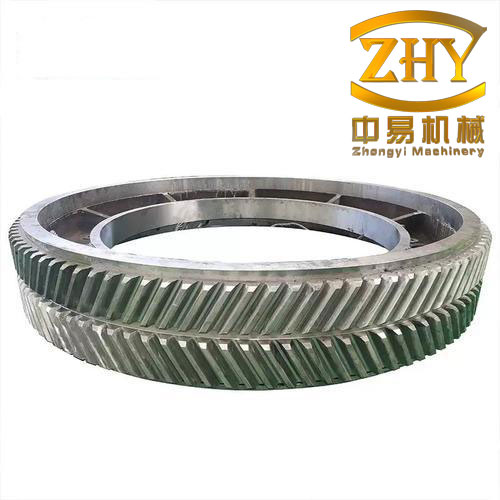
The detailed dimensions of the herringbone gear design are listed in Table 1.
| Parameter | Value |
|---|---|
| Normal module | 2.5 mm |
| Number of teeth | 20 |
| Face width | 10 mm |
| Normal pressure angle | 20° |
| Helix angle (left-hand) | 20° |
| Pitch circle diameter | 53 mm |
| Addendum circle diameter | 58 mm |
| Normal profile shift coefficient | 0 |
| Root fillet radius | 0.25 mm |
The 3D model was exported in STL format and imported into the slicing software Model Wizard. The printing process used ABS filament with a nozzle temperature of 230 °C and a layer height of 0.2 mm. The build platform temperature was set at 80 °C. The only variable in this experiment was the chamber temperature, which I set to 30 °C, 60 °C, and 90 °C respectively for each batch of herringbone gears. All other parameters (print speed, infill density, support material, etc.) were kept constant. The additive manufacturing principle, i.e., layer-by-layer deposition, was employed to fabricate the herringbone gears.
Chamber Temperature Conditions and Sample Preparation
Three sets of herringbone gears were printed, each under a different constant chamber temperature. The temperature control was maintained by the enclosed build chamber of the 3D printer. I observed that at 30 °C, the ABS filament cooled too rapidly upon extrusion, leading to poor adhesion between adjacent layers and a high number of visible voids. The gear printed at 30 °C was severely warped and exhibited extensive porosity; thus it was deemed a defective product and not subjected to ultrasonic testing. The herringbone gears printed at 60 °C and 90 °C appeared visually acceptable, with smoother surfaces and minimal warpage. These two samples were then prepared for non-destructive evaluation using ultrasonic flaw detection.
Ultrasonic Flaw Detection Methodology
Ultrasonic testing is a widely used non-destructive technique that relies on the reflection and refraction of high-frequency sound waves in a medium. The principle is as follows: a high-frequency pulse is generated by a transducer and transmitted into the material. When the wave encounters an internal discontinuity (e.g., a void, crack, or delamination), part of the energy is reflected back to the transducer. The reflected signal is displayed on an oscilloscope as a defect echo (B) between the initial pulse (A) and the bottom echo (C). The amplitude and arrival time of the defect echo provide information about the defect’s size, location, and nature. In a perfectly homogeneous part, only the initial pulse and the back-wall echo are observed. The attenuation of ultrasonic waves in a material can be described by the exponential decay law:
$$ A = A_0 \, e^{-\alpha x} $$
where A is the amplitude after propagating a distance x, A0 is the initial amplitude, and α is the attenuation coefficient. A higher attenuation coefficient indicates more energy loss due to scattering and absorption, often correlated with internal porosity or microstructural defects. The presence of multiple small defects (such as pores) increases the attenuation significantly. I used a digital ultrasonic flaw detector with a 5 MHz longitudinal wave probe. The testing was conducted on the tooth region and the gear body of each herringbone gear to assess the internal quality.
Experimental Results and Data Analysis
I performed ultrasonic scans on the herringbone gears printed at 60 °C and 90 °C. The 30 °C sample was discarded due to obvious gross defects. The A-scan waveforms for both temperatures were recorded and analyzed. The key findings are summarized in Table 2.
| Chamber Temperature | Attenuation Coefficient α (dB/mm) | Number of Significant Defect Echoes | Estimated Porosity (%) | Remarks |
|---|---|---|---|---|
| 30 °C | — (not tested) | — | > 15% (visual estimate) | Gross warpage, massive voids, discarded |
| 60 °C | 0.45 ± 0.03 | 3–5 | 5–8% | Moderate attenuation, multiple small pores |
| 90 °C | 0.12 ± 0.02 | 0–1 | < 1% | Very low attenuation, near defect-free |
The waveform at 60 °C exhibited a significant reduction in the back-wall echo amplitude compared to the initial pulse, indicating high attenuation. Several small defect echoes appeared between the initial and back-wall signals, suggesting the presence of distributed porosity and interlayer debonding. The attenuation coefficient was calculated using the ratio of the first back-wall echo amplitude to the second back-wall echo over a known thickness. For the herringbone gear printed at 90 °C, the waveform showed a strong back-wall echo with minimal loss, and almost no defect echoes were observed. The attenuation coefficient was an order of magnitude smaller than that of the 60 °C sample. This clearly demonstrates that a higher chamber temperature promotes better fusion between deposited layers, reduces thermal gradients, and minimizes void formation.
I further quantified the internal quality by estimating the ultrasonic velocity and the acoustic impedance. The velocity v of longitudinal waves in the ABS material was measured to be approximately 2250 m/s at room temperature, but it varied slightly with the degree of consolidation. The measured velocities for the two samples are shown in Table 3.
| Chamber Temperature | Longitudinal Velocity (m/s) | Acoustic Impedance (MRayl) |
|---|---|---|
| 60 °C | 2180 ± 30 | 2.18 ± 0.03 |
| 90 °C | 2230 ± 20 | 2.23 ± 0.02 |
The slightly higher velocity and impedance for the 90 °C sample indicate a denser, more homogeneous structure. The relationship between porosity P and ultrasonic velocity can be approximated by a simple rule of mixtures:
$$ \frac{1}{v} = \frac{1-P}{v_m} + \frac{P}{v_a} $$
where vm is the velocity in the solid ABS matrix (≈ 2250 m/s) and va is the velocity in air (≈ 340 m/s). Solving for porosity using the measured velocities yields the porosity estimates in Table 2.
Discussion
The experimental results confirm that the chamber temperature is a critical parameter in the FDM printing of herringbone gears made from ABS. At low temperatures (30 °C), the rapid cooling of the extruded filament prevents adequate bonding between adjacent layers, leading to high porosity and severe warpage. At intermediate temperature (60 °C), bonding improves but still leaves a significant number of micro-voids, as evidenced by the ultrasonic attenuation. Only at the highest tested temperature (90 °C) does the material achieve near-full density and excellent interlayer cohesion. This is consistent with the known behavior of ABS, which has a glass transition temperature around 105 °C. Printing at a chamber temperature close to the glass transition allows the polymer chains to diffuse across layer interfaces more effectively, resulting in a stronger and more uniform herringbone gear.
The ultrasonic method proved to be a reliable tool for non-destructive evaluation of internal defects in these 3D printed herringbone gears. The attenuation coefficient and the presence of defect echoes provide direct quantifiable metrics for quality assessment. Moreover, the velocity-derived porosity correlates well with visual and mechanical observations. This approach can be extended to other materials (e.g., PLA, nylon, or metal-filled filaments) and other gear geometries.
It should be noted that the present study only varied the chamber temperature while keeping all other parameters constant. In practice, the nozzle temperature and print speed also interact with the ambient temperature to influence the final quality. Further optimization of the printing process for herringbone gears should consider a multi-parameter design of experiments. Additionally, mechanical testing such as gear tooth bending fatigue or wear tests would complement the ultrasonic findings and provide direct validation of the structural integrity.
Conclusion
In this investigation, I designed and printed ABS herringbone gears at three chamber temperatures (30 °C, 60 °C, 90 °C) and evaluated their internal quality using ultrasonic flaw detection. The key conclusions are as follows:
- The herringbone gear printed at 30 °C exhibited gross defects and was unusable.
- The herringbone gear printed at 60 °C showed moderate ultrasonic attenuation with multiple small defect echoes, corresponding to a porosity of 5–8%.
- The herringbone gear printed at 90 °C had low attenuation, almost no defect echoes, and porosity below 1%, indicating excellent interlayer fusion.
- Ultrasonic velocity measurements further confirmed the density improvement with increasing chamber temperature.
- The study demonstrates that a chamber temperature close to the glass transition of ABS is beneficial for producing high-quality herringbone gears via FDM 3D printing.
Although these experiments are limited to ABS plastic, the underlying principles can guide the selection of processing temperatures for other thermoplastic materials used in additive manufacturing of herringbone gears. The ultrasonic non-destructive evaluation technique provides a practical means for quality control in production environments. Future work will involve correlating ultrasonic results with tensile and fatigue properties of printed herringbone gears to establish a comprehensive process-structure-property relationship.