
Herringbone gears are widely used in heavy machinery industries such as shipbuilding, coal mining, and hydropower due to their high load capacity, long service life, and high reliability. In conventional gear modeling, two prominent issues arise: the involute profile is often approximated using spline curves, and the tooth root transition curve is difficult to determine precisely. Additionally, repeated modeling is required for gears with different parameters. To address these challenges, I adopt a parameterized modeling approach on the Pro/Engineer platform, utilizing exact mathematical equations for the involute and tooth root transition curves. This method ensures high geometric accuracy and enables rapid design modification. Furthermore, I integrate virtual assembly techniques to eliminate tooth interference, which is common in conventional assembly due to positioning errors. The resulting model provides a solid foundation for finite element analysis, kinematic analysis, and dynamic simulation of herringbone gears.
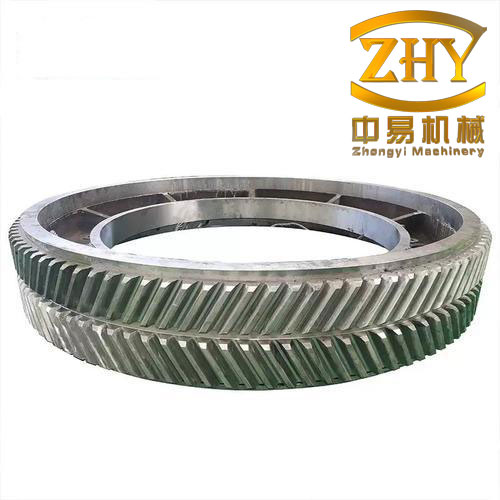
Parameterized Modeling Methodology
I exploit Pro/Engineer’s parametric design system to convert the precise equations of the involute and tooth root transition curves into relations that the software can interpret. Since all teeth of a herringbone gear share identical geometric features, I build a single tooth first and then replicate it via a circular pattern. The modeling process begins by generating the transverse tooth profile of the gear, constrained by geometric parameters such as number of teeth (Z), normal module (mn), pressure angle (α), and helix angle (β). Structural parameters like shaft hole diameter and undercut width define the overall blank shape. I then sweep the transverse profile along a projection of a helical trajectory onto the pitch cylinder to form a single tooth of the herringbone gear. Finally, I array the tooth around the axis to obtain the full gear. By modifying the geometric and structural parameters, the model can be automatically updated, enabling the creation of a family of herringbone gears.
Geometric Parameters of Herringbone Gears
Table 1 lists the essential geometric parameters used in the modeling. These parameters are input into Pro/Engineer’s “Parameters” dialog and linked via relations.
| Parameter | Symbol in model | Initial value |
|---|---|---|
| Normal module | MODULE_NOR | 9 |
| Number of teeth | NUM_TEETH | 49 |
| Normal pressure angle (°) | ALPHA | 20 |
| Helix angle (°) | BATA | 25 |
| Normal addendum coefficient | HA_NOR_COEF | 1 |
| Normal clearance coefficient | C_NOR_COEF | 0.25 |
| Normal profile shift coefficient | X_NOR_COEF | 0 |
| Face width (mm) | WIDTH | 250 |
| Total width (mm) | B | 590 |
Exact Equations for Involute and Root Transition Curve
The working tooth profile of a herringbone gear is an involute curve, generated by the enveloping action of the cutter’s working edges. The transition curve at the tooth root is produced by the rounded tip of the cutter. Both curves can be expressed precisely in Cartesian coordinates. I convert these equations into Pro/Engineer relations to ensure high fidelity.
The involute curve for the transverse section of a herringbone gear is given by:
$$
\begin{aligned}
k &= 180 / \pi \\
\rho_0 &= c_n^* \cdot m_n \\
y_0 &= \left(\frac{\pi}{4} + x_n \cdot \tan(\alpha_t)\right) \cdot m_t \\
x_c &= (h_{an}^* + c_n^* – x_n) \cdot m_n – \rho_0 \\
y_c &= y_0 + x_c \cdot \tan(\alpha_t) + \frac{\rho_0}{\cos(\alpha_t)} \\
h_a &= m_n \cdot (h_{an}^* + x_n) \\
\phi_1 &= \frac{y_0 – 2 h_a / \sin(2\alpha_t)}{d/2} \\
\phi_2 &= \frac{y_c + x_c \cdot \tan(90^\circ – \alpha_t)}{d/2} \\
\phi &= \phi_1 + t \cdot (\phi_2 – \phi_1) \\
x &= \left( \frac{d}{2} – \frac{(d/2 \cdot \phi – y_0) \cdot \sin(2\alpha_t)}{2} \right) \cdot \cos(\phi \cdot k) + \frac{(d/2 \cdot \phi – y_0) \cdot \cos(\alpha_t)}{\cos(\alpha_t)} \cdot \sin(\phi \cdot k) \\
y &= \left( \frac{d}{2} – \frac{(d/2 \cdot \phi – y_0) \cdot \sin(2\alpha_t)}{2} \right) \cdot \sin(\phi \cdot k) + \frac{(d/2 \cdot \phi – y_0) \cdot \cos(\alpha_t)}{\cos(\alpha_t)} \cdot \cos(\phi \cdot k) \\
z &= 0
\end{aligned}
$$
where:
\( \rho_0 \) = tool tip radius,
\( y_0 \) = half of transverse tooth thickness,
\( \phi \) = roll angle (varying from \( \phi_1 \) to \( \phi_2 \)),
\( t \) = parameter (0 ≤ t ≤ 1),
\( d \) = pitch circle diameter,
\( \alpha_t \) = transverse pressure angle,
\( m_n \) = normal module,
\( m_t \) = transverse module,
\( h_{an}^* \) = normal addendum coefficient,
\( c_n^* \) = normal clearance coefficient,
\( x_n \) = normal profile shift coefficient.
The tooth root transition curve is expressed as:
$$
\begin{aligned}
k &= 180 / \pi \\
\rho_0 &= c_n^* \cdot m_n \\
y_0 &= \left( \frac{\pi}{4} + x_n \cdot \tan(\alpha_t) \right) \cdot m_n \\
x_c &= (h_{an}^* + c_n^* – x_n) \cdot m_n – \rho_0 \\
y_c &= y_0 + x_c \cdot \tan(\alpha_t) + \frac{\rho_0}{\cos(\alpha_t)} \\
\phi_1 &= -\frac{y_c}{d/2} \\
\phi_2 &= \frac{y_c + x_c \cdot \tan(90^\circ – \alpha_t)}{d/2} \\
\phi &= \phi_1 + t \cdot (\phi_2 – \phi_1) \\
\psi &= \arctan\left( \frac{d/2 \cdot \phi – y_c}{x_c} \right) \\
\varphi &= \phi \cdot k \\
x &= \left( \frac{d}{2} – x_c – \rho_0 \cdot \cos(\psi) \right) \cdot \cos(\varphi) + \left( x_c \cdot \tan(\psi) + \rho_0 \cdot \sin(\psi) \right) \cdot \sin(\varphi) \\
y &= \left( \frac{d}{2} – x_c – \rho_0 \cdot \cos(\psi) \right) \cdot \sin(\varphi) + \left( x_c \cdot \tan(\psi) + \rho_0 \cdot \sin(\psi) \right) \cdot \cos(\varphi) \\
z &= 0
\end{aligned}
$$
The geometric relationships linking the key diameters are:
$$
\begin{aligned}
d &= m_n \cdot Z / \cos(\beta) \\
\alpha_t &= \arctan\left( \frac{\tan(\alpha_n)}{\cos(\beta)} \right) \\
d_b &= d \cdot \cos(\alpha_t) \\
m_t &= m_n / \cos(\beta) \\
d_f &= m_n \left( \frac{Z}{\cos(\beta)} – 2 h_{an}^* – 2 c_n^* + 2 x_n \right) \\
d_a &= m_n \left( \frac{Z}{\cos(\beta)} + 2 h_{an}^* + 2 x_n \right) \\
\text{inv}(\alpha_t) &= \tan(\alpha_t) – \alpha_t \cdot \pi / 180
\end{aligned}
$$
Here, \( d_b \) is the base circle diameter, \( d_f \) the root circle diameter, \( d_a \) the addendum circle diameter, and \( \text{inv}(\alpha_t) \) the involute function (angle in radians).
Modeling Procedure in Pro/Engineer
The step-by-step procedure I follow for constructing the herringbone gear is outlined in Table 2.
| Step | Action | Details |
|---|---|---|
| 1 | Define parameters | Enter parameters from Table 1 in Pro/Engineer’s “Parameters” dialog. |
| 2 | Input geometric relations | Write equations (3) as relations in the “Relations” dialog. |
| 3 | Generate tooth profile curves | Create datum curves using the involute and transition equations (1) and (2). Also draw addendum, pitch, and root circles. |
| 4 | Create helical trajectory | Sketch a line at the helix angle β on a plane, then project it onto the pitch cylinder surface to obtain the 3D trajectory. |
| 5 | Variable section sweep | Use “Variable Section Sweep” with the trajectory. Select “X trajectory” direction, keep “Constant section”. Sketch the closed tooth outline (four curves). |
| 6 | Single tooth solid | Confirm sweep to produce the first tooth solid. |
| 7 | Pattern teeth | Use “Pattern” with “Axis” option, number of teeth = Z, angle = 360/Z. Achieve full gear. |
| 8 | Add features | Cut the undercut (relief groove) and central bore using revolve/cut features. |
Parameterization Realization
After completing the model, I can change any geometric parameter in the “Parameters” dialog (e.g., module, number of teeth, helix angle) and regenerate the model. This parametric capability allows me to quickly create a series of herringbone gears with different dimensions without rebuilding from scratch. The relations ensure that all dependent dimensions update automatically.
Virtual Assembly of Herringbone Gears
Virtual assembly technology is a crucial part of virtual manufacturing. By assembling components in a virtual environment, I can detect and resolve interferences, optimize assembly sequences, and reduce costly physical prototyping. Pro/Engineer’s assembly module supports bottom-up design, where I place individual part instances and define constraints between them. For herringbone gears, achieving a correct meshing condition without interference is challenging because the tooth flanks must be tangent at the pitch circles. Traditional constraints like “Mate” or “Insert” often leave errors that require manual adjustment, which may introduce interference.
Assembly Procedure to Eliminate Interference
I developed a systematic method to ensure proper meshing of two identical herringbone gears. The steps are as follows:
| Step | Action | Description |
|---|---|---|
| 1 | Create assembly reference geometry | In the assembly file, create two parallel datum axes separated by the center distance: a = mn·(Z₁+Z₂)/(2·cos β). Also create datum planes for end faces. |
| 2 | Place gears using “Pin” constraint | Constrain each gear’s axis to align with the corresponding datum axis, and a plane of the gear to coincide with the assembly datum plane. Rotate gears manually to approximate meshing. |
| 3 | Run motion analysis and detect interference | Use Pro/Mechanism to drag the gears and check for tooth penetration. Interference is common at this stage. |
| 4 | Align symmetry planes | Use the “Align” constraint to match the tooth space symmetry plane of one gear with the tooth tip symmetry plane of the other gear. |
| 5 | Capture snapshot | In Pro/Mechanism, use the “Snapshot” tool to save the aligned position. |
| 6 | Define gear pair relationship | Add a “Gear” connection in the Mechanism environment, specifying the two axes and the ratio. This locks the relative rotation. |
| 7 | Verify interference | Run a new interference check; the previously observed red interference zones disappear. |
The key insight is to align a symmetry plane of a tooth space on the first gear with a symmetry plane of a tooth tip on the second gear. This ensures the teet are exactly half a pitch offset, which is the correct meshing condition. The snapshot captures this configuration, and then defining the gear relationship ensures that the assembly maintains the correct phase during motion simulation.
Results and Benefits
The modeling and assembly method described above yields several advantages:
- High geometric accuracy: Using exact involute and transition curve equations eliminates approximations from spline fitting, which is critical for stress analysis of herringbone gears.
- Parametric flexibility: Changing a few input parameters regenerates the entire herringbone gear, enabling rapid design iterations and family tables.
- Interference-free assembly: The symmetry-plane alignment method reliably produces a correct meshing condition without manual trial-and-error, which is especially important for double-helical herringbone gears where axial positioning is critical.
- Foundation for advanced simulation: The precise solid model can be directly used in finite element analysis (FEA) for tooth contact and root stress calculations, as well as in multi-body dynamics for vibration and noise studies of herringbone gear systems.
Conclusion
In this work, I have presented a comprehensive methodology for the accurate parameterized modeling and virtual assembly of herringbone gears. By employing exact mathematical expressions for the involute and tooth root transition curves within Pro/Engineer, I achieve a high-fidelity solid model that captures the true tooth geometry. The parametric implementation allows quick design changes, making it suitable for series production of herringbone gears. The virtual assembly technique using symmetry-plane alignment effectively eliminates tooth interference, ensuring correct meshing. This approach provides a reliable digital model for subsequent finite element analysis, kinematic simulation, and dynamic analysis, thereby supporting the engineering design and optimization of herringbone gears in heavy machinery applications.