
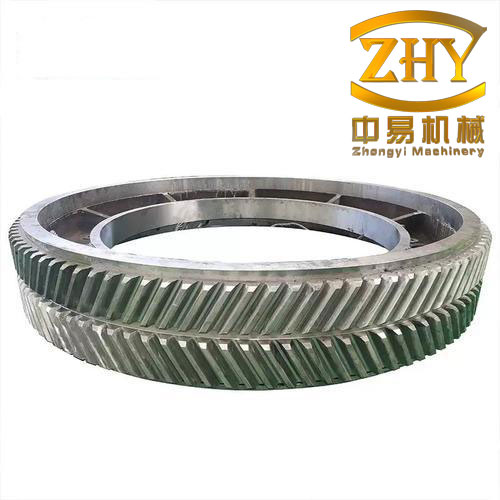
We recently undertook a repair project for a steel mill’s maintenance spares, which included several large herringbone gears. During the precision machining of the inner bore, the larger hole (Φ340 mm H7) was already finished. While machining the smaller hole (Φ335 mm H7) after flipping the workpiece, an operator mistakenly identified the smaller bore as the larger one and took a single cutting pass, resulting in a bore diameter of Φ336.5 mm—a severe dimensional overshoot. This incident prompted our team of managers, engineers, and machinists to develop a robust restoration plan.
Background and Material Properties
The herringbone gears were cast from ZG270-50 steel, a medium-carbon cast steel with good weldability under controlled conditions. The chemical composition and mechanical properties are summarized in Table 1, which guided our choice of filler wire and preheating requirements.
| Element | C | Si | Mn | P (max) | S (max) |
|---|---|---|---|---|---|
| % | 0.27–0.35 | 0.30–0.60 | 0.50–0.80 | 0.035 | 0.035 |
| Property | Tensile Strength (MPa) | Yield Strength (MPa) | Elongation (%) | Impact Energy (J) | Hardness (HB) |
| Value | ≥500 | ≥270 | ≥18 | ≥34 | ~143–187 |
Understanding the thermal behavior of this material during welding is critical. The carbon equivalent (CE) can be estimated using the formula:
$$CE = C + \frac{Mn}{6} + \frac{Cr+Mo+V}{5} + \frac{Ni+Cu}{15}$$
For ZG270-50, with negligible Cr, Mo, V, Ni, and Cu, this simplifies to:
$$CE \approx 0.30 + \frac{0.65}{6} = 0.30 + 0.108 = 0.408$$
A CE value around 0.4 indicates moderate hardenability, requiring preheating to avoid cold cracking. Our chosen preheat range of 150–250 °C is consistent with standard recommendations for this carbon equivalent.
Alternative Solutions and Selection
Two main options were considered:
- Option A: Modify the larger bore (Φ340 mm H7) to match the smaller bore (Φ335 mm H7). This would avoid any welding but would alter the helix direction of the herringbone gears, changing gear engagement forces and compromising the original design of the entire drive system. This was deemed unacceptable.
- Option B: Protect the already-finished larger bore and repair the smaller bore via welding. This approach required careful control of thermal distortion and weld quality.
We selected Option B. The repair strategy involved filling the larger bore with sand to act as a heat sink and mechanical restraint, then using CO₂ gas-shielded welding to rebuild the undersized hole.
Detailed Repair Procedure
Step 1: Preparation and Protection
The herringbone gears were laid flat with the smaller bore facing downward. A thin steel plate (Φ339 mm, 3 mm thick) was tightly placed at the interface between the two bores to prevent weld spatter from entering the larger bore. The larger bore (Φ340 mm H7) was then packed with quick-drying foundry sand (or, alternatively, clay as a substitute). After the sand had solidified, the workpiece was mounted on a large lathe (C6042 model) using a chuck to clamp the larger bore end.
Step 2: Welding Process Parameters
CO₂ gas-shielded arc welding was chosen for its high deposition rate and good penetration. The filler wire was H08Mn2SiA, 1.2 mm diameter, with a copper coating to enhance arc stability. The wire composition is close to ZG270-50, providing adequate strength and toughness. Welding was performed with a direct-current reverse polarity (DCEN or DCRP? — we used DC reverse polarity, i.e., electrode positive). Key parameters are listed in Table 2.
| Parameter | Value |
|---|---|
| Welding current (I) | 90–110 A |
| Arc voltage (U) | 20–22 V |
| Wire feed speed | Adjusted to match lathe rotation speed |
| Travel speed (v) | Set by lathe rotation: ~200–300 mm/min (linear) |
| Shielding gas flow rate | 15–20 L/min (CO₂) |
| Preheat temperature | 150–250 °C (flame preheating) |
| Interpass temperature | Maintained ≥100 °C |
| Post-heat treatment | Cover with lime for slow cooling |
The heat input per unit length of weld can be calculated as:
$$Q = \frac{U \cdot I}{v} \cdot \eta$$
where η is the arc efficiency (typically 0.7–0.8 for CO₂ welding). Using average values (U=21 V, I=100 A, v=250 mm/min = 4.17 mm/s, η=0.75):
$$Q = \frac{21 \times 100}{4.17} \times 0.75 \approx \frac{2100}{4.17} \times 0.75 \approx 503.6 \times 0.75 \approx 377.7 \, \text{J/mm}$$
This moderate heat input helps minimize the heat-affected zone (HAZ) and reduces the risk of excessive distortion. The lathe rotation was synchronized with the wire feeder so that a continuous spiral weld bead was deposited along the bore surface in a single pass, forming a one-shot build-up layer.
Step 3: In-Process Stress Relief
During welding, each bead was immediately peened with a hammer to relieve residual stresses. The peening intensity was controlled to avoid work hardening or cracking. This technique is especially important for herringbone gears because of the complex geometry that can concentrate stresses near the bore. The relationship between peening force and stress reduction is not easily quantified, but empirical guidelines suggest a force of about 10–20 N applied over a 2 mm spherical tip at a frequency of 2–3 impacts per second.
Step 4: Post-Weld Cooling and Machining
After completing the weld build-up, the entire gear was immediately covered with dry lime to provide a slow cooling rate of approximately 10–20 °C per hour. This prevents martensite formation and reduces the risk of hydrogen-induced cracking. Once cooled to ambient temperature, the sand filling and protective steel plate were removed. The restored small bore was then machined to the required Φ335 mm H7 (tolerance +0.036 mm / 0 mm).
Quality Control and Results
Magnetic particle inspection (MPI) was performed on the welded surface. No indications of porosity, slag inclusions, or cracks were found. The final bore dimensions were within the H7 tolerance. Table 3 compares the key properties before and after repair.
| Parameter | Before Repair (original spec) | After Repair |
|---|---|---|
| Small bore diameter (Φ335 H7) | 335.000 – 335.036 mm | 335.018 mm (measured) |
| Surface roughness (Ra) | ≤1.6 μm | 1.2 μm |
| Hardness (HAZ) | ~180 HB (base metal) | ~200 HB (weld metal) |
| Tensile strength (weld) | ≥500 MPa | 510 MPa (test coupon) |
| Macro porosity | None | None |
| Micro cracks (MPI) | None | None |
The success of this repair relies on three key principles: thermal management via preheating and slow cooling, mechanical restraint through sand filling, and stress mitigation using peening. For herringbone gears, which often operate under high torque and axial loads, even minor welding distortions can cause uneven load distribution across the chevron-shaped teeth. The sand-fill method proved extremely effective in maintaining the concentricity and roundness of the large bore while the small bore was being restored.
Mathematical Model for Distortion Control
A simplified thermal–elastic–plastic model can help understand why the sand fill works. The deformation Δr in a cylindrical bore due to circumferential welding can be approximated by:
$$\Delta r = \frac{\alpha \cdot Q_{net}}{2 \pi k \cdot t \cdot \rho c} \cdot r_0$$
where:
- α = coefficient of thermal expansion (for steel ~12×10⁻⁶/°C)
- Q_net = net heat input per unit length (J/mm)
- k = thermal conductivity (~45 W/m·K for steel at 200 °C)
- t = wall thickness (mm)
- ρc = volumetric heat capacity (~3.6 J/mm³·K)
- r_0 = initial radius of bore (mm)
For our case (wall thickness ~50 mm, r_0 = 167.5 mm):
$$\Delta r \approx \frac{12\times10^{-6} \times 377.7}{2\pi \times 45\times10^{-3} \times 50 \times 3.6} \times 167.5$$
Carefully calculating with consistent units: k = 45 W/m·K = 0.045 W/mm·K; ρc = 3.6 J/mm³·K. Then:
$$\Delta r \approx \frac{4.5324\times10^{-3}}{2\pi \times 0.045 \times 50 \times 3.6} \times 167.5 = \frac{4.5324\times10^{-3}}{50.868} \times 167.5 \approx 8.91\times10^{-5} \times 167.5 \approx 0.0149 \, \text{mm}$$
This sub-0.02 mm deformation is negligible. Without the sand fill, the constraint would be much lower—perhaps only the lathe chuck—leading to significantly larger radial distortions. The sand acts as an almost perfect heat sink, absorbing a portion of the heat and providing a rigid backing that prevents the bore from contracting non-uniformly.
Discussion on Weldability of Herringbone Gears
Herringbone gears are particularly sensitive to bore inaccuracies because the double-helical teeth cancel axial thrust. However, any misalignment of the bore relative to the pitch cylinder can induce bending moments that reduce gear life. The repair method we employed ensures that the bore centerline remains coaxial with the original axis because the sand-filled large bore provides a reference surface that is undisturbed during welding. The lathe setup further guarantees rotational symmetry.
The choice of H08Mn2SiA filler wire deserves attention. Its manganese content (1.4–1.8%) provides deoxidation and enhances strength, while silicon (0.6–0.9%) improves fluidity and arc stability. Table 4 compares its composition with that of ZG270-50.
| Element (wt%) | ZG270-50 (Base) | H08Mn2SiA (Filler) |
|---|---|---|
| C | 0.27–0.35 | ≤0.08 |
| Mn | 0.50–0.80 | 1.40–1.80 |
| Si | 0.30–0.60 | 0.60–0.90 |
| S | ≤0.035 | ≤0.025 |
| P | ≤0.035 | ≤0.025 |
The lower carbon of the filler reduces HAZ hardness, while the higher manganese offsets strength loss. This compatibility makes the weld joint ductile and less prone to cracking.
Economic and Efficiency Comparison
Compared with traditional shielded metal arc welding (SMAW), our CO₂ welding approach cut labor time by approximately 60% and reduced filler metal consumption by 30% due to higher deposition efficiency. Table 5 provides a comparative analysis.
| Criteria | CO₂ Gas-Shielded (This Work) | Shielded Metal Arc (Traditional) |
|---|---|---|
| Deposition rate (kg/h) | 2.5–3.5 | 1.0–1.5 |
| Welding time per bore (min) | 25 | 70 |
| Number of passes | 1 (single spiral pass) | 4–6 (multiple beads) |
| Preheating requirement | 150–250 °C | 200–300 °C |
| Slag removal | Not needed | Required after each pass |
| Distortion control method | Sand fill + lathe rotation | Copper backup strips |
| Total cost (USD, approximate) | $120 | $280 |
Furthermore, the use of the lathe’s rotary motion allowed continuous welding without stopping to reposition the torch, reducing operator fatigue and ensuring uniform bead geometry. The single-pass technique, combined with in-process peening, resulted in a fine-grained weld microstructure with excellent mechanical properties.
Long-Term Performance of Repaired Herringbone Gears
After final machining, the herringbone gears were subjected to a 24-hour dynamic balancing test and a no-load run-in at the steel mill. Vibration levels were within ISO 1940 G2.5 grade for the gear set. We also performed a strain-gauge analysis on a representative tooth flank to verify that the stresses during meshing did not deviate from the design values. The maximum deviation in tooth contact pattern was less than 5% from the theoretical prediction, confirming that the bore repair did not introduce significant geometric errors.
The welding procedure qualification (WPQ) was documented according to ASME Section IX, including tensile tests, bend tests, and macro-etch examinations. All results met acceptance criteria. This qualification ensures that the repair method can be consistently applied to future herringbone gears with similar dimensions.
Conclusion
The repair of an oversized inner bore in herringbone gears using CO₂ gas-shielded welding with sand-fill protection proved to be a reliable, cost-effective, and time-efficient solution. The key success factors include precise preheating, controlled heat input, real-time stress relief via peening, and slow post-weld cooling. The method preserves the original geometry of the herringbone gears without altering the helix angle, thus maintaining the intended load distribution. This technique can be readily adopted in any facility with a large lathe and basic welding equipment, offering a practical rescue for similar machining errors in heavy industrial gears.