
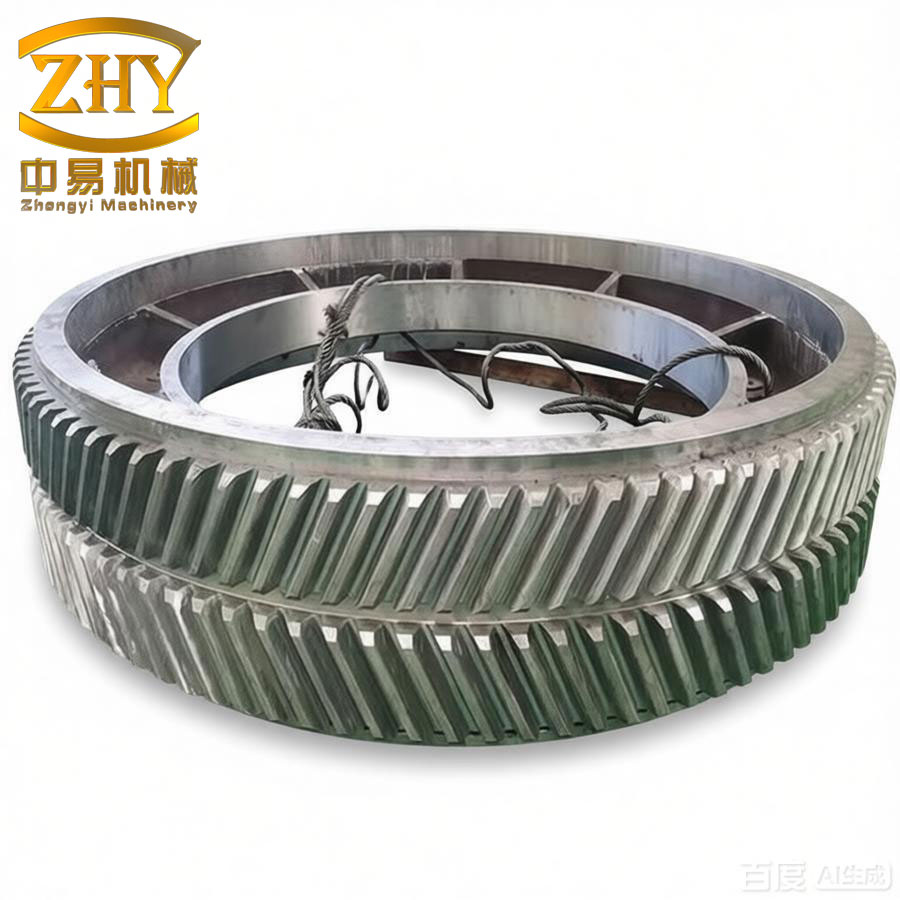
Herringbone gears are widely used in heavy machinery transmission systems due to their high load capacity, smooth operation, and minimal axial thrust. Typical applications include mechanical presses with capacities exceeding 800 tons. However, manufacturing herringbone gears presents significant challenges, including high cost and processing difficulty. There are two primary structural configurations for herringbone gears: one involves separate manufacturing of the two helical halves followed by assembly, and the other features an integral structure where both halves are machined from a single blank. This article introduces a practical machining scheme for the separate manufacturing and assembly of herringbone gears, based on a case study of a combined herringbone gear used in the main drive of a CNC deep hole drilling machine (model TK2150×120/20) designed by a specialized machine tool company. The proposed approach addresses the critical issue of ensuring phase synchronization between the two gear halves after assembly.
Challenges and Key Issues
The combined herringbone gear under consideration has a normal module of 8 mm, a helix angle of $\beta = 20^\circ 1′ 30”$, and a face width of 60 mm per half. The total width of the assembled gear is 130 mm, leaving a central relief groove of only 10 mm. Conventional methods for machining herringbone gears typically involve assembling the two halves before tooth cutting, then machining one side, and using a scribing or gaging method to align the second side. However, standard hobbing cutters for herringbone gears require a relief groove width of at least 85 mm for a normal module of 8 mm and helix angle between $15^\circ$ and $25^\circ$. The available 10 mm groove is far too narrow to allow tool clearance. Gear shaping could be considered, but the part requires a gear accuracy of grade 7-6C according to ISO 1328, and the tooth flanks must be induction hardened to 52 HRC. Shaping after heat treatment is impractical. Therefore, gear grinding is necessary, which forces us to machine the two halves separately and then assemble them. The core challenge is to ensure that the tooth spaces (or tooth centers) of the two halves align perfectly after assembly. The phase synchronization must be maintained within tight tolerances.
Proposed Manufacturing Strategy
Our strategy is based on a pre-assembly and precision pinning approach. The main steps are summarized below:
- Before tooth cutting, temporarily assemble the two gear blanks using six M20 socket head cap screws and six precision locating pins.
- Drill and ream two 6H7 locating holes across the joint of the two halves. These holes must be positioned symmetrically relative to the gear axis and at equal distances from the end faces.
- Disassemble the two halves and machine the teeth on each half separately, using the 6H7 holes as references to ensure tooth symmetry.
- After heat treatment and grinding, reassemble using the same pins.
The key challenges in this approach are: (1) heat treatment distortion may prevent reassembly, and (2) ensuring that the 6H7 hole centers fall exactly at the midpoint of a tooth space (or tooth tip) to guarantee phase synchronization. To address the first issue, we specify that the gear blanks must undergo normalizing before machining to stabilize the material. Induction hardening only affects the tooth flanks and has minimal influence on the overall geometry, provided the base material is stable. For the second challenge, we designed a special gage that references the 6H7 holes to verify tooth centering during grinding. This gage allows us to maintain tooth symmetry within 0.02 mm. Based on this theoretical value, we predicted that the final assembled gear would have a phase synchronization error within 0.10 mm, meeting the design requirement.
Detailed Process Planning
The manufacturing sequence for the gear halves is described below, using part 2 (the right-hand half) as an example. The complete process for both halves is identical.
Step 1: Rough Turning (CNC Lathe)
Clamp the left end outer diameter (OD) of $\varnothing195k6$. Align the gear OD and end face. Rough turn the gear OD to $\varnothing343.80h7$. Face the right end. Cut a reference band on the left side of the 60 mm dimension. Leave 0.70 mm stock on the bore.
Step 2: Second Turning (CNC Lathe)
Clamp the right end OD. Align the gear OD and the reference band (within 0.01 mm). Turn the OD to $\varnothing195k6$, $\varnothing285$, the 65±0.1 mm shoulder, the left face of the 130 mm dimension, and the tooth face width to $60^{+0}_{-0.02}$ mm. All runout tolerances must be within 0.015 mm. Chamfer as per drawing.
Step 3: Assembly and Hole Drilling
Assemble the two rough-machined blanks with bolts. Using a CNC boring machine, drill and ream two 6H7 locating holes on the gear OD. These holes must lie on the same axis parallel to the gear centerline and be equidistant from both end faces, with an error within 0.02 mm. This ensures that after grinding, the holes will be positioned at the center of a tooth space (or tooth tip) when the gear is subsequently machined.
Step 4: Tooth Hobbing (Pre-grinding)
Disassemble the two halves. For each half, hob the teeth using the 6H7 holes as reference centers. Leave 0.8 mm stock per tooth flank for grinding. The symmetry of the 6H7 hole relative to the tooth space must be within 0.06 mm. This is verified using a simple caliper gage that locates on the holes and measures the tooth thickness.
Step 5: Heat Treatment
Induction harden only the tooth flanks to 52 HRC. The rest of the gear remains soft. Normalizing of the blanks before machining minimized distortion.
Step 6: Gear Grinding
Mount each half on the grinder using the 6H7 holes as centering references. Use the centering gage shown conceptually in the original design (a dedicated fixture with two pins that fit into the 6H7 holes and a central probe that contacts the tooth space). Grind the teeth to final dimensions while monitoring the symmetry of the 6H7 hole center relative to the tooth space, maintaining it within 0.02 mm. The grinding allowance is removed uniformly.
Centering Gage Principle
The centering gage ensures that the midpoint of a tooth space coincides with the axis passing through the two 6H7 holes. The gage consists of a base plate with two fixed pins that engage the 6H7 holes, and a sliding probe that contacts the tooth flanks. The position of the probe relative to the pins is adjusted so that when the probe contacts both flanks symmetrically, the gear is correctly oriented. The measured deviation is used to adjust the grinding wheel position. The accuracy of this gage directly influences the final phase synchronization of the assembled herringbone gears.
Mathematical Foundation for Phase Synchronization
The phase synchronization error $\delta_\phi$ (in angular measure) between the two gear halves after assembly is related to the centering error $\Delta x$ (linear displacement of the tooth center from the reference hole axis) by:
$$ \delta_\phi = \frac{2 \Delta x}{r_b} \times \frac{180}{\pi} \tag{1} $$
where $r_b$ is the base radius. For the given gear, the base radius is:
$$ r_b = \frac{m_n z}{2 \cos \beta} = \frac{8 \times 38}{2 \cos(20.025^\circ)} \approx 152.94 \text{ mm} \tag{2} $$
With a centering error $\Delta x = 0.02$ mm, the angular error is approximately:
$$ \delta_\phi = \frac{2 \times 0.02}{152.94} \times 57.3^\circ / \text{rad} \approx 0.015^\circ \tag{3} $$
This small angular error translates into a linear displacement at the pitch circle of about 0.04 mm. However, since the two halves are assembled with the same pins, the cumulative error is doubled when considering relative tooth positions. In practice, the measured synchronization error after assembly was 0.08 mm, which corresponds to approximately 0.03° angular discrepancy, well within the required tolerance.
Key Process Parameters and Tolerances
| Parameter | Value |
|---|---|
| Number of teeth | $z = 38$ |
| Normal module | $m_n = 8 \text{ mm}$ |
| Pressure angle | $\alpha = 20^\circ$ |
| Helix angle | $\beta = 20^\circ 1′ 30”$ |
| Accuracy grade | ISO 7-6C |
| Base tangent length | $W_k = 111.24^{+0}_{-0.063} \text{ mm}$ (over $k$ teeth) |
| Heat treatment | Tooth flanks: G52 (52 HRC) |
| Item | Tolerance |
|---|---|
| Position of 6H7 holes relative to gear axis | ≤ 0.02 mm |
| Distance from each hole to respective end face | Equal within 0.02 mm |
| Perpendicularity of holes to gear face | 0.01 mm |
| Centering of tooth space relative to hole axis (hobbing) | ≤ 0.06 mm |
| Centering of tooth space relative to hole axis (grinding) | ≤ 0.02 mm |
| Step | Operation | Machine | Key Requirement |
|---|---|---|---|
| 1 | Rough turning | CNC lathe | Leave 0.7 mm on bore; gear OD to $\varnothing343.80h7$ |
| 2 | Finish turning | CNC lathe | Face width $60^{+0}_{-0.02}$ mm; runout ≤ 0.015 mm |
| 3 | Drill and ream 6H7 holes | CNC boring machine | Two holes on common axis; symmetric to end faces |
| 4 | Hob teeth | Hobbing machine | Leave 0.8 mm stock; hole symmetry ≤ 0.06 mm |
| 5 | Induction hardening | Induction heater | Tooth flanks only; 52 HRC |
| 6 | Grind teeth | Gear grinder | Hole symmetry ≤ 0.02 mm; final dimensions |
Experimental Results and Discussion
The proposed manufacturing scheme was validated with actual production. After grinding, each half was inspected individually using the centering gage. The deviation of the tooth center from the 6H7 hole axis was consistently below 0.02 mm. The two halves were then assembled with the original pins and bolts. The assembled herringbone gear was mounted on a test arbor, and the phase synchronization was measured by comparing the angular positions of corresponding teeth on both sides using a dial indicator and a known master tooth. The maximum measured synchronization error was 0.08 mm linear displacement at the pitch circle, which is significantly better than the design target of 0.10 mm. This success is attributed to the stable material (normalized blanks), precise hole drilling, and the dedicated centering gage that allowed accurate tooth grinding referencing the same holes.
Conclusion
We have developed and implemented a reliable manufacturing approach for combined herringbone gears that require separate machining due to narrow relief grooves. The key to achieving phase synchronization between the two halves is the use of precision locating holes drilled in a common assembly before tooth cutting, followed by tooth machining with reference to these holes. The centering gage enables grinding accuracy within 0.02 mm, leading to an assembled synchronization error of only 0.08 mm. This method has been successfully applied to the main drive herringbone gears of a CNC deep hole drilling machine, demonstrating its practicality for heavy machinery applications. Future work may explore the use of alternative referencing methods such as laser alignment to further enhance precision and reduce setup time.