
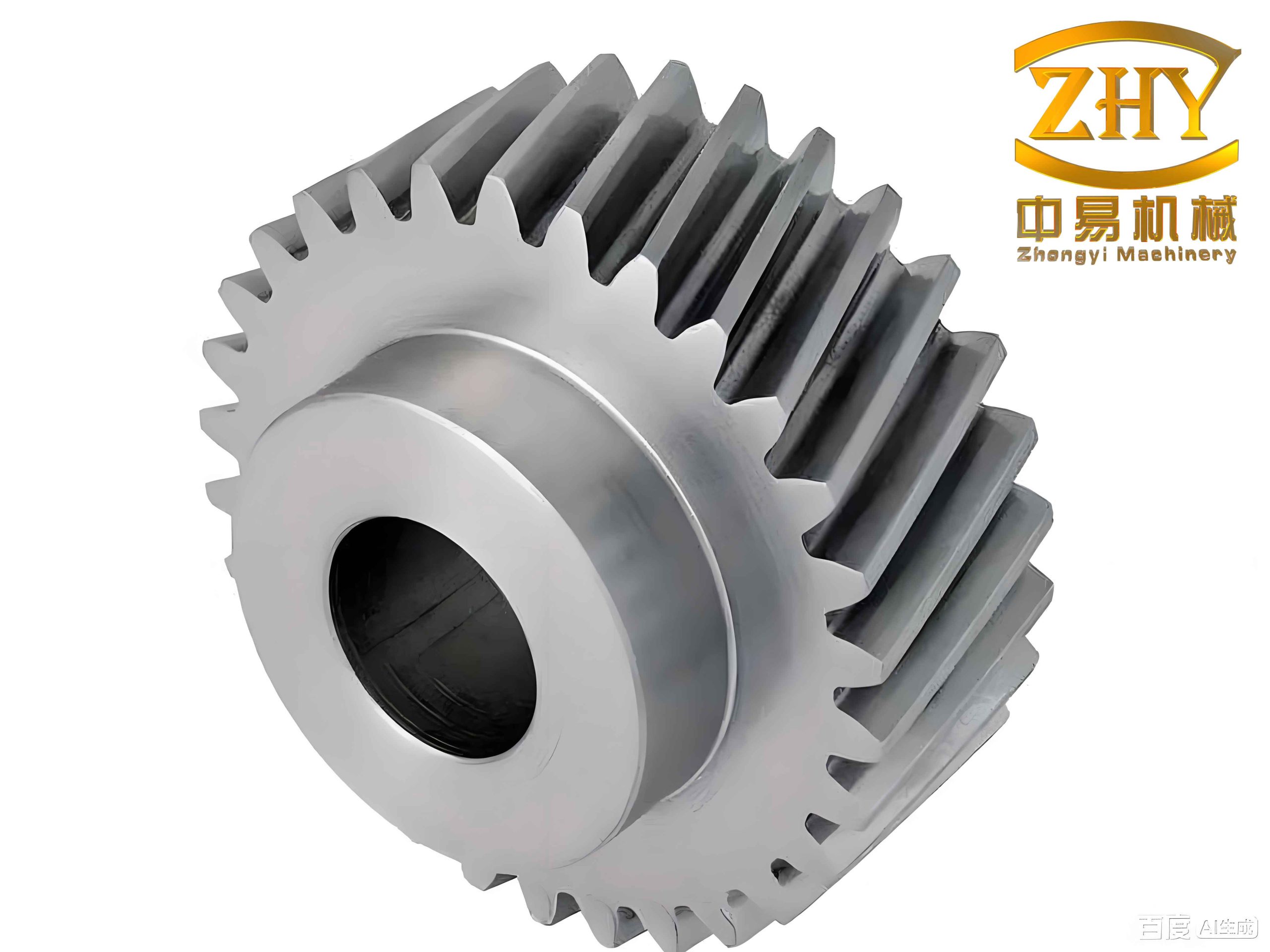
In my research, I focus on improving the meshing performance of helical gears used in forging presses, which are subjected to high loads and cyclic stresses. Tooth surface spalling is a common failure mode in such helical gear systems, significantly affecting the mesh stiffness and dynamic behavior. I have developed a comprehensive model to evaluate the time-varying mesh stiffness of helical gear pairs with spalling defects, considering the actual contact line characteristics and the slicing method combined with integral calculations. This study provides insights into how spalling parameters—such as size, axial and radial positions, and shape—influence the mesh stiffness, which is crucial for predicting gear system reliability and vibration.
To begin, I constructed a contact line model for the helical gear pair. Unlike spur gears, helical gears have inclined contact lines that change continuously along the face width. I employed a slicing technique that divides the gear tooth into numerous thin slices along the axial direction. Each slice is treated as a spur gear segment, and the total mesh stiffness is obtained by integrating the stiffness contributions of all slices while accounting for the phase difference due to the helix angle. The fundamental equations for the bending, shear, and compressive stiffness components are derived from the potential energy method. The following table summarizes the key geometric parameters of the helical gear pair used in my analysis.
| Parameter | Symbol | Value |
|---|---|---|
| Module (normal) | \(m_n\) | 6 mm |
| Number of teeth (pinion) | \(Z_1\) | 25 |
| Number of teeth (gear) | \(Z_2\) | 38 |
| Pressure angle (normal) | \(\alpha_n\) | 20° |
| Helix angle | \(\beta\) | 15° |
| Face width | \(B\) | 80 mm |
| Addendum coefficient | \(h_a^*\) | 1.0 |
| Clearance coefficient | \(c^*\) | 0.25 |
The helical gear tooth is modeled as a variable cross-section cantilever beam. The tooth profile is defined from the root circle to the tip circle, and the base circle is used as the reference. The displacement at the point of load application comprises bending, shear, and compressive deformations, plus the Hertzian contact deformation. The stiffness of a single tooth slice is given by:
$$
\frac{1}{k_{\text{slice}}} = \frac{1}{k_b} + \frac{1}{k_s} + \frac{1}{k_a} + \frac{1}{k_h}
$$
where \(k_b\) is the bending stiffness, \(k_s\) is the shear stiffness, \(k_a\) is the axial compressive stiffness, and \(k_h\) is the Hertzian contact stiffness. For a slice at a given normalized tooth height, the bending stiffness is calculated using the integral formula:
$$
\frac{1}{k_b} = \int_{0}^{x} \frac{(x – u)^2}{E I_u} du
$$
where \(E\) is Young’s modulus, \(I_u\) is the area moment of inertia at section \(u\), and \(x\) is the distance from the root to the load point. The shear stiffness is:
$$
\frac{1}{k_s} = \int_{0}^{x} \frac{1.2(1+\nu)}{E A_u} du
$$
with \(\nu\) being Poisson’s ratio and \(A_u\) the cross-sectional area. The axial compressive stiffness is:
$$
\frac{1}{k_a} = \int_{0}^{x} \frac{\sin^2\alpha}{E A_u} du
$$
where \(\alpha\) is the local pressure angle. The Hertzian stiffness for the slice is approximated using the formula for cylindrical contacts with the local radius of curvature. For a helical gear, the contact line is divided into multiple segments along the face width. The total mesh stiffness is obtained by summing the stiffness of all active slices, considering the number of tooth pairs in contact simultaneously. The time-varying mesh stiffness is then computed as a function of the rotation angle.
To verify the accuracy of my method, I compared the average mesh stiffness obtained from my model with the results from the empirical formula and finite element analysis. The comparison is presented in Table 2.
| Method | Maximum | Minimum | Average | Error (%) vs. empirical |
|---|---|---|---|---|
| Empirical formula | — | — | 2.005 | — |
| Finite element method | 2.123 | 1.998 | 2.095 | 4.5 |
| My proposed method | 2.079 | 1.976 | 2.075 | 3.5 |
| Method using only face width | 2.195 | 2.103 | 2.144 | 6.9 |
| Method using contact ratio | 2.239 | 2.125 | 2.187 | 9.1 |
My method yields an average stiffness error of only 3.5%, which is lower than the 4.5% from the finite element method and significantly better than the simplified approaches (6.9% and 9.1%). This demonstrates that the slicing algorithm combined with the integral process accurately captures the helical gear mesh characteristics.
3. Influence of Spalling Characteristics on Mesh Stiffness
3.1 Spalling size effect
I first investigated the effect of rectangular (quadrilateral) spalling on the time-varying mesh stiffness. The spalling geometry is defined by its length \(l_s\), width \(w_s\), and depth \(h_s\). In my model, a spalling region is treated as a loss of material; any slice that falls within the spalling zone contributes zero stiffness to the gear pair. Therefore, the effective stiffness of the affected slices is omitted. For rectangular spalling with varying length, I computed the mesh stiffness as a function of the meshing period. The results are summarized in Table 3 for different spalling lengths while keeping the width and depth constant (width = 2 mm, depth = 1 mm).
| Spalling length \(l_s\) (mm) | Average stiffness (×10¹⁰ N·m⁻¹) | Reduction (%) |
|---|---|---|
| 0 (healthy) | 2.075 | 0 |
| 2 | 2.052 | 1.1 |
| 5 | 2.018 | 2.7 |
| 10 | 1.966 | 5.2 |
| 30 | 1.912 | 7.9 |
The time-varying mesh stiffness curves show that as the spalling length increases, the mesh stiffness decreases continuously. The reduction occurs not only in the single-tooth contact region but also in the double-tooth contact zones because the spalling affects multiple meshing positions. When the spalling length exceeds a critical value (approximately 10 mm in this case), the stiffness drop becomes more pronounced, and the transition between double- and single-tooth contact becomes less distinct.
3.2 Axial and radial position effects
Another important factor is the location of the spalling along the face width (axial direction) and along the tooth profile (radial direction). I defined the axial coordinate \(w_a\) relative to the center of the face width, and the radial coordinate \(t_a\) relative to the pitch circle. The boundary parameters for the spalling region are determined using:
$$
n_s = \text{ceil}\left( \frac{N}{2} + \frac{2 w_a – w_s \cos\beta_b}{2 \Delta L_i} \right)
$$
$$
n_e = \text{ceil}\left( \frac{N}{2} + \frac{2 w_a + w_s \cos\beta_b}{2 \Delta L_i} \right)
$$
where \(N\) is the total number of slices, \(\Delta L_i\) is the slice width, and \(\beta_b\) is the base helix angle. The stiffness reduction due to axial position variation is shown in Table 4 for a rectangular spalling of fixed size (length 5 mm, width 2 mm).
| Axial position \(w_a\) (mm) | Average stiffness (×10¹⁰ N·m⁻¹) | Reduction (%) |
|---|---|---|
| 0 (center) | 2.018 | 2.7 |
| +10 (toward one end) | 2.022 | 2.5 |
| -10 | 2.021 | 2.6 |
| +15 | 2.025 | 2.4 |
| -15 | 2.024 | 2.5 |
The axial position has only a minor effect on the average stiffness, but the shape of the time-varying curve changes. When the spalling is located near the entry or exit side of the face width, the affected meshing positions shift, causing earlier or later dips in the stiffness curve. For radial position variations, the influence is more significant. A spalling closer to the tooth root (negative \(t_a\)) reduces more material at the base of the cantilever, leading to a larger stiffness reduction. Table 5 shows the effect for a fixed spalling size.
| Radial position \(t_a\) (mm) | Average stiffness (×10¹⁰ N·m⁻¹) | Reduction (%) |
|---|---|---|
| 0 (pitch circle) | 2.018 | 2.7 |
| +1 (toward tip) | 2.030 | 2.2 |
| -1 (toward root) | 2.005 | 3.4 |
| -2 | 1.992 | 4.0 |
These observations are consistent with the fact that the bending moment arm is largest at the root, so a loss of material there has a stronger impact on the overall stiffness.
3.3 Influence of spalling shape
I further examined the effect of spalling shape by considering three typical geometries: circular, triangular, and rectangular (quadrilateral). Each shape was designed to have the same area (approximately 30 mm²) and depth (1 mm) to isolate the shape effect. The mesh stiffness curves for these shapes are compared in Table 6 and Figure 7 (conceptually).
| Spalling shape | Average stiffness (×10¹⁰ N·m⁻¹) | Reduction (%) | Trend of stiffness reduction in spalling zone |
|---|---|---|---|
| None (healthy) | 2.075 | 0 | — |
| Circular | 2.040 | 1.7 | Nonlinear (parabolic) |
| Triangular | 2.035 | 1.9 | Nonlinear (increasing slope) |
| Rectangular | 2.018 | 2.7 | Linear |
The circular spalling produces a smooth, rounded dip in the stiffness curve, while the triangular shape creates a sharper, asymmetric decrease. The rectangular spalling yields a nearly linear reduction in stiffness across the meshing positions it covers. Among the three, the rectangular shape causes the largest average stiffness reduction because it removes a larger continuous band of material along the contact line. The triangular and circular shapes, despite having the same area, affect fewer slices simultaneously, leading to a less severe drop. The differences in the shape of the stiffness reduction curve are important for diagnosing the type of spalling defect from vibration signals.
4. Conclusions
In this study, I have developed a robust method for calculating the time-varying mesh stiffness of helical gears with tooth surface spalling. The method is validated against empirical and finite element results, showing an average error of only 3.5%. Through parametric analysis, I have drawn the following conclusions:
- Increasing the length of rectangular spalling continuously reduces mesh stiffness, affecting both single- and double-tooth contact regions.
- The axial position of spalling has a minor effect on the average stiffness, but it shifts the timing of the stiffness drop. Radial position near the tooth root causes a greater reduction in stiffness than near the tip.
- The shape of the spalling defect significantly influences the profile of the stiffness reduction: circular and triangular shapes produce nonlinear decreases, while rectangular spalling leads to a linear drop. This information is valuable for fault diagnosis and condition monitoring of helical gear transmissions in press machines.
My findings provide a theoretical foundation for predicting the dynamic behavior of helical gear systems under spalling defects and can guide the design of more robust gear drives for high-load applications.