
In our study of the tribo-dynamic behavior of helical gears used in electric vehicle reducers, we developed a comprehensive 10-degree-of-freedom (DOF) tribo-dynamic model that incorporates stiffness excitation, friction excitation, and error excitation. The helical gear pair in modern electric vehicles is designed with a large helix angle to ensure smooth and quiet operation, yet the combined effects of time-varying mesh stiffness, friction forces from elastohydrodynamic lubrication (EHL), and manufacturing errors can significantly influence dynamic responses such as vibration, noise, and load sharing. Understanding these interactions is critical for improving the reliability and efficiency of the drivetrain.
We began by establishing the tribo-dynamic model using the lumped parameter approach. The helical gear pair was modeled with 10 DOFs, including rotational and translational motions of the driving gear, driven gear, motor, and load. The dynamic mesh force along the line of action was expressed as a function of the relative displacement in the mesh plane, which accounts for the transverse and axial components due to the helix angle. The governing equations were derived and solved numerically using the fourth-order Runge-Kutta method.
To compute the time-varying mesh stiffness, we employed the potential energy method. Each tooth was idealized as a variable cross-section cantilever beam fixed at the root circle. The total stiffness comprised bending, shear, axial compression, fillet-foundation, and contact stiffness components. For a helical gear, the tooth is sliced into thin segments along the face width, and the stiffness of each slice is summed. The mesh stiffness of a single tooth pair was determined by combining the stiffness of the driving and driven teeth in series. The overall time-varying mesh stiffness was obtained by summing contributions from all tooth pairs in contact, accounting for the high contact ratio of the reducer helical gear (ε = 4.512). This large contact ratio results in 4 to 5 tooth pairs simultaneously engaged, leading to small fluctuations in mesh stiffness and thus smoother transmission.
| Parameter | Symbol | Value |
|---|---|---|
| Number of teeth (pinion/gear) | z₁, z₂ | 26 / 75 |
| Module (mm) | mₙ | 1.6 |
| Helix angle (°) | β | 30.5 |
| Center distance (mm) | a | 93 |
| Mass of pinion/gear (kg) | m₁, m₂ | 0.673 / 3.424 |
| Moment of inertia of pinion/gear (kg·m²) | I₁, I₂ | 1.736×10⁻⁴ / 6.07×10⁻³ |
| Motor/load inertia (kg·m²) | Iₘ, Iₗ | 0.4 / 0.78 |
| Torsional stiffness of input/output shaft (N·m) | kₚ, k₉ | 4.3×10⁴ / 1.2×10⁵ |
| Bearing stiffness (x,y,z) for pinion (N/m) | k1x,k1y,k1z | 1.0×10⁸ |
| Bearing stiffness (x,y,z) for gear (N/m) | k2x,k2y,k2z | 1.5×10⁸ |
| Damping ratio for meshing | ξ | 0.03–0.17 |
| Input torque (N·m) | Tin | 71.63 |
| Input speed (r/min) | n₁ | 6000 |
The friction coefficient was calculated using the formula proposed by Xu et al., which is based on EHL theory. It depends on the slide-to-roll ratio (SR), maximum Hertzian pressure (ph), oil viscosity (η₀), surface roughness (S), and entraining velocity. From the friction coefficient, we determined the friction force acting on each tooth pair as a product of the coefficient and the normal load. The friction force direction reverses at the pitch point, and its magnitude varies throughout the meshing cycle. The total friction force and torque on each gear were obtained by summing contributions from all engaged tooth pairs. Our results showed that as the rotational speed increased, both single-tooth and total friction forces decreased due to the reduction in the friction coefficient under higher sliding velocities.
To validate our stiffness calculation method, we compared it with published results for a spur gear pair from the literature. The agreement was excellent, with only minor differences attributed to unknown profile shift coefficients. Similarly, we validated the dynamic model by comparing the phase diagram at a dimensionless excitation frequency of Ωh=1 with the results of Kahraman and Singh; the two matched perfectly, confirming the correctness of our dynamic formulation.
| Component | Formula |
|---|---|
| Relative displacement in mesh plane | $$x_{12n} = (r_{b1}\theta_1 – r_{b2}\theta_2)\cos\beta_b + (z_1 – z_2)\sin\beta_b – (y_1 – y_2)\cos\alpha_t\cos\beta_b + (x_1 – x_2)\sin\alpha_n – e_{12}(t)$$ |
| Dynamic meshing force | $$F_{m12}(t) = k_{12}(t) x_{12n} + c_{12} \dot{x}_{12n}$$ |
| Bending stiffness (slice j) | $$k_{b,j} = \frac{1}{\int_{\alpha_4}^{-\alpha’} \frac{A}{2E} [\sin\alpha + (\alpha_2 – \alpha)\cos\alpha]^3 d\alpha}$$ |
| Shear stiffness (slice j) | $$k_{s,j} = \frac{1}{\int_{\alpha_5}^{-\alpha’} \frac{C}{E} [\sin\alpha + (\alpha_2 – \alpha)\cos\alpha] \Delta y d\alpha}$$ |
| Contact stiffness per slice | $$k_h = \frac{\pi E l}{4(1-\gamma^2)}$$ |
| Single-tooth pair stiffness | $$k_{pg} = \left( \frac{1}{k_h} + \frac{1}{k_{b1}} + \frac{1}{k_{s1}} + \frac{1}{k_{a1}} + \frac{1}{k_{f1}} + \frac{1}{k_{b2}} + \frac{1}{k_{s2}} + \frac{1}{k_{a2}} + \frac{1}{k_{f2}} \right)^{-1}$$ |
| Time-varying mesh stiffness | $$k(t) = \sum_{n=1}^{n_s} \left( \frac{1}{k_{pg,n}} \right)^{-1}$$ |
| Friction coefficient (Xu et al.) | $$\mu = e^{f(SR, p_h, \eta_0, S)} \, p_h^{b_2} |SR|^{b_3} v_e^{b_6} v_0^{b_7} R^{b_8}$$ |
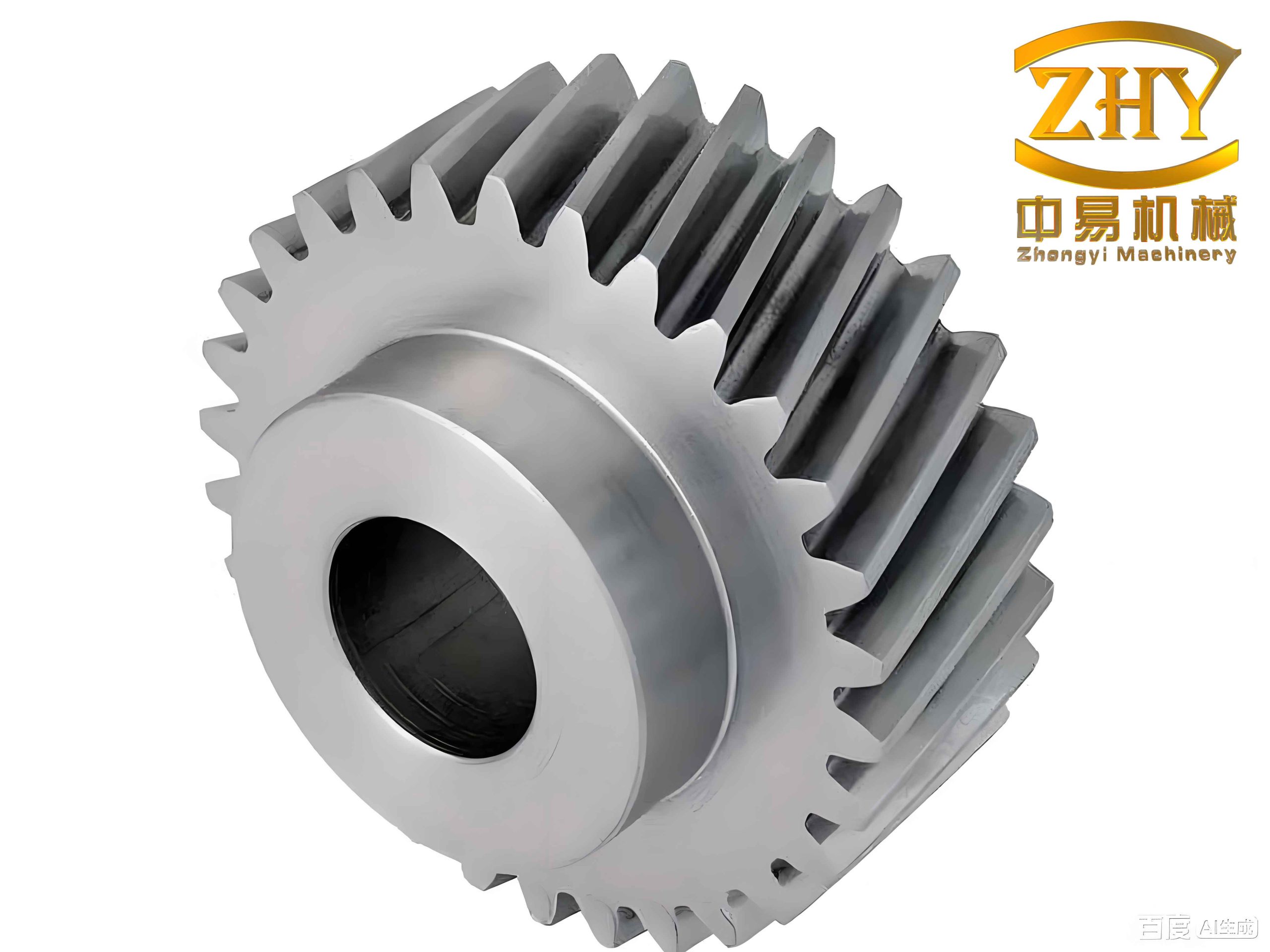
In the results section, we analyzed the time-varying mesh stiffness of the electric vehicle reducer helical gear. The plots showed that the total stiffness varied smoothly with a small amplitude, due to the high contact ratio. The single-tooth stiffness exhibited a typical parabolic shape, and the meshing process involved nine tooth pairs over one complete cycle, with 4 to 5 pairs always in contact. This desirable property minimizes excitation forces and contributes to low noise and vibration levels.
We then investigated the effect of friction on the dynamic characteristics. The time-domain and frequency-domain responses of the driven gear in the x-direction (along the line of centers) were significantly altered by friction. Without friction, the displacement spectrum was dominated by the meshing frequency (2,600 Hz). With friction, additional frequency components appeared, and at certain frequencies (e.g., 980 Hz), the vibration amplitude caused by friction exceeded that due to stiffness variation. The friction also amplified the vibration velocity and acceleration in all directions, with the largest effect in the x-direction, followed by the y-direction, and the smallest in the z-direction. This aligns with the fact that the friction force has the largest component along the x-axis. Surprisingly, friction had only a minor influence on the dynamic meshing force, because the friction direction is perpendicular to the line of action, and the friction torque on each gear was relatively small compared to the transmitted torque.
Error excitation was modeled as a sinusoidal static transmission error with amplitude e₀ and initial phase φ₁. We varied e₀ from 0 to 5 μm and observed that increasing the error amplitude significantly increased the vibration displacement in the x-direction and broadened the frequency content. At e₀ = 3 μm, the dynamic meshing force fluctuations became much more pronounced than in the case without error. Comparing the influence of friction and error, we found that error excitation dominated the dynamic response at moderate to high error levels, while friction played a secondary role. This underscores the importance of manufacturing precision in helical gear reducers.
Finally, we computed the single-tooth meshing force under both the tribo-dynamic model (with e₀ = 3 μm) and the static load distribution based on the minimum elastic potential energy method. The results showed marked differences: the dynamic single-tooth load exhibited larger oscillations and a different pattern of load sharing among the engaged tooth pairs. This dynamic load variation directly impacts the local contact pressure and sliding velocity, which in turn affect the lubricant film thickness and the risk of scuffing or pitting. Our findings suggest that a purely static load analysis may not be sufficient for accurate prediction of the helical gear’s tribological performance, and a coupled tribo-dynamic approach is necessary.
| Excitation Type | Vibration Displacement (x-direction) | Dynamic Meshing Force | Frequency Content |
|---|---|---|---|
| Stiffness only | Low amplitude, periodic at fm | Smooth, small variation | Dominant at meshing frequency |
| Stiffness + friction | Increased amplitude, additional peaks | Marginally changed | Broadband with friction-related frequencies |
| Stiffness + error (e₀=3 μm) | Significantly larger amplitude | Strong fluctuations | Meshing frequency and harmonics increased |
| Stiffness + friction + error | Largest amplitude, complex pattern | Highest fluctuations | Rich spectral content |
In conclusion, we have presented a thorough tribo-dynamic analysis of helical gears in electric vehicle reducers. The key findings are:
- High contact ratio leads to low mesh stiffness fluctuation, contributing to smooth transmission.
- Friction significantly affects vibration displacements, velocities, and accelerations, especially in the direction of its component, but has little influence on the dynamic meshing force.
- Error excitation is a dominant factor affecting both vibration and dynamic meshing force; increasing error amplitude amplifies the dynamic response.
- Single-tooth dynamic load differs substantially from the static load distribution, highlighting the need for coupled tribo-dynamic modeling when predicting gear lubrication and wear.
Future work will extend this model to include thermal effects and investigate the influence of dynamic loading on the EHL film thickness and micropitting initiation in helical gear pairs.