
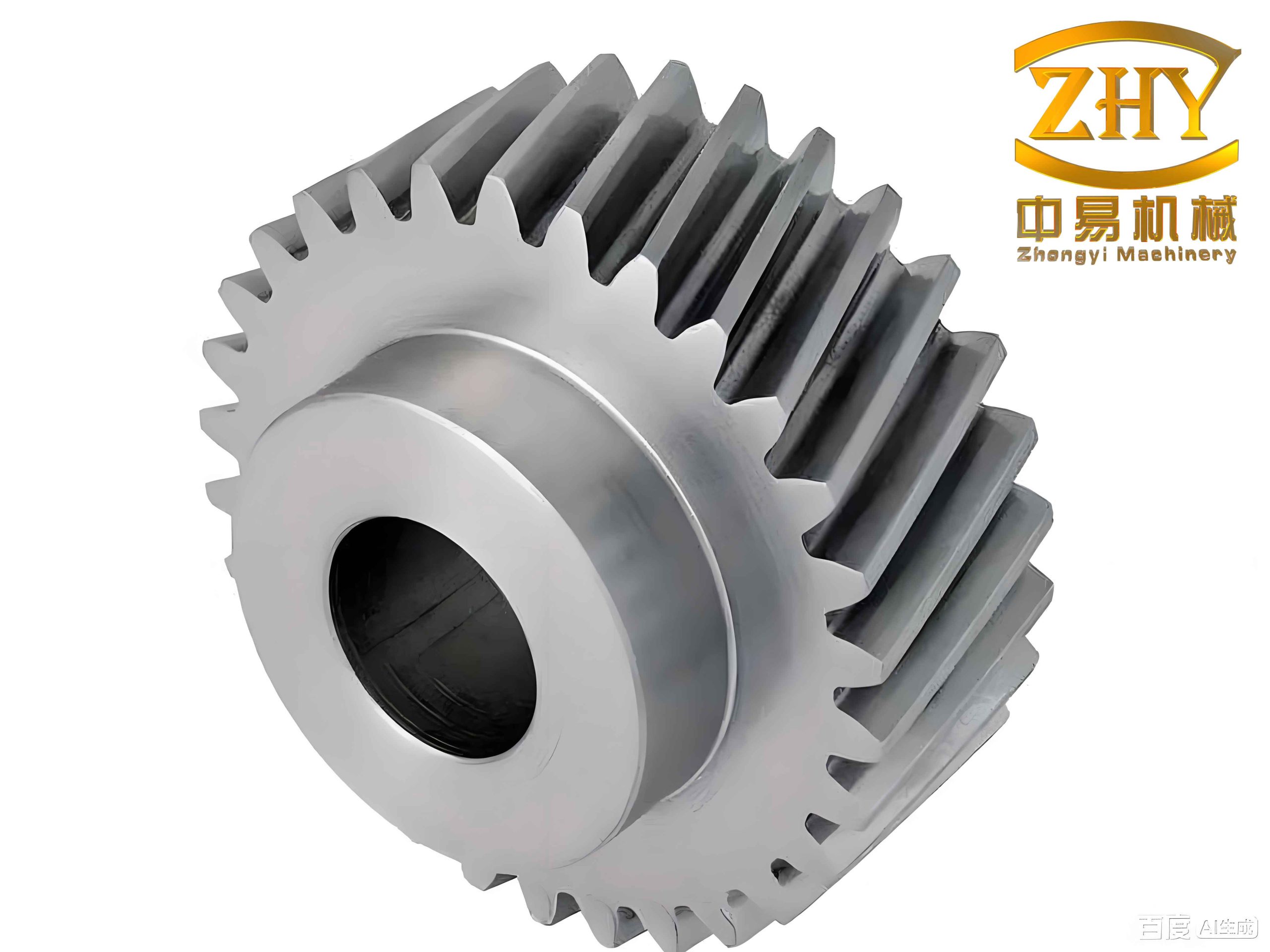
In the field of precision gear manufacturing, the form grinding process of internal helical gears with tooth profile modification plays a critical role in achieving high load capacity and transmission performance. However, inherent machine tool errors during the grinding process often lead to unacceptable tooth surface deviations, especially when the gear incorporates deliberate modifications for noise reduction and stress distribution. In this work, we present a comprehensive methodology to model, analyze, and correct the tooth surface deviations of modified internal helical gears ground on a CNC form grinding machine. Our approach integrates a rigorous mathematical description of the modified tooth surface, a kinematic model of the machine tool, and a quantitative analysis of position-dependent errors. By establishing the coupling relationship between machine tool errors and tooth surface deviations, we develop an on-machine correction software and validate its effectiveness through experimental grinding and inspection.
This study focuses on the internal helical gear with parabolic tooth profile modification in both the tooth crest and tooth root regions. The deviation correction strategy involves adjusting the machine’s radial position, tangential position, and the helical angle interpolation based on the measured tooth profile and helix slope deviations. After compensation, the grinding accuracy improved from Grade 7 to Grade 6 according to ISO 1328 standards, confirming the validity of our error model and correction algorithm.
1. Mathematical Model of Modified Internal Helical Gear
We begin by defining the tooth surface geometry of the internal helical gear with a second‑order parabolic profile modification. The modification amount $\Delta E$ is superimposed on the standard involute profile along the tooth height direction. The modification is applied only at the tooth tip and root regions, while the active flank remains unmodified to preserve the intended contact pattern.
Let $r_b$ be the base circle radius, $\sigma_0$ the base tooth space half‑angle, and $u$ the roll angle of an arbitrary point on the involute. The parabolic modification $\Delta E$ is expressed as:
$$
\Delta E =
\begin{cases}
a_{mp} (u – u_c)^2, & u_d \leq u \leq u_c \\
0, & u_c < u < u_b \\
a_{mp} (u – u_b)^2, & u_b \leq u \leq u_a
\end{cases}
$$
where $a_{mp}$ is the modification coefficient, and $u_a, u_b, u_c, u_d$ are the roll angles at the starting and ending points of the modified segments. The modified involute profile in the transverse plane is given by the position vector $\mathbf{r}(u)$:
$$
\mathbf{r}(u) =
\begin{bmatrix}
r_b \cos(\sigma_0 + u) + (r_b u + \Delta E) \sin(\sigma_0 + u) \\
r_b \sin(\sigma_0 + u) – (r_b u + \Delta E) \cos(\sigma_0 + u) \\
0
\end{bmatrix}
$$
To generate the helical tooth surface, we impose a helical motion. Defining a coordinate system $\{S_2\}$ attached to the transverse section and $\{S_3\}$ moving along the gear axis, the transformation matrix $\mathbf{M}_{3,2}$ is:
$$
\mathbf{M}_{3,2} =
\begin{bmatrix}
\cos\varphi & -\sin\varphi & 0 & 0 \\
\sin\varphi & \cos\varphi & 0 & 0 \\
0 & 0 & 1 & h \\
0 & 0 & 0 & 1
\end{bmatrix}
$$
The rotational angle $\varphi$ and axial displacement $h$ are related by the gear’s helix angle $\beta$ and module $m$:
$$
\varphi = \frac{2 h \sin\beta}{m z}
$$
Thus, the modified tooth surface of the internal helical gear is represented as:
$$
\mathbf{r}_3(u, h) = \mathbf{M}_{3,2} \cdot \mathbf{r}_2(u) =
\begin{bmatrix}
r_b \cos(\sigma_0 + u + \varphi) + (r_b u + \Delta E) \sin(\sigma_0 + u + \varphi) \\
r_b \sin(\sigma_0 + u + \varphi) – (r_b u + \Delta E) \cos(\sigma_0 + u + \varphi) \\
h \\
1
\end{bmatrix}
$$
The unit normal vector $\mathbf{n}_3$ to the tooth surface is obtained by cross‑product of the partial derivatives:
$$
\mathbf{n}_3 = \frac{\partial \mathbf{r}_3 / \partial u \times \partial \mathbf{r}_3 / \partial h}{\left\| \partial \mathbf{r}_3 / \partial u \times \partial \mathbf{r}_3 / \partial h \right\|}
$$
1.1 Form Grinding Wheel Profile
The form grinding wheel must be conjugate to the modified helical gear surface. During grinding, a spatial contact line exists between the wheel and the gear flank. By rotating this line about the wheel axis, we obtain the wheel’s axial cross‑section profile. The transformation from gear coordinates $\{S_3\}$ to wheel coordinates $\{S_s\}$ involves the center distance $a$ and the helix angle $\beta$:
$$
\mathbf{M}_{s,3} =
\begin{bmatrix}
1 & 0 & 0 & -a \\
0 & \cos\beta & -\sin\beta & 0 \\
0 & \sin\beta & \cos\beta & 0 \\
0 & 0 & 0 & 1
\end{bmatrix}
$$
After an additional rotation $\Sigma$ to project the contact line onto the $x_s$–$y_s$ plane, the wheel profile $\mathbf{r}_4$ is computed as:
$$
\mathbf{r}_4(u, h, \Sigma) = \mathbf{M}_{4,s} \cdot \mathbf{M}_{s,3} \cdot \mathbf{r}_3(u, h)
$$
where $\mathbf{M}_{4,s}$ represents a rotation about the $y$-axis by $\Sigma$. The resulting set of points defines the axial cross‑section of the form grinding wheel required to generate the modified helical gear tooth surface.
| Parameter | Value |
|---|---|
| Number of teeth $z$ | 79 |
| Normal module $m_n$ (mm) | 2 |
| Pressure angle $\alpha_n$ (°) | 20 |
| Helix angle $\beta$ (°) | 15 |
| Addendum modification coefficient $x_n$ | 0.4987 |
| Face width $B$ (mm) | 65 |
| Tip modification amount ($\mu$m) | $5 \pm 4$ |
| Root modification amount ($\mu$m) | $5 \pm 4$ |
| Grinding wheel radius (mm) | 65 |
2. CNC Form Grinding Machine Motion Model
The CNC internal gear form grinding machine used in this study has six axes: three linear axes ($X$, $Y$, $Z$) and three rotary axes ($A$, $B$, $C$). The wheel head moves along $Y$ and $Z$, the wheel arm rotates about $A$, and the grinding wheel rotates about $C$. The workpiece rotates about $B$ on a rotary table that also translates along $X$.
To model the relative motion, we establish coordinate systems $\{S_g\}$ fixed to the gear, $\{S_a\}$ fixed to the wheel head at the machine zero, and $\{S_s\}$ fixed to the grinding wheel. The transformations are as follows.
From $\{S_g\}$ to the moving gear coordinate $\{S_m\}$ (rotation by $\varphi_g$ about $Z$):
$$
\mathbf{M}_{m,g} =
\begin{bmatrix}
\cos\varphi_g & \sin\varphi_g & 0 & 0 \\
-\sin\varphi_g & \cos\varphi_g & 0 & 0 \\
0 & 0 & 1 & 0 \\
0 & 0 & 0 & 1
\end{bmatrix}
$$
From $\{S_a\}$ to the wheel arm coordinate $\{S_n\}$ (rotation about $x_a$ by $\varphi_a$):
$$
\mathbf{M}_{n,a} =
\begin{bmatrix}
1 & 0 & 0 & 0 \\
0 & \cos\varphi_a & -\sin\varphi_a & 0 \\
0 & \sin\varphi_a & \cos\varphi_a & 0 \\
0 & 0 & 0 & 1
\end{bmatrix}
$$
From $\{S_s\}$ to the rotating wheel coordinate $\{S_f\}$ (rotation about $y_s$ by $\varphi_s$):
$$
\mathbf{M}_{f,s} =
\begin{bmatrix}
\cos\varphi_s & 0 & -\sin\varphi_s & 0 \\
0 & 1 & 0 & 0 \\
\sin\varphi_s & 0 & \cos\varphi_s & 0 \\
0 & 0 & 0 & 1
\end{bmatrix}
$$
Translations of the wheel head: $c_y$ along $Y_0$, $c_z$ along $Z_0$, and of the gear table: $c_x$ along $X_0$ are represented by:
$$
\mathbf{M}_{0,n} =
\begin{bmatrix}
1 & 0 & 0 & 0 \\
0 & 1 & 0 & -c_y \\
0 & 0 & 1 & c_z \\
0 & 0 & 0 & 1
\end{bmatrix}, \quad
\mathbf{M}_{0,g} =
\begin{bmatrix}
1 & 0 & 0 & -c_x \\
0 & 1 & 0 & 0 \\
0 & 0 & 1 & 0 \\
0 & 0 & 0 & 1
\end{bmatrix}
$$
Finally, the grinding wheel surface expressed in the gear dynamic coordinate $\{S_m\}$ is:
$$
\mathbf{r}_m(u, \sigma, \varphi) = \mathbf{M}_{m,g} \mathbf{M}_{0,g} \mathbf{M}_{0,n} \mathbf{M}_{n,a} \mathbf{M}_{f,s} \mathbf{r}_s(u, \sigma)
$$
where $\mathbf{r}_s(u, \sigma)$ is the wheel surface vector expressed in its own coordinates.
3. Machine Tool Position Error Analysis
During actual grinding, three primary position errors exist: the wheel head mounting error $\Delta y$ (shift along the $Y$ direction), the wheel arm angular error $\Delta \varphi$ (deviation of the $A$ axis), and the workpiece radial positioning error $\Delta x$ (deviation of the $X$ axis). Incorporating these errors, the transformation matrices become:
Wheel head translation with error:
$$
\mathbf{M}_{0,n}’ =
\begin{bmatrix}
1 & 0 & 0 & 0 \\
0 & 1 & 0 & -c_y + \Delta y \\
0 & 0 & 1 & c_z \\
0 & 0 & 0 & 1
\end{bmatrix}
$$
Wheel arm rotation with error:
$$
\mathbf{M}_{n,a}’ =
\begin{bmatrix}
1 & 0 & 0 & 0 \\
0 & \cos(\varphi_a+\Delta\varphi) & -\sin(\varphi_a+\Delta\varphi) & 0 \\
0 & \sin(\varphi_a+\Delta\varphi) & \cos(\varphi_a+\Delta\varphi) & 0 \\
0 & 0 & 0 & 1
\end{bmatrix}
$$
Gear table translation with error:
$$
\mathbf{M}_{0,g}’ =
\begin{bmatrix}
1 & 0 & 0 & -c_x + \Delta x \\
0 & 1 & 0 & 0 \\
0 & 0 & 1 & 0 \\
0 & 0 & 0 & 1
\end{bmatrix}
$$
Substituting these into the overall transformation yields the erroneous tooth surface $\mathbf{r}_m’$ in the gear coordinate system. By comparing $\mathbf{r}_m’$ with the theoretical surface $\mathbf{r}_m$, we compute the tooth surface deviations for a given set of error values.
3.1 Influence of Each Error Component
We performed a quantitative analysis by introducing individual errors at representative magnitudes ($\pm 0.15\,\text{mm}$ for $\Delta x$ and $\Delta y$, $\pm 0.15^\circ$ for $\Delta \varphi$) and evaluating the resulting tooth profile slope deviation $f_{H\alpha}$ and helix slope deviation $f_{H\beta}$ on both left and right flanks. The results are summarized in the following table.
| Error component | Value | Left flank $f_{H\alpha}$ ($\mu$m) | Right flank $f_{H\alpha}$ ($\mu$m) | Left flank $f_{H\beta}$ ($\mu$m) | Right flank $f_{H\beta}$ ($\mu$m) |
|---|---|---|---|---|---|
| $\Delta y$ (mm) | +0.15 | -6.2 | +5.8 | -0.3 | +0.2 |
| $\Delta y$ (mm) | -0.15 | +6.1 | -5.9 | +0.4 | -0.3 |
| $\Delta \varphi$ (°) | +0.15 | +0.5 | +0.6 | +9.2 | +9.5 |
| $\Delta \varphi$ (°) | -0.15 | -0.4 | -0.5 | -9.0 | -9.3 |
| $\Delta x$ (mm) | +0.15 | +7.8 | +8.0 | 0.0 | 0.0 |
| $\Delta x$ (mm) | -0.15 | -7.6 | -7.9 | 0.0 | 0.0 |
From the table we observe:
- $\Delta y$ primarily causes opposite profile slope deviations on left and right flanks, i.e., it induces a pressure angle asymmetry.
- $\Delta \varphi$ mainly affects the helix slope deviation on both flanks in the same direction, simulating a change in the effective helix angle.
- $\Delta x$ produces a uniform profile slope deviation on both flanks, representing a pure radial offset.
These observations form the basis for our correction strategy: by measuring the combined tooth profile and helix slope deviations, we can decompose the error vector into three components and counterbalance them through machine adjustments.
4. Correction Method
Let $f_{H\alpha L}$ and $f_{H\alpha R}$ be the measured tooth profile slope deviations (in $\mu$m) on the left and right flanks, respectively. The required adjustments along the $X$ and $Y$ axes are given by:
$$
\Delta x_{\text{corr}} = \frac{f_{H\alpha L} + f_{H\alpha R}}{2},\qquad
\Delta y_{\text{corr}} = \frac{f_{H\alpha L} – f_{H\alpha R}}{2}
$$
Similarly, let $f_{H\beta L}$ and $f_{H\beta R}$ be the helix slope deviations. The effective helix angle error $\beta_e$ and the additional gear rotation $B_{ge}$ required to compensate are computed as:
$$
\beta_e = \arctan\left(\frac{f_{H\beta L} – f_{H\beta R}}{2 H}\right),\qquad
B_{ge} = \frac{H \tan\beta_e}{r}
$$
where $H$ is the tooth trace evaluation length (typically the face width) and $r$ is the pitch circle radius. The corrected helical interpolation parameters are then fed back into the CNC control system.
To automate the correction process, we developed a dedicated software tool in MATLAB. The user interface accepts the gear basic parameters, modification specifications, and the measured deviations from left and right flanks. The software outputs the adjusted machine coordinates: $\Delta x_{\text{corr}}$, $\Delta y_{\text{corr}}$, and the modified $B$‑axis rotation array. This tool significantly reduces the manual trial‑and‑error cycles typically required in precision gear grinding.
5. Experimental Verification
The grinding experiments were performed on a YK7350 CNC form gear grinding machine. The gear material was 20CrMnTi, case‑hardened to HRC 58–62. After rough machining, the gear blanks were heat‑treated and then finish‑ground using a CBN form wheel dressed to the calculated profile.
We first conducted a trial grind without any compensation. The gear was then inspected on a Gleason 650GMS gear measurement center. The measured deviations are shown in the following table.
As evident from the initial results, the profile slope deviations on left and right flanks were $-8.5\ \mu$m and $+1.9\ \mu$m, respectively, while the helix slope deviations were $+12.2\ \mu$m (left) and $-4.1\ \mu$m (right). Applying the correction formulae, we obtained:
$$
\Delta x_{\text{corr}} = \frac{-8.5 + 1.9}{2} = -3.3\ \mu\text{m},\quad
\Delta y_{\text{corr}} = \frac{-8.5 – 1.9}{2} = -5.2\ \mu\text{m}
$$
For the helix error, with $H = 65\ \text{mm}$ and $r = 79 \times 2 / (2\cos 15^\circ) = 81.75\ \text{mm}$, we computed $\beta_e = 0.138^\circ$ and $B_{ge} = 0.0019\ \text{rad}$. The machine parameters were adjusted accordingly and a second grinding pass was performed.
After compensation, the deviations were significantly reduced, as shown in the table below.
| Parameter | Before correction ($\mu$m) | After correction ($\mu$m) |
|---|---|---|
| Left flank $f_{H\alpha}$ | $-8.5$ | $+4.6$ |
| Right flank $f_{H\alpha}$ | $+1.9$ | $+4.6$ |
| Left flank $f_{H\beta}$ | $+12.2$ | $+1.2$ |
| Right flank $f_{H\beta}$ | $-4.1$ | $-0.9$ |
The compensated gear achieved a flank quality of Grade 6 according to ISO 1328, whereas the original grind fell into Grade 7. The tooth surface accuracy improvement validates the correctness of the error model and the effectiveness of our correction methodology.
6. Conclusion
This paper presented a systematic approach for correcting tooth surface deviations of internal helical gears with profile modification during form grinding. The main contributions are summarized as follows:
- A complete mathematical model of the modified internal helical gear tooth surface was established, and the conjugate form grinding wheel profile was accurately computed based on the spatial contact line.
- A six‑axis CNC form grinding machine kinematic model was developed, incorporating three key position errors (radial, axial, and angular). The quantitative influence of each error on tooth profile and helix slope deviations was revealed through simulation.
- A decoupled correction strategy was derived: radial errors affect both flanks equally, lateral errors cause opposite effects, and angular errors primarily alter the helix. This allows independent compensation using measured deviations.
- An automated correction software was developed and validated through actual grinding experiments on a YK7350 machine. The final gear quality improved from Grade 7 to Grade 6, confirming the practical value of the method.
The proposed technique can be directly applied in production environments to reduce setup time and ensure consistent gear quality. Future work will extend the analysis to higher‑order modifications and investigate the influence of geometric errors of the grinding wheel itself.