
In our research work, we focus on the nonlinear dynamic behavior of helical gear transmission systems subjected to progressive tooth surface wear. The interplay between wear-induced morphology evolution and meshing characteristics significantly alters time-varying mesh stiffness (TVMS) and transmission error, which are critical sources of gear system failures. Traditional analytic approaches often ignore the coupling between wear and friction, thus failing to capture the actual dynamic evolution under realistic operating conditions. We propose a comprehensive model that integrates an improved Archard wear model for helical gears, a wear-dependent TVMS and transmission error calculation method, a load sharing factor (LSF)-based friction model under mixed lubrication, and a helical gear-rotor-bearing friction dynamics model. Through systematic numerical simulations, we investigate how progressive wear influences system dynamics at fixed and varying rotational speeds. Our findings reveal that vibration displacement increases with wear depth, transitioning from single-period to multi-period motions, and chaotic dynamics can dominate vibration amplification beyond wear effects. We also validate our model against experimental data, demonstrating its effectiveness in capturing core nonlinear features.
1. Wear Model for Helical Gears
We employ a modified Archard wear equation to predict the evolution of tooth surface wear on helical gears. Under the assumptions that contact pressure is uniformly distributed along the contact line, wear depth is small enough to neglect tooth geometry changes, and the gear material is linearly elastic and isotropic, the wear depth on the driving pinion at a point A is given by:
$$h_{w}^{A} = N_s \cdot 2 p_A k_s a_H \left| \frac{V_1 – V_2}{V_1} \right|$$
where: \(N_s\) is the number of meshing cycles, \(p_A\) is the contact pressure at point A, \(k_s\) is the wear coefficient (taken as \(5\times10^{-18}\) in our study), \(a_H\) is the half-contact width, and \(V_1, V_2\) are the sliding velocities of the driving and driven gear surfaces. The wear coefficient is selected based on published experimental data for similar lubricated contacts.
We discretize the helical gear into thin slices along the face width, modeling each slice as a spur gear. The contact line is inclined due to the helix angle; wear on each slice is computed independently. The total wear transmission error for a tooth pair is taken as the minimum wear depth along the contact line because the highest point of single tooth contact governs the effective error. The overall wear transmission error is then obtained by superimposing the contributions from all meshing tooth pairs:
$$e_{\text{wear}} = \sum_{i=1}^{n} e_{L_b,i}$$
where \(n\) is the number of tooth pairs simultaneously in contact, and \(e_{L_b,i}\) is the single-tooth wear transmission error of the \(i\)-th pair. We perform a fifth-order Fourier series fitting for the periodic error to facilitate dynamic analysis.
| Parameter | Gear 1 (Pinion) | Gear 2 (Wheel) |
|---|---|---|
| Number of teeth | 24 | 48 |
| Module (mm) | 2 | 2 |
| Face width (mm) | 25 | 25 |
| Pressure angle (°) | 20 | 20 |
| Helix angle (°) | 15 | 15 |
| Normal pressure angle (°) | 20 | 20 |
2. Time-Varying Mesh Stiffness and Load Sharing Factor of Worn Helical Gears
We compute the TVMS of worn helical gears using the slice method combined with the energy method. The Hertzian contact stiffness is:
$$k_h = \frac{\pi E b}{4(1-\nu^2)}$$
For each slice, the wear depth \(h_w(\alpha)\) modifies the tooth thickness, thereby affecting the bending, shear, and axial compressive stiffnesses. The bending stiffness of a worn tooth slice is:
$$k_b = \int_{0}^{b} \frac{E \, dy}{\displaystyle \int_{0}^{R_b – R_f} \frac{12 D^2 \, dx}{[2R_b \sin\alpha_2 – h_w(\alpha)\cos\alpha]^3}}$$
with the auxiliary function \(D = [L(y)-x]\cos\alpha_1(y) – h(y)\sin\alpha_1(y)\). Similar expressions exist for shear stiffness \(k_s\) and axial stiffness \(k_a\). The fillet-foundation stiffness is based on Muskhelishvili’s theory. The total mesh stiffness of the \(i\)-th tooth pair is:
$$\frac{1}{k_i} = \frac{1}{k_h} + \frac{1}{k_{b1,i}} + \frac{1}{k_{b2,i}} + \frac{1}{k_{a1,i}} + \frac{1}{k_{a2,i}} + \frac{1}{k_{s1,i}} + \frac{1}{k_{s2,i}} + \frac{1}{k_{f1,i}} + \frac{1}{k_{f2,i}}$$
The overall TVMS is \(k_m = \sum_{i=1}^{n} k_i\). The load sharing factor (LSF) for tooth pair \(i\) is defined as:
$$\text{LSF}_i = \frac{k_i}{k_m}$$
We computed the TVMS for healthy gears and for wear levels of \(N_s = 1\times10^8, 2\times10^8, 3\times10^8\). The results show that TVMS decreases with wear, especially near the pitch line, and the LSF becomes more uneven.
| Wear level (\(N_s\)) | Average TVMS (N/m) |
|---|---|
| Healthy | 5.348 × 10^8 |
| 1 × 10^8 | 5.330 × 10^8 |
| 2 × 10^8 | 5.301 × 10^8 |
| 3 × 10^8 | 5.262 × 10^8 |
3. Mixed Lubrication Friction Model for Helical Gears
We develop a friction coefficient model under mixed lubrication conditions that accounts for the varying equivalent radius along the contact line. Using the slice method, the instantaneous friction coefficient at a point \((x,y)\) on the tooth surface is:
$$\mu(x,y) = \frac{0.0127 \times 1.13}{1.13 – R_{\text{avg}}} \lg\left( \frac{29700 \, F(x)}{L_b(x) \, \eta \, |v_s(x,y)| \, v_e^2(x,y)} \right)$$
where \(R_{\text{avg}}\) is the average surface roughness (taken as 0.8 μm for both gears), \(\eta\) is the dynamic viscosity (0.058 Pa·s), \(L_b(x)\) is the actual contact length, \(F(x)\) is the contact force on the line (obtained from LSF and input torque), \(v_s\) and \(v_e\) are the sliding and entrainment velocities respectively. The contact line length varies with the meshing position:
$$L_b(x) =
\begin{cases}
x / \sin\beta_b, & 0 < x < \varepsilon_\beta p_b \\
b / \cos\beta_b, & \varepsilon_\beta p_b < x < \varepsilon_\alpha p_b \\
(A_1B_2 – x)/\sin\beta_b, & \varepsilon_\alpha p_t < x < A_1B_2
\end{cases}$$
where \(\beta_b\) is the base helix angle, \(p_b\) is the base pitch, \(\varepsilon_\alpha, \varepsilon_\beta\) are the transverse and overlap contact ratios, and \(b\) is the face width. The total friction force and moments on the pinion and gear are obtained by integrating the elemental friction forces over the contact lines.
4. Helical Gear-Rotor-Bearing Friction Dynamic Model
We establish a 24-degree-of-freedom lumped-parameter dynamic model of the helical gear transmission system, including four tapered roller bearings (two at each shaft). The displacements of the bearings and gears in x, y, z directions and the rotational degrees of freedom (\(\theta_{1x}, \theta_{1y}, \theta_{1z}, \theta_{2x}, \theta_{2y}, \theta_{2z}\)) are considered. The bearing forces are modeled using Hertzian line contact theory. For a tapered roller bearing, the radial and axial displacements lead to roller deformation:
$$\delta_{ei} = \delta_{ri}\cos\alpha_e + \delta_a \sin\alpha_e$$
where \(\delta_{ri} = x_b\cos\theta_i + y_b\sin\theta_i\) and \(\delta_a = z_b\). The bearing force components are summed over all rollers.
The meshing line displacement \(x_n\) includes the contribution of relative motions, the static transmission error \(e(t)\), and the wear transmission error \(e_{\text{wear}}\):
$$x_n = \left[ R_{b1}\theta_{1z} – R_{b2}\theta_{2z} + (x_1 – x_2)\sin\alpha_t \right]\cos\beta_b + \left[ z_1 – z_2 + (R_{b1}\theta_{1y} – R_{b2}\theta_{2y}) \right]\sin\beta_b + (y_1 – y_2)\cos\alpha_t \cos\beta_b – e(t) – e_{\text{wear}}$$
The meshing force is \(F_m = c_m \dot{x}_n + k_m f(x_n)\), where \(c_m\) is the mesh damping and \(f(x_n)\) is the backlash function. The complete equations of motion for the bearings and gears are constructed using Newton’s second law. We solve the system using a fourth-order Runge-Kutta method with a fixed time step.
5. Dynamic Response Under Fixed Speed and Varying Wear
We first fix the rotational speed at 5818 rad/min (meshing frequency \(f_m = 2327\) Hz) and analyze the dynamic response for healthy and three wear levels. The bifurcation behavior is examined through Poincaré sections and phase portraits.
| Wear level | Motion type | Peak-to-peak vibration displacement (mm) | Dominant sideband interval |
|---|---|---|---|
| Healthy | Period-1 | 0.05 | None (only \(f_m\)) |
| \(N_s=1\times10^8\) | Period-2 | 0.07 | \(f_m/2\) |
| \(N_s=2\times10^8\) | Period-2 | 0.09 | \(f_m/2\) |
| \(N_s=3\times10^8\) | Period-3 | 0.12 | \(f_m/3\) |
Our analysis shows that as wear increases, the system transitions from period-1 to period-2 to period-3 motion. The FFT spectra confirm that the sideband intervals change from \(f_m\) to \(f_m/2\) and then to \(f_m/3\). The amplitudes at \(f_m\) and its harmonics grow with wear depth. Time-frequency wavelet maps further reveal time-dependent amplitude modulation under wear.
6. Dynamic Response Under Varying Speed and Different Wear Levels
We then sweep the rotational speed from 5200 to 6400 rad/min to investigate how wear affects the nonlinear evolution of the system. Bifurcation diagrams and maximal Lyapunov exponent (TLE) are computed for each wear state.
| Wear level | Speed ranges for chaotic motion (rad/min) | Speed ranges for period-doubling motion (rad/min) | Speed ranges for period-1 motion (rad/min) |
|---|---|---|---|
| Healthy | 5200–5350, 5397–5488 | 5488–5810 | 5810–6400 |
| \(N_s=1\times10^8\) | 5200–5539 | 5539–5919 | 5919–6400 |
| \(N_s=2\times10^8\) | 5243–5581 | 5581–6101 | 5200–5243, 6101–6400 |
| \(N_s=3\times10^8\) | 5370–5462, 5519–5615 | 5615–6224 | 5200–5370, 6224–6400 |
The general evolutionary path for all wear levels is: chaotic → period-doubling → period-1 as speed increases. However, with more severe wear, the period-1 window shrinks and the period-doubling window expands. A striking finding is that chaotic motion can amplify vibration displacement more than wear itself. For example, in the healthy case, chaotic motion at 5200 rad/min produces displacement amplitudes up to 90% of the maximum in the entire speed range, while at \(N_s=3\times10^8\), the maximum displacement occurs within chaotic regimes. The FFT spectra show that sideband intervals evolve from \(f_m/4\) to \(f_m/3\) to \(f_m/2\) and finally to \(f_m\) as speed increases, reflecting the transition from chaos to order.
7. Experimental Validation
We conducted experiments on a helical gear test rig with heavily worn gears (operated at 3000 rad/min without load) to validate our model. The acceleration signals measured by piezoelectric sensors were compared to our simulation results and also to a simplified model that only considers TVMS variation without friction and transmission error changes due to wear.
| Source | Main peak frequency (Hz) | Harmonics observed | Sidebands observed | Amplitude at \(f_m\) (m/s²) |
|---|---|---|---|---|
| Experiment | ~1160 (meshing frequency) | \(2f_m, 3f_m, 4f_m\) | \(f_m \pm f_r\) (rotating frequency modulation) | ~0.9 |
| Our model (wear + friction) | ~1160 | \(2f_m, 3f_m, 4f_m\) | Weak sidebands at \(2f_m \pm f_r\) | ~0.75 |
| Simplified model (TVMS only) | ~1160 | None | None | ~0.5 |
Our model captures the main meshing frequency and its harmonics with reasonable amplitude. The simplified model fails to reproduce harmonic content and sidebands. The discrepancy in sideband amplitudes is attributed to simplifications in boundary conditions and the omission of nonlinear damping and casing coupling. Nonetheless, the results confirm that it is essential to include wear-induced transmission error and friction changes when modeling dynamics of worn helical gear systems.
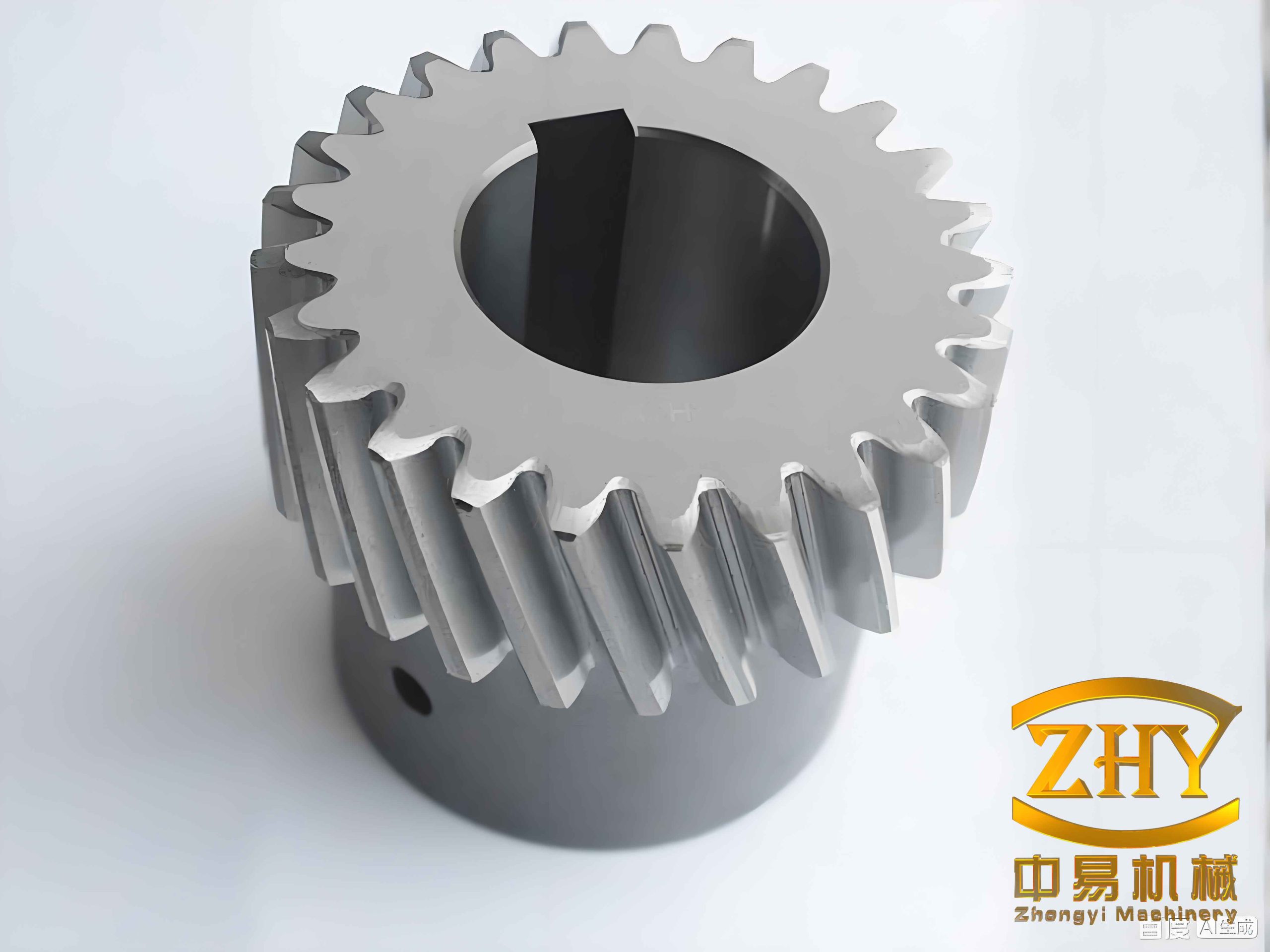
Finally, we illustrate a typical worn helical gear used in our study. The image below shows the actual gear tooth surface after extensive wear testing.
8. Conclusions
Through this comprehensive study, we have demonstrated the profound influence of progressive tooth surface wear on the nonlinear dynamic response of helical gear transmission systems. Our key conclusions are:
- At a fixed speed of 5818 rad/min, wear induces a transition from period-1 to period-3 motion, with sideband intervals shifting from \(f_m\) to \(f_m/3\) and vibration amplitudes increasing significantly.
- Over a broad speed range (5200–6400 rad/min), the system follows a common evolutionary path: chaos → period-doubling → period-1. Wear tends to expand the period-doubling regime and compress the period-1 regime.
- Chaotic motion can dominate vibration amplification, often exceeding the effect of wear alone. This highlights the importance of avoiding chaotic operating conditions in gear design.
- Validations against experimental data confirm that our model (including wear-induced TVMS, transmission error, and friction) captures the essential nonlinear characteristics, whereas simplified models neglecting friction and transmission error variations fail to reproduce harmonic and sideband features.
Our research provides a theoretical foundation for fault diagnosis of helical gear systems and offers guidance for vibration control in practical applications.