
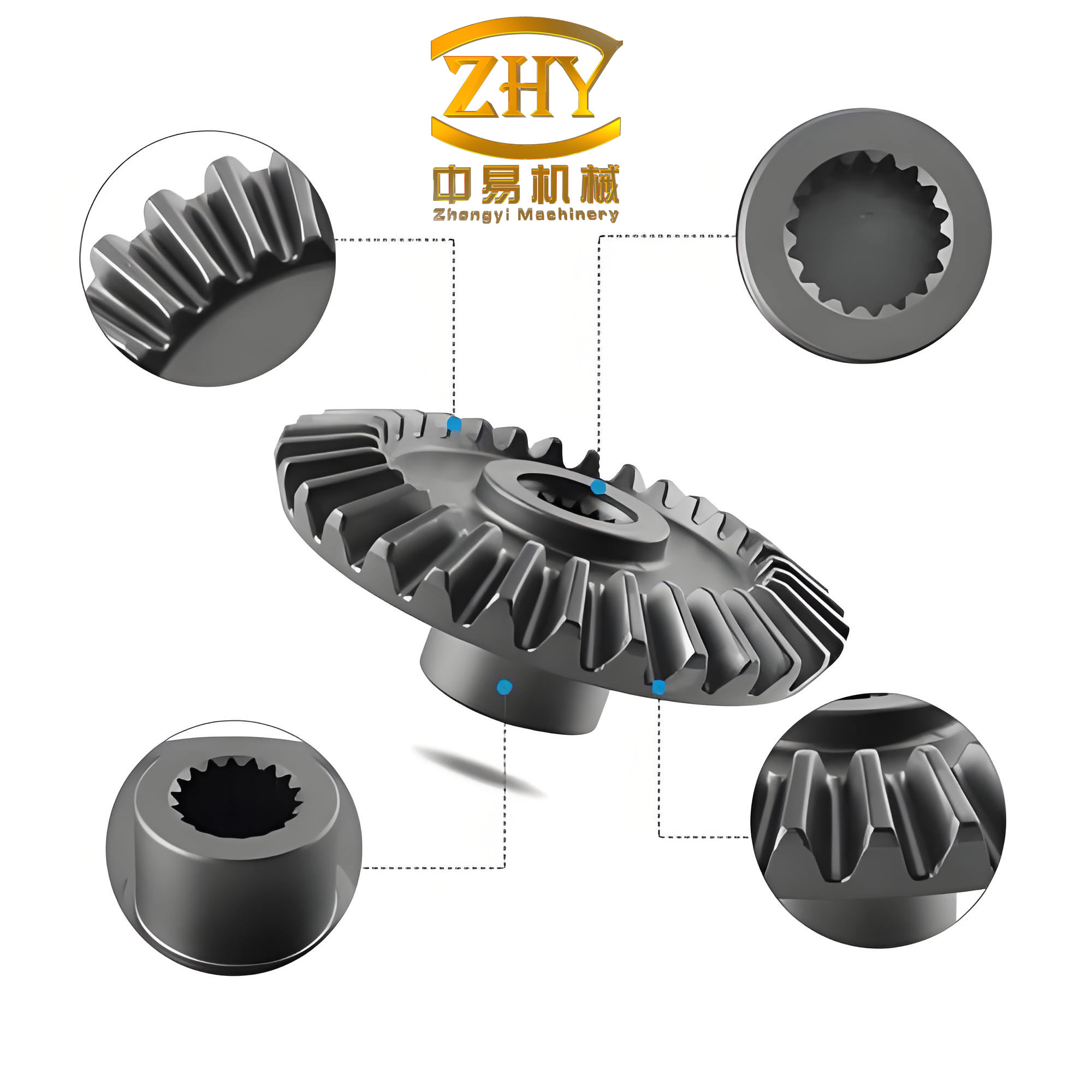
I carried out a numerical study of a two-step precision forging route for a straight bevel gear, using a central shunting cavity to improve tooth filling and reduce forming load. The straight bevel gear is a widely used transmission component in vehicles, machine tools, ships, and general mechanical systems. Its precision forging is attractive because it can reduce material waste, improve load-carrying capacity, and shorten the manufacturing chain. However, the straight bevel gear also presents a difficult forming problem: the small-end tooth tip is often the last region to fill, and when the process relies only on a single open-die stroke, the forming load rises sharply near the end of the stroke. I therefore examined whether a central shunting precision forging process could provide a better balance between tooth filling and die life for the straight bevel gear.
My approach was based on the principle of divided flow forging. In a divided flow process, the material is allowed to flow not only into the high-precision tooth cavity but also into a lower-precision relief region. This relief region acts as a temporary reservoir and a pressure-relief zone. When the punch continues to move, the material in the relief region can be displaced back into the tooth cavity or can remain as an internal or external feature that is later removed if necessary. For a straight bevel gear, I placed the relief region near the small end of the gear, because the small end is the region that most often suffers from incomplete filling. I used an upper punch with a boss to form a pre-forging depression in the small-end face of the billet. In the final forging step, I used a punch without a boss, so the depression acted as a central shunting cavity. The straight bevel gear therefore experienced a two-stage flow path: first, a controlled outward and inward flow that created the shunting volume; second, a final flow that filled the tooth shape while the cavity accommodated excess material and reduced contact pressure.
The basic geometric condition for the shunting cavity can be expressed by the ratio of the shunting volume to the total cavity volume:
$$\phi_s = \frac{V_s}{V_c}$$
where \(V_s\) is the volume of the central shunting cavity and \(V_c\) is the total volume of the die cavity. I also defined a filling coefficient for the tooth region:
$$\eta_f = \frac{V_{\text{filled}}}{V_{\text{cavity}}}$$
For a successful straight bevel gear forging, the target is \(\eta_f \to 1.0\) in the tooth region while keeping the maximum forming load and the non-uniformity of strain, stress, and temperature within acceptable limits. I used the finite element software DEFORM-3D to compare the central shunting precision forging process with a traditional open precision forging process. The traditional open precision forging process used a single stroke and a die cavity similar to the final forging cavity, but without the central relief feature. The straight bevel gear material was 18CrMnTi, and the initial billet temperature was 800 °C. The dies were initially at 200 °C, the upper punch speed was 50 mm/s, and the friction coefficient between the billet and the dies was 0.25. The billet was meshed with approximately 80,000 elements. The heat transfer coefficient between the billet and the dies was 5 N/(s·mm·°C), and the heat transfer coefficient between the billet and the air was 0.02 N/(s·mm·°C). I used these settings to keep the comparison between the central shunting precision forging process and the traditional open precision forging process as consistent as possible.
The straight bevel gear used in my model had 20 teeth, a module of 2.75 mm, and a pressure angle of 20°. The forged geometry included a central hole and a tooth profile that required filling along the tooth width. The small end of the straight bevel gear was the critical region for filling, because the local section thickness is smaller and the die contact time is longer. This leads to more rapid cooling and higher flow stress. In a traditional open precision forging process, the material near the small end can become effectively locked before the tooth tip is completely filled. The punch then continues to press against a nearly rigid region, and the load increases rapidly. In my central shunting precision forging process, the pre-forged depression changed the local stress state and provided a path for material to move inward rather than only outward into the tooth cavity. This is the main reason why I expected the straight bevel gear to fill more completely and with lower load.
I used the following equivalent strain definition to evaluate deformation uniformity:
$$\bar{\varepsilon} = \int_0^t \sqrt{\frac{2}{3}\dot{\varepsilon}_{ij}\dot{\varepsilon}_{ij}}\,dt$$
where \(\dot{\varepsilon}_{ij}\) is the strain-rate tensor. The equivalent stress was evaluated as:
$$\bar{\sigma} = \sqrt{\frac{3}{2}s_{ij}s_{ij}}$$
where \(s_{ij}\) is the deviatoric stress tensor. For the thermal field, I used the transient heat conduction equation with a plastic dissipation source:
$$\rho c_p \frac{\partial T}{\partial t} = k \nabla^2 T + \dot{q}_{\text{plastic}}$$
where \(\rho\) is density, \(c_p\) is specific heat, \(k\) is thermal conductivity, and \(\dot{q}_{\text{plastic}}\) is the heat generated by plastic deformation. The forming load was calculated by integrating the interface pressure over the contact area:
$$F = \int_A p(T,\bar{\varepsilon},\dot{\bar{\varepsilon}})\,dA$$
I also defined three simple non-uniformity indicators for the straight bevel gear:
$$\Delta \varepsilon = \bar{\varepsilon}_{\max} – \bar{\varepsilon}_{\min}$$
$$\Delta \sigma = \bar{\sigma}_{\max} – \bar{\sigma}_{\min}$$
$$\Delta T = T_{\max} – T_{\min}$$
These indicators allowed me to compare the central shunting precision forging process with the traditional open precision forging process without relying only on visual contour plots. A lower \(\Delta \varepsilon\), \(\Delta \sigma\), and \(\Delta T\) along the tooth width indicates a more uniform deformation history, which is beneficial for dimensional accuracy and for reducing residual stress in the straight bevel gear.
I first examined the load–time curves. In the central shunting precision forging process, the pre-forging step began with the formation of a truncated conical depression. During this early stage, the billet had a relatively large free surface, so the load increased smoothly with punch displacement. When the tooth-shaped region began to fill, the free surface decreased and friction between the billet and the die increased. The load then rose more quickly, reaching a maximum of about 5.44 MN in the pre-forging step. In the final forging step, the pre-formed depression acted as a central shunting cavity. Initially, part of the metal continued to flow into the tooth cavity, while another part flowed inward to fill or maintain the depression. Because this inward flow reduced the hydrostatic pressure in the tooth cavity, the forming load remained lower than in the open process. As the tooth cavity approached complete filling, the contact area increased and the load rose again. The maximum final forging load was about 5.15 MN. This value is significantly lower than the maximum load in the traditional open precision forging process.
In the traditional open precision forging process, the deformation began mainly as upsetting. The load increased slowly at first because the billet was compressed between relatively flat surfaces. As the billet contacted the tooth cavity and began to fill the tooth shape, the load increased rapidly. When the tooth shape reached a certain degree of filling, the small end of the straight bevel gear had already been in contact with the die for a long time and had cooled significantly. The flow stress in that region therefore became high, and the local material flow slowed. This slowing effect constrained the flow of neighboring material, making further tooth filling difficult. The load curve became unstable and eventually rose steeply to about 9.09 MN. This sharp final rise is a characteristic problem of the traditional open precision forging of a straight bevel gear. It also indicates that much of the punch work near the end of the stroke is spent increasing the internal pressure rather than filling the tooth cavity.
The load reduction achieved by central shunting precision forging can be quantified as follows:
$$\lambda_F = \frac{F_{\text{open}} – F_{\text{central}}}{F_{\text{open}}} \times 100\%$$
Using the maximum final forging load of the central shunting process, the reduction relative to the traditional open process was about 43.3%. Using the pre-forging load, the reduction was about 40.2%. Both values show that the central shunting cavity had a strong effect on the load history of the straight bevel gear. The pre-forging step did not simply add cost; it redistributed the material and created a flow path that made the final forging step much more stable.
| Process stage | Maximum load (MN) | Load behavior | Straight bevel gear filling response |
|---|---|---|---|
| Central shunting pre-forging | 5.44 | Smooth rise, then faster rise as tooth region fills | Forms central depression and prepares shunting volume |
| Central shunting final forging | 5.15 | Relatively stable rise, reduced final peak | Tooth cavity fills fully and uniformly |
| Traditional open precision forging | 9.09 | Slow initial rise, steep and fluctuating final rise | Small-end tooth tip fills poorly and unevenly |
I then analyzed the equivalent strain fields. In the central shunting precision forging process, the pre-forging and final forging stages produced a relatively uniform deformation distribution along the tooth width of the straight bevel gear. The final forging stage had an average equivalent strain of about 2.1 in the tooth region, and the difference across the tooth width was small. This means that the material in the large end, middle region, and small end experienced comparable amounts of plastic deformation. A more uniform strain field is desirable because it reduces the risk of localized residual stress, cracking, and distortion after forging. It also helps maintain symmetrical tooth profiles in the straight bevel gear.
In the traditional open precision forging process, the deformation was much less uniform. The material near the tooth ends experienced larger strains, while the middle region experienced smaller strains. The maximum difference in equivalent strain along the tooth width was approximately 2.2, and the local strain heterogeneity was visually obvious. The small end and large end were not deformed in the same way. This non-uniformity is caused by the differences in local cooling, contact time, and constraint. The small end cooled faster and resisted flow, while the large end had more material and a different contact condition. As a result, the strain field in the traditional open precision forging of the straight bevel gear was highly path-dependent and less controllable. The central shunting process reduced this path dependence by allowing material to move into the central cavity instead of forcing all deformation to occur in the tooth cavity.
| Process | Equivalent strain uniformity | Observed strain difference along tooth width | Effect on straight bevel gear quality |
|---|---|---|---|
| Central shunting pre-forging | Good | Small | Prepares uniform flow for final filling |
| Central shunting final forging | Very good | Small, average about 2.1 | Promotes symmetrical tooth profiles |
| Traditional open precision forging | Poor | Large, about 2.2 or more locally | Creates uneven deformation and residual stress |
The equivalent stress fields showed a similar trend. In the central shunting precision forging process, the pre-forging stage had its maximum stress near the small-end tooth tip, with a secondary maximum near the large-end tooth tip. In the final forging stage, the maximum equivalent stress was about 500 MPa and appeared near the large-end tooth tip, while the small-end tooth tip had a slightly lower value. The stress difference along the tooth width was not large. This is important for the straight bevel gear because a moderate and evenly distributed stress field reduces the chance of local overloading in the die and in the workpiece. Lower local pressure also reduces die wear and delays fatigue failure of the die insert.
In the traditional open precision forging process, the tooth region experienced large local deformation, and the equivalent stress was correspondingly high. The maximum stress reached nearly 900 MPa and was concentrated at the small-end tooth tip. The stress distribution alternated between high-stress and low-stress zones along the tooth width. This kind of alternating stress field is unfavorable because it can generate a complex residual stress state after unloading. For a straight bevel gear, residual stress can affect tooth contact patterns, noise, vibration, and fatigue life. It can also increase the risk of cracking during subsequent heat treatment. The central shunting cavity helped reduce the peak stress by providing an additional deformation path and by lowering the pressure required to fill the tooth cavity.
| Process | Maximum equivalent stress (MPa) | Location of maximum stress | Stress distribution along tooth width |
|---|---|---|---|
| Central shunting pre-forging | Approximately 800–900 | Small-end tooth tip | Relatively continuous |
| Central shunting final forging | About 500 | Large-end tooth tip | Uniform and moderate |
| Traditional open precision forging | Nearly 900 | Small-end tooth tip | Highly non-uniform and alternating |
Temperature is another critical factor in the precision forging of a straight bevel gear. In the central shunting precision forging process, the pre-forging stage produced a maximum temperature of about 870 °C in the large-end tooth profile region. The small-end face had the lowest temperature. The temperature distribution along the tooth width was relatively uniform, with most of the tooth region staying near 800 °C. In the final forging stage, the highest temperature remained at the large-end tooth profile and in the flash region, approaching 900 °C because of plastic work heating. The small-end temperature distribution was more uniform than after pre-forging because the central shunting cavity allowed material to flow and reduced the local concentration of deformation. This uniform temperature field is beneficial for the straight bevel gear because it keeps the flow stress relatively consistent and helps the small-end tooth tip fill before it becomes too cold.
In the traditional open precision forging process, the highest temperature appeared at both the large-end and small-end tooth tips, reaching nearly 950 °C. The temperature decreased from the tooth ends toward the middle region, with the lowest value around 280 °C. This wide temperature range is extremely unfavorable. A large temperature difference changes the local flow stress, makes the material flow unevenly, and creates thermal gradients that can lead to residual thermal stress. In a straight bevel gear, this can result in incomplete filling at the small end, uneven tooth dimensions, and reduced die life. The central shunting precision forging process clearly reduced the temperature difference and made the thermal history more uniform.
| Process | Maximum temperature (°C) | Minimum temperature (°C) | Temperature difference (°C) | Effect on straight bevel gear filling |
|---|---|---|---|---|
| Central shunting pre-forging | About 870 | About 800 | About 70 | Keeps flow stress moderate |
| Central shunting final forging | About 900 | About 800 | About 100 | Supports complete tooth filling |
| Traditional open precision forging | Nearly 950 | About 280 | About 670 | Causes cold small-end locking and poor filling |
I also compared the final forged shape of the straight bevel gear. In the central shunting precision forging process, both the pre-forged and final forged tooth profiles were completely filled. The final forging had a smooth and full tooth surface, a symmetrical tooth profile, and a small, uniform flash. The central depression did not interfere with the final tooth accuracy; instead, it improved the filling behavior. In the traditional open precision forging process, the tooth accuracy was lower. The tooth tips were not completely filled, and the filling was uneven. The tooth surface was not full or smooth. In particular, the small-end tooth profile of the straight bevel gear was asymmetric and severely deformed. The flash was larger and more uneven. These observations confirm that the central shunting cavity is not merely a load-reduction feature; it also directly improves the formability of the straight bevel gear.
| Quality indicator | Central shunting precision forging | Traditional open precision forging |
|---|---|---|
| Tooth tip filling | Complete | Incomplete, especially at small end |
| Tooth surface smoothness | Good | Poor |
| Tooth profile symmetry | Good | Poor at small end |
| Flash uniformity | Small and uniform | Large and uneven |
| Overall straight bevel gear accuracy | High | Low |
The role of the central shunting cavity can be understood through the local stress state. In a conventional open die forging of a straight bevel gear, the tooth cavity is a closed or nearly closed region. As the punch advances, the material in the tooth cavity is subjected to high hydrostatic pressure. This pressure is necessary for filling, but it also increases the forming load and the die contact pressure. In the central shunting process, the cavity provides a lower-pressure region. Material can flow toward the cavity when the pressure in the tooth cavity becomes high. This reduces the maximum pressure and allows the punch to continue moving without an excessive load spike. The shunting cavity therefore acts as a pressure regulator. It also changes the material flow direction near the small end, which is the most difficult region to fill in a straight bevel gear.
I found that the pre-forging step must be designed carefully. If the central depression is too small, it cannot provide enough shunting volume, and the final forging load will still be high. If the depression is too large, the final forging may not have enough material to fill the tooth cavity, or the central hole may become excessive. The optimal shunting volume depends on the tooth geometry, the billet size, the friction condition, and the temperature. In my simulation, the pre-forged depression created by the upper punch boss was sufficient to improve filling without causing underfilling elsewhere. The straight bevel gear filled completely, and the final load remained below the pre-forging load. This suggests that the central shunting design can be tuned to balance material distribution and pressure relief.
The flow stress of 18CrMnTi during warm forging can be represented in a general form as:
$$\bar{\sigma} = K \bar{\varepsilon}^n \dot{\bar{\varepsilon}}^m \exp\left(\frac{\beta}{T}\right)$$
where \(K\) is a strength coefficient, \(n\) is the strain-hardening exponent, \(m\) is the strain-rate sensitivity, and \(\beta\) is a temperature-related coefficient. In the actual DEFORM-3D simulation, the flow stress was interpolated from tabular data. The important point is that the flow stress increases as temperature decreases. In the traditional open precision forging of a straight bevel gear, the small end cools faster, so its flow stress becomes higher. The central shunting process reduces the cooling effect at the small end by maintaining a more uniform deformation and temperature field. This is one of the reasons why the small-end tooth tip fills more completely.
The frictional condition also affects the straight bevel gear forging process. With a friction coefficient of 0.25, the material near the die surface experiences significant shear resistance. In the traditional open process, this friction contributes to the high pressure at the end of the stroke. In the central shunting process, the central cavity reduces the contact area in the high-pressure region and provides an alternative flow path. As a result, the friction-induced load increase is less severe. I did not vary the friction coefficient in this study, but the comparison between the two processes shows that the central shunting design is beneficial even under the same friction condition.
From a die-life perspective, the central shunting precision forging process has clear advantages for the straight bevel gear. The maximum forming load is lower, the maximum contact stress is lower, and the temperature distribution is more uniform. These factors reduce the mechanical and thermal loads on the die. In the traditional open process, the small-end tooth tip experiences high pressure and a large temperature difference. This combination can cause local plastic deformation, wear, and thermal fatigue of the die insert. The central shunting process reduces the peak pressure and avoids the extreme temperature gradient. Therefore, it can potentially extend die life while maintaining tooth filling. This is important because the contradiction between tooth filling and die life is one of the main obstacles in the precision forging of a straight bevel gear.
| Die-life factor | Central shunting precision forging | Traditional open precision forging |
|---|---|---|
| Maximum forming load | About 5.15 MN final, 5.44 MN pre | About 9.09 MN |
| Maximum contact pressure | Moderate | High |
| Temperature difference | Small | Large |
| Risk of local die overload | Low | High |
| Potential die life | Longer | Shorter |
I also considered the strain path in the straight bevel gear. In the central shunting process, the pre-forging step imposed a moderate and relatively uniform strain on the billet. The final forging step then completed the tooth shape with a smaller additional strain. This two-step strain path avoids the sudden localization of deformation that occurs in a single open stroke. In the traditional open process, the tooth corners and small-end regions experience rapid strain localization. This localization increases the local flow stress and makes the material less able to fill the remaining cavity. The central shunting process distributes the total strain over two steps, which reduces the maximum local strain and improves the final filling.
The temperature history in the straight bevel gear also supports this conclusion. In the central shunting process, the pre-forging step does not expose the small end to a long, high-pressure contact period. The final forging step then begins with a relatively uniform temperature field. In the traditional open process, the small end is in contact with the die for a long time during the single stroke, so it cools continuously. By the time the tooth tip should fill, the local temperature is low and the flow stress is high. The central shunting process avoids this late-stage cold locking by allowing the material to flow earlier and more uniformly. This is especially important for the straight bevel gear because the small end has a small thermal mass and loses heat quickly.
I evaluated the filling behavior using the filling coefficient \(\eta_f\). In the central shunting precision forging process, the final tooth cavity reached \(\eta_f \approx 1.0\). The small-end tooth tip, which is the critical region, was completely filled. In the traditional open precision forging process, the small-end tooth tip had \(\eta_f < 1.0\), and the unfilled region was visible in the simulation. The improvement in \(\eta_f\) is directly related to the reduction in forming load and the more uniform temperature and strain fields. This confirms that the central shunting cavity is an effective process design for the straight bevel gear.
The maximum stress difference and strain difference can be related to the risk of residual stress. A simple qualitative indicator is:
$$R_{\text{res}} \propto \Delta \sigma + \Delta \varepsilon + \Delta T$$
where \(R_{\text{res}}\) is a relative measure of residual stress risk. In the traditional open process, \(\Delta \sigma\), \(\Delta \varepsilon\), and \(\Delta T\) are all larger than in the central shunting process. Therefore, the risk of residual stress in the straight bevel gear is higher. In the central shunting process, all three indicators are smaller, so the residual stress risk is lower. This is beneficial for the dimensional stability and service performance of the straight bevel gear.
I also note that the central shunting process does not eliminate the need for careful die design. The boss on the upper punch must be positioned and sized so that the pre-forged depression is located at the small-end face of the straight bevel gear. The depression must be deep enough to provide a shunting volume but not so deep that it weakens the final part or creates an excessive central hole. The transition between the depression and the tooth cavity must be smooth to avoid stress concentration. The final forging punch must also be designed to close the depression or to leave a controlled feature that can be removed later. In my simulation, the pre-forged depression was successfully used as a shunting cavity, and the final forging completed the straight bevel gear without underfilling.
The simulation results also provide guidance for process optimization. The pre-forging load of 5.44 MN and the final forging load of 5.15 MN are both lower than the traditional open forging load of 9.09 MN. If the press capacity is limited, the central shunting process can be carried out on a smaller press, or the same press can be used with a larger safety margin. The lower load also reduces elastic deflection of the press and die, which improves the dimensional accuracy of the straight bevel gear. The lower temperature difference reduces the thermal load on the die and the workpiece, which can improve microstructure uniformity. The more uniform strain and stress fields reduce the risk of cracking and distortion. These benefits make the central shunting precision forging process attractive for industrial production of the straight bevel gear.
| Comparison item | Central shunting precision forging | Traditional open precision forging | Improvement |
|---|---|---|---|
| Maximum load | 5.15 MN final | 9.09 MN | About 43% lower |
| Strain uniformity | Uniform | Non-uniform | Better dimensional stability |
| Stress uniformity | Moderate and even | High and alternating | Lower residual stress risk |
| Temperature uniformity | Small difference | Large difference | Better flow and die life |
| Tooth filling | Complete | Incomplete | Higher straight bevel gear accuracy |
| Flash | Small and uniform | Large and uneven | Less material waste |
In my view, the central shunting precision forging process is a practical solution to the classic conflict between tooth filling and die life in the straight bevel gear. The traditional open precision forging process can fill the tooth cavity only by increasing the pressure, which raises the load and the die stress. The central shunting process changes the boundary condition of the deformation zone. It allows the material to flow into a controlled low-pressure region, so the tooth cavity can fill without an excessive pressure rise. The result is a straight bevel gear with complete tooth filling, lower forming load, and more uniform strain, stress, and temperature distributions. These findings are consistent with the general principle of divided flow forging and extend that principle to the specific geometry of the straight bevel gear.
I also compared the two processes in terms of energy consumption. The area under the load–displacement curve represents the forming energy. Although I did not compute a full energy balance, the lower maximum load and the more stable load history of the central shunting process indicate that the required press energy is lower. In the traditional open process, the steep final load rise means that a large amount of energy is consumed at the end of the stroke, when the material is nearly unable to flow. This energy is converted largely into elastic deformation of the press and dies, heat, and internal pressure rather than useful tooth filling. In the central shunting process, the energy is distributed more evenly over the stroke, so a larger fraction is used for plastic flow and tooth filling. This is another advantage for the straight bevel gear.
The central shunting process also affects the microstructure evolution of the straight bevel gear. A more uniform strain field means that the accumulated dislocation density and substructure are more evenly distributed. A more uniform temperature field means that dynamic recovery and recrystallization are more consistent across the tooth width. This can lead to more uniform grain size and mechanical properties. In contrast, the traditional open process produces large local strain and temperature gradients, which can lead to mixed grain structures, local hardness variation, and residual stress. For a straight bevel gear, uniform microstructure is important for tooth bending fatigue and contact fatigue performance.
I can summarize the material flow mechanism as follows. In the first stage, the upper punch boss presses into the small-end face of the billet and forms a central depression. The material displaced by the boss flows radially outward and begins to enter the tooth cavity. In the second stage, the final punch closes the tooth cavity. The central depression acts as a free surface or a low-pressure region. When the pressure in the tooth cavity rises, material can flow inward toward the depression. This inward flow reduces the pressure required to push material into the small-end tooth tip. As the punch continues downward, the tooth cavity fills completely. The remaining material may form a small central feature or flash, depending on the final punch design. The straight bevel gear is thus formed with a more favorable pressure and flow history.
The finite element model used in my study included the effects of temperature, strain, and strain rate through the material database. The mesh was sufficiently fine to capture the tooth profile, especially at the small end. I used remeshing to avoid element distortion during the large plastic deformation. The contact conditions were updated automatically by DEFORM-3D. The simulation was able to predict the load–time curve, the strain and stress fields, the temperature field, and the final shape of the straight bevel gear. The comparison between the central shunting process and the traditional open process was therefore based on a consistent numerical framework.
One important observation is that the central shunting process reduces the load difference between the pre-forging and final forging steps. The pre-forging load was 5.44 MN, and the final forging load was 5.15 MN. This means that the two steps can be performed on a press with a capacity only slightly above 5.44 MN, if other factors allow. In contrast, the traditional open process requires a press capacity above 9.09 MN. The lower and more balanced load requirement can reduce equipment cost and improve process flexibility. It also reduces the risk of press overload and die breakage, which is a common problem in the precision forging of a straight bevel gear.
The temperature results also have implications for lubrication. In the traditional open process, the large temperature difference can cause the lubricant to break down or become unevenly distributed. The small-end region may be too cold for effective lubrication, while the large-end region may be too hot. In the central shunting process, the temperature field is more uniform, so the lubricant can maintain a more consistent film. This reduces friction and wear and helps the tooth cavity fill. The lower friction also contributes to the lower forming load. Therefore, the central shunting process can improve the effectiveness of the lubrication system for the straight bevel gear.
I further considered the effect of the shunting cavity on the flash. In the traditional open process, the flash is large and uneven because the material is pushed outward with high pressure. In the central shunting process, the flash is smaller and more uniform because the central cavity absorbs some of the excess material and reduces the outward pressure. A smaller flash is beneficial because it reduces material waste and the energy required for trimming. A uniform flash also makes the trimming operation more predictable and improves the final dimensions of the straight bevel gear. The central shunting process therefore contributes to both precision and material efficiency.
The strain and stress results can be interpreted using the concept of deformation work. The deformation work per unit volume is:
$$w = \int \bar{\sigma}\,d\bar{\varepsilon}$$
If the strain is concentrated in a small region, the local deformation work is high, even if the total work is the same. In the traditional open process, the small-end tooth tip experiences high strain and high stress, so the local deformation work is very high. This can cause local heating, damage, and residual stress. In the central shunting process, the strain and stress are distributed over a larger region, so the local deformation work is lower. This improves the uniformity of the straight bevel gear and reduces the risk of local defects.
The equivalent stress and strain results also suggest that the central shunting process produces a more hydrostatic stress state in the tooth cavity. A higher hydrostatic pressure can improve ductility and filling, but an excessive pressure increases the load and die stress. The central shunting cavity reduces the excess pressure while maintaining enough pressure for filling. This balance is the key to successful precision forging of a straight bevel gear. The cavity does not eliminate the need for pressure; it regulates the pressure so that filling is achieved without overloading the die.
From a practical point of view, I would recommend the following design guidelines for the central shunting precision forging of a straight bevel gear. First, place the shunting cavity at the small end, because that is the last region to fill. Second, use a pre-forging step to create the cavity, so that the final forging can use the cavity as a relief region. Third, control the cavity volume so that it is large enough to reduce the load but not so large that the final tooth cavity lacks material. Fourth, maintain a uniform temperature field by controlling the transfer time between the pre-forging and final forging steps. Fifth, use a lubrication system that can withstand the local temperature and pressure. These guidelines follow directly from the simulation results and can be used to design a robust process for the straight bevel gear.
| Design variable | Recommended direction | Reason for straight bevel gear |
|---|---|---|
| Shunting cavity location | Small-end face | Small end is the critical filling region |
| Pre-forging boss size | Moderate | Provides enough shunting volume without starving tooth cavity |
| Final punch shape | No boss or controlled boss | Uses depression as relief and completes tooth shape |
| Billet temperature | About 800 °C | Balances flow stress and die thermal load |
| Die temperature | About 200 °C | Reduces thermal shock and improves stability |
| Friction coefficient | As low as practical | Reduces load and improves filling |
The numerical simulation of the straight bevel gear also showed that the central shunting process is robust with respect to the small-end filling problem. In the traditional open process, the small-end tooth tip is vulnerable to incomplete filling because it cools quickly and is difficult to reach with the material flow. In the central shunting process, the pre-forged depression changes the flow pattern so that the small end is filled earlier and more completely. This is a direct solution to the main forming difficulty of the straight bevel gear. The simulation results therefore provide a theoretical basis for solving the contradiction between tooth filling and die life.
I also note that the central shunting process can be combined with other process improvements. For example, a slightly larger pre-forging cavity can be used to reduce the final forging load further, provided that the final tooth cavity still fills. A local die heating system can be used at the small end to reduce the temperature difference. A better lubricant can be used to reduce friction. These measures can be combined with the central shunting concept to optimize the straight bevel gear forging process. The simulation framework used here can be extended to evaluate these combinations.
The equivalent strain and stress fields also provide information for die insert design. The die regions that experience the highest stress in the traditional open process are the small-end tooth tip and the tooth corners. In the central shunting process, the maximum stress is lower and more evenly distributed, so the die insert can be designed with a more uniform safety margin. This can reduce the need for local reinforcement or expensive die materials. It can also reduce the risk of premature die failure. For the straight bevel gear, die life is a major cost factor, so this is an important practical benefit.
The temperature field results suggest that the central shunting process can reduce the risk of thermal fatigue. Thermal fatigue is caused by repeated heating and cooling cycles and by large temperature gradients. In the traditional open process, the die surface experiences a wide temperature range, especially at the tooth tips. In the central shunting process, the temperature range is narrower, so the thermal strain is smaller. This can extend the die life and reduce maintenance costs. The straight bevel gear forging process therefore becomes more economically viable.
In conclusion, my numerical simulation of the straight bevel gear shows that the central shunting precision forging process is superior to the traditional open precision forging process in terms of tooth filling, forming load, strain uniformity, stress uniformity, temperature uniformity, and flash control. The central shunting cavity acts as a pressure-relief region and a material reservoir. It allows the straight bevel gear to fill completely, especially at the small-end tooth tip, while reducing the maximum load from about 9.09 MN to about 5.15 MN. The strain, stress, and temperature differences along the tooth width are also reduced. These results provide a theoretical basis for solving the conflict between tooth filling and die life in the precision forging of a straight bevel gear.
I believe that the central shunting precision forging process can be applied to industrial production of the straight bevel gear after further experimental validation. The process design should focus on the shunting cavity location, the pre-forging boss size, the final punch shape, the billet temperature, the die temperature, and the lubrication condition. With these variables properly controlled, the central shunting process can produce a high-quality straight bevel gear with complete tooth filling, low forming load, and long die life. The simulation results also provide a basis for optimizing the process parameters and for extending the method to other types of bevel gears and precision forged components.