
Why Robustness Is a Design Requirement
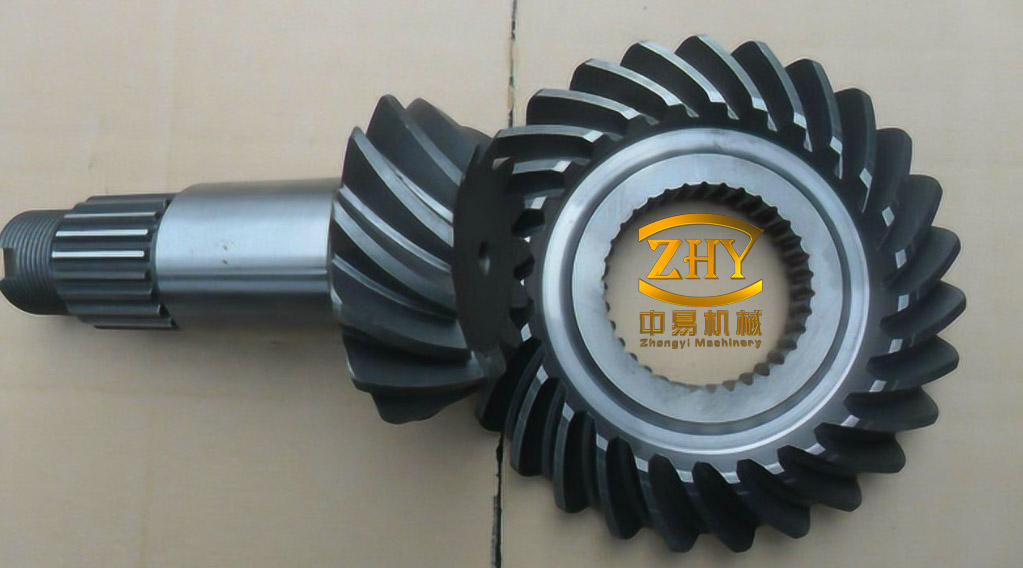
Spiral bevel gears transmit motion and torque between intersecting shafts. Their teeth are curved and inclined, so contact does not engage across the full face at once; it enters at one end of the tooth trace and slides progressively toward the other while several tooth pairs share the load. This kinematics gives smoother operation than straight bevel gears, along with high load capacity, high transmission efficiency, a stable ratio, and relatively low noise. These properties explain their use in automotive drivetrains, aviation, marine propulsion, and mining machinery.
The same geometry makes performance sensitive to relative position. In service, installation error, mesh stiffness, and backlash can prevent the teeth from reaching the intended meshing position. The contact pattern shifts, the transmission error changes, and the instantaneous ratio fluctuates; the result is vibration, noise, and reduced life. Tightening manufacturing and assembly tolerances can reduce the problem, but precision is nonlinear in cost: beyond a certain point, each increment in accuracy becomes disproportionately expensive. Robust design takes a different route. It leaves the uncertain factors in place and adjusts the design so that the quality characteristic changes less when those factors vary. In a spiral bevel gear, this means shaping the tooth surface so that the contact pattern and transmission error remain acceptable under a range of alignment conditions.
Installation Error as the Dominant Random Input
Installation error is commonly decomposed into axial displacement of the pinion and gear, vertical offset, and shaft-angle error. Each changes the relative position of the two tooth surfaces from the design condition. The theoretical conjugate contact is lost, the contact pattern moves or distorts, and the transmission-error curve is altered. Because the error is random and cannot be fully removed in service, it is a natural target for robust parameter design: the objective is not to eliminate the error but to make the tooth surface less sensitive to it. Mesh stiffness and backlash also influence vibration, but they are separate design and operating variables; installation error directly displaces the contact pattern and therefore provides a clear path from uncertainty to mesh excitation.
Analytical and simulation studies have established this sensitivity. Wang Xiaochun and Wu Xutang derived a sensitivity matrix for spatial point-contact tooth surfaces under mounting error in 1990. Su Hui simulated contact-pattern changes under mounting-distance deviations in 2008. Tang Jinyuan and Du Jin proposed an active design method that included mounting-error sensitivity in 2009. Lu Fengxia and co-workers developed a method for determining the initial contact point in tooth contact analysis with installation errors in 2020. Su Yulong and co-workers simulated contact patterns under assembly misalignment in 2017. Together, these studies show that the contact pattern is not only an inspection index; it is the transfer path through which alignment error becomes transmission error and dynamic excitation.
Because the error is uncertain, a single nominal contact analysis is insufficient. The design must be evaluated over a distribution or a bounded set of installation conditions, and the optimization must trade nominal performance against the rate at which performance degrades as the error grows.
Robust Design Methods and Their Trade-offs
Genichi Taguchi’s robust design approach treats quality as a response to controllable and uncontrollable factors. Controllable factors include design variables and tolerances; uncontrollable factors include manufacturing conditions, operating environment, load, material variation, and assembly error. The method seeks parameter settings that make the quality response insensitive to the uncontrollable factors while keeping cost low. Two broad families have developed. Traditional robust design relies on experience, experiment design, and empirical models: Taguchi methods, response surface methods, dual response surface methods, and generalized linear models. Engineering-model-based robust optimization combines a physical or simulation model with numerical optimization: tolerance polyhedron methods, sensitivity methods, variation transmission methods, stochastic models, and mixed cost-quality models.
| Method | Strength | Limitation |
|---|---|---|
| Taguchi robust design | Accepts continuous, discrete, and even non-numeric design variables; can handle complex models. | Requires an approximate range and levels of the optimum before the experiment; the signal-to-noise formulation imposes a proportionality requirement between mean and variance. |
| Response surface method | Relaxes the need to know the optimum range in advance. | Results are sensitive to missing experimental data; an empirical response model is required. |
| Dual response surface method | Includes error distributions and factor interactions; can give higher accuracy. | Depends on experience to build the response model; computation and model fitting are iterative. |
| Generalized linear model | Useful when variance in parameter design is not homogeneous, as assumed in ordinary regression. | Selecting the variance and link functions for a specific problem remains difficult. |
| Tolerance polyhedron method | Frequently used for constrained optimization problems. | The solution procedure is relatively complex. |
| Sensitivity method | Quickly identifies the range or direction in which a variable should be adjusted. | Variable tolerances are not explicitly considered. |
| Variation transmission method | Avoids the Taguchi requirement that signal-to-noise ratio, mean, and variance change proportionally. | Applies mainly when variation between controllable and uncontrollable factors is small. |
| Stochastic model method | Can remain robust when controllable and uncontrollable factors vary. | Model construction and computation are complex; approximations can reduce accuracy. |
A robust optimization problem extends this idea by treating design variables, objective, and constraints as uncertain and seeking a parameter set that is best in a probabilistic sense while remaining feasible. The methods differ in what they assume about uncertainty and in how much physical detail they can carry. Traditional experimental methods are efficient when the design space is not well understood, but they depend on the chosen levels and on the empirical model. Sensitivity and variation-transmission methods are transparent and inexpensive, but they linearize response and may miss strong nonlinearity. Stochastic and 6σ formulations represent uncertainty more directly, at the cost of repeated model evaluations. In gear design, the practical choice is often a hybrid: a physical contact model supplies the response, a statistical or interval description supplies the uncertainty, and an optimization algorithm searches for a design that is both feasible and insensitive.
What Gear Robust Design Has Established
Robust design entered machinery applications through Li Wei’s work and was systematized for engineering optimization by Chen Lizhou and Weng Haishan in 1998. Zhang Lei and co-workers were among the earliest to apply it to gears, building a model for a high-speed, medium-load cylindrical gear reducer with selected design variables, an objective function, and constraints, and using an orthogonal array to obtain a satisfactory design. A persistent difficulty then became visible: the robust optimum often lies on the boundary of the feasible region. A small perturbation in a design variable can push the solution outside that boundary, so a design that looks optimal at the nominal point may fail in production. Later work therefore combined robust design with methods that represent or control variation.
Dong Enguo and co-workers built a dual-response-surface model of a planetary gear mechanism in 2009, adding uncontrollable factors to the design variables and reducing their influence on the result. Lu Xinchun and Wang Mingqiang used a dispersion-coefficient transformation to control the effect of uncontrollable factors and reported more reliable gear transmission than conventional robust design. Yang Dechun combined robust design with sensitivity analysis for a multi-stage gear transmission, and Zhou Na addressed multiple failure modes in reliability-based robust design. Lin Yanhong combined 6σ robust design with sequential quadratic programming, and Sun and co-workers used a related SQP-based reliability optimization for a wind-turbine gearbox; both aimed to reduce the sensitivity of the optimum to design-variable changes.
Because gear optimization models are nonlinear and computationally demanding, later studies coupled robust design with global or heuristic search. Li Q C and co-workers used MATLAB and SQP for gear model optimization. Artoni developed a simulation-based multiobjective methodology for gear design. Yao used the elitist non-dominated sorting genetic algorithm NSGA-II to handle competing objectives in a spur-gear model. Atila and co-workers compared artificial algae, artificial bee colony, whale optimization, grey wolf, and particle swarm algorithms with a traditional genetic algorithm for gear robust design; the newer algorithms were reported to be more efficient and to perform better on the robust gear problem. Wang Chun and co-workers applied an improved particle swarm algorithm, exploiting its convergence speed and search capability. Fuzzy formulations have also been used: Zhao Xiaosong combined a MATLAB genetic-algorithm toolbox with fuzzy design theory for a two-stage planetary reducer, Wang C G used a predatory-search genetic algorithm for fuzzy reliability optimization of a two-stage planetary gear system with minimum volume and maximum efficiency objectives, and Wang J and co-workers built a fuzzy reliability optimization model for a differential mechanism.
These results are important, but most concern cylindrical, planetary, or spur gears. They supply algorithms and uncertainty-handling strategies rather than direct tooth-surface design rules. A spiral bevel gear is different: its design variables are machine-tool settings and tooth-surface modification parameters, and its performance is evaluated through tooth contact analysis rather than through simple macro-geometry. The transfer from gear robust design to spiral bevel robust design therefore requires a contact-mechanics model, a parameterization of the tooth surface, and a sensitivity measure that connects manufacturing settings to meshing behavior.
Sensitivity-Oriented Tooth-Surface Optimization
In spiral bevel gear robust optimization, installation error is treated as an uncertain input and tooth-surface parameters as design variables. The usual objective is to minimize the sensitivity of the contact pattern and transmission error to installation error, subject to constraints on contact area, contact position, transmission-error amplitude and continuity, and strength. The optimization does not remove the error; it redistributes contact and shapes the transmission-error curve so that a given alignment deviation produces a smaller change in meshing behavior.
Chen Peng and co-workers formulated an ELTCA-based 6σ robust optimization model in 2021. Second-order contact parameters and installation error were treated as variables, quantified contact-pattern features were used as constraints, Monte Carlo sampling represented uncertainty, and a multi-island genetic algorithm searched for the design. The reported robustness index under installation-error uncertainty improved by more than 99%, and the sensitivity of meshing to installation error fell by more than 30%. These are model-based results, but they show that a probabilistic formulation can produce a substantial change in sensitivity within the same contact-analysis framework.
Mu and co-workers addressed loaded meshing performance of a high-speed spiral bevel gear in 2021. They built a multiobjective ease-off optimization model to reduce transmission error and meshing impact, obtained machining parameters, and used a genetic algorithm to invert the optimized parameters. The loaded transmission error was reported to be 31.66% lower than before optimization, with a significant reduction in dynamic meshing impact. Su Jinzhan and Fang Zongde used the total curvature of the difference surface as a sensitivity coefficient and optimized the first derivative, contact-trace direction, and second- and third-order modification coefficients of the pinion; the resulting tooth surface was less sensitive to installation error and had improved meshing performance. In a second study, they used the sum of the sensitivity coefficients of contact-pattern area and horizontal position as the objective, took pinion cutting parameters as design variables, imposed transmission-error continuity and amplitude as constraints, and defined a sensitivity matrix to reduce contact-pattern sensitivity under installation error.
Tang Jinyuan and co-workers built a model that included both installation-error sensitivity and tolerance, and identified the relation between the model, contact quality, and cutting parameters. Huang and co-workers started from assumed installation-error values, performed ETCA, and used a BP neural network to optimize second-order contact parameters for low sensitivity and high contact ratio. The common thread is that the robust design problem is not a single-objective tolerance exercise. It is a contact-pattern shaping problem in which the load distribution, transmission-error curve, and sensitivity to alignment are coupled.
| Study | Design focus | Uncertainty or optimization approach | Reported result |
|---|---|---|---|
| Chen Peng et al. (2021) | Second-order contact parameters under installation error | 6σ model, Monte Carlo sampling, multi-island genetic algorithm | Robustness index improved by more than 99%; installation-error sensitivity reduced by more than 30% |
| Mu et al. (2021) | Ease-off machining parameters | Multiobjective optimization with genetic-algorithm inversion | Loaded transmission error reduced by 31.66%; dynamic meshing impact significantly lower |
| Su Jinzhan and Fang Zongde (2012, curvature-based) | First derivative, contact-trace direction, second- and third-order modification coefficients | Total curvature of the difference surface used as sensitivity coefficient | Lower installation-error sensitivity and improved meshing performance |
| Su Jinzhan and Fang Zongde (2012, contact-pattern objective) | Pinion cutting parameters and contact-pattern sensitivity | Contact-area and contact-position sensitivity objective; sensitivity matrix | Reduced contact-pattern sensitivity under installation error |
| Tang Jinyuan et al. (2009) | Sensitivity and tolerance model | Combined sensitivity and tolerance formulation | Established relation between contact quality, cutting parameters, and error sensitivity |
| Huang et al. (2014) | Second-order contact parameters for low sensitivity and high contact ratio | Assumed installation errors, ETCA, BP neural network | Low sensitivity with high contact ratio |
The quantitative evidence remains limited and not directly comparable across studies. Different papers use different sensitivity indices, different contact models, and different optimization algorithms. A 30% reduction in one sensitivity metric is not equivalent to a 30% reduction in vibration or noise. The numbers establish feasibility and direction, not a general design law.
Open Problems and Design Trade-offs
Several gaps remain before spiral bevel gear robust optimization can be treated as a mature design method.
- Static models often assume the error. Many studies prescribe installation-error values before contact analysis and then optimize the tooth surface for those values. Because installation error is random, a small deviation can produce a relatively large change in the computed contact pattern. Deterministic assumptions are useful for screening, but they can miss the tail of the response distribution and may not hold for complex cases.
- Accuracy and computational cost are in tension. Uncertainty-based optimization requires repeated tooth contact analysis, and each analysis is expensive. Surrogate models, improved sampling, and global algorithms can raise speed, but the approximation must preserve the contact physics that controls sensitivity. The literature still lacks a validated balance between fidelity and efficiency for industrial tooth-surface design.
- Dynamic robust design is underdeveloped. Real spiral bevel gears operate under time-varying load, mesh stiffness variation, and impact. A design that is robust in static contact analysis may not be robust in the dynamic regime. Studies that optimize dynamic meshing impact exist, but a full dynamic robust design with installation-error uncertainty remains scarce.
- Lower sensitivity can conflict with contact ratio. In the reported designs, reducing sensitivity can also reduce contact ratio. Low sensitivity and high contact ratio are both desirable for load capacity and quiet operation, so they should be treated as competing objectives rather than sequential requirements. Integrated design of low sensitivity and high contact ratio has been attempted, but the trade-off is not yet resolved.
- Uncertainty descriptions are incomplete. Installation error, manufacturing variation, and service loads are not always available as reliable statistical distributions. Fuzzy optimization can represent imprecise information, but its integration with spiral bevel tooth-surface robust design is still limited.
- Other error sources remain outside the frame. Manufacturing error, thermal distortion, elastic deformation, and load-dependent misalignment also affect meshing. A design optimized only for installation error may not cover the full service envelope. Multi-error robust design is needed.
- Experimental validation is thin. Most reported gains are simulation-based. Bench tests and service data are needed to connect sensitivity metrics to vibration, noise, and life, and to confirm that optimization gains survive manufacturing and assembly variation.
Design Implications
For spiral bevel gears, robust optimization is best understood as a shift from nominal contact design to sensitivity-controlled contact design. The design variables are not simply dimensions; they are the machine-tool settings and tooth-surface modifications that determine the contact pattern and transmission-error curve. The uncertainty is not a nuisance to be removed; it is part of the design problem. The most developed route combines a loaded tooth contact model, a probabilistic or 6σ treatment of installation error, and a global search over tooth-surface parameters. Reported results show that this route can substantially improve robustness and reduce sensitivity, but the evidence is still model-based and fragmented across different metrics.
The next step is not additional optimization alone; it is the construction of design criteria that remain valid under combined installation, manufacturing, and load variation, and that treat contact ratio, load capacity, transmission error, and sensitivity as coupled objectives. This matters in aviation, where low vibration and noise must be achieved without sacrificing load capacity or reliability. Without experimental calibration and a common sensitivity metric, robust optimization will remain a collection of promising case studies rather than a design standard for low-noise, long-life spiral bevel gears.