
In the realm of automotive powertrains, the hypoid gear pair is a critical component, particularly for rear axle drives. Its design, characterized by offset axes between the pinion and gear, allows for smoother engagement, higher torque capacity, and the ability to lower the vehicle’s center of gravity. However, this complexity in geometry translates directly into a significant challenge during manufacturing. Achieving a controlled and optimized tooth contact pattern—the elliptical area where the mating teeth surfaces actually bear load—is paramount for ensuring quiet operation, long life, and efficient power transmission. The contact pattern’s position, size, and shape directly influence noise-vibration-harshness (NVH) performance and structural durability.
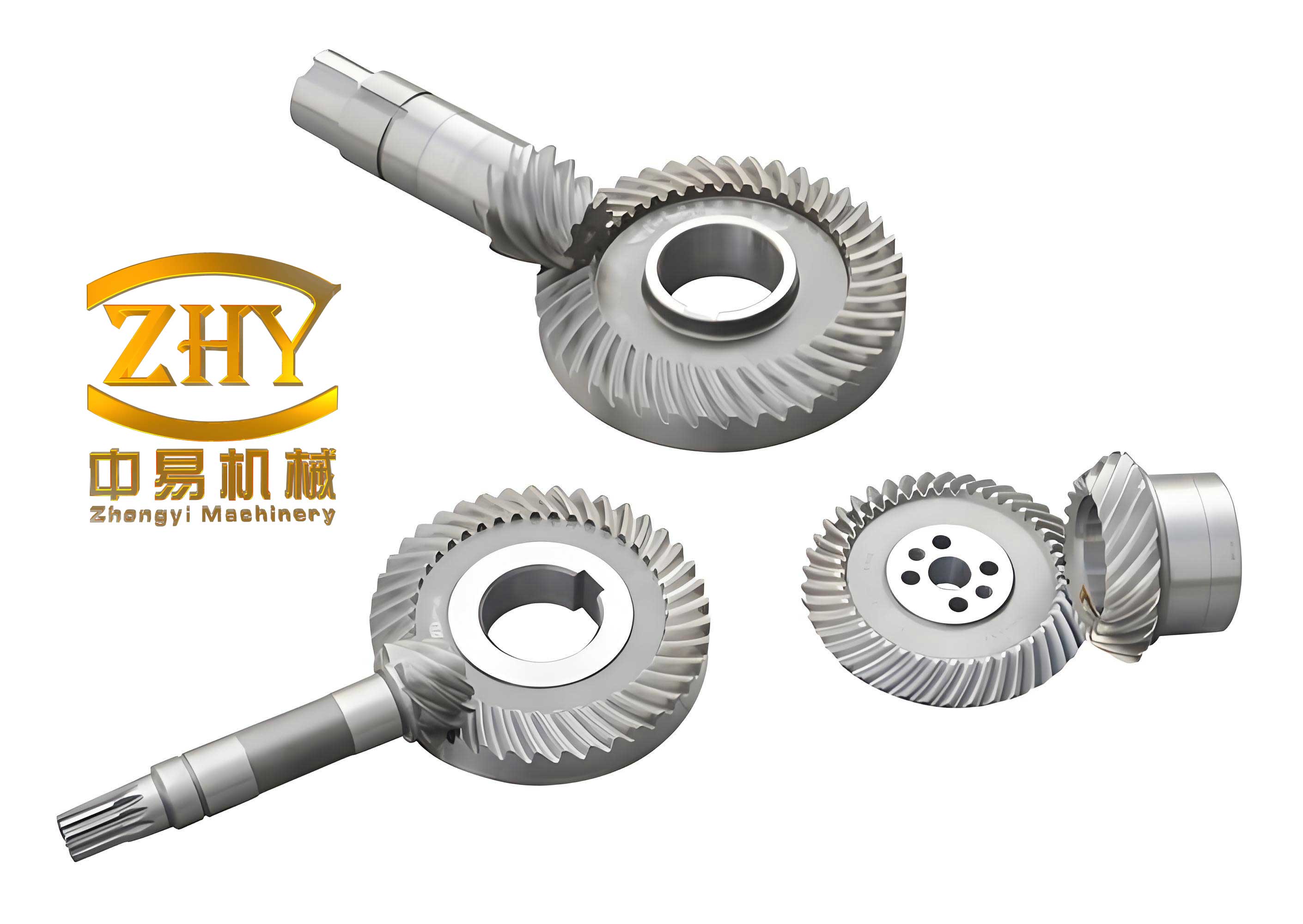
My investigation focuses on a specific manufacturing methodology for hypoid gears known as the Tilted Head Cutter Semi-Finishing method. This process is particularly suited for manufacturing hypoid gears where the gear member (the larger wheel) has a pitch cone angle exceeding 50 degrees. In this method, the gear is produced via a form-cutting (non-generating) process, while the more complex pinion is generated using a cradle-style machine. A defining feature is the intentional tilting of the cutter head, which introduces a normal tilt angle, enabling precise control over the pinion tooth flank geometry. The successful application of this method hinges on understanding and manipulating a set of key control parameters provided in standard calculation sheets (e.g., Gleason’s). Among these, the lengthwise crowning coefficient (often denoted as φ) and the pinion root angle correction (δ) are particularly influential on the final contact pattern. This article presents a detailed experimental analysis, conducted from a first-person research perspective, to isolate and elucidate the effects of these two parameters on the contact characteristics of a hypoid gear set. The goal is to establish clear guidelines for machine setup adjustment to achieve a desirable, stable, and forgiving contact pattern in production.
Fundamentals of the Tilted Head Cutter Semi-Finishing Method
The manufacturing of a hypoid gear pair requires sophisticated machine tools and mathematical models. The semi-finishing approach acknowledges the different functional complexities of the gear and pinion. The gear, with its relatively simpler curvature, can be machined accurately and efficiently using a form-cutting method with a prescribed cutter profile. The pinion, however, must conjugate precisely with this pre-manufactured gear. This is achieved through a generating motion, where the cutting tool (mounted in a tilted head) and the pinion blank simulate a rolling engagement between a theoretical generating gear and the pinion.
The fundamental geometry is governed by the spatial relationship between the cutter, the machine cradle, and the workpiece. The basic equation relating the cradle rotation angle $\theta_c$ to the workpiece rotation angle $\theta_w$ during generation is given by the ratio known as the machine root angle:
$$ \theta_w = \frac{\theta_c}{R_{atio}} $$
Where $R_{atio}$ is the generating gear ratio. The cutter tilt, a crucial aspect of this method, modifies the effective cutting profile and pressure angle along the tooth length. The tool’s position is defined by its radial setting $S_r$, angular setting $q$, and the tilt angle $i$. The relationship between the nominal cutter pressure angle $\alpha_0$ and the effective pressure angle $\alpha_{eff}$ at a point on the tooth flank can be approximated by:
$$ \tan \alpha_{eff} \approx \frac{\tan \alpha_0}{\cos i} \pm \text{(terms based on cutter geometry and position)} $$
The sign depends on whether the convex or concave side of the pinion is being cut. This tilt is the primary mechanism for introducing lengthwise crowning—a deliberate curvature along the tooth length that localizes the contact pattern and makes it less sensitive to minor assembly misalignments.
Experimental Design and Parameter Selection
The subject of this experimental study was a hypoid gear pair from a mainstream automotive rear axle drive. The primary design and operational parameters for this hypoid gear set are summarized in Table 1.
| Parameter | Gear (Wheel) | Pinion | Unit |
|---|---|---|---|
| Number of Teeth | 41 | 11 | – |
| Module (Normal) | ~5.2 | mm | |
| Shaft Offset | 15 | mm | |
| Gear Pitch Cone Angle | 72 | ~15 | deg |
| Hand of Spiral | Left | Right | – |
| Mean Spiral Angle | 30 | 50 | deg |
The machining was performed on a dedicated hypoid gear generator capable of implementing the tilted head cutter method. The gear member was pre-finished using its form-cutting process. All pinion cutting trials were then conducted on this machine using computer-calculated setup data derived from the standard calculation methodology. The contact pattern evaluation was carried out on a universal rolling tester, where the gear pair was run under a very light load with a marking compound (e.g., Prussian blue) applied to the gear teeth. The resulting imprint on the gear flanks was recorded using transparent tape for analysis.
The core of the experimental strategy was the “single-factor” method. This involved holding all but one control parameter constant at its initial or baseline value while systematically varying the parameter under investigation. This approach isolates the effect of each parameter, providing clear cause-and-effect relationships. The two parameters chosen for deep analysis were:
- Lengthwise Crowning Coefficient (φ): This dimensionless parameter theoretically dictates the proportion of the tooth face width occupied by the contact pattern under light load conditions. It is a primary driver for defining the cutter geometry and machine kinematics to achieve the desired lengthwise curvature.
- Pinion Root Angle Correction (δ): This angular correction, typically measured in minutes of arc (‘), is applied to the nominal pinion root angle setting on the machine. It is a powerful, fine-tuning adjustment that primarily shifts the contact pattern along the length of the tooth without drastically altering its basic shape.
The experimental sequence was deliberate: First, trials were conducted to establish an optimal value for φ, as this parameter fundamentally influences the cutter tip radius and the basic curvature of the pinion flank. Once a suitable φ value (and corresponding cutter) was fixed, a series of trials varying only δ were performed to map its specific influence on the contact pattern location. A subset of the experimental matrix is shown in Table 2.
| Trial ID | Lengthwise Crown Coeff. (φ) | Root Angle Corr. (δ) | Primary Variable | Observed Focus |
|---|---|---|---|---|
| P-01 | 0.20 | 0′ | φ | Contact length & shape |
| P-02 | 0.35 | 0′ | φ | Contact length & shape |
| P-03 | 0.50 | 0′ | φ | Contact length & shape |
| D-01 | 0.35 (fixed) | -10′ | δ | Pattern position shift |
| D-02 | 0.35 (fixed) | 0′ | δ | Pattern position (baseline) |
| D-03 | 0.35 (fixed) | +10′ | δ | Pattern position shift |
Results and In-Depth Analysis of Control Parameter Effects
The contact patterns obtained from the rolling tests were meticulously analyzed. The patterns on both the convex and concave sides of the gear teeth were recorded. The following sections detail the isolated effects of each control parameter based on the experimental evidence.
Effect of the Lengthwise Crowning Coefficient (φ)
The parameter φ is defined in the calculation theory as the desired ratio of the contact length to the total face width under light test conditions. The experimental results confirmed a strong positive correlation: as φ increased, the observed length of the contact ellipse along the tooth also increased. For instance, with a theoretical φ value of 0.35, the actual contact patch already occupied approximately 50% of the total face width under light rolling load.
However, a critical and practical discrepancy was consistently observed: the actual contact length was generally longer than the simple product φ * (Face Width). For example, a φ setting of 0.35 often yielded a contact patch covering 50-60% of the face, not 35%. This phenomenon can be explained by delving into the fundamental difference between the theoretical definition and the physical manifestation of the contact pattern.
Theoretically, φ relates to the projection of a single instantaneous contact line onto the lengthwise direction of the tooth. This instantaneous line is the set of points of tangency between the two perfectly aligned tooth surfaces at one specific moment in the mesh cycle. Its length can be designed. However, the visible contact pattern from a rolling test is not this single line. It is the accumulated envelope of all instantaneous contact lines throughout the entire meshing cycle of a tooth pair, as the contact travels from the tip to the root and across the face. This is illustrated conceptually by the equation describing the family of contact lines:
$$ F(\xi, \eta, \psi) = 0 $$
Where $\xi$ and $\eta$ are surface coordinates on the gear tooth, and $\psi$ is the parameter of motion (roll angle). The physical pattern is the projection of the union of all solutions for different $\psi$. Since these instantaneous lines are not parallel to each other and their orientation changes through the mesh, their accumulated footprint creates an elongated ellipse that is inherently longer than any single line’s projection. This is a fundamental aspect of conjugate hypoid gear contact. Therefore, the control parameter φ should be viewed as a calibration factor rather than a direct predictor of absolute length. For light-load rolling tests, a φ value in the range of 0.30 to 0.40 was found to produce a robust and practical contact pattern length of about 50-70% of the face width, which is generally desirable for a good balance between load capacity and misalignment forgiveness.
Effect of the Pinion Root Angle Correction (δ)
The pinion root angle correction δ proved to be an exceptionally effective parameter for fine-tuning the position of the contact pattern along the tooth length. The experimental data showed a consistent and predictable trend:
- Increasing a positive δ (adding to the nominal root angle setting) caused the contact pattern on the gear convex side to shift towards the toe (inner end).
- Conversely, the same positive δ caused the contact pattern on the gear concave side to shift towards the heel (outer end).
The effect was symmetric: a negative δ moved the patterns in the opposite directions. This behavior is directly linked to how δ alters the relative positioning of the pinion to the gear in the mesh simulation on the rolling tester. Changing the pinion’s root angle effectively changes the local separation of the tooth surfaces. The direction of shift depends on the flank geometry (convex vs. concave) and the hand of spiral. The relationship can be modeled as a first-order correction to the ease-off topography (the separation map between the mating flanks). A simplified expression for the change in separation $\Delta S$ at a point due to a small δ is:
$$ \Delta S(x, y) \approx \pm R_{base} \cdot \tan(\delta) \cdot f(x, y) $$
Where $R_{base}$ is a base radius, $f(x,y)$ is a function of the tooth coordinates describing the sensitivity, and the sign differs for the two flanks. This change in separation directly alters which areas of the tooth make first contact under light load, thereby shifting the pattern origin. The experimental sensitivity was particularly pronounced within the range of $\delta = \pm 15’$, aligning well with the typical adjustment range suggested in standard calculation guidelines. This makes δ an indispensable “knob” for production floor technicians to quickly center a contact pattern that is biased too much towards the heel or toe due to minor cumulative errors in machining or component housing.
| Control Parameter | Primary Effect | Mechanism | Practical Adjustment Range | Design Consideration |
|---|---|---|---|---|
| Lengthwise Crown Coeff. (φ) | Controls the length of the contact ellipse. Higher φ gives longer contact. | Modifies the principal curvature of the pinion flank along its length, changing the ease-off topography’s “crowning”. | 0.25 – 0.45 (Typical for automotive). Target light-load length ~50-70% of face width. | Main parameter for initial setup. Defines basic cutter geometry and kinematics. Must be set first. |
| Root Angle Corr. (δ) | Controls the lengthwise position (heel-toe). Positive δ moves pattern on convex to toe, on concave to heel. | Alters the effective spatial orientation of the pinion relative to the gear, shifting the contact initiation zone. | $\pm 15’$ (minutes of arc). Fine-tuning parameter. | Primary correction for pattern centering. Does not require cutter change. Essential for production debugging. |
Conclusion and Practical Implications
This experimental investigation into the tilted head cutter semi-finishing method for hypoid gears has yielded clear, actionable insights. By employing a disciplined single-factor methodology, the distinct roles of two pivotal control parameters—the lengthwise crowning coefficient φ and the pinion root angle correction δ—have been successfully isolated and characterized.
The key findings are: First, φ is the foundational parameter that governs the fundamental size and longitudinal curvature of the contact pattern on the hypoid gear. Practitioners must understand that its value calibrates the generation of the entire ease-off surface; the resulting physical contact length under light load will be naturally longer than the simple theoretical ratio due to the accumulation of instantaneous contact lines through the mesh cycle. A value in the mid-range (e.g., 0.35) often provides an optimal starting point. Second, δ serves as a powerful, independent fine-tuning adjustment specifically for positioning the established contact pattern along the tooth’s face width. Its predictable and symmetric effect on the convex and concave flanks makes it an indispensable tool for correcting heel-toe bias during final production adjustments or compensating for system deflections.
For the manufacturing engineer, this translates into a streamlined process: the major setup for cutting a hypoid gear pinion is determined by calculating machine settings based on a chosen φ. Subsequently, any minor longitudinal mispositioning of the contact pattern observed during the first-article rolling test can be efficiently corrected by adjusting δ, typically without the need to re-cut with a different cutter or recalculate the primary machine settings. This separation of functions (size/shape vs. position) greatly simplifies the trial-and-error process, reduces setup time, and minimizes scrap. The methodology underscores that successful hypoid gear manufacturing relies not only on precise machinery but also on a deep, practical understanding of how specific mathematical control parameters manifest in the physical contact between two complex, spatially curved surfaces. This knowledge is essential for producing durable, quiet, and efficient hypoid gear drives that meet the stringent demands of modern automotive applications.