
The pursuit of higher power density, smoother operation, and increased reliability in modern mechanical transmissions has led to the widespread adoption of planetary gear systems. Among these, systems employing helical gears are particularly favored due to their inherent advantages over spur gears. The angled teeth of a helical gear provide gradual engagement and disengagement, resulting in higher contact ratios, reduced noise and vibration, and superior load-carrying capacity. This makes planetary helical gear sets indispensable in demanding applications across aerospace, automotive, wind turbine, and marine industries.
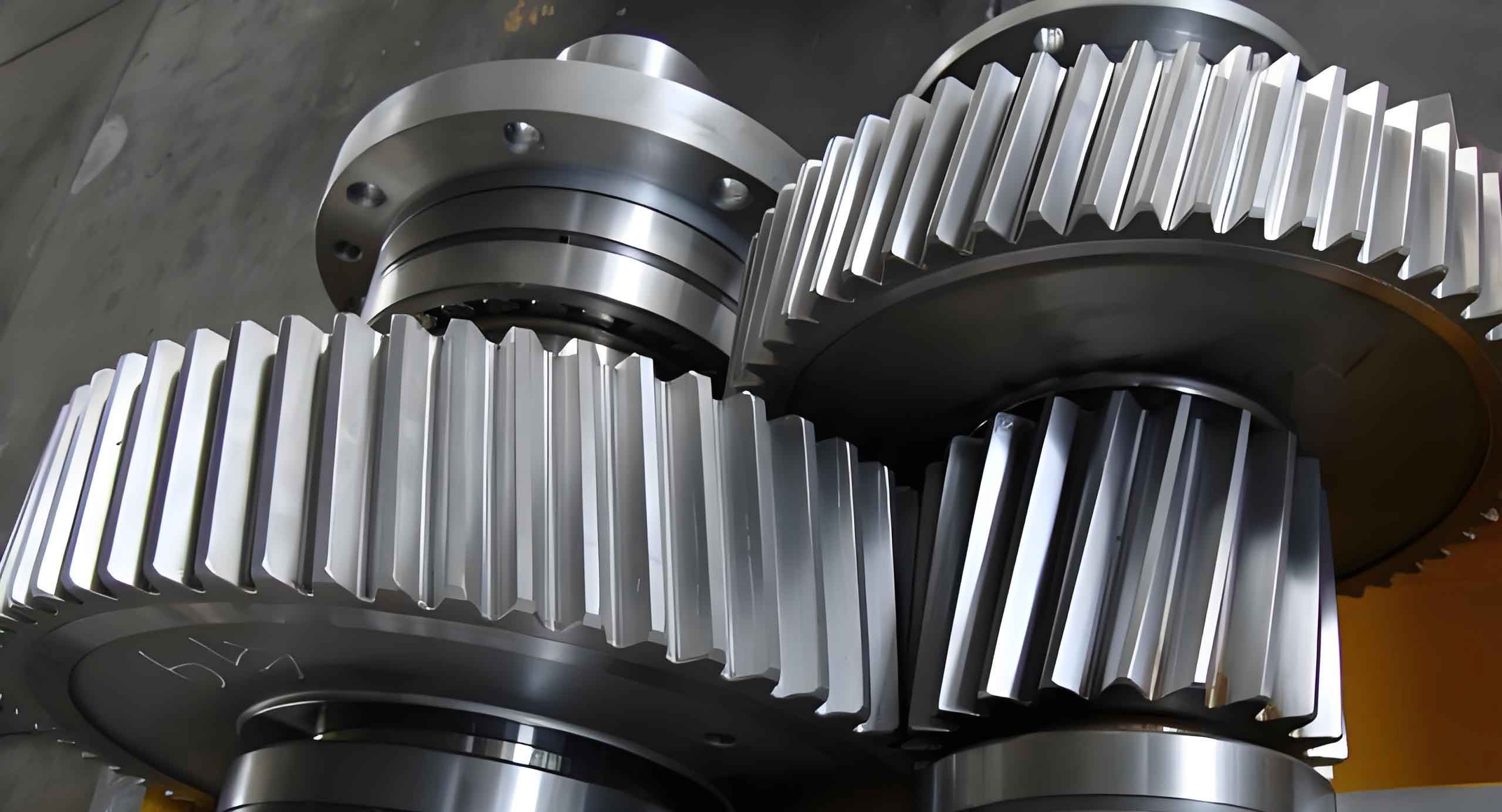
However, the theoretical ideal of perfectly equal torque distribution among the multiple planet gears in a planetary train is rarely achieved in practice. Manufacturing inaccuracies, assembly misalignments, and elastic deformations of components inevitably lead to uneven load sharing. This load imbalance significantly undermines the system’s advantages, causing premature wear, reduced fatigue life, increased stresses, and potential failure of the most heavily loaded planets. Therefore, ensuring optimal load sharing is a critical design objective for maximizing the performance and durability of planetary helical gear drives.
Traditional methods for analyzing load distribution in planetary systems often rely on lumped-parameter models, simplified formulas, or finite element analysis of simplified geometries. While these approaches offer valuable insights, they frequently lack a detailed integration of the intricate tooth contact geometry inherent to helical gears with the system’s static equilibrium. The load sharing behavior is fundamentally governed by the initial contact conditions—the gaps between mating tooth surfaces—which are directly altered by assembly errors and the subsequent floating of components to achieve equilibrium. A methodology that seamlessly couples detailed geometric tooth contact analysis with mechanical load distribution analysis is therefore essential for the accurate design of high-precision systems.
This article presents an advanced, integrated approach for the static load sharing analysis of planetary helical gear systems. The core of the method is a multi-body Loaded Tooth Contact Analysis (LTCA) model that explicitly accounts for the floating of central members (sun gear and ring gear). The model starts from the fundamental influence of alignment errors on the initial tooth separations within each sun-planet and planet-ring helical gear pair. It then combines geometric conformity conditions with force equilibrium and compatibility equations to solve for the final load distribution on each tooth flank and the corresponding radial float displacements of the components. Unlike conventional lumped-parameter models that represent forces as concentrated vectors, this method operates on a distributed force system, resolving the load across the entire contact line of the helical gear teeth, thereby offering a more detailed and physically accurate representation.
Geometric Contact Analysis of the Planetary Helical Gear System
The foundation for any loaded contact analysis is a precise understanding of the unloaded (geometric) meshing condition. For a single helical gear pair, geometric contact analysis determines the transmission error (TE) and the contact path on the tooth flanks under negligible load, based on the condition that the two surfaces are in continuous tangency. For a planetary system with N planets, this analysis must be performed concurrently for all N planet-ring and N sun-planet meshes, considering their spatial relationships.
A global fixed coordinate system \( S_f(O_f-x_fy_fz_f) \) is established at the center of the carrier. The local coordinate systems for the planets, \( S_{fpi}(O_{fpi}-x_{fpi}y_{fpi}z_{fpi}) \), are arranged uniformly around the carrier. The local coordinate systems for the sun gear \( S_{fs} \) and the ring gear \( S_{fr} \) are defined relative to the fixed system, incorporating potential assembly errors. These errors include:
- Center distance errors (\(\Delta E_s\) for sun, \(\Delta E_r\) for ring).
- Shaft angle errors (\(\Delta \gamma_s\) for sun, \(\Delta \gamma_r\) for ring).
The tooth surfaces of the sun, planets, and ring are mathematically defined. For any engaged helical gear pair (e.g., sun-planet i), the condition for contact at any instant is that the position vectors and surface normals of the two mating tooth surfaces coincide in a common coordinate system. This leads to a set of nonlinear equations. Solving these equations for successive increments of gear rotation yields the geometric transmission error \( \psi_{ij}(\phi) \) and the coordinates of the contact line for each mesh \( j \) (where \( j \) corresponds to a specific planet number). The geometric TE, defined as the deviation of the planet’s position from its theoretical location relative to the sun or ring, is a direct measure of the initial kinematic mismatch or “gap” between the teeth before loading is applied.
A critical output of this stage is the initial separation \( w_{ij}^k \) at discrete points \( k \) along the potential contact line for every tooth pair that is simultaneously in mesh. This set of \( w_{ij}^k \) values forms the geometric input to the load distribution model. The basic parameters for a sample planetary helical gear set used for demonstration are listed below:
| Parameter | Sun Gear | Planet Gear | Ring Gear | Unit |
|---|---|---|---|---|
| Number of Teeth, \( z \) | 23 | 31 | 85 | – |
| Normal Module, \( m_n \) | 3.5 | mm | ||
| Normal Pressure Angle, \( \alpha_n \) | 20 | ° | ||
| Helix Angle, \( \beta \) | 15 | ° | ||
| Face Width, \( B \) | 40 | 38 | 40 | mm |
| Number of Planets, \( N \) | 4 | – | ||
Loaded Tooth Contact Analysis Model with Component Floating
Under an applied torque, the system components deflect, and floating members (typically the sun or ring gear) displace radially to seek a force-balanced state. The proposed multi-body LTCA model solves for this state. The core problem is to find the load distribution across all discrete contact points on all simultaneously engaged tooth flanks and the radial float displacements \( \delta_x, \delta_y \) of the floating component(s).
The model is governed by the following set of equations and conditions, formulated here for the case where the ring gear is allowed to float radially (a similar set applies for the sun gear or both). We consider a single meshing position with \( M \) tooth pairs in contact across all meshes. Each tooth pair contact line is discretized into \( Q \) points.
1. Deformation Compatibility Condition:
At every contact point \( k \) on tooth pair \( i \), the sum of the initial geometric separation \( w_i^k \), the change in separation due to radial float \( s_i^k(\delta_x, \delta_y) \), and the contact deformation \( \lambda_i^k \) must equal the overall body approach \( Z \) (a single value for each mesh) plus any residual gap \( d_i^k \).
$$ w_i^k + s_i^k(\delta_x, \delta_y) + \lambda_i^k = Z_{m(i)} + d_i^k, \quad \text{for } i=1…M, \, k=1…Q $$
Here, \( Z_{m(i)} \) is the approach for the mesh (sun-planet or planet-ring) to which tooth pair \( i \) belongs. The term \( s_i^k \) is computed by updating the geometric contact analysis with the float displacements \( \delta_x, \delta_y \).
2. Force-Deformation Relationship:
The contact deformation \( \lambda_i^k \) is related to the contact load \( p_i^k \) at that point via a flexibility influence coefficient matrix \( [\mathbf{F}] \). This matrix, obtained from a detailed finite element model of a single gear body, accounts for the bending, shearing, and contact compression at point \( k \) due to a unit load at point \( l \).
$$ \{ \lambda \} = [\mathbf{F}] \{ p \} $$
Where \( \{ \lambda \} \) and \( \{ p \} \) are vectors of all deformations and loads at all contact points.
3. Static Force Equilibrium:
The vector sum of all contact forces in the system must balance the external torque. For a system with the sun gear as input (torque \( T_{in} \)), carrier fixed, and ring gear as output:
$$ \sum_{i=1}^{M} \sum_{k=1}^{Q} p_i^k \cdot \mathbf{n}_i^k \cdot r_{b,i} = T_{in} $$
where \( \mathbf{n}_i^k \) is the surface normal vector and \( r_{b,i} \) is the base radius for the gear in mesh \( i \). Equilibrium for the floating ring gear also requires the net radial force on it to be zero, which is inherently satisfied by the floating condition.
4. Load Sharing Condition for Floating:
The fundamental action of radial floating is to equalize the total normal force transmitted through each parallel load path. For a system with \( N \) planets, this means the sum of normal forces on all tooth pairs in mesh for a given planet-ring interface must be equal for all planets, and similarly for the sun-planet interfaces if the sun is also floating. For a floating ring gear:
$$ \sum_{k \in \text{Planet } j} p^k = \frac{F_{\text{total}}}{N}, \quad \text{for } j = 1, 2, …, N $$
where \( F_{\text{total}} \) is the total normal force derived from the input torque.
5. Contact Complementarity Condition:
A point can either be in contact (load > 0) or have a gap (load = 0).
$$ p_i^k \geq 0, \quad d_i^k \geq 0, \quad p_i^k \cdot d_i^k = 0 $$
The solution of this system is a non-linear mathematical programming problem. An iterative numerical procedure is employed:
- Assume initial float displacements \( (\delta_x, \delta_y) \).
- Update geometric contact analysis to compute new \( w_i^k + s_i^k \).
- Solve the LTCA problem (Equations 1-5) for the assumed float, obtaining loads \( p_i^k \) and mesh approaches \( Z_m \).
- Check the load sharing condition (Equation 4). Calculate the imbalance in planet loads.
- Adjust \( (\delta_x, \delta_y) \) using an optimization algorithm (e.g., Golden-Section search) to minimize the load imbalance.
- Repeat steps 2-5 until the load imbalance falls below a specified tolerance (e.g., 5% of average planet load).
Case Study and Results Analysis
The proposed methodology is applied to the example 4-planet helical gear system with parameters from Table 1. An input torque of 3000 Nm is applied to the sun gear. The carrier is fixed, and the ring gear is allowed to float radially. Several assembly error scenarios are analyzed to demonstrate the model’s capabilities.
Scenario 1: Pure Center Distance Error
First, consider only a center distance error for the ring gear, \( \Delta E_r = +0.008 \, \text{mm} \). Without floating, this error creates different initial gaps in the four planet-ring helical gear meshes. The geometric transmission error curves have identical shapes but different offsets. Consequently, the load is uneven, with the planet in the tightest mesh carrying the highest share. The calculated Load Sharing Factor \( LSF_j \) (planet load / average load) deviates significantly from the ideal value of 1.0.
When ring gear floating is enabled, the model calculates a radial float displacement primarily along the direction of the initial error. The process equalizes the effective gaps. After floating, the geometric TE curves for all four planet-ring meshes become virtually identical. The load sharing becomes perfect, with \( LSF_j = 1.00 \) for all planets. This confirms that for errors that only cause a uniform translational shift of the contact pattern (like pure center distance error), radial floating can achieve ideal load sharing in a helical gear system.
Scenario 2: Combined Center Distance and Shaft Angle Error
A more realistic case involves combined errors: \( \Delta E_r = +0.005 \, \text{mm}, \Delta \gamma_r = 0.3′ \) (shaft tilt). The shaft angle error alters the contact pattern on the tooth flank of the helical gear, causing bias and changing the shape of the geometric TE curve. Now, without floating, the differences between meshes are more complex—both the offset and the functional form of the TE vary per planet.
The model is applied. The calculated radial float path for the ring gear is not a simple straight line due to the interaction of the two error types. The final float displacement is \( \delta_x = 0.0021 \, \text{mm}, \delta_y = 0.0063 \, \text{mm} \). After this float, the geometric TE curves are brought closer together but do not become perfectly identical because their shapes (functional form) are inherently different due to the shaft tilt. The load sharing is greatly improved but not perfect. The results are summarized below:
| Planet Number | LSF (No Float) | LSF (With Ring Float) | % Improvement |
|---|---|---|---|
| 1 | 1.32 | 1.04 | 21.2% |
| 2 | 0.85 | 0.98 | 15.3% |
| 3 | 1.18 | 1.06 | 10.2% |
| 4 | 0.65 | 0.92 | 41.5% |
| Maximum Deviation | ±35% | ±8% | – |
The table shows a dramatic improvement. The maximum deviation from the average load drops from 35% to 8%. The root cause of the residual unevenness is the shaft angle error, which modifies the conjugate action of the helical gear pair. The floating mechanism can compensate for translational mismatches in the “rigid body” position of the gear, but it cannot alter the relative orientation of the teeth within a mesh. Therefore, differences in the loaded contact pattern and meshing stiffness due to tilt errors persist, leading to residual load imbalance. This insight is crucial for high-precision design: to achieve near-perfect load sharing, controlling shaft alignment errors is as important as allowing for component float.
Detailed Load Distribution on Tooth Flanks
Beyond planet-to-planet load sharing, the distributed force model provides the micro-scale load distribution \( p_i^k \) along the contact lines on individual tooth flanks. This is a significant advantage over lumped-parameter models. For a sun-planet helical gear pair under load, the model can predict the load concentration at the edges due to misalignment or the effect of tip and root relief. The contact pressure \( \sigma_H^k \) at each point can be estimated using Hertzian theory:
$$ \sigma_H^k = \sqrt{ \frac{p_i^k \cdot E^*}{\pi \cdot \rho_{eff}^k \cdot L_{eff}} } $$
where \( E^* \) is the equivalent Young’s modulus, \( \rho_{eff}^k \) is the effective radius of curvature at point \( k \), and \( L_{eff} \) is the effective contact length for the helical gear tooth. This detailed output is vital for contact fatigue (pitting) life predictions.
Discussion and Design Implications
The analysis reveals that the process of component floating is essentially an automatic adjustment of the system’s kinematic chain to minimize potential energy by equalizing the load paths. It acts to make the effective initial gaps \( w_i^k + s_i^k \) as uniform as possible across parallel meshes. For a helical gear planetary system, the following key conclusions and design guidelines can be drawn:
- Model Superiority: The integrated multi-body LTCA method provides a more physically detailed analysis than concentrated force models. It directly links manufacturing/assembly geometry (errors) to system-level mechanical performance (load sharing and flank pressures).
- Error Sensitivity: The effectiveness of radial floating depends on the type of assembly error. It can completely compensate for center distance errors in helical gear sets but can only partially mitigate errors involving shaft angles (tilt, parallelism).
- Float Travel: The required radial float displacement is not necessarily collinear with the direction of a simple center distance error when other errors are present. Design must provide adequate float clearance in all radial directions.
- Stiffness Interaction: While this analysis assumes rigid bearings, in reality, support stiffness influences the float. The model can be extended by incorporating bearing compliance matrices into the global flexibility matrix \( [\mathbf{F}] \).
- Micro-Geometry Optimization: The residual load imbalance from shaft errors can be further reduced by optimizing tooth micro-geometry (profile and lead modifications). The proposed model serves as an excellent platform for such optimization, as it can evaluate the load sharing performance of different helical gear flank modifications under error conditions.
In summary, achieving optimal load sharing in high-performance planetary helical gear transmissions requires a dual strategy: first, allowing critical components to float radially to compensate for translational mismatches, and second, tightly controlling gear and housing manufacturing tolerances—particularly those affecting shaft alignment—to minimize errors that floating cannot fully correct. The analytical framework presented here, which deeply integrates the loaded contact mechanics of the helical gear tooth with the system statics of the planetary train, provides the necessary engineering tool to quantitatively implement this strategy and design more robust, efficient, and reliable gear systems.