
The transmission of mechanical power is fundamental to modern machinery, and among the various mechanisms available, gear drives stand out for their reliability, precision, and ability to transmit significant power across a range of speeds and ratios. The efficiency of these drives is a paramount concern, directly impacting energy consumption, thermal management, and operational costs. Spur gears, with their straightforward design and ease of manufacturing, are among the most prevalent types. Therefore, developing accurate and insightful models for predicting their meshing efficiency is of great practical importance. While numerous advanced methodologies exist, often involving complex elastohydrodynamic lubrication (EHL) and dynamic load distribution models, they frequently present the relationship between efficiency and fundamental gear design parameters in an implicit, non-intuitive manner. This discussion focuses on the method of integration along the path of contact, a classical approach whose strength lies in its ability to yield explicit formulas directly linking efficiency to gear geometry.
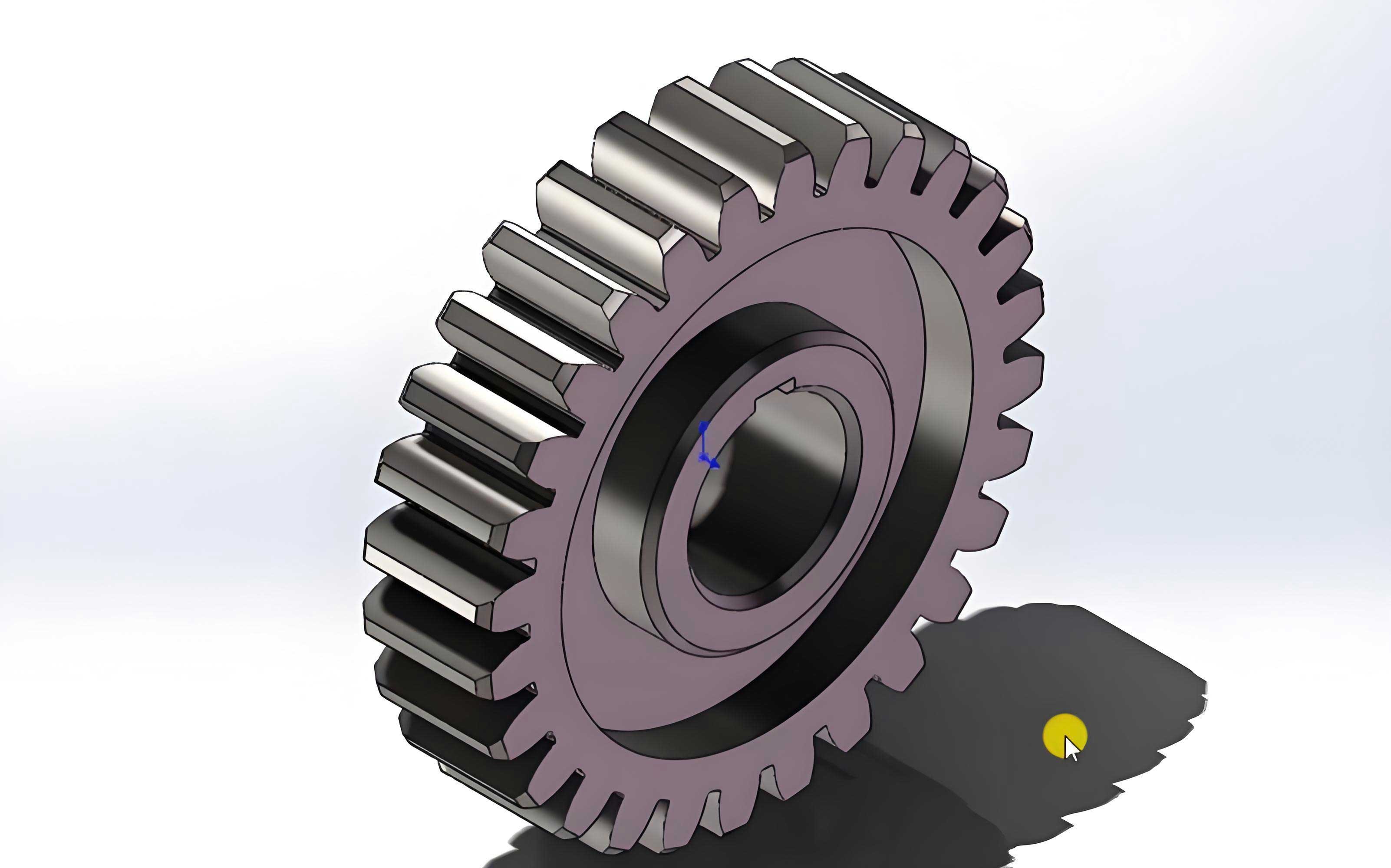
However, a critical limitation persists in the standard application of this integral method. Traditionally, the integration is performed solely over the total length of action for a single tooth pair, from its initial contact (meshing-in) to its final separation (meshing-out). The resulting value is presented as the meshing efficiency for the gear pair. This is a conceptual simplification that does not accurately reflect the continuous nature of power transmission in spur gears. In reality, for a gear pair with a contact ratio between 1 and 2, two pairs of teeth share the load for portions of the engagement cycle. A true average efficiency for the running gear pair must account for the complete engagement cycle where multiple tooth pairs participate, rather than the isolated journey of one single pair. This article addresses this gap by constructing a meshing efficiency model for spur gears based on a full cycle analysis of contact along the line of action.
The Continuous Meshing Cycle of Spur Gears
Consider a standard external spur gear pair with a contact ratio, ε, satisfying 1 < ε < 2. The path of contact is the straight line segment B₁B₂, where B₁ is the start of contact (tip of driven gear tooth contacts root of driving gear tooth) and B₂ is the end of contact (tip of driving gear tooth contacts root of driven gear tooth). The pitch point P lies on this segment.
The cycle for continuous transmission unfolds as follows. When a given tooth pair, designated pair k, first makes contact at point B₁, the preceding tooth pair, pair k-1, is already in contact somewhere on the upper segment B₃B₄. As pair k-1 disengages at point B₂, pair k becomes the sole load-bearing pair, carrying the load alone along the single-pair contact zone B₃B₄. When pair k reaches point B₄, the succeeding tooth pair, pair k+1, enters contact at point B₁. For the remainder of pair k‘s engagement from B₄ to B₂, the load is shared between pair k and pair k+1 (on segment B₁B₃). At the instant pair k disengages at B₂, pair k+1 is at point B₃, and the cycle repeats. The zones B₁B₃ and B₂B₄ are thus double-pair contact zones, while B₃B₄ is the single-pair contact zone. The traditional integration method only considers the path B₁B₂ for one pair, neglecting the multi-pair sharing inherent in the actual operation of spur gears.
Instantaneous Efficiency at a Contact Point
The foundation of the integral method is the expression for the instantaneous efficiency at a specific point of contact between two tooth profiles. This efficiency is derived from the basic principles of power transmission considering sliding friction. Let μ be the coefficient of friction, assumed constant along the path for simplicity in deriving the explicit relationship. Let αk1 and αk2 be the pressure angles on the driving and driven gear tooth profiles at the instantaneous contact point K. The distance from the pitch point P to the contact point K is denoted by x, with a sign convention such that x is positive on the B₂ side of P and negative on the B₁ side.
The fundamental formulas, derived from velocity and force relations, are:
For the segment from the pitch point P to the start of contact B₁ (where αk1 < αk2):
$$ \eta_d = \frac{1 – \mu \tan\alpha_{k2}}{1 – \mu \tan\alpha_{k1}} $$
Expressing this in terms of base circle radii (rb1, rb2), pressure angle α, and distance x:
$$ \eta_d = \frac{1 – \mu (r_{b2} \tan\alpha + x) / r_{b2}}{1 – \mu (r_{b1} \tan\alpha – x) / r_{b1}} \quad \text{(for } PB_1 \text{ segment)} $$
For the segment from the pitch point P to the end of contact B₂ (where αk1 > αk2):
$$ \eta_d = \frac{1 + \mu \tan\alpha_{k2}}{1 + \mu \tan\alpha_{k1}} $$
Which becomes:
$$ \eta_d = \frac{1 + \mu (r_{b2} \tan\alpha – x) / r_{b2}}{1 + \mu (r_{b1} \tan\alpha + x) / r_{b1}} \quad \text{(for } PB_2 \text{ segment)} $$
Calculating Meshing Efficiency for the Gear Pair
To calculate the true average efficiency for a pair of spur gears, we must integrate the instantaneous efficiency over all contact segments that occur during one complete engagement cycle. It is convenient to visualize the line of action laid flat and divided into four key segments defined by points B₁, B₃, P, B₄, and B₂. First, we define their lengths using standard gear geometry.
Let m be the module, α the pressure angle, and ha* the addendum coefficient. The base pitch is pb = π m cosα. The lengths are:
$$ PB_2 = r_{b1} (\tan\alpha_{a1} – \tan\alpha) = r_{b1} \left( \tan\left(\arccos\left(\frac{r_{b1}}{r_1 + h_{a}^* m}\right)\right) – \tan\alpha \right) $$
$$ PB_1 = r_{b2} (\tan\alpha_{a2} – \tan\alpha) = r_{b2} \left( \tan\left(\arccos\left(\frac{r_{b2}}{r_2 + h_{a}^* m}\right)\right) – \tan\alpha \right) $$
$$ PB_3 = p_b – PB_2 $$
$$ PB_4 = p_b – PB_1 $$
Where αa1 and αa2 are the tip pressure angles of the driving and driven gear, respectively, and r₁, r₂ are the pitch radii.
The total active length for a single tooth pair is B₁B₂ = PB₁ + PB₂. The lengths of the double-pair contact zones are B₁B₃ = B₁B₂ – pb and B₂B₄ = B₁B₂ – pb. The single-pair contact zone is B₃B₄ = 2pb – B₁B₂.
Now, we perform the integration of the instantaneous efficiency ηd over each distinct segment of the line of action that is traversed during the engagement cycle of a reference tooth pair. It is critical to recognize that during one full cycle of the gear pair’s operation, the segments B₁B₃ and B₂B₄ are traversed twice (once while the pair is leading and once while it is trailing), whereas segments PB₃ and PB₄ are traversed only once.
The efficiency integral for each segment is calculated as follows:
1. For segment PB₄ (driven gear tip relief zone, single traversal):
$$ S_{PB_4} = \int_{0}^{p_b – PB_1} \eta_d \, dx = \int_{0}^{p_b – PB_1} \frac{1 + \mu (r_{b2} \tan\alpha – x) / r_{b2}}{1 + \mu (r_{b1} \tan\alpha + x) / r_{b1}} \, dx $$
This integrates to:
$$ S_{PB_4} = \frac{r_{b1}}{r_{b2}} (r_{b1} + r_{b2}) \left( \frac{1}{\mu} + \tan\alpha \right) \ln\left( \frac{1/\mu + \tan\alpha + (p_b – PB_1)/r_{b1}}{1/\mu + \tan\alpha} \right) – (p_b – PB_1) $$
2. For segment B₄B₂ (upper double-pair zone, traversed twice in a full cycle):
$$ S_{B_4B_2} = \int_{p_b – PB_1}^{PB_2} \eta_d \, dx $$
$$ S_{B_4B_2} = \frac{r_{b1}}{r_{b2}} (r_{b1} + r_{b2}) \left( \frac{1}{\mu} + \tan\alpha \right) \ln\left( \frac{1/\mu + \tan\alpha + PB_2/r_{b1}}{1/\mu + \tan\alpha + (p_b – PB_1)/r_{b1}} \right) – (B_1B_2 – p_b) $$
3. For segment PB₃ (driving gear tip relief zone, single traversal):
$$ S_{PB_3} = \int_{0}^{p_b – PB_2} \eta_d \, dx = \int_{0}^{p_b – PB_2} \frac{1 – \mu (r_{b2} \tan\alpha + x) / r_{b2}}{1 – \mu (r_{b1} \tan\alpha – x) / r_{b1}} \, dx $$
$$ S_{PB_3} = \frac{r_{b1}}{r_{b2}} (r_{b1} + r_{b2}) \left( \frac{1}{\mu} – \tan\alpha \right) \ln\left( \frac{1/\mu – \tan\alpha + (p_b – PB_2)/r_{b1}}{1/\mu – \tan\alpha} \right) – (p_b – PB_2) $$
4. For segment B₃B₁ (lower double-pair zone, traversed twice in a full cycle):
$$ S_{B_3B_1} = \int_{p_b – PB_2}^{PB_1} \eta_d \, dx $$
$$ S_{B_3B_1} = \frac{r_{b1}}{r_{b2}} (r_{b1} + r_{b2}) \left( \frac{1}{\mu} – \tan\alpha \right) \ln\left( \frac{1/\mu – \tan\alpha + PB_1/r_{b1}}{1/\mu – \tan\alpha + (p_b – PB_2)/r_{b1}} \right) – (B_1B_2 – p_b) $$
The total effective contact length BB for one complete engagement cycle of the gear pair, accounting for load sharing, is not simply B₁B₂. It is the sum of the single-pair contact zone and the two double-pair zones: B₁B₂ (single) + B₁B₃ (double) + B₂B₄ (double). Since B₁B₃ = B₂B₄ = B₁B₂ – pb, we have:
$$ BB = B_1B_2 + 2(B_1B_2 – p_b) = 3B_1B_2 – 2p_b $$
Therefore, the true average meshing efficiency η for the pair of spur gears is the total “efficiency-length” product over one full cycle divided by the total effective contact length:
$$ \eta = \frac{S_{PB_4} + 2S_{B_4B_2} + S_{PB_3} + 2S_{B_3B_1}}{BB} = \frac{S_{PB_4} + 2S_{B_4B_2} + S_{PB_3} + 2S_{B_3B_1}}{3B_1B_2 – 2p_b} $$
In contrast, the traditional method yields:
$$ \eta_{traditional} = \frac{S_{PB_4} + S_{B_4B_2} + S_{PB_3} + S_{B_3B_1}}{B_1B_2} $$
The new formula explicitly accounts for the fact that the double-pair contact zones contribute twice to the power transmission cycle of the gear pair, providing a more accurate representation of the continuous operation of spur gears.
Relationship Between Design Parameters and Meshing Efficiency
The explicit nature of the derived formulas allows for a direct analysis of how key design parameters influence the meshing efficiency of spur gears. By systematically varying one parameter while holding others constant (and ensuring the contact ratio remains between 1 and 2), we can observe clear trends. The following table summarizes the influence of major design parameters on the calculated average meshing efficiency η for a standard spur gearset.
| Design Parameter | Symbol | Typical Variation Range | Effect on Meshing Efficiency (η) | Primary Physical Reason |
|---|---|---|---|---|
| Number of Teeth (Pinion) | z₁ | Increase (e.g., 20 to 50) | Increases | Reduces relative sliding velocity and pressure angles at the endpoints of contact. |
| Module | m | Increase (e.g., 2 mm to 5 mm) | Negligible Direct Effect* | Scales geometry proportionally; effect is seen indirectly through contact ratio changes. |
| Gear Ratio | i₁₂ | Increase (e.g., 1.5 to 5) | Increases | Shifts the path of contact asymmetry, generally reducing average sliding. |
| Pressure Angle | α | Increase (e.g., 20° to 25°) | Increases | Increases the radial component of force, reducing normal force and sliding friction work for the same torque. |
| Addendum Coefficient | ha* | Increase (e.g., 1.0 to 1.2) | Decreases | Lengthens the path of contact, extending the high-sliding regions near the tooth tips and roots. |
| Coefficient of Friction | μ | Decrease (e.g., 0.05 to 0.02) | Increases significantly | Directly reduces the power loss due to sliding friction along the path of contact. |
*The module itself does not appear as an independent scaling factor in the final efficiency ratio when all lengths are expressed relative to base pitch. Its main influence is through the resultant contact ratio.
The analysis leads to practical design guidelines for enhancing the meshing efficiency of spur gears where efficiency is a critical design driver. For standard gears, within the constraints of required strength, size, and avoiding undercutting:
- Prefer higher tooth counts on the pinion and gear to reduce sliding.
- Select a higher pressure angle (e.g., 22.5° or 25°) if design constraints allow.
- Use a standard or slightly reduced addendum to limit the engagement in high-sliding zones.
- Optimize the gear ratio considering the efficiency trend along with other requirements.
- Employ high-quality lubrication and surface finishing to minimize the operating coefficient of friction, μ, which is the most influential factor.
Conclusions
This analysis has addressed a key conceptual shortcoming in the classical integration method for determining the meshing efficiency of spur gears. By modeling the complete engagement cycle of a gear pair—accounting for the single-pair and double-pair contact zones according to the actual sequence of load sharing—a more accurate formula for average meshing efficiency is derived. The new formulation integrates efficiency over the effective contact length experienced during continuous operation, rather than over the path of a single, isolated tooth pair.
The primary advantage of this refined approach is its preservation of an explicit analytical relationship between the meshing efficiency and the fundamental geometrical parameters of spur gears. This clarity allows designers to quickly understand the qualitative impact of parameter choices. The analysis confirms that for standard spur gears, efficiency can be favored by specifying a higher number of teeth, a larger pressure angle, a prudent gear ratio, and most importantly, by ensuring conditions that promote a low coefficient of friction through effective lubrication. This method provides a valuable, physics-based tool for the preliminary design and efficiency estimation of one of the most fundamental components in mechanical engineering: the spur gear pair.