
The analysis and prediction of power loss in mechanical transmissions, particularly those involving bevel gears, is a critical aspect of design for efficiency, reliability, and thermal management. Bevel gears, especially spiral bevel gears, are fundamental components in numerous applications where power must be transmitted between intersecting axes. Their advantages, including high load capacity, smooth operation due to multi-tooth contact, and compact design, make them indispensable in demanding sectors such as aerospace, automotive, and heavy machinery. A primary contributor to overall power loss in these systems is the sliding friction generated between the interacting tooth surfaces during meshing. This friction directly converts mechanical energy into heat, influencing lubricant performance, inducing thermal distortions, and accelerating failure modes like pitting and scuffing. Therefore, developing accurate models for the instantaneous sliding friction power loss in bevel gear pairs is paramount for advancing transmission technology.
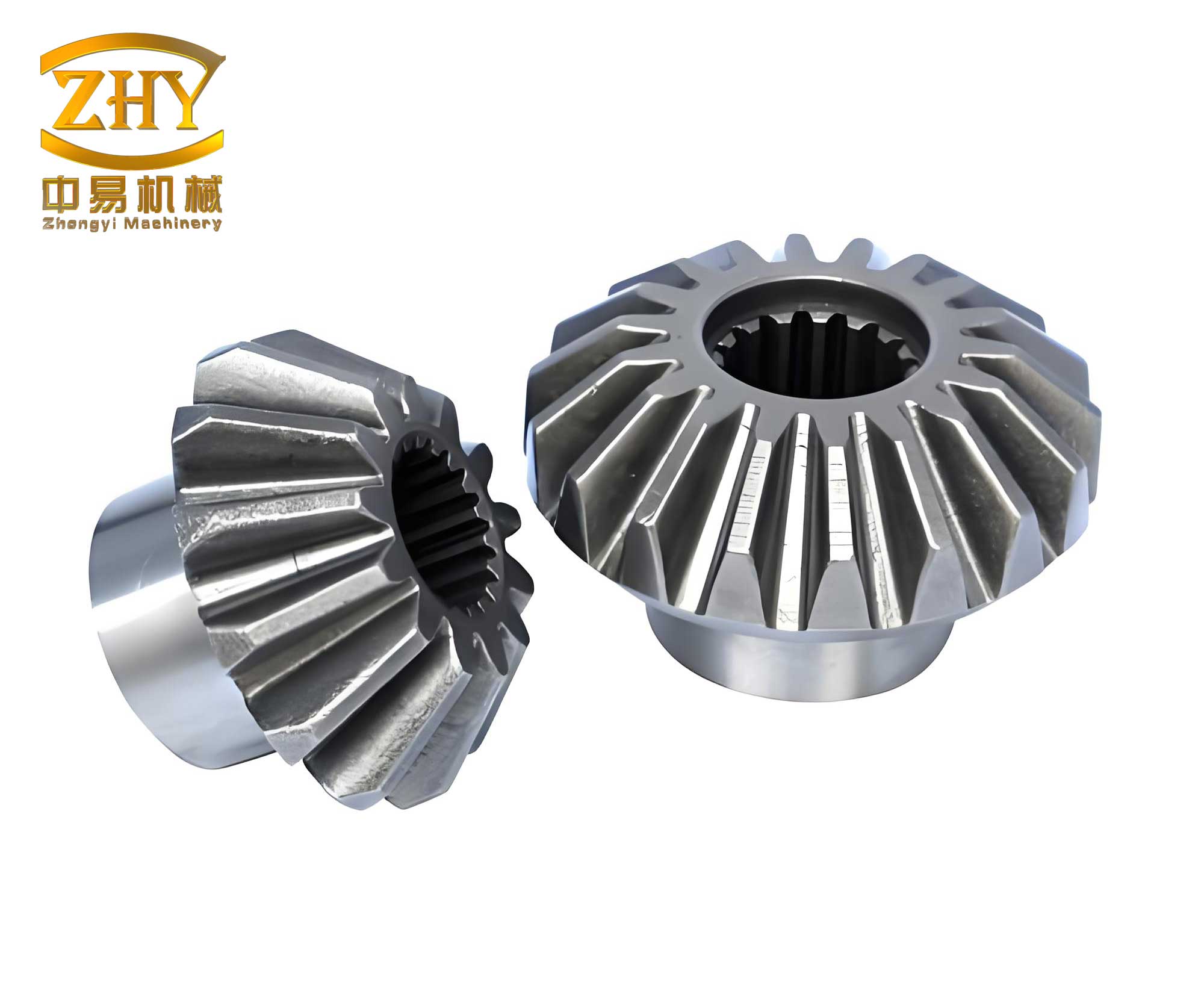
Traditional methods for estimating power loss in bevel gears often rely on simplified empirical formulas. While computationally efficient, these approaches typically yield average efficiency values and fail to account for the dynamic, time-varying nature of the meshing process. They neglect crucial factors such as the changing geometry of contact, the variation in load sharing among multiple teeth, and the transient conditions of the lubricating film. More sophisticated methods based on Loaded Tooth Contact Analysis (LTCA) and elastohydrodynamic lubrication (EHL) theory offer greater accuracy. However, the complex spatial geometry of bevel gear teeth presents significant challenges in determining the instantaneous load distribution and kinematics at the contact point, often leading to cumbersome and computationally intensive procedures.
To bridge this gap, this article presents a methodology for calculating the instantaneous sliding friction power loss in bevel gear drives by developing a comprehensive time-varying parameter model. The core of this approach lies in integrating gear geometry, dynamic load distribution, mixed elastohydrodynamic lubrication analysis, and kinematics into a unified framework that is solved as a function of time. A key innovation is the treatment of load sharing based on the actual contact line variation derived from the bevel gear’s real contact ratio, moving beyond the oversimplified single/double tooth pair contact assumption. Furthermore, by formulating the power loss integration over the meshing time period instead of along a discretized path of contact, inherent kinematic inconsistencies in traditional models are avoided.
1. Geometric Modeling and Equivalent Representation
The first step in analyzing a complex bevel gear system is to establish a manageable geometric model. The three-dimensional nature of bevel gear meshing is addressed by employing the concept of the “equivalent cylindrical gear” at the mean point of the tooth face width. This transformation allows the well-established contact and kinematic principles for parallel-axis gears to be applied to the intersecting-axis bevel gear problem with sufficient accuracy for efficiency calculations.
At the midpoint of the face width, a back-cone is constructed. When this back-cone is developed onto a plane, it forms a sector of a cylindrical gear. Completing this sector gives the equivalent cylindrical gear. For a straight bevel gear, this results in an equivalent spur gear; for a spiral bevel gear, it results in an equivalent helical gear. The parameters of this equivalent gear—module, pressure angle, helix angle—correspond to those of the bevel gear at the reference point. The total contact ratio (ε) of the bevel gear, a vital parameter for load sharing, is the sum of the transverse (εα) and overlap (εβ) ratios, calculated using the equivalent gear’s geometry:
$$ \varepsilon = \varepsilon_{\alpha} + \varepsilon_{\beta} $$
where the transverse contact ratio is:
$$ \varepsilon_{\alpha} = \frac{z_1 (\tan\alpha_{a1} – \tan\alpha’) + z_2 (\tan\alpha_{a2} – \tan\alpha’)}{2\pi} $$
and the face contact ratio is:
$$ \varepsilon_{\beta} = \frac{b \sin\beta}{\pi m_n} $$
In these equations, \( z_{1,2} \) are the numbers of teeth, \( \alpha_{a1,a2} \) are the tip pressure angles, \( \alpha’ \) is the operating pressure angle, \( b \) is the face width, \( \beta \) is the spiral angle at the mean point, and \( m_n \) is the normal module.
2. Time-Varying Load Distribution on Bevel Gear Teeth
Accurate determination of the load carried by each pair of teeth at every instant is fundamental to calculating friction losses. The total normal force \( F_n \) transmitted is considered constant for a given steady-state torque. However, this force is distributed among the discrete lines of contact that exist simultaneously due to the gear’s contact ratio.
The methodology involves first determining the integer part \( n \) of the total contact ratio \( \varepsilon \). During meshing, either \( n \) or \( n+1 \) pairs of teeth share the load. The critical task is to model the length of the contact line \( L_i(t) \) for the \( i \)-th tooth pair as it progresses through the meshing cycle. For a straight bevel gear, the contact line is a straight line across the face width. Its effective length in the zone of action changes linearly as the tooth engages and disengages. For a spiral bevel gear, the contact line is a spatially curved path. Its length varies non-linearly, typically increasing from a point at initial contact, reaching a maximum, and then decreasing to a point at exit.
By discretizing the tooth surface and tracking the contact kinematics, the instantaneous total contact line length \( L_{total}(t) \) can be obtained as the sum of the contact lines from all simultaneously engaged tooth pairs:
$$ L_{total}(t) = \sum_{i=1}^{n_{\text{engaged}}(t)} L_i(t) $$
Assuming the load is uniformly distributed per unit length of contact line at any given time, the load intensity \( p_n(t) \) is:
$$ p_n(t) = \frac{F_n}{L_{total}(t)} = \frac{T_1}{r_{m1} \cos\alpha_n \cos\beta_b \cdot L_{total}(t)} $$
where \( T_1 \) is the input torque, \( r_{m1} \) is the mean pitch radius of the pinion, \( \alpha_n \) is the normal pressure angle, and \( \beta_b \) is the base helix angle. Consequently, the normal force on a specific tooth pair \( i \) is:
$$ F_{ni}(t) = p_n(t) \cdot L_i(t) $$
This formulation provides the crucial time-varying tooth load input for the friction power loss calculation.
3. Kinematics: Instantaneous Sliding and Rolling Velocities
The power loss due to friction is the product of friction force and sliding velocity. Therefore, precise kinematic analysis at the instantaneous point of contact is essential. On the path of contact of the equivalent gear, the position of the contact point Q varies with time. The radii of curvature for the pinion and gear at point Q are \( \rho_1(t) \) and \( \rho_2(t) \), respectively.
The tangential velocities of the contact point on the pinion and gear surfaces are:
$$ v_1(t) = \omega_1 \rho_1(t) $$
$$ v_2(t) = \omega_2 \rho_2(t) $$
where \( \omega_1 \) and \( \omega_2 \) are the angular velocities. The key kinematic parameters for friction and lubrication analysis are the sliding velocity \( v_s(t) \) and the entrainment or rolling velocity \( v_e(t) \), defined as:
$$ v_s(t) = | v_1(t) – v_2(t) | $$
$$ v_e(t) = \frac{v_1(t) + v_2(t)}{2} $$
The sliding velocity is zero at the pitch point (pure rolling) and increases towards the points of engagement and disengagement. The entrainment velocity governs the formation of the lubricant film.
4. Time-Varying Friction Coefficient under Mixed EHL Conditions
The friction coefficient between lubricated gear teeth is not constant. It depends heavily on the lubrication regime, which transitions between boundary, mixed, and full-film elastohydrodynamic lubrication. The central parameter for identifying the regime is the lubricant film thickness ratio \( \lambda \).
First, the minimum EHL film thickness \( h_{min}(t) \) is calculated using a widely accepted formula for the elastic-isoviscous regime, such as the Dowson-Higginson relation:
$$ h_{min}(t) = 2.65 \frac{\alpha^{0.54} (\eta_0 v_e(t))^{0.7} R^{0.43}}{p_n(t)^{0.13} E’^{0.03}} $$
where \( \alpha \) is the pressure-viscosity coefficient, \( \eta_0 \) is the dynamic viscosity at ambient pressure, \( R \) is the equivalent radius of curvature \( \left( \frac{1}{R} = \frac{1}{\rho_1} + \frac{1}{\rho_2} \right) \), \( p_n(t) \) is the contact pressure from the load intensity, and \( E’ \) is the reduced elastic modulus.
The composite surface roughness \( \sigma \) is the root-mean-square of the two tooth surface roughness values. The film thickness ratio is then:
$$ \lambda(t) = \frac{h_{min}(t)}{\sigma} $$
The lubrication regime is classified as:
- Boundary Lubrication (λ ≤ ~1): Surfaces are in asperity contact. The friction coefficient \( f_b \) is relatively high, typically taken as a constant in the range of 0.07–0.12.
- Full-Film EHL (λ ≥ ~3): Surfaces are fully separated by the lubricant film. The friction coefficient \( f_{ehl}(t) \) can be modeled by a rheological equation. A common form derived from the Eyring fluid model is:
$$ f_{ehl}(t) = K \cdot \eta_0^{a} \cdot v_s(t)^{b} \cdot p_n(t)^{c} \cdot R^{d} $$
where \( K, a, b, c, d \) are constants derived from empirical fits or theoretical models.
- Mixed Lubrication (1 < λ < 3): The total load \( F_{ni}(t) \) is carried partly by the fluid film (\( F_{f} \)) and partly by asperity contact (\( F_{a} \)). A load-sharing model is used:
$$ F_{ni}(t) = F_{f}(t) + F_{a}(t) $$
One prevalent model relates the fraction of load carried by the fluid film to the film thickness ratio:
$$ \phi_f(t) = \frac{F_{f}(t)}{F_{ni}(t)} = \frac{1.21 \lambda(t)^{0.64}}{1 + 0.37 \lambda(t)^{1.26}} $$
The instantaneous mixed friction coefficient \( f_m(t) \) is then a weighted average:
$$ f_m(t) = \phi_f(t) \cdot f_{ehl}(t) + (1 – \phi_f(t)) \cdot f_b $$
This approach provides a time-varying friction coefficient \( f(t) \) that realistically reflects the changing lubrication conditions throughout the meshing cycle of the bevel gear.
5. Instantaneous and Total Sliding Friction Power Loss
The instantaneous sliding friction power loss for a single engaged tooth pair \( i \) is the product of the friction force and the sliding velocity at that contact:
$$ P_{si}(t) = f(t) \cdot F_{ni}(t) \cdot v_s(t) $$
Substituting the expressions for \( F_{ni}(t) \) and simplifying:
$$ P_{si}(t) = f(t) \cdot p_n(t) \cdot L_i(t) \cdot v_s(t) $$
The total instantaneous power loss for the entire bevel gear pair is the sum of the losses from all simultaneously engaged tooth pairs:
$$ P_{s-total}(t) = \sum_{i=1}^{n_{\text{engaged}}(t)} P_{si}(t) = f(t) \cdot p_n(t) \cdot v_s(t) \cdot \sum_{i=1}^{n_{\text{engaged}}(t)} L_i(t) = f(t) \cdot p_n(t) \cdot v_s(t) \cdot L_{total}(t) $$
Finally, the average sliding friction power loss over one complete meshing cycle \( T_{mesh} \) (or the energy loss per cycle) is obtained by integration with respect to time, which is the most kinematically consistent approach:
$$ \overline{P}_{s} = \frac{1}{T_{mesh}} \int_{0}^{T_{mesh}} P_{s-total}(t) \, dt $$
The corresponding mechanical efficiency \( \eta \) due to sliding friction alone is:
$$ \eta = 1 – \frac{\overline{P}_{s}}{P_{in}} $$
where \( P_{in} \) is the input power.
6. Case Study: Analysis of a Helicopter Spiral Bevel Gear Pair
To demonstrate the application of the time-varying parameter model, we analyze a high-power spiral bevel gear pair from a helicopter main transmission. The operating conditions and gear parameters are summarized below.
| Parameter | Symbol | Value | Unit |
|---|---|---|---|
| Input Power | \( P_{in} \) | 1000 | kW |
| Pinion Speed | \( n_1 \) | 5000 | rpm |
| Pinion Teeth | \( z_1 \) | 30 | – |
| Gear Teeth | \( z_2 \) | 80 | – |
| Normal Module (mean) | \( m_n \) | 3.8 | mm |
| Face Width | \( b \) | 50 | mm |
| Normal Pressure Angle | \( \alpha_n \) | 20 | ° |
| Mean Spiral Angle | \( \beta \) | 35 | ° |
| Shaft Angle | \( \Sigma \) | 90 | ° |
| Composite Roughness | \( \sigma \) | 0.5 | μm |
| Lubricant Viscosity | \( \eta_0 \) | 0.02 | Pa·s |
| Pressure-Viscosity Coeff. | \( \alpha \) | 2.2e-8 | Pa⁻¹ |
Using the geometric model, the total contact ratio for this spiral bevel gear pair is calculated to be \( \varepsilon = 3.45 \). This indicates that 3 or 4 tooth pairs are in contact at any given time, leading to a complex, continuously varying load-sharing scenario. The following key results were obtained from the time-varying simulation over one mesh cycle.
| Calculated Metric | Value | Unit |
|---|---|---|
| Transverse Contact Ratio (\( \varepsilon_{\alpha} \)) | 1.78 | – |
| Face Contact Ratio (\( \varepsilon_{\beta} \)) | 1.67 | – |
| Total Contact Ratio (\( \varepsilon \)) | 3.45 | – |
| Average Film Thickness Ratio (\( \bar{\lambda} \)) | 2.1 | – |
| Range of Friction Coefficient (\( f(t) \)) | 0.045 – 0.095 | – |
| Average Sliding Friction Power Loss (\( \overline{P}_s \)) | 5.62 | kW |
| Sliding Friction Efficiency (\( \eta_s \)) | 99.44 | % |
The simulation reveals several important dynamic behaviors. The film thickness ratio \( \lambda(t) \) fluctuates between approximately 1.8 and 2.5, confirming that the gear pair operates predominantly in the mixed lubrication regime throughout the cycle. The friction coefficient varies significantly, reaching lower values in regions of higher entrainment velocity and higher values where boundary interaction is more pronounced. Crucially, due to the high contact ratio (>2), the total instantaneous friction power loss \( P_{s-total}(t) \) never falls to zero. It exhibits a multi-peak waveform corresponding to the engagement and disengagement events of multiple tooth pairs, unlike models assuming single/double tooth contact which would predict periods of zero sliding loss. The average sliding power loss of 5.62 kW represents 0.56% of the input power, resulting in a sliding friction efficiency of 99.44%. This value aligns well with published efficiency ranges for well-lubricated spiral bevel gears (often cited as 99.0–99.5%), validating the accuracy of the proposed time-varying model.
7. Discussion and Conclusions
The developed methodology provides a robust framework for analyzing sliding friction power loss in bevel gear transmissions by explicitly accounting for time-varying parameters. The primary conclusions and insights are as follows:
1. Elimination of Principle Error: Formulating the power loss integration over meshing time, rather than discretizing the static path of contact, resolves a fundamental kinematic inconsistency present in some existing models. This ensures the kinematic relationships between gear rotation, contact point velocity, and position are correctly preserved.
2. Practical Solution for Complex Load Distribution: The model successfully addresses the challenge of determining instantaneous tooth loads on complex bevel gear surfaces. By leveraging the real contact ratio and modeling the time-varying total contact line length, it enables a realistic calculation of dynamic load sharing among multiple tooth pairs without requiring extremely resource-intensive finite element contact simulations for preliminary efficiency analysis.
3. Critical Role of Contact Ratio: The analysis underscores that the contact ratio, especially in spiral bevel gears where it often exceeds 2, has a profound impact on the characteristics of instantaneous power loss. Models that assume only single or double tooth pair contact are inadequate for such gears, as they fail to capture the continuous, non-zero nature of the friction power loss and its multi-tooth interaction profile.
4. Insights for Thermal and Lubrication Design: The time-varying output of the model, showing fluctuations in friction coefficient, film thickness, and localized power loss, provides valuable detailed input for advanced thermal network or finite element analysis of gear temperature fields. It identifies phases within the mesh cycle (e.g., post-engagement) where heat generation may be highest, informing targeted lubrication or cooling strategies.
In summary, this time-varying parameter model offers a balanced approach between computational simplicity and physical accuracy for predicting sliding friction losses in bevel gear drives. It serves as a powerful tool for designers aiming to optimize transmission efficiency, durability, and thermal performance in applications ranging from aerospace to industrial machinery.