
Gear honing is a crucial hard finishing process widely employed in the manufacture of high-precision gears, particularly for automotive transmission applications. Its significance stems from its ability to generate superior surface finish, induce beneficial compressive residual stresses, and create a distinctive cross-hatched surface texture on the gear tooth flanks. This unique texture is instrumental in reducing noise during gear meshing, making internal gear power honing a preferred final machining operation. However, the process robustness is often challenged by dynamic cutting forces. These forces vary continuously in both magnitude and direction due to the complex and changing contact conditions between the honing wheel and the workpiece. Such fluctuations can lead to self-excited vibrations and regenerative chatter, adversely affecting the final gear quality and accelerating tool wear. Therefore, developing a reliable predictive model for honing forces is paramount for optimizing process parameters, enhancing system stability, and ultimately ensuring consistent high-quality gear production. This article establishes a fundamental analytical model to predict honing forces in CNC internal gear power honing, moving beyond purely empirical or simulation-based approaches to address the underlying mechanistic principles.
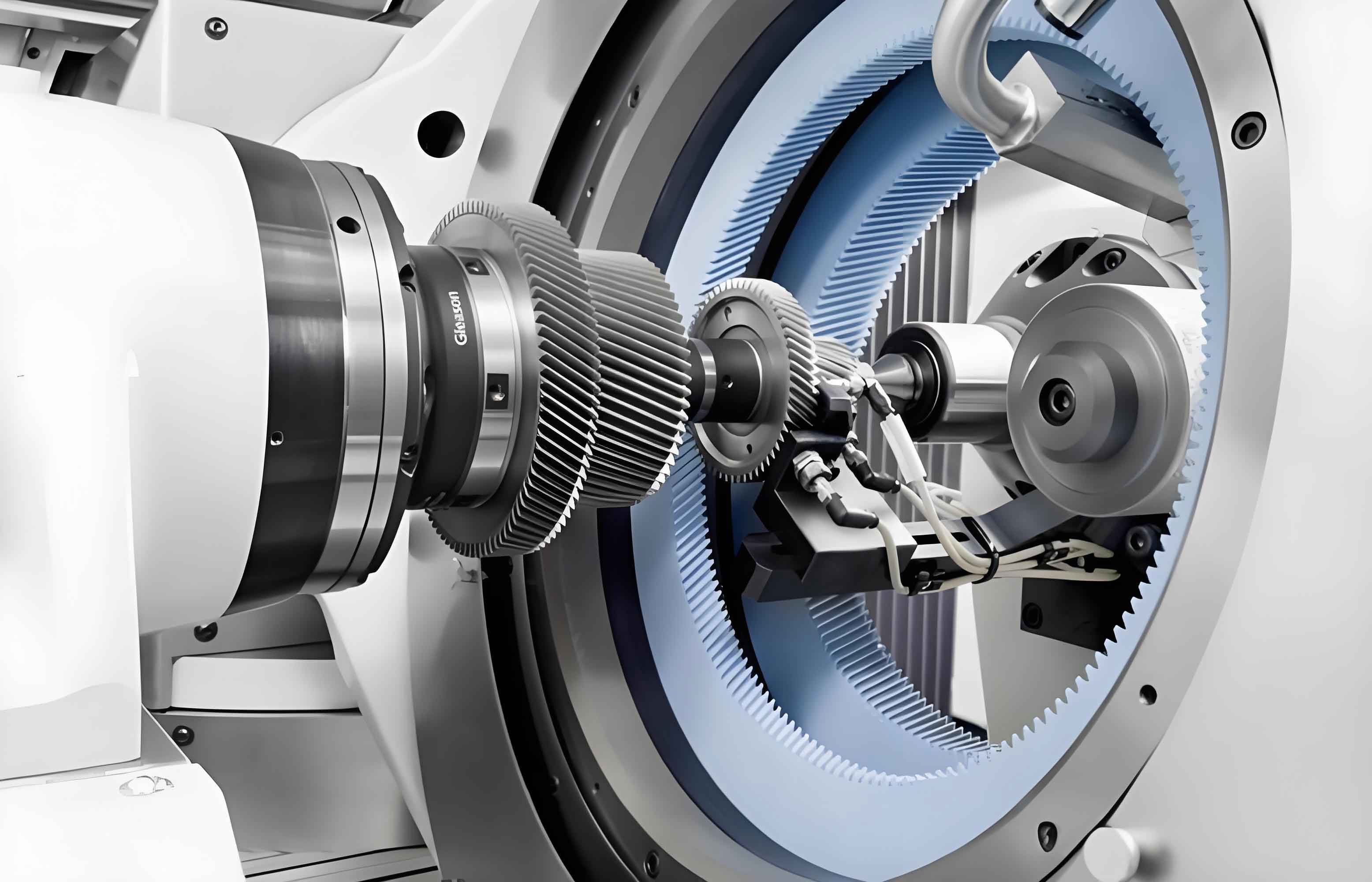
The gear honing process involves the meshing of a honing wheel, typically an internal gear, with the external workpiece gear under a prescribed speed ratio. The axes of the honing wheel and the workpiece are set at a crossing angle, simulating the kinematics of crossed helical gears. The material removal occurs through the abrasive action of the grains bonded on the honing wheel’s tooth surfaces as they slide against the workpiece tooth flanks under controlled radial and axial feeds. The primary motions in gear honing include the synchronous rotational motion of the workpiece (C1 axis) and the honing wheel (C2 axis), the radial infeed motion, and the axial reciprocating motion of the honing wheel along the workpiece face width.
Geometric Modeling of the Gear Honing Contact
To predict forces in gear honing, a precise geometric model of the instantaneous contact is essential. The first step is to establish the mathematical model for the line of contact between the honing wheel and the workpiece gear during their conjugate motion. A spatial coordinate system is defined for this purpose. Let \( O_g – x_g y_g z_g \) represent the fixed coordinate system attached to the workpiece gear at its initial position, and \( O_1 – x_1 y_1 z_1 \) represent the moving coordinate system that rotates with the workpiece. Similarly, \( O_h – x_h y_h z_h \) is the fixed coordinate system for the honing wheel, and \( O_2 – x_2 y_2 z_2 \) is its moving coordinate system. The center distance is denoted by \( a_{hg} \), the rotational angles of the workpiece and honing wheel by \( \phi_1 \) and \( \phi_2 \) respectively, and the crossing angle between their axes by \( \Sigma \), calculated as \( \Sigma = \beta_2 – \beta_1 \), where \( \beta_1 \) and \( \beta_2 \) are the helix angles of the workpiece and honing wheel.
The tooth surface of the workpiece gear, typically a standard involute helicoid, can be expressed in its moving coordinate system \( O_1 – x_1 y_1 z_1 \) as:
$$ x_1 = r_{b1} \cos(\sigma_0 + \theta + \lambda) + r_{b1} \lambda \sin(\sigma_0 + \theta + \lambda) $$
$$ y_1 = r_{b1} \sin(\sigma_0 + \theta + \lambda) – r_{b1} \lambda \cos(\sigma_0 + \theta + \lambda) $$
$$ z_1 = \theta p $$
where \( r_{b1} \) is the base radius, \( \sigma_0 \) is the start angle of the involute, \( \lambda \) is the involute roll angle, \( \theta \) is the rotation parameter along the helicoid, and \( p \) is the helix parameter.
According to the theory of gearing, for two surfaces to be in conjugate contact, the relative sliding velocity at any point of contact must be perpendicular to the common surface normal at that point. This condition is expressed as:
$$ \vec{v}_{12} \cdot \vec{n} = 0 $$
where \( \vec{v}_{12} \) is the relative velocity vector and \( \vec{n} \) is the unit normal vector of the workpiece tooth surface at the contact point. The relative velocity in the fixed coordinate system can be derived from the kinematics. By substituting the expressions for \( \vec{v}_{12} \) and \( \vec{n} \) into the conjugate condition and simplifying, the equation of meshing for the gear honing process is obtained:
$$ (a p \cos\Sigma – r_{b1}^2 \sin\Sigma) \cos(\sigma_0 + \theta + \lambda + \phi_1) + (\theta p^2 – \lambda r_{b1}^2) \sin\Sigma \sin(\sigma_0 + \theta + \lambda + \phi_1) + (p \cos\Sigma – a \sin\Sigma – i_{12} p) r_{b1} = 0 $$
This equation, denoted as \( f(\theta, \lambda, \phi_1) = 0 \), relates the three parameters \( \theta \), \( \lambda \), and \( \phi_1 \). For a given rotational angle \( \phi_1 \), solving this equation simultaneously with the tooth surface equations yields the coordinates of the instantaneous line of contact on the workpiece tooth surface. Since the gear honing process typically has a contact ratio greater than 2, multiple tooth pairs are in contact simultaneously. The contact lines on successive teeth are identical but separated by the angular pitch \( \phi_0 \), and can be obtained through a coordinate transformation using the matrix \( \mathbf{M}_{O_1} \). The distribution of these concurrent contact lines is crucial for the total force calculation.
The next critical parameter is the instantaneous cutting thickness. During gear honing, the radial infeed \( f_x \) (along the \( x_g \) axis in the fixed frame) is not directly the material removal depth at a specific point on the tooth flank. It must be projected onto the normal direction of the tooth surface at the contact point. If \( \alpha \) is the angle between the surface normal at a point and the radial direction, the normal feed in the transverse plane \( f_1 \) is:
$$ f_1 = f_x \cos \alpha $$
where \( \alpha = \pi/2 – (\lambda + \sigma_0) \). Furthermore, considering the elastic deformation of both the workpiece and the honing wheel, the actual cutting thickness \( f_1′ \) is less than the nominal feed. Modeling the contact as springs in series, the effective cutting thickness is:
$$ f_1′ = f_1 \frac{E_H}{E_H + E_W} = f_x \cos \alpha \frac{E_H}{E_H + E_W} $$
where \( E_H \) and \( E_W \) are the elastic moduli of the honing wheel and workpiece, respectively. This effective thickness is a key input for the force model at each discrete point along the contact line.
Discrete Predictive Model for Gear Honing Forces
The core of gear honing material removal is the abrasive grinding action of the honing wheel’s grains. Therefore, to predict the overall gear honing force, we start with a fundamental grinding force model and adapt it to the complex gear geometry. A comprehensive plane grinding model that accounts for both chip formation and ploughing forces, as well as variable friction coefficients, is adopted as the micro-scale foundation. The specific grinding force (force per unit width) in the normal (\( F_n’ \)) and tangential (\( F_t’ \)) directions is given by:
$$ F_n’ = K \frac{V_w}{V_c} a + \frac{K_1 V_w}{V_c} \frac{a}{\sqrt{d_e}} + \frac{K_4}{C_s} \left( \frac{V_w}{V_c} \right)^{a_0} d_e^{b_0} a^{c_0} \sqrt{a d_e} $$
$$ F_t’ = K’ \frac{V_w}{V_c} a + \left( K_2 + \frac{K_3 V_w}{d_e V_c} \right) \sqrt{a d_e} + \frac{K_5}{C_s} \left( \frac{V_w}{V_c} \right)^{a_0} d_e^{b_0} a^{c_0} \sqrt{a d_e} $$
where:
- \( V_w \): Workpiece feed speed (axial reciprocation speed component along the contact line).
- \( V_c \): Relative grinding speed at the point.
- \( a \): Depth of cut (taken as the effective cutting thickness \( f_1′ \)).
- \( d_e \): Equivalent grinding wheel diameter (related to the local curvature of the gear tooth flank).
- \( K, K’, K_1, K_2, K_3, K_4, K_5, C_s, a_0, b_0, c_0 \): Empirical constants dependent on the workpiece and abrasive tool properties.
To apply this plane model to the spatially complex contact in gear honing, a discretization approach is employed. Each active contact line on the honing wheel tooth is divided into a finite number of small, discrete micro-cutting edges. For each micro-segment \( i \) on contact line \( k \), the local process parameters—relative speed \( V_c(i) \), feed speed \( V_w(i) \), equivalent diameter \( d_e(i) \), and depth of cut \( a(i) \) (i.e., \( f_1′(i) \))—are calculated based on the geometric model and are assumed constant over that segment. The force on this micro-element is then:
$$ d\vec{F}(k,i) = (F_n'(i) \, dl) \, \vec{n}_i + (F_t'(i) \, dl) \, \vec{v}_{12i} $$
where \( dl \) is the length of the micro-segment, \( \vec{n}_i \) is the unit surface normal vector at the segment, and \( \vec{v}_{12i} \) is the unit vector of the relative velocity direction. These vectors are derived from the gear honing kinematics and geometry.
The total honing force acting on the honing wheel is obtained by vectorially summing the contributions from all micro-elements across all simultaneously engaged honing wheel teeth \( m \):
$$ \vec{F}_{\text{total}} = \sum_{k=1}^{m} \sum_{i=1}^{n} d\vec{F}(k,i) $$
This resultant force \( \vec{F}_{\text{total}} \), typically resolved in the honing wheel fixed coordinate system (\( O_h – x_h y_h z_h \)), represents the dynamic gear honing force. Its component along the radial direction (\( x_h \)-axis) is of particular interest for process monitoring and control.
Simulation Analysis and Experimental Validation in Gear Honing
To validate the predictive model for gear honing forces, a series of simulations and physical experiments were conducted. The geometrical and material parameters for the workpiece gear and the honing wheel used in the study are summarized in Table 1.
| Workpiece Gear Parameter | Value | Honing Wheel Parameter | Value |
|---|---|---|---|
| Number of Teeth (\( z_1 \)) | 73 | Number of Teeth (\( z_2 \)) | 123 |
| Module (\( m_1 \), mm) | 2.25 | Module (\( m_2 \), mm) | 2.25 |
| Normal Pressure Angle (\( \alpha_{n1} \), °) | 17.5 | Normal Pressure Angle (\( \alpha_{n2} \), °) | 17.5 |
| Helix Angle (\( \beta_1 \), °) | 33 | Helix Angle (\( \beta_2 \), °) | 41.722 |
| Face Width (\( b_1 \), mm) | 27 | Face Width (\( b_2 \), mm) | 30 |
| Elastic Modulus (\( E_W \), GPa) | 207 | Elastic Modulus (\( E_H \), GPa) | 70 |
The cutting force model parameters (\( K, K’, K_1, etc. \)) were calibrated based on typical values for similar abrasive grinding processes involving hardened steel and vitrified abrasives. The model was then implemented computationally to predict the radial component of the gear honing force (\( F_x \)) over one complete meshing cycle for various process conditions. The root mean square (RMS) value of this force over the cycle was used as a representative metric for comparison.
Experimental validation was performed on a Fassler HMX-400 CNC internal gear honing machine. This machine is equipped with a built-in Kistler force measurement system that directly records the radial honing force during the process. Experiments were designed by varying two key process parameters: the honing wheel rotational speed (\( n_2 \)) and the radial infeed rate (\( f_x \)). The axial reciprocation speed was held constant at 60 mm/min. The measured RMS radial force was compared against the model predictions.
The relationship between the predicted and measured gear honing force as a function of honing wheel speed is shown in Table 2 and its analysis. The force decreases with increasing speed, following a roughly inverse proportional trend, which is correctly captured by the model as the \( V_w/V_c \) ratio in the force equations decreases.
| Wheel Speed, \( n_2 \) (rpm) | Predicted \( F_x \) (N) | Measured \( F_x \) (N) | Deviation (%) |
|---|---|---|---|
| 800 | 152 | 145 | +4.8 |
| 1000 | 128 | 122 | +4.9 |
| 1200 | 110 | 105 | +4.8 |
| 1400 | 96 | 92 | +4.3 |
The effect of radial infeed rate on gear honing force is presented in Table 3. As expected, the radial force increases linearly with infeed, as the cutting thickness \( a \) increases proportionally. The model accurately predicts this linear trend, though the absolute deviation tends to increase slightly at higher feeds. This can be attributed to secondary effects such as changes in the effective elastic modulus under higher load or increased ploughing dominance, which the basic model may not fully capture.
| Infeed Rate, \( f_x \) (μm/s) | Predicted \( F_x \) (N) | Measured \( F_x \) (N) | Deviation (%) |
|---|---|---|---|
| 2 | 85 | 82 | +3.7 |
| 4 | 128 | 122 | +4.9 |
| 6 | 170 | 158 | +7.6 |
| 8 | 213 | 195 | +9.2 |
Discussion and Implications for Gear Honing Process Optimization
The developed model provides a mechanistic foundation for understanding force generation in gear honing. The close agreement between the predicted and experimental trends validates the core approach of discretizing the complex gear contact and applying a fundamental grinding model at the micro-scale. The consistent over-prediction, particularly at higher feeds, offers insight into potential areas for model refinement. For instance, the assumption of constant elastic moduli \( E_H \) and \( E_W \) might be enhanced by considering their load-dependent behavior. Furthermore, the grinding force coefficients (\( K, K’, etc. \)) could be more accurately determined through dedicated calibration experiments specific to the honing wheel and workpiece material pair.
The model’s ability to predict force variations with key parameters like speed and feed is directly useful for process planning in gear honing. It allows engineers to estimate the mechanical load on the spindle and tooling system for a given set of parameters, helping to avoid excessive forces that could cause vibration, poor surface finish, or rapid wheel wear. By simulating the force profile over a meshing cycle, the model can also identify periods of high dynamic loading that might be prone to excite chatter frequencies. This knowledge can guide the selection of process parameters (e.g., adjusting speed ratios) or the design of active control strategies to dampen these force fluctuations.
The discrete nature of the model makes it extensible. It can be integrated with thermal models to predict grinding temperatures in gear honing, or with wheel wear models to simulate the evolution of forces and surface quality over the tool’s lifetime. This forms a comprehensive digital twin approach for the gear honing process.
Conclusion
This article has presented a comprehensive analytical model for predicting honing forces in internal gear power honing processes. The model is built from first principles by:
- Deriving the precise geometry of the conjugate contact lines and the effective cutting thickness during gear honing.
- Discretizing the complex contact into numerous micro-cutting edges.
- Applying a fundamental plane grinding force model that accounts for both chip formation and ploughing mechanisms to each micro-element.
- Vectorially summing the contributions from all active micro-elements across all engaged teeth to obtain the total dynamic gear honing force.
The model’s predictions for the radial honing force show excellent agreement with experimental measurements in terms of both numerical values and, more importantly, the correct trends with respect to variations in honing wheel speed and radial infeed rate. While minor deviations exist, particularly at higher infeed rates, the model successfully captures the core physics of force generation in gear honing. This validated predictive model serves as a powerful tool for understanding, simulating, and optimizing the gear honing process, contributing to improved stability, higher quality, and more efficient production of precision gears. Future work will focus on refining the model’s parameters through specific calibration and integrating it with models for wheel wear and workpiece surface integrity in gear honing.