
The pursuit of efficient, high-torque, and precise motion transmission has led to the development of ingenious mechanisms that transcend traditional gear contact. At the forefront of these innovations is the principle of harmonic drive, most famously embodied in the mechanical strain wave gear. This technology achieves remarkable gear ratios and torque density through controlled elastic deformation. A fascinating electromagnetic counterpart to this mechanical genius is the eccentric magnetic harmonic gear, which replicates the kinematic motion using magnetic fields instead of physical strain. This article delves into the core principles of this wave-based transmission, with a particular focus on the challenging task of accurately modeling the complex magnetic fields within such devices, presenting a sophisticated hybrid computational approach.
The fundamental principle behind a strain wave gear involves three key components: a rigid circular spline, a flexible spline (or flexspline), and an elliptical wave generator. As the wave generator rotates, it induces a traveling wave of elastic deformation in the flexspline. The teeth on the flexspline engage with those on the circular spline in a progressive, wave-like manner. Due to the difference in the number of teeth between the two splines, each rotation of the wave generator results in only a tiny relative rotation between the flexspline and the circular spline, yielding very high reduction ratios in a compact package. The elegance lies in replacing sliding friction with rolling contact and elastic hysteresis, leading to high precision, near-zero backlash, and excellent torque-to-weight ratios. The electromagnetic analog seeks to replicate this kinematic magic using magnetic forces.
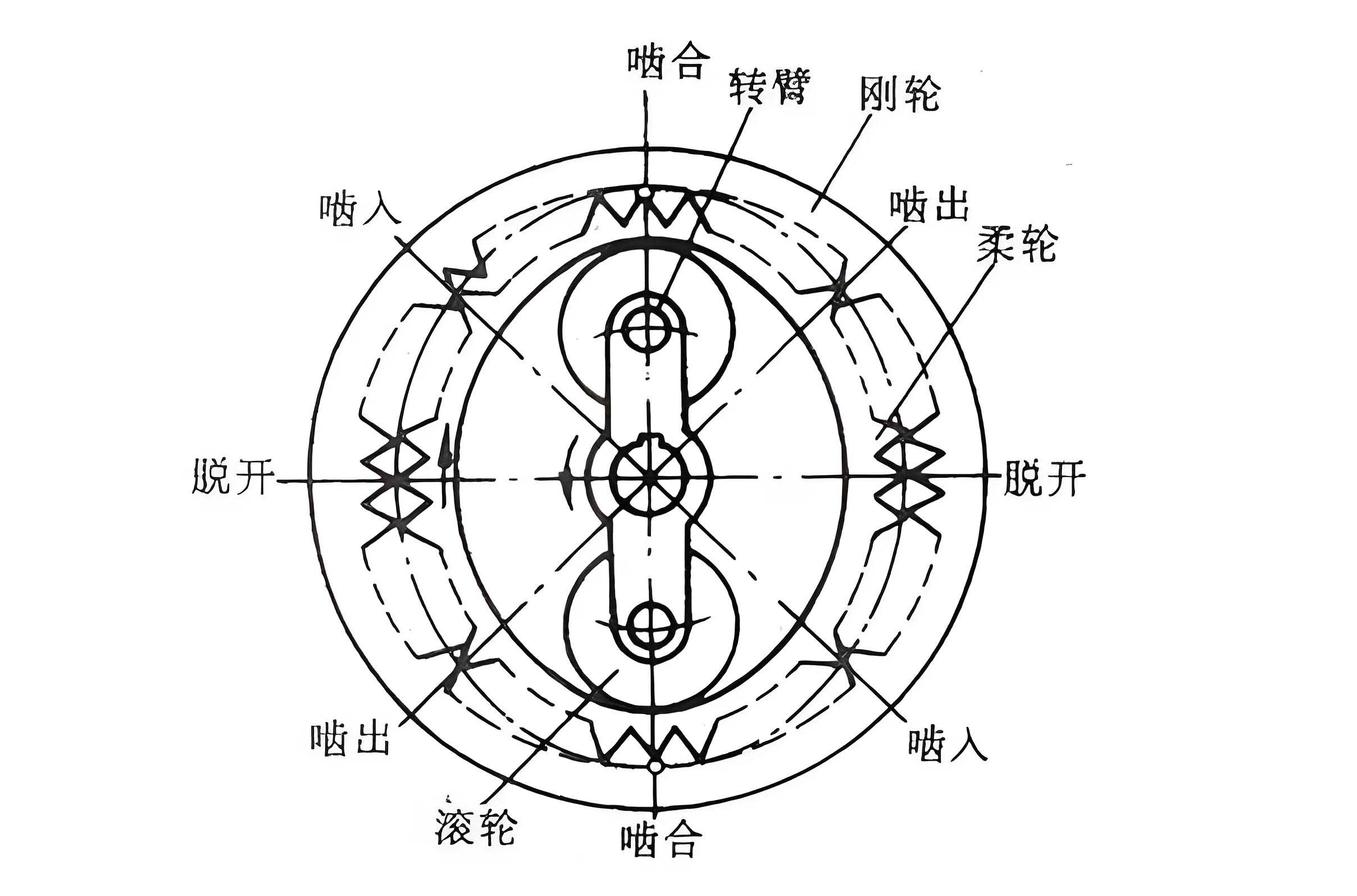
In an eccentric magnetic harmonic gear, the mechanical components are translated into electromagnetic ones. The high-speed rotor, analogous to the wave generator, creates a rotating pattern of magnetic reluctance or flux modulation. This is often achieved through a toothed ferromagnetic structure called a “flux modulator” or “air-gap permeance wave.” The low-speed rotor, laden with permanent magnets, corresponds to the flexspline. It is mounted eccentrically. The stationary stator, with a different number of magnetic poles, acts as the circular spline. The interaction is purely magnetic: the rotating magnetic field from the high-speed rotor (or the modulation effect) “drags” the magnetic field of the low-speed rotor, causing it to rotate slowly relative to the stator. The gear ratio is determined by the pole-pair relationship, similar to the tooth-count difference in a mechanical strain wave gear. The primary advantages are contactless torque transmission, inherent overload protection, negligible maintenance, and high efficiency.
Accurately predicting the performance of an eccentric magnetic harmonic gear hinges on solving its magnetic field distribution. This is a significant computational challenge due to two key factors: the non-uniform, eccentric air gap that changes with rotation, and the need to model the non-linear magnetic properties of the ferromagnetic materials. Traditional analytical methods, while fast, often rely on approximations like perturbation theory which are only valid for small eccentricities and cannot handle material non-linearities effectively. On the other hand, pure Finite Element Analysis (FEA) can handle complex geometries and non-linearity but struggles with motion. The meshed air gap “ties” the stator and rotor grids together; any eccentric motion severely distorts these air-gap elements, degrading accuracy and forcing a complete re-meshing at each rotor position, which is computationally prohibitive.
To overcome these limitations, a hybrid Finite Element and Double Air-Gap Macro-Element (FE-2AGE) model is proposed. This method strategically partitions the problem domain to leverage the strengths of both numerical and analytical techniques. The non-uniform air gap region is conceptually divided into three concentric layers. The two outer layers, which are adjacent to the stator and the rotor surfaces, are treated as uniform annular air gaps. These layers are modeled not with finite elements, but with Air-Gap Macro-Elements (AGEs). An AGE is an analytical solution to Laplace’s equation in a circular annular region, expressed in terms of the vector magnetic potential values on its inner and outer boundaries.
Let the outer and inner radii of a macro-element be $R_p$ and $R_q$, respectively. The general solution for the vector potential $A(r,\theta)$ within this element can be expressed as a series expansion based on the boundary values $A_{pi}$ and $A_{qj}$ at nodes on the outer and inner circles:
$$A(r, \theta) = \sum_{i=1}^{M_p} \alpha_i(r, \theta) A_{pi} + \sum_{j=1}^{M_q} \beta_j(r, \theta) A_{qj}$$
where the shape functions $\alpha_i$ and $\beta_j$ are derived from harmonic series:
$$
\begin{aligned}
\alpha_i(r, \theta) &= g_{a,i} + \sum_{n=1}^{\infty} [g_{an,i} \cos(n\theta) + g_{bn,i} \sin(n\theta)] \\
\beta_j(r, \theta) &= h_{c,j} + \sum_{n=1}^{\infty} [h_{cn,j} \cos(n\theta) + h_{dn,j} \sin(n\theta)]
\end{aligned}
$$
The coefficients $g$ and $h$ are functions of $r$, $R_p$, $R_q$, and the angular positions of the boundary nodes. The middle layer of the air gap, which contains the non-uniform permeance wave (the modulator), is discretized using standard finite elements, as are the stator and rotor iron cores and permanent magnet regions. This setup is summarized in the table below.
| Region | Modeling Technique | Purpose / Characteristics |
|---|---|---|
| Stator Core & Windings/PMs | Finite Element Method (FEM) | Handles non-linear B-H curves, complex shapes. |
| Outer Air-Gap Layer | Air-Gap Macro-Element (AGE) | Analytical, uniform, connects to stator. |
| Middle Air-Gap Layer (Modulator) | Finite Element Method (FEM) | Represents the non-uniform permeance wave. |
| Inner Air-Gap Layer | Air-Gap Macro-Element (AGE) | Analytical, uniform, connects to rotor. |
| Rotor Core & PMs | Finite Element Method (FEM) | Handles non-linearity and eccentric motion. |
The key advantage is that the double AGEs act as a “buffer zone.” The stator mesh, the modulator mesh, and the rotor mesh are no longer connected to each other through shared nodes in the air gap. This completely liberates the rotor and the modulator from mesh constraints, allowing them to move freely (eccentrically) without distorting any elements. The connection between domains is now enforced mathematically through the shared vector potential values on the AGE boundaries, which become degrees of freedom in the global system matrix.
The global system of equations is assembled by combining the standard finite element matrix for the iron and modulator regions with the matrix contributions from the AGEs. The stiffness contribution from an AGE is derived from the magnetic energy within it, $W_a = \frac{1}{2} \int_{\Omega} \nu_0 |\nabla \times \mathbf{A}|^2 d\Omega$. Differentiation with respect to the nodal potentials $A_{pi}$ and $A_{qj}$ yields the AGE matrix coefficients $k^{age}_{ij}$, which are added to the global FEM matrix $K$:
$$K_{global} = K_{fe} + K^{age}_{outer} + K^{age}_{inner}, \quad \text{and} \quad K_{global} \mathbf{A} = \mathbf{f}$$
where $\mathbf{f}$ is the source vector from permanent magnets or currents.
A significant benefit of this hybrid approach is the high-accuracy calculation of electromagnetic torque. Using the Maxwell Stress Tensor method, the torque is computed by integrating the tangential force density along a circular contour within an AGE. Because the magnetic flux density components $B_r$ and $B_\theta$ are derived analytically from the gradient of the potential function $A(r,\theta)$ within the AGE, the torque can be expressed directly as a function of the boundary node potentials:
$$T_{em} = \frac{L_{ef} r^2}{\mu_0} \int_0^{2\pi} B_r(r,\theta) B_\theta(r,\theta) d\theta = \mathcal{F}(A_{pi}, A_{qj})$$
This analytical integration yields results with higher accuracy than methods relying on numerically differentiated field values from finite element meshes, which are prone to discretization errors.
While the AGEs solve the motion problem, they introduce a computational burden: their matrices are dense (not sparse like FEM matrices), increasing the solution time. Furthermore, if the rotor moves, the boundary nodes on the moving AGE would shift, requiring a complete recalculation of the AGE coefficients at every step—a costly process. To overcome this, an Equivalent Motion Mode combined with a Sliding Surface Technique is employed. The reference frame is shifted to the center of the low-speed rotor. In this frame, the stator and the modulator appear to rotate in the same direction at different speeds, while the rotor’s own center is stationary relative to itself. At the interface between an AGE and a moving part (e.g., the rotor), a sliding surface is implemented. The nodes on the AGE side of the interface are fixed in space. The nodes on the moving part’s side move, but at each step, they are made to coincide spatially with the fixed AGE nodes. The connection is maintained by cyclically permuting the correspondence between the moving and fixed node numbers. This clever trick ensures that the spatial distribution of the AGE boundary nodes never changes. Consequently, the AGE matrices and their coefficients need to be calculated only once at the beginning of the simulation, leading to drastic time savings, often by a factor of two-thirds or more.
To validate this hybrid modeling approach, consider a two-stage eccentric magnetic harmonic gear prototype designed for high gear ratio. The relevant parameters for the second, high-torque stage are listed below.
| Parameter | Value (Second Stage) |
|---|---|
| Stator Outer Diameter | 103 mm |
| Rotor Inner Diameter | 55 mm |
| Number of Rotor Pole Pairs ($p_r$) | 15 |
| Number of Stator Pole Pairs ($p_s$) | 16 |
| Average Air-Gap Length | 5 mm |
| Eccentricity | 4 mm |
| Axial Length ($L_{ef}$) | 20 mm |
| Permanent Magnet Remanence ($B_r$) | 1.25 T |
Applying the FE-2AGE model, the magnetic field distribution is computed. The modulation effect of the non-uniform air gap (the permeance wave) is clearly visible, creating spatial harmonics in the field. The radial flux density in the outer and inner AGEs shows a clear sinusoidal pattern with periods corresponding to 16 and 15 pole-pairs, respectively, confirming the field modulation principle that is kinematically analogous to a strain wave gear. The steady-state peak holding torque calculated from the model for this stage is approximately 19.2 Nm. The torque-angle characteristic exhibits a sinusoidal shape typical of permanent magnet synchronous machines, with the ratio of the torques computed from the inner and outer AGEs being close to the pole-pair ratio $p_r / p_s = 15/16$, validating the underlying magnetic gearing theory.
Experimental measurements on the prototype were conducted. At a high-speed input of 1820 rpm, the low-speed output achieved 100 rpm, confirming a gear ratio consistent with the pole-pair difference. The maximum sustained output torque measured was 17.2 Nm. This is slightly lower than the computed peak static torque of 19.2 Nm, which is expected as the peak static torque represents an instability point; the maximum steady-state operating torque is always lower due to factors like minor misalignment and thermal effects. The close correlation between the predicted and measured performance validates the accuracy and effectiveness of the hybrid FE-2AGE model. For comparison, a pure FEA simulation with a finely meshed, moving air gap was also performed. The torque result from this method showed a larger discrepancy from the measured value, and the computed flux density waveform appeared coarser due to the discretization inherent in post-processing finite element results, underscoring the accuracy advantage of the analytical torque computation in the AGE-based method.
The following table summarizes a comparison of key characteristics between the classic mechanical strain wave gear and its magnetic harmonic counterpart, highlighting their shared wave-based principle and different implementations.
| Feature | Mechanical Strain Wave Gear | Eccentric Magnetic Harmonic Gear |
|---|---|---|
| Transmission Principle | Controlled elastic deformation wave. | Rotating magnetic field / permeance wave. |
| Key Components | Wave Generator, Flexspline, Circular Spline. | High-speed Rotor/Modulator, Low-speed PM Rotor, Stator. |
| Torque Transfer | Mechanical contact (rolling). | Non-contact magnetic forces. |
| Backlash | Near-zero. | Inherently zero. |
| Modeling Challenge | Non-linear material stress, contact fatigue. | Non-linear BH-curve, eccentric motion, field modulation. |
| Primary Losses | Hysteresis, friction, wear. | Iron loss, eddy currents in conductors/PMs. |
In conclusion, the principle of wave-based transmission, exemplified by the strain wave gear, finds a powerful and innovative expression in the domain of electromagnetics through magnetic harmonic gears. The computational challenge of designing and analyzing these eccentric magnetic devices is effectively addressed by a hybrid modeling strategy that combines the geometric flexibility and non-linear capability of the Finite Element Method with the analytical precision and motion-handling elegance of Double Air-Gap Macro-Elements. This approach not only allows for the accurate simulation of the complex, moving magnetic fields but also facilitates the efficient computation of performance metrics like torque. The synergistic combination of an equivalent motion mode and sliding surface technique further optimizes the computational process. As the demand for efficient, maintenance-free, and high-performance drives grows in robotics, aerospace, and precision automation, the magnetic harmonic gear and the robust modeling techniques developed for it will undoubtedly play an increasingly vital role, standing as a testament to the enduring power of the harmonic wave transmission concept first realized in the mechanical strain wave gear.