
This analysis details the investigation into the premature failure of a cylindrical roller bearing supporting the driving gear shaft within a helicopter engine’s transmission system. The bearing, specified for a 1,000-hour service life, exhibited spalling on several rollers after less than 100 hours of operation. The following report, presented from my analytical perspective, systematically examines the failure through metallurgical inspection, dimensional metrology, and mechanical principle analysis, culminating in root cause identification and preventive recommendations.
Case Background and System Context
The failure was indicated by metallic debris on an engine magnetic chip detector. Disassembly confirmed the debris originated from rollers within the front bearing supporting the engine’s input driving gear shaft. This gear shaft is a critical component, transmitting power through a two-stage helical gear reduction system. It is supported by two nominally identical cylindrical roller bearings at its front (input side) and rear. The failed bearing is located at the front, high-speed end. The bearing design lacks an inner ring, utilizing the hardened gear shaft journal as the inner raceway. The outer ring features a flange for mounting and double ribs for roller guidance. The bearing operates at a high dmn value of approximately $1.87 \times 10^6 \text{ mm} \cdot \text{r} \cdot \text{min}^{-1}$, indicating severe operational conditions common in aerospace gear shafts.
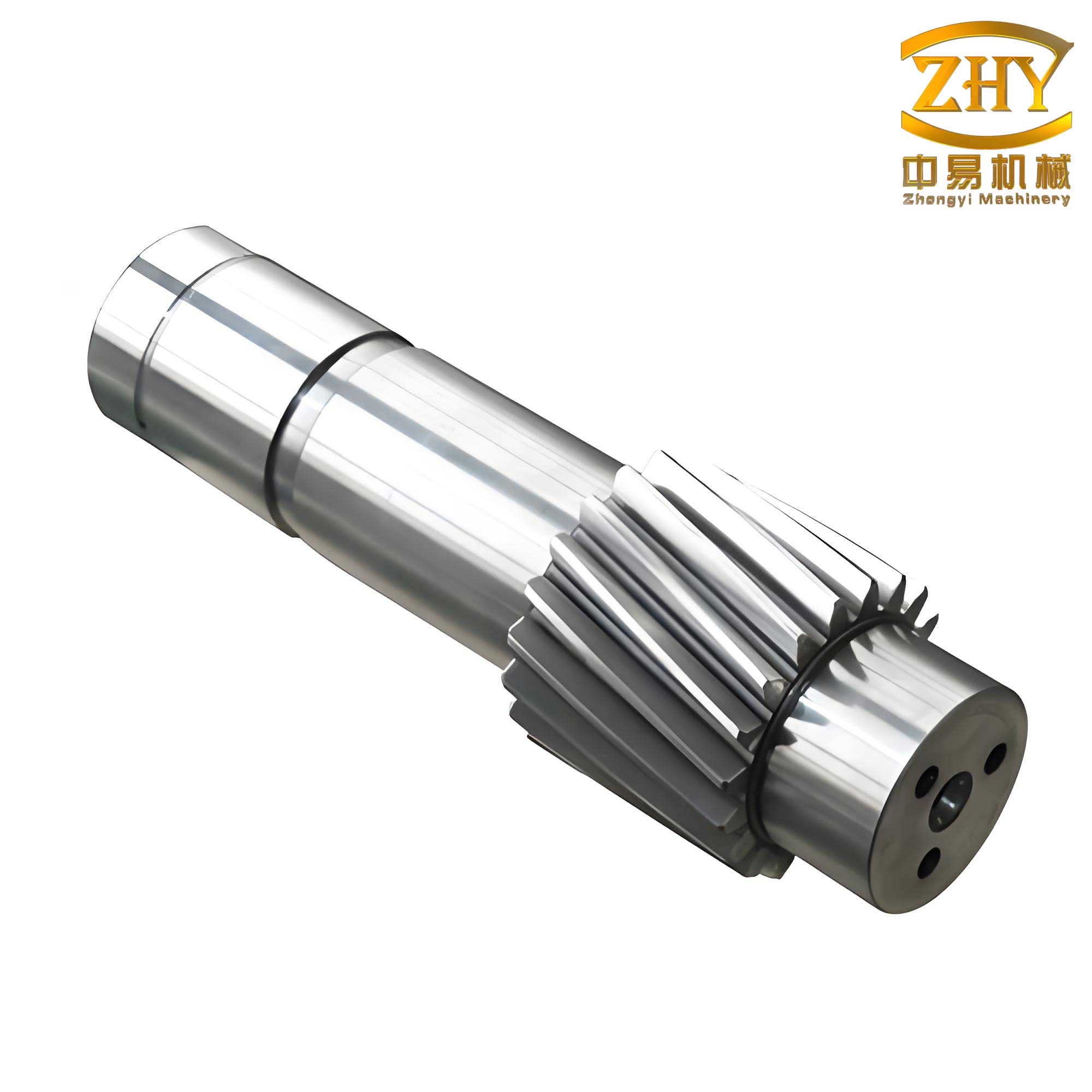
Detailed Examination of the Failed Bearing
1.1 Macroscopic Visual Inspection
Upon disassembly, three out of twelve rollers showed significant damage. The damage zone on each roller was fan-shaped, located proximately to one end of the roller’s active profile, measuring approximately 4 mm in circumferential length and 1 mm in axial width. The corresponding sections of the outer raceway and the gear shaft journal (inner raceway) exhibited localized spalling and wear marks. The cage showed no obvious damage. The concentrated location of damage near the roller ends immediately suggested an issue related to stress concentration at the roller profile edge, a critical interface within the gear shaft assembly.
1.2 Microscopic Fractography
Scanning Electron Microscopy (SEM) examination of a representative failed roller revealed classic fatigue failure characteristics. The fan-shaped spall initiated at the roller’s outer surface, at the transition between the chamfer and the crowned working surface. The fracture surface exhibited clear fatigue beach marks, indicating progressive crack propagation under cyclic loading. The origin region showed a linear, multi-initiation site pattern with no evidence of inherent material defects like large inclusions or forging laps. Adjacent areas showed incipient flaking, suggesting widespread high-stress conditions. The morphology was consistent with high-contact-stress, surface-originated fatigue.
1.3 Material, Microstructure, and Hardness Verification
Energy Dispersive X-ray Spectroscopy (EDS) confirmed the roller material conformed to AISI M50 (Cr4Mo4V) high-temperature bearing steel specification. Microstructural analysis revealed a tempered martensitic structure with uniformly dispersed carbides, appropriate for the required quench and temper heat treatment. No abnormal features like excessive retained austenite, grain boundary carbide networks, or non-metallic inclusions were observed. Hardness measurements averaged 63 HRC, well within the acceptable range for this material and application. These results conclusively eliminated material composition, heat treatment, or bulk hardness as contributing factors to the premature failure. The root cause had to lie elsewhere, likely in the geometry or assembly of the gear shaft bearing system.
Precision Dimensional Metrology: The Revelatory Data
To investigate geometric anomalies, a high-precision profilometer was employed to measure the contour of rollers and raceways from the failed bearing, its paired rear bearing, and new bearings from inventory. The findings were critical.
| Bearing Component | Measurement Target | Result | Conclusion vs. Spec (3-6 µm) |
|---|---|---|---|
| Failed Front Bearing | Outer Raceway | Localized bump at raceway edge | Abnormal |
| Intact Rollers | Crown: 3.3 to 4.4 µm | Marginally Acceptable/Low | |
| Paired Rear Bearing | Outer Raceway | Normal contour | Normal |
| Rollers | Crown: 13.3 to 14.2 µm | Excessive (Out of Spec) | |
| New Bearing (Inventory) | Outer Raceway | Normal contour | Normal |
| Rollers | Crown: 2.0 to 3.0 µm | Insufficient (Out of Spec) |
Furthermore, critical dimensional spreads were measured on the rollers from the failed bearing:
- Roller Diameter Variation (ΔD): 2.3 µm. This exceeded the specified maximum limit of 0.7 µm by a factor of over three.
- Roller Length Variation (ΔL): 2.0 µm. This was within the acceptable specification.
The profilometry data revealed systemic manufacturing inconsistencies: improper roller crown geometry was prevalent, and the failed bearing exhibited excessive roller diameter variation. The localized bump on the outer raceway of the failed bearing was identified as a secondary effect, likely caused by debris from the failing rollers or direct over-stress from an improperly crowned roller.
Failure Mechanism and Root Cause Analysis
3.1 The Critical Role of Roller Crown (Crowning) in Gear Shaft Bearings
In cylindrical roller bearings, especially those supporting high-speed gear shafts, perfect cylindrical rollers would create theoretically infinite edge stresses due to misalignment, shaft deflection under load, or geometric inaccuracies. To mitigate this, rollers and raceways are ground with a slight barrel-shaped profile, known as a crown or logarithmic profile. This design intentionally relieves stress at the ends of the contact patch, ensuring a more uniform stress distribution along the roller’s length. The optimal crown height is a calculated compromise that minimizes both edge stress and the reduction of load-carrying capacity at the center.
When the crown is insufficient (under-crowned), as suspected for the failed rollers, the roller edge makes severe, highly concentrated contact with the raceway. The contact stress at this edge can exceed the material’s endurance limit by a large margin. The resulting subsurface shear stress cycles initiate micro-cracks, leading to premature spalling. The fundamental relationship for contact stress in a roller-raceway conjunction is given by the Hertzian theory. For a crowned roller, the maximum contact pressure $p_0$ is distributed, while for an under-crowned roller, an edge stress intensity factor $K_{edge}$ must be considered, leading to a localized stress $\sigma_{edge}$ far greater than the design intent:
$$
\sigma_{edge} \approx K_{edge} \cdot p_0 \quad \text{where} \quad K_{edge} \gg 1 \text{ for under-crowned condition}
$$
The analysis concluded that the primary root cause of failure was the operation of one or more rollers with an effective crown height below the minimum specification. This led to catastrophic edge stress concentration, initiating fatigue spalls at the roller ends after a short service life. The precise interaction between the gear shaft’s deflected path and the bearing rollers made this issue critically acute.
3.2 The Amplifying Effect of Excessive Roller Diameter Variation
In a radially loaded rolling bearing, load distribution among the rollers is not equal. In a perfect bearing with zero clearance, the most radially aligned roller carries the highest load. With practical clearance and dimensional variations, the load distribution becomes uneven. Excessive variation in roller diameters ($\Delta D$) exacerbates this imbalance. The largest diameter rollers within a row will carry a disproportionately higher share of the total radial load, $F_r$.
If we model a bearing with n rollers, the load on the i-th roller, $Q_i$, is a function of its diameter deviation $\delta D_i$ from the set’s mean, the radial internal clearance, and the applied load. Simplistically, for a bearing under pure radial load, the load on the most heavily loaded roller can be approximated by:
$$
Q_{max} \approx \frac{4.37 \cdot F_r}{n} \cdot \left(1 + \frac{\delta D_{max}}{\epsilon}\right)
$$
where $\epsilon$ is a factor related to internal clearance and deflection. A large positive $\delta D_{max}$ significantly increases $Q_{max}$. When this overloaded roller also suffers from an insufficient crown (a condition not easily screened in standard inspection), the combination is devastating: not only is the edge stress high due to poor geometry, but the cyclic magnitude of that stress is also increased due to the higher load borne by that specific roller. This synergistic effect explains why only three specific rollers failed prematurely—they were likely the largest in diameter and had the smallest crowns.
| Condition | Effect on Load Distribution | Effect on Local Contact Stress | Combined Result |
|---|---|---|---|
| Normal Crown, Low ΔD | Load shared relatively evenly. | Stress uniformly distributed, peak stress within design limit. | Expected fatigue life achievable. |
| Insufficient Crown, High ΔD | Largest rollers are overloaded. | Severe edge stress concentration on overloaded rollers. | Catastrophic early failure of specific rollers. |
| Excessive Crown, High ΔD | Largest rollers are overloaded. | Reduced load capacity at center, but low edge stress. | Possible early wear or skidding, but not necessarily rapid spalling. |
Proposed Corrective Actions and Advanced Process Control
The failure underscores that traditional inspection protocols for gear shaft bearings—focusing on visual checks, clearance, rotation torque, and material conformance—are insufficient to detect subtle yet critical geometric imperfections like crown profile and diameter consistency.
4.1 Enhanced 100% Final Inspection via Vibration Monitoring
The most effective proactive measure is the implementation of vibration signature analysis as a mandatory 100% final inspection step for such high-criticality bearings. The vibration spectrum of a rotating bearing is a sensitive fingerprint of its geometric perfection. Specific manufacturing defects correlate with distinct frequency components:
- Roller Diameter Variation (ΔD): Manifests as increased vibration at the roller pass frequency and its harmonics.
- Roller Crown Error & Raceway Form Error: Affects the wideband noise floor and can excite specific high-frequency resonances related to impacts or irregular rolling motion.
- Surface Roughness/Waviness: Generates specific high-frequency content.
A bearing with an out-of-spec crown and high diameter variation would produce a distinctly noisier and higher-amplitude vibration signature compared to a good bearing. Establishing accept/reject thresholds based on overall vibration velocity (e.g., in mm/s) or acceleration levels within specific frequency bands would reliably screen out defective units before they reach the gear shaft assembly.
| Defect Type | Primary Vibration Frequency Domain | Measurable Parameter |
|---|---|---|
| Roller Diameter Variation | Low-Frequency (Rolling Element Pass Freq.) | RMS Velocity |
| Roller/Raceway Crown/Form Error | Mid to High-Frequency (Impact Events) | Peak Acceleration, Spike Energy |
| Surface Finishing (Roughness) | Very High-Frequency (Ultrasonic) | Acoustic Emission, Enveloped Acceleration |
Implementing this requires investment in standardized vibration testers and the development of statistically justified pass/fail limits, but it is a proven technology for ensuring the dynamic quality of precision bearings.
4.2 Statistical Process Control (SPC) in Grinding Operations
To address the root cause at the source, SPC must be rigorously applied to the crown grinding and diameter sorting processes. For crown grinding:
* The crown height and profile shape must be measured on a sampling basis using profilometers, with control charts tracking the process mean and variation.
* Any drift towards the specification limits must trigger immediate machine adjustment.
For diameter sorting:
* The diameter of every roller must be measured and sorted into much tighter tolerance groups than the final bearing’s ΔD requirement.
* A single bearing must be assembled using rollers from a single, tight-tolerance group to ensure minimal diameter variation. The formula for the resulting bearing’s ΔD is constrained by the group’s range:
$$
\Delta D_{bearing} \leq \max(S_i) – \min(S_i) \quad \text{for rollers } R_i \in S
$$
where $S$ is the selected tight-tolerance group of rollers.
Conclusion
The premature failure of the helicopter engine driving gear shaft bearing was not attributable to material deficiency but to precise geometric deviations in its roller components. The primary root cause was the operation of specific rollers with an insufficient crown profile. This design/manufacturing flaw led to severe edge stress concentration under load. This condition was critically exacerbated by an excessive roller diameter variation within the bearing, which caused those same under-crowned rollers to be disproportionately overloaded. The synergy of these two factors—poor load distribution due to high ΔD and catastrophic stress risers due to low crown—resulted in high-cycle fatigue spalling at the roller ends in a small fraction of the design life. Ensuring the long-term reliability of such critical gear shaft components demands moving beyond traditional inspection methods to embrace 100% vibration testing for final quality assurance and implementing rigorous SPC in the grinding and assembly processes to control crown geometry and dimensional uniformity.