
The pursuit of precision, high torque density, and reliable motion control in robotic joints has led to the widespread adoption of the RV reducer. As a key power transmission component, the performance of the RV reducer directly dictates the operational accuracy, stiffness, and longevity of the robotic system. Among its core components, the cycloid wheel stands out due to its role in the critical second-stage reduction. Compared to other transmission forms like standard planetary gears or harmonic drives, the cycloid drive within the RV reducer offers unparalleled advantages, including a very high transmission ratio, exceptional torsional stiffness, high positional accuracy, compact structure, and smooth operation under heavy loads. Consequently, the structural integrity and stress state of the cycloid wheel are paramount to the overall health and performance of the entire RV reducer. This article details a thorough investigation into the mechanical behavior of the cycloid wheel, encompassing theoretical force derivation, precise 3D modeling, and a rigorous finite element analysis (FEA) to validate its strength under operational loads.
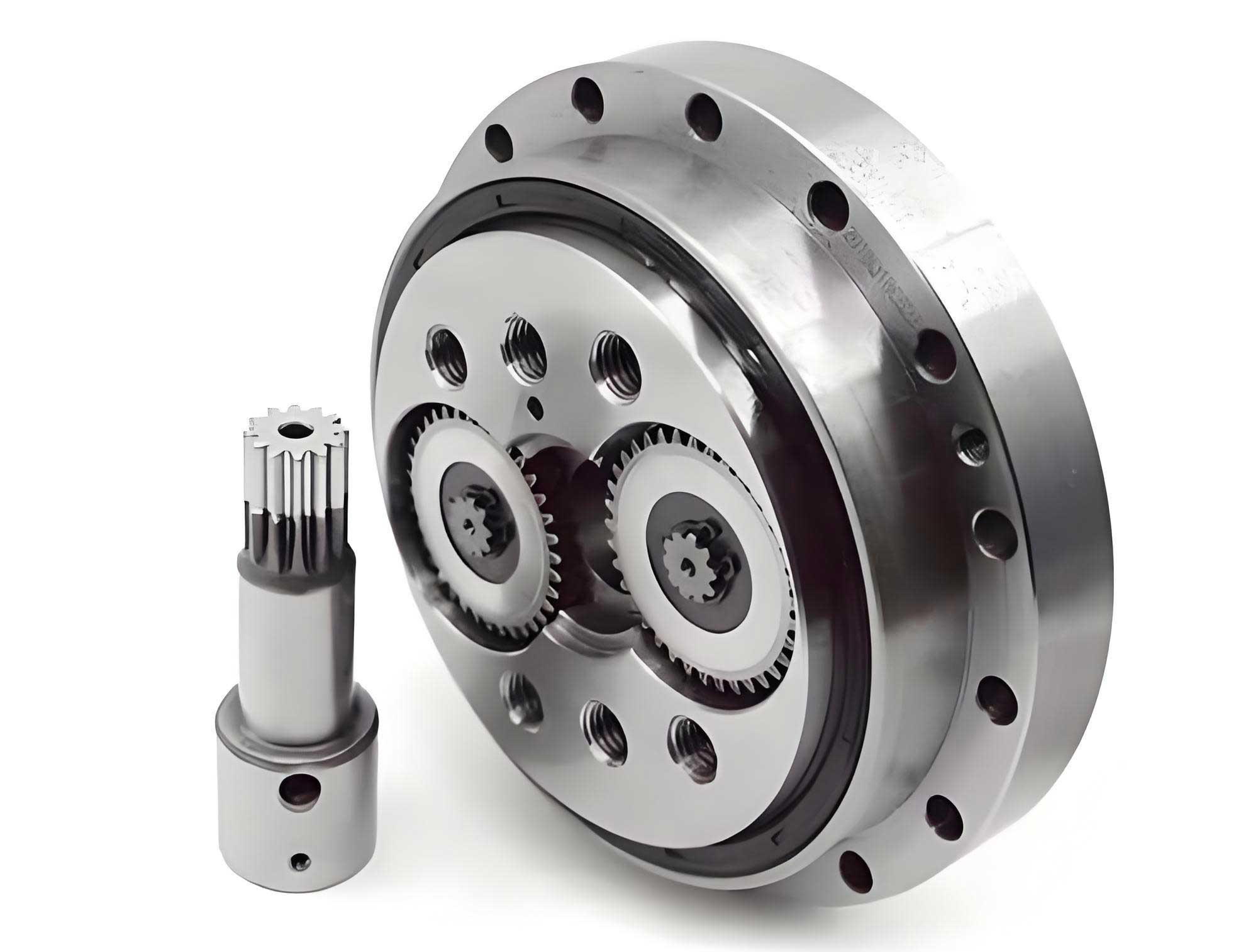
The operational principle of the RV reducer is a sophisticated combination of planetary and cycloidal gearing. The motion transmission follows a two-stage path. First, the input rotation from the servo motor is delivered to the sun gear, which engages with multiple planetary gears to achieve the first stage of speed reduction. Second, the rotation of the planetary gears drives the crankshafts, which are integral to the RV reducer‘s housing. These crankshafts impart an eccentric motion (revolution) to the cycloid wheels. With the ring of needle rollers (the pin gear) held stationary, this revolution forces the cycloid wheels to undergo a contrary rotation (spin) due to their meshing with the needle rollers. Finally, this spin of the cycloid wheels is transmitted back to the crankshafts, causing them to orbit, which in turn drives the output carrier. The total transmission ratio of the RV reducer is given by the formula:
$$
i_{16} = 1 + \frac{z_2}{z_1} z_5
$$
where \(z_1\) is the number of teeth on the sun gear, \(z_2\) is the number of teeth on the planetary gear, and \(z_5\) is the number of needle rollers (pin teeth).
The unique architecture of the RV reducer bestows it with several critical features essential for robotic applications:
| Feature | Description |
|---|---|
| High Compactness | The transmission elements are positioned between the support bearings of the output carrier, significantly reducing axial dimensions. |
| High Rigidity & Smoothness | The two-stage design lowers the speed of the cycloid stage. Multiple simultaneous tooth contacts and the use of bearings at the crankshaft connections ensure smooth motion and high rigidity, enhanced by a simply-supported output structure. |
| Large Transmission Ratio | By adjusting the gear counts in the first stage, a wide range of ratios (typically 31 to 171) can be achieved. |
| High Efficiency & Precision | The predominant use of rolling contacts (bearings, needle rollers) leads to high transmission efficiency (0.85-0.92). Precision manufacturing yields high rotational accuracy and low backlash. |
Theoretical Force Analysis of the Cycloid Wheel
A prerequisite for an accurate finite element analysis is a precise understanding of the loading conditions. In an ideal scenario with zero clearance, nearly half of the needle rollers would share the load. However, accounting for realistic manufacturing tolerances and clearances is crucial, as the ideal assumption can lead to significant errors in stress prediction. Based on established deformation compatibility methods, the analysis for a standard RV reducer configuration reveals that a specific subset of teeth carries the entire load during operation. For a typical design with 40 needle rollers, the force is distributed among approximately 7 simultaneously engaged tooth pairs.
The following assumptions are made to simplify the force model for the cycloid wheel within the RV reducer:
- The material of the cycloid wheel is homogeneous, isotropic, and continuous.
- Friction forces at the tooth contact interfaces are negligible.
- The contact force between the cycloid wheel and each needle roller acts along the common normal line at the point of contact.
The force transmission mechanism is special. The lines of action for all contact forces converge at a single instantaneous center of rotation. The cycloid wheel is thus subjected to these 7 contact forces and reaction forces from the two crankshaft bearings. The force \(F_i\) on an individual tooth \(i\) can be calculated using the following derived formula, which considers the geometry and torque transmission:
$$
F_i = \frac{4T_c}{K_1 Z_c r_p} \frac{\sin\varphi_i}{(1+K_1^2 – 2K_1\cos\varphi_i)^{0.5}}
$$
Where:
- \(T_c\) is the resistive torque on one cycloid wheel. For a twin-cycloid RV reducer with good manufacturing quality, \(T_c \approx 0.55T\), where \(T\) is the output torque.
- \(K_1\) is the shortening factor, defined as \(K_1 = \frac{a Z_p}{r_p}\), with \(a\) being the eccentricity.
- \(Z_c\) is the number of lobes on the cycloid wheel (\(Z_c = Z_p – 1\)).
- \(r_p\) is the radius of the pin circle (the circle on which needle roller centers lie).
- \(\varphi_i\) is the angular position of the \(i\)-th needle roller relative to the line of symmetry.
For analysis, an RV-20E type RV reducer is considered. Its key parameters related to the cycloid wheel are summarized below:
| Parameter | Symbol | Value |
|---|---|---|
| Pin Circle Radius | \(r_p\) | 52.5 mm |
| Needle Roller Radius | \(r_{rp}\) | 2.0 mm |
| Number of Needle Rollers | \(Z_p\) | 40 |
| Eccentricity | \(a\) | 1.0 mm |
| Shortening Factor | \(K_1\) | 0.7619 |
| Cycloid Wheel Thickness | \(b_c\) | 9.0 mm |
| Crank Bearing Hole Diameter | \(d_b\) | 26.5 mm |
Applying the force formula to the 7 load-bearing teeth (numbered 2 through 8 in a typical engagement pattern) yields the following force magnitudes for a given output torque condition:
| Tooth Number (i) | Angle \(\varphi_i\) (degrees) | Force \(F_i\) (Newtons) |
|---|---|---|
| 2 | 13.5 | 1549.1 |
| 3 | 22.5 | 1920.8 |
| 4 | 31.5 | 2055.0 |
| 5 | 40.5 | 2085.8 |
| 6 | 49.5 | 2063.3 |
| 7 | 58.5 | 2008.1 |
| 8 | 67.5 | 1929.6 |
The direction of each force \(F_i\) is along the common normal line at the meshing point, pointing toward the instantaneous center. The crankshaft bearing holes are modeled as fixed hinge supports for the purpose of this static structural analysis, which simplifies the application of boundary conditions without compromising the fundamental stress state in the tooth region.
Finite Element Modeling and Simulation
3D Geometric Modeling
An accurate geometric model is the foundation of a reliable FEA. The complex profile of the cycloid wheel is defined by its parametric trochoidal equations. For a standard cycloid wheel in an RV reducer, the coordinates of the tooth profile are given by:
$$
\begin{aligned}
x_c &= \left[ r_p – r_{rp} \Phi^{-1}(K_1, \phi) \right] \cos\left[(1-i_H)\phi\right] – \left[ a – K_1 r_{rp} \Phi^{-1}(K_1, \phi) \right] \cos(i_H \phi) \\
y_c &= \left[ r_p – r_{rp} \Phi^{-1}(K_1, \phi) \right] \sin\left[(1-i_H)\phi\right] + \left[ a – K_1 r_{rp} \Phi^{-1}(K_1, \phi) \right] \sin(i_H \phi)
\end{aligned}
$$
where \(\Phi^{-1}(K_1, \phi)\) is the tooth profile modifier function, \(\phi\) is the generating angle, and \(i_H = Z_p / Z_c\) is the transmission ratio between the pin gear and the cycloid wheel. Using the parameters from the RV-20E model, these equations were programmed into Pro/ENGINEER to generate the precise tooth profile curve. This curve was then used to create a solid 3D model of the cycloid wheel through extrusion and boolean operations, resulting in a digital twin ready for analysis.
FEA Setup in SolidWorks Simulation
While ANSYS is a powerful general-purpose FEA tool, SolidWorks Simulation offers seamless integration with the CAD environment, simplifying the process of applying forces to specific, hard-to-locate contact points on the complex tooth flanks. Therefore, SolidWorks Simulation was chosen for this study of the RV reducer component.
Material Properties: The cycloid wheel is typically manufactured from high-carbon chromium bearing steel, such as GCr15 (AISI 52100 equivalent), to withstand high contact stresses. The material properties defined in the simulation are:
| Property | Value |
|---|---|
| Elastic Modulus | 208 GPa |
| Poisson’s Ratio | 0.30 |
| Density | 7800 kg/m³ |
| Tensile Yield Strength | ~1200 MPa (Used as reference allowable stress) |
Boundary Conditions and Loads:
- Fixtures: The inner surfaces of the two crankshaft bearing holes were assigned fixed hinge (cylindrical) supports. This constrains translational motion while allowing for the realistic reaction forces to develop.
- Loads: The calculated forces \(F_i\) from Table 2 were applied to the cycloid wheel. To accurately apply these forces, the tooth profile surfaces corresponding to the 7 engaged regions were first split. The force vectors were then applied normal to these split faces at the theoretical points of contact, following the directions determined from the kinematic analysis.
Meshing: A standard solid mesh was generated using tetrahedral elements. A curvature-based mesh control was applied to the tooth profiles to ensure sufficient element density in the high-stress contact regions. The final mesh consisted of a high number of quality elements to guarantee result convergence and accuracy for this critical part of the RV reducer.
Results and Discussion of the FEA
The static structural analysis was run to solve for displacements, strains, and stresses. The primary focus for strength validation is the von Mises stress, which is an effective stress criterion for ductile materials like bearing steel.
The results clearly illustrate the load distribution predicted by the theoretical analysis. The maximum displacement occurred near the tooth experiencing the largest moment arm (tooth #8), with a magnitude of approximately 0.0271 mm. The strain distribution mirrored the load pattern, with the highest values localized around the central loaded teeth (#4, #5, #6).
Most importantly, the von Mises stress contour plot revealed the critical stress zones. The maximum stress was concentrated at the root fillet region of the tooth flank near the 6th loaded tooth. The peak value obtained from the simulation was:
$$
\sigma_{vm}^{max} \approx 733.2 \text{ MPa}
$$
This maximum operating stress is significantly lower than the typical yield strength (allowable stress) of GCr15 material, which is around 1200 MPa. This provides a substantial safety factor and confirms that the cycloid wheel design for this RV reducer model possesses adequate structural strength under the analyzed load conditions. The results validate the theoretical force distribution model and demonstrate the effectiveness of the standard design parameters.
| Result Metric | Maximum Value | Location | Comment |
|---|---|---|---|
| Nodal Displacement | 0.0271 mm | Tip of tooth #8 | Indicates overall stiffness and deformation pattern. |
| Equivalent Strain | ~1.93e-3 | Root region near tooth #6 | Correlates directly with the high-stress region. |
| von Mises Stress | 733.2 MPa | Root fillet of tooth #6 | Critical value for strength assessment. Well below yield. |
Conclusions and Implications for RV Reducer Design
This integrated study, combining theoretical mechanics and advanced numerical simulation, provides deep insights into the performance of the cycloid wheel within an RV reducer.
- Realistic Load Sharing: The analysis moves beyond the ideal assumption of 50% tooth contact, demonstrating that for a standard RV reducer configuration, the load is effectively shared among approximately 7 tooth pairs due to necessary manufacturing clearances. The derived formula provides a reliable method for calculating individual tooth loads.
- Strength Validation: The finite element analysis conducted in SolidWorks Simulation offers a clear visual and quantitative assessment of the stress state. The maximum von Mises stress of 733.2 MPa, found at the root of a centrally loaded tooth, is substantially below the material’s yield strength. This confirms the structural integrity and safety factor of the cycloid wheel design for the specified RV reducer operating conditions.
- Design Verification Tool: The methodology established here—from parametric modeling based on trochoidal equations to FEA with realistically applied contact forces—serves as a powerful tool for verifying and optimizing cycloid wheel designs. It allows engineers to probe the effects of parameter changes (e.g., eccentricity, tooth thickness, profile modification) on stress concentrations and overall strength before physical prototyping, enhancing the reliability and development efficiency of the entire RV reducer.
The analysis presented assumes a static load and perfect geometry. Future work could involve dynamic analysis to account for inertial effects and transient loads, as well as a nonlinear contact analysis to more precisely model the interaction between the cycloid wheel and the needle rollers, further refining the stress prediction for this essential component in high-precision RV reducers.