
The contact pattern on a pair of bevel gears is the actual marking or “witness” left on the tooth flanks after the gears have meshed under controlled or operational conditions. It is the most direct and critical indicator of the meshing quality of a bevel gear pair. The shape, size, and location of this pattern directly influence the smoothness of operation, load distribution, service life, and noise generation of the gear drive. As such, the analysis and precise adjustment of the contact pattern is a fundamental and often challenging task in the assembly and maintenance of power transmission systems utilizing bevel gears. This process is not merely about achieving a visually pleasing mark on the tooth; it is about controlling the loaded tooth contact to ensure optimal performance and longevity under real-world operating conditions.
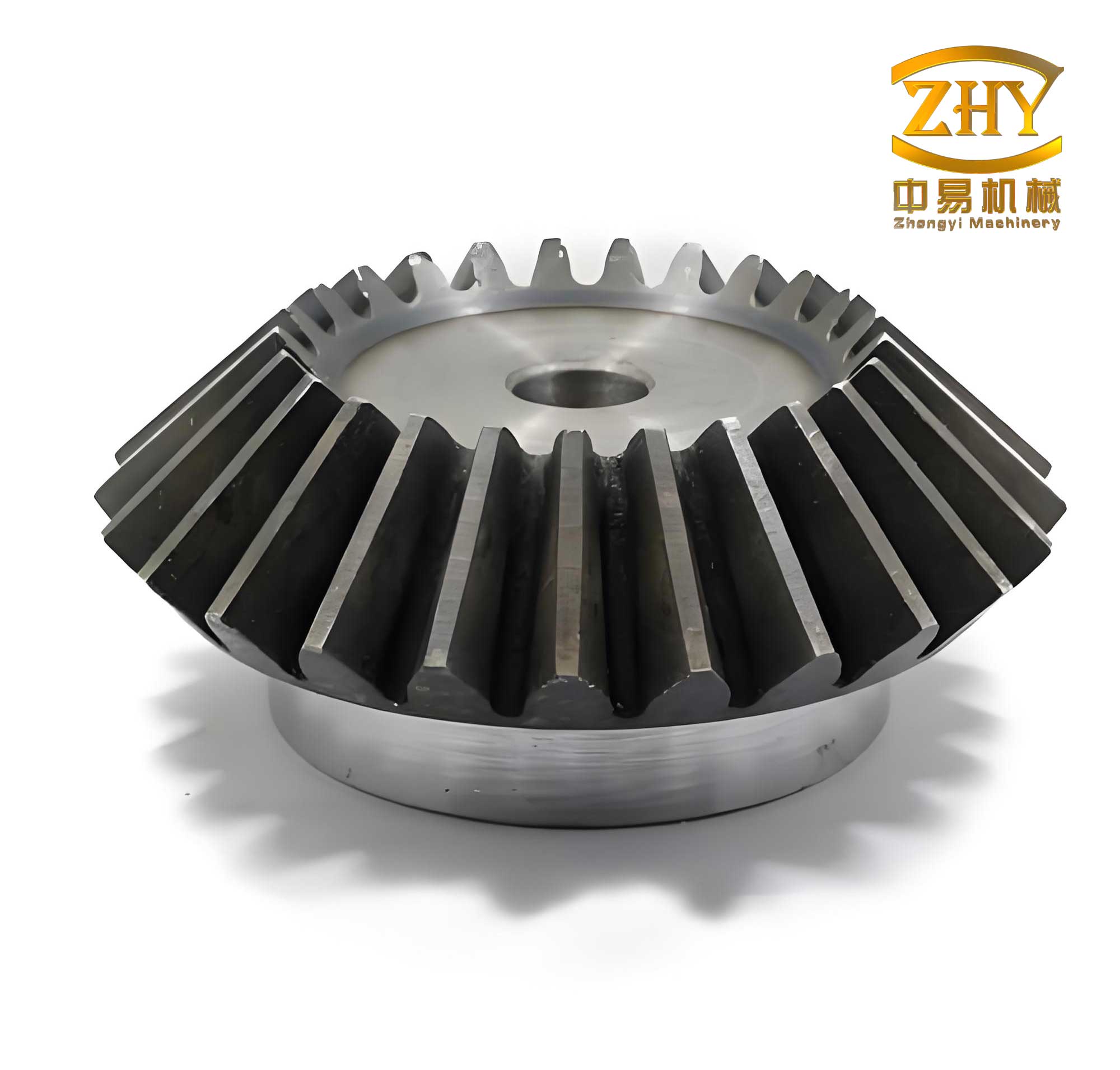
In technical specifications for bevel gears, contact patterns are typically categorized into two types: the static (or unloaded) contact pattern and the dynamic (or loaded) contact pattern. These are not independent of each other but are intrinsically linked. The dynamic contact pattern, which develops under full operational load and speed, is the ultimate criterion for final acceptance. The static contact pattern serves as a crucial reference and control metric during assembly, allowing technicians to predict and influence the final loaded contact behavior. The primary goal of adjustment work on bevel gears is therefore to manipulate the static pattern in such a way that, after accounting for elastic deflections under load, the resulting dynamic pattern meets all design requirements for contact area and position.
The necessity for adjustment stems from inevitable manufacturing tolerances and assembly errors. Components like gear housings, bearings, and the gears themselves have dimensional variations. These cumulative errors mean that simply installing bevel gears at their nominal theoretical positions will rarely yield a satisfactory contact pattern. To compensate, the axial installation distance of the pinion and the gear can be finely tuned, typically by adding or removing shims, to bring the gears into their optimal relative position. This adjustment ensures that under load, the contact spreads appropriately across the tooth flank without concentrating stress at the edges, which could lead to premature failure, pitting, or excessive noise.
Fundamental Principles of Contact Pattern Behavior
The core principle behind adjusting bevel gears lies in understanding how relative axial movement of the pinion and gear alters the contact pattern on the tooth flanks. This movement changes the effective pressure angle and the point of mesh along the tooth profile and length.
Consider a spiral bevel gear set. The pressure angle ($\alpha$) and spiral angle ($\beta$) vary along the tooth profile. When the pinion’s axial installation distance is decreased (moving it closer to the gear’s theoretical apex), the local mesh conditions are altered. It effectively reduces the pinion’s pressure angle relative to the gear. According to meshing theory, this causes the contact pattern to shift towards the pinion’s tooth tip on both the convex and concave flanks. Simultaneously, due to the changing spiral angle from the toe to the heel of the tooth, the pattern also shifts along the tooth length. For a typical spiral bevel gear with a concave pinion flank driving a convex gear flank, decreasing the pinion’s axial distance will shift the pattern on the pinion’s concave flank towards the toe (small end) and on its convex flank towards the heel (large end).
This relationship can be conceptually summarized. Let $\Delta H_p$ represent the change in the pinion’s axial position (positive for increasing the distance). The corresponding change in the contact pattern location ($\Delta CP$) can be qualitatively described. A more formal understanding involves the concept of mismatch or “ease-off” in the gear tooth surfaces, but the axial adjustment directly manipulates this ease-off topography.
The fundamental formula governing the need for adjustment is the deviation from the theoretical mounting distance ($MD_{theoretical}$). The actual mounting distance ($MD_{actual}$) is a sum of the nominal dimension and all cumulative tolerances ($\sum \delta_i$):
$$ MD_{actual} = MD_{theoretical} + \sum_{i=1}^{n} \delta_i $$
where $\delta_i$ represents tolerances from housing bore locations, bearing widths, gear shaft dimensions, etc. The adjustment shim thickness ($T_{shim}$) is then calculated to correct this deviation:
$$ T_{shim} = MD_{theoretical} – MD_{actual} + \Delta_{correction} $$
Here, $\Delta_{correction}$ is the fine-tuning adjustment made based on the observed static contact pattern to anticipate the dynamic pattern.
Static vs. Dynamic Contact Pattern: Formation and Characteristics
Static Contact Pattern Formation
The static contact pattern is obtained by applying a thin layer of marking compound (e.g., Prussian blue, red lead, or specialized paste) to the flanks of one gear. The gear pair is then slowly rotated under very light braking torque, transferring the compound to the mating flank and revealing the areas of initial contact. This pattern represents the contact under no-load or minimal load conditions and is a composite reflection of the combined errors in tooth geometry, spacing, and assembly alignment. It is the primary visual guide for initial assembly adjustments of bevel gears.
Characteristics of an Acceptable Static Pattern
An ideal static contact pattern for heavily loaded bevel gears should exhibit the following characteristics:
Shape: Preferably elliptical or oval, indicating a gradual engagement and load transition.
Position: Centrally located on the tooth flank, both in height (midway between tip and root) and in length (centered between toe and heel). It may be slightly biased towards the toe (small end) on the pinion to allow for pattern growth towards the heel under load.
Size: For initial static adjustment, the pattern length is often targeted to be 30-50% of the available face width. A pattern that is too large during static testing may leave no room for growth under load, risking edge contact. A pattern that is too small may indicate insufficient contact area, leading to high stress.
| Pattern Characteristic | Ideal/Desired State | Acceptable Compromise |
|---|---|---|
| Shape | Elliptical, uniform density | Oval, slightly irregular but continuous |
| Height Position | Centered on tooth profile | Between mid-point and slightly towards root |
| Length Position | Centered or slightly towards toe | Clearly not contacting heel or toe edges |
| Length Size (% of face width) | 40-60% | 30-70% depending on application |
Dynamic Contact Pattern Development
The dynamic contact pattern is the pattern observed after the gear set has been run under its normal operational load, speed, and temperature. Under load, tooth bending, shaft wind-up, and housing deflection occur elastically. These deflections cause the contact area to enlarge from the initial static “core” pattern. Ideally, this growth spreads evenly, primarily along the length of the tooth, often more towards the heel, resulting in a full, elliptical pattern that covers a significant portion of the tooth flank without breaking out over the edges. The relationship between the static and dynamic pattern is the cornerstone of successful bevel gear adjustment. The static pattern is intentionally set “low and towards the toe” so that under load, it “climbs” and “moves towards the heel” to the correct central position.
| Aspect | Static (Unloaded) Contact Pattern | Dynamic (Loaded) Contact Pattern |
|---|---|---|
| Purpose | Assembly guide, predicts loaded behavior | Final performance validation |
| Condition | Light braking torque, slow rotation | Full operational load and speed |
| Typical Size | Smaller (e.g., 30-60% face width) | Larger (e.g., 60-90% face width) |
| Primary Influence | Assembly alignment (axial position) | Tooth deflection, system stiffness, load |
| Adjustment Target | Yes, the primary variable to change | No, it is the result to be achieved |
Practical Methodology for Adjusting Bevel Gear Contact Patterns
The adjustment process is iterative and relies on systematic observation and correction. The only degree of freedom typically available in final assembly is the axial position of the pinion and/or the gear, controlled by shim packs.
The Adjustment Procedure
1. Initial Setup: Install the gears with shims calculated from nominal mounting distances or based on initial measurement (if using mounting distance gauges). Ensure proper bearing preload.
2. Apply Marking Compound: Apply a thin, even layer of marking compound to several teeth (3-4) on the pinion or gear flanks.
3. Generate Static Pattern: Rotate the gear pair slowly while applying a light drag brake to the output shaft. Rotate through several complete revolutions to ensure a clear, consistent pattern is transferred.
4. Observe and Analyze: Carefully examine the pattern’s shape, size, and position on both the drive and coast sides of the teeth. Compare it to the specification or desired target pattern.
5. Determine Adjustment Direction: Based on the observed pattern deviation, determine the required axial movement for the pinion or gear. The basic rules for a pinion adjustment are summarized below. Note: Moving the pinion requires a compensatory opposite movement of the gear (or change in its shim) to maintain proper backlash.
6. Calculate Shim Change: Estimate the required shim thickness change. A small change (e.g., 0.05 mm to 0.15 mm) can cause a significant pattern shift. The relationship is often non-linear and gear-design specific.
7. Implement Change and Re-check: Change the shims, reapply marking compound, and generate a new static pattern. Repeat steps 3-6 until the static pattern meets the target criteria and the gear backlash is within specification.
The fundamental effect of pinion axial movement on the contact pattern of spiral bevel gears is governed by the following rules, assuming backlash is maintained by corresponding gear movement:
| Action | Effect on Pinion Contact Pattern (Concave & Convex Flanks) | Pattern Movement Direction (Height) | Pattern Movement Direction (Length: Concave Flank / Convex Flank) |
|---|---|---|---|
| Increase Pinion Axial Distance (Move Pinion away from Gear) | Pattern moves towards Tooth ROOT | Towards Root | Towards HEEL / Towards TOE |
| Decrease Pinion Axial Distance (Move Pinion towards Gear) | Pattern moves towards Tooth TIP | Towards Tip | Towards TOE / Towards HEEL |
These rules are essential for diagnosing and correcting pattern issues. For example, if the static pattern is too high on the tooth (near the tip), the pinion needs to be moved away from the gear (increase its axial distance).
Backlash Consideration
Backlash ($B$) is the clearance between mating tooth flanks. It is crucial for lubrication, thermal expansion, and preventing binding. Adjusting the axial position of bevel gears to correct the pattern directly changes the backlash. The relationship is approximately:
$$ \Delta B \approx \Delta A_p \cdot \tan(\alpha) + \Delta A_g \cdot \tan(\alpha) $$
where $\Delta B$ is the change in backlash, $\Delta A_p$ and $\Delta A_g$ are the axial movements of the pinion and gear respectively, and $\alpha$ is the pressure angle. Therefore, pattern adjustment is always a two-variable optimization: achieving the correct pattern while maintaining backlash within its specified limits. This often necessitates moving both members.
Analysis and Correction of Faulty Contact Patterns
Despite careful adjustment, certain undesirable pattern formations may occur. Some indicate correctable assembly misalignment, while others point to inherent manufacturing errors in the bevel gears themselves.
Diagonal Contact (Bias Pattern)
This is a common condition where the pattern runs diagonally across the tooth flank. It is often caused by misalignment that is not purely axial, such as incorrect housing bore offset or excessive shaft deflection. There are two types:
Toe-Heel Diagonal (Outer Bias): Pattern runs from the toe-root to the heel-tip.
Heel-Toe Diagonal (Inner Bias): Pattern runs from the heel-root to the toe-tip.
Minor diagonal contact may “wear in” during initial operation. Significant diagonal contact requires investigation of housing alignment, bearing seating, or may indicate that the gear teeth have been manufactured with inherent bias, requiring selective assembly or gear correction.
Pattern at Opposite Ends on Two Flanks
If the pattern on the drive flank is at the toe and on the coast flank is at the heel (or vice-versa), with backlash correct, it often indicates an error in the shaft angle setting or housing bore angle. This condition is usually not correctable by simple axial shimming and may require component correction.
Edge Contact
This is the most dangerous condition where the pattern runs off the tooth at the toe, heel, tip, or root. It leads to severe stress concentration. Causes include extreme axial misadjustment, excessive load deflection, or gross manufacturing errors. Immediate correction is mandatory to prevent rapid failure of the bevel gears.
Corrective Actions Summary
| Observed Pattern Fault | Probable Cause | Corrective Action |
|---|---|---|
| Pattern too high (near tip) | Pinion too close to gear | Increase pinion axial distance |
| Pattern too low (near root) | Pinion too far from gear | Decrease pinion axial distance |
| Pattern at toe on both flanks | Excessive mounting distance or shaft angle error | Check housing geometry; adjust gear position |
| Pattern at heel on both flanks | Insufficient mounting distance or shaft angle error | Check housing geometry; adjust gear position |
| Severe diagonal contact | Horizontal misalignment, bore offset error | Check housing alignment; measure bore locations |
| Correct static pattern but poor dynamic pattern | Insufficient static pattern “set,” or excessive system deflection | Adjust static pattern to be lower/more towards toe; review system stiffness |
Dynamic Pattern Adjustment and Final Validation
The ultimate validation occurs during the loaded test run. Even with a perfect static pattern, the dynamic pattern may develop unfavorably due to unanticipated system deflections or thermal effects.
Adjustment Strategy Post-Test: If the dynamic pattern after testing is unsatisfactory (e.g., edge contact, too small), the relationship between the final static pattern (checked after the test) and the dynamic result is analyzed. The static pattern is then readjusted in the opposite direction of the undesired dynamic shift. For instance, if the dynamic pattern moved too far towards the heel and off the edge, the next assembly should set the static pattern even more towards the toe than before. This iterative, experience-based process is key to fine-tuning high-performance bevel gear drives.
Gear Correction (Lapping/Polishing): In some precision applications, if the pattern location is acceptable but the shape is irregular or carries high stress concentrations, a controlled hand-lapping or polishing process might be employed. This is a delicate process of removing minute amounts of material from specific areas of the tooth flank to smooth out the contact and improve load distribution. It requires great skill and is only done when the basic gear geometry is sound.
Conclusion
The successful adjustment of bevel gear contact patterns is a blend of science, empirical rules, and practical experience. It hinges on a deep understanding of the relationship between axial installation position, static tooth contact, and the final loaded behavior. The static pattern serves as the primary control variable, manipulated through calculated shim changes, to steer the development of the dynamic pattern under load. Mastery of the pattern movement rules, combined with meticulous observation and an iterative approach, allows engineers and technicians to overcome cumulative manufacturing tolerances and achieve the optimal meshing condition for bevel gears. This optimization is critical for ensuring high efficiency, minimal noise, maximum load capacity, and extended service life in the countless mechanical systems that rely on these essential components for power transmission between intersecting axes.