
In my experience as a design engineer specializing in automotive drivetrains, the design of the final drive hypoid gear set is one of the most critical and challenging tasks. The hypoid gear, with its offset pinion axis, offers significant advantages in vehicle packaging, allowing for a lower driveline tunnel and a lower center of gravity. However, this complexity comes at the cost of a highly intricate design process fraught with interdependent parameters and non-linear relationships. The traditional design approach, which I and many peers have long relied upon, often involves determining basic parameters based on empirical rules and past experience, followed by extensive calculation and strength verification. This method is inherently iterative and can be suboptimal, as the initial parameter choices heavily constrain the final outcome. The multitude of calculation formulas—often over thirty, with at least three requiring iterative solutions—means that an improperly chosen starting point can lead to numerous time-consuming loops or a compromise in performance, durability, noise, or weight.
To overcome these limitations, I have adopted and rigorously applied the Three-Stage Design methodology, a systematic approach rooted in quality engineering. This method decomposes the design process into three distinct phases: System Design, Parameter Design, and Tolerance Design. System Design involves selecting the fundamental working principle and basic configuration—in this case, opting for a Gleason system hypoid gear set to meet the functional requirements of a vehicle’s final drive. Parameter Design is the absolute core; it is the stage where the nominal values of the system’s controllable parameters are optimized to make the product’s performance minimally sensitive to noise factors (uncontrollable variations), thereby achieving robust performance at minimal cost. Finally, Tolerance Design is employed only if Parameter Design is insufficient, where tolerances are tightened selectively on parameters that have a significant impact on performance variation, inevitably increasing cost. For most hypoid gear designs, a well-executed Parameter Design renders Tolerance Design unnecessary for many factors. Therefore, this discussion will focus primarily on the transformative application of System and Parameter Design to hypoid gear development.
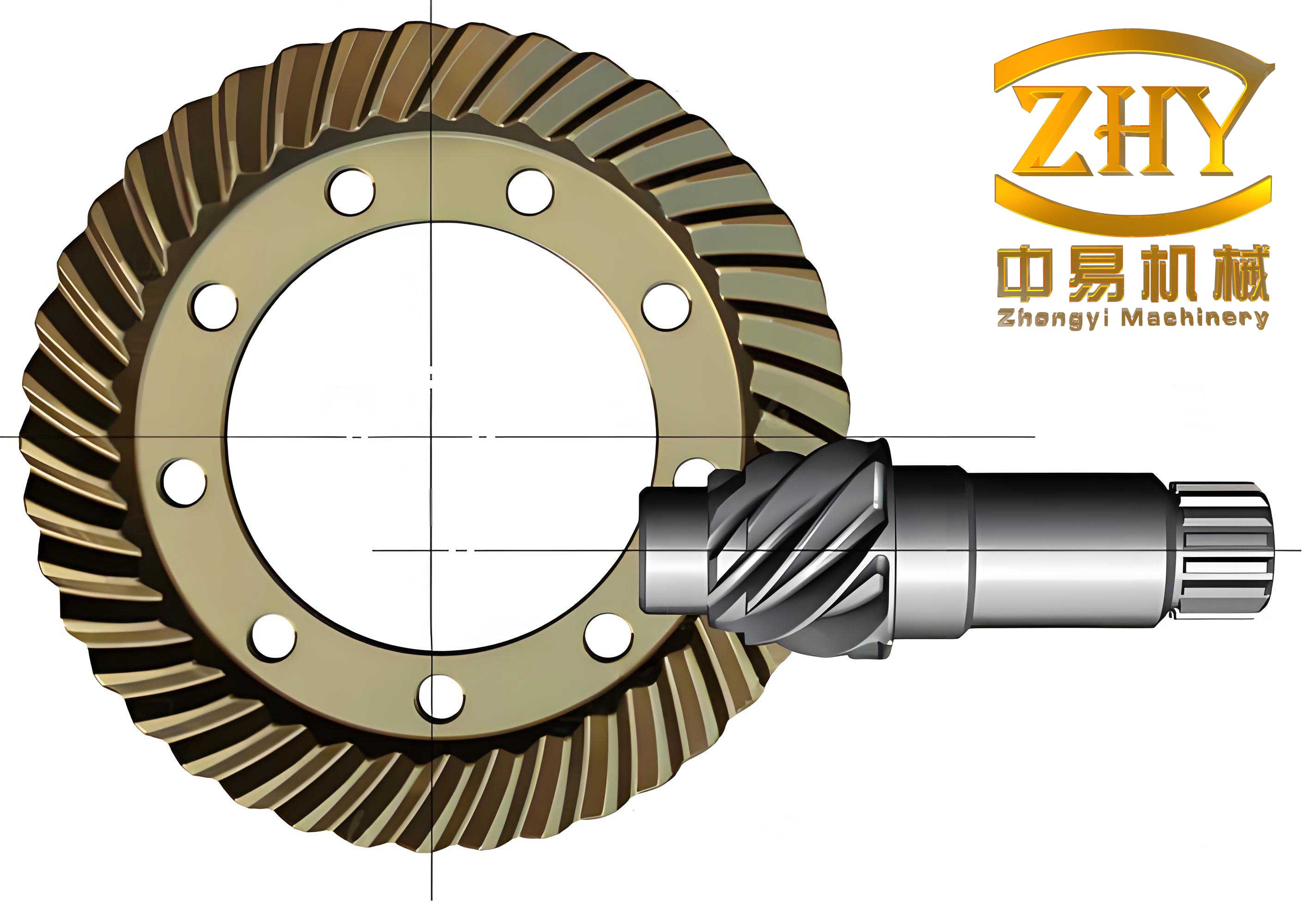
System Design: Defining Objectives and Metrics
The first step is to formally define what constitutes a “good” hypoid gear design. We must translate qualitative goals into quantitative objective functions. Typically, for an automotive hypoid gear, we aim for:
- High Strength & Durability (Smaller-the-Better Characteristics): Minimize bending stress on the pinion and gear, and minimize contact stress.
- Smooth Operation & Low Noise (Larger-the-Better Characteristic): Maximize the transverse contact ratio for smoother meshing.
- Compact Size & Light Weight (Smaller-the-Better Characteristics): Minimize the volume (a proxy for weight and size) of both the pinion and the gear.
These objectives often conflict. A stronger gear may be larger and heavier. A design optimized for smoothness might have different pressure angles or spiral angles that affect strength. Therefore, we need a multi-objective formulation. Let’s define our controllable design parameters as a vector x = [x1, x2, …, xn]. For a hypoid gear, key parameters include the ring gear pitch diameter (D), pinion and gear tooth numbers (zp, zg), offset distance (E), and face width (F).
We evaluate these under different load conditions (e.g., maximum torque, average torque). For the k-th load condition, we calculate:
- Bending stress: σFpk(x), σFgk(x)
- Contact stress: σHk(x)
- Volumes: Vpk(x), Vgk(x)
- Transverse contact ratio: εαk(x)
Our composite objective function Y(x) can be constructed as a weighted sum of normalized deviations from ideal targets (zero for stress/volume, infinity for contact ratio). A practical form for Parameter Design using Signal-to-Noise (SN) ratios is to treat each as a separate quality characteristic. We then seek the parameter set x that optimizes a combined SN ratio across all objectives and conditions.
For this article, let’s consider a case study based on a light-duty passenger vehicle with the following specifications:
$$ T_{engine}^{max} = 200 \, Nm, \quad i_{trans}^{max} = 5.0, \quad m_{vehicle} = 2000 \, kg, \quad i_{axle} = 4.5, \quad r_{wheel} = 0.35 \, m $$
The design goal is to determine the optimal hypoid gear parameters for this application.
Parameter Design: The Orthogonal Experiment
This is the heart of the robust design process. We use designed experiments, specifically orthogonal arrays, to efficiently explore the multi-dimensional parameter space.
Step 1: Selecting Controllable Factors and Levels
We identify the primary controllable factors for the hypoid gear: Ring Gear Pitch Diameter (D), Pinion Teeth (zp), Gear Teeth (zg), Offset (E), and Face Width (F). We assign three levels to each factor—a low, a nominal (center), and a high value. The nominal level is set based on preliminary sizing, while the high and low levels offer a reasonable range for exploration. The offset E is treated as an “active” factor; its level is calculated as a percentage of the ring gear’s outer cone distance (Ao), which itself depends on D and other factors, making it a dynamic level. This ensures the full practical range is covered. A sample factor level table is constructed:
| Factor | Symbol | Level 1 (Low) | Level 2 (Nominal) | Level 3 (High) |
|---|---|---|---|---|
| Ring Gear Dia. | D | 240 mm | 250 mm | 260 mm |
| Pinion Teeth | zp | 9 | 10 | 11 |
| Gear Teeth | zg | 41 | 45 | 49 |
| Offset (as % of Ao) | E | 15% | 20% | 25% |
| Face Width | F | 30 mm | 35 mm | 40 mm |
Step 2: Inner Array Design
We select an appropriate orthogonal array to accommodate our factors. An L18 array is a good choice as it can handle up to one 3-level factor and seven 2-level factors. We adapt it for our 3-level factors. The array defines an “inner array” or “control array”—a set of 18 distinct hypoid gear design configurations (combinations of D, zp, zg, E, F) to be analyzed. This is the core of our parameter design study for the hypoid gear.
Step 3: Selecting Error Factors and Outer Array
To evaluate the robustness of each design configuration from the inner array, we subject them to “noise” or variation. We identify key error factors: manufacturing variations in pressure angle (α), spiral angle (β), and gear mesh alignment (Γ). Each is assigned three levels: nominal, nominal-Δ, nominal+Δ. An “outer array” (e.g., an L9 orthogonal array) is used to define nine noise conditions for each inner array design.
| Error Factor | Level 1 | Level 2 (Nominal) | Level 3 |
|---|---|---|---|
| Pressure Angle, α | Nominal – 1° | Nominal | Nominal + 1° |
| Spiral Angle, β | Nominal – 2° | Nominal | Nominal + 2° |
| Alignment, Γ | Nominal – 0.05 mm | Nominal | Nominal + 0.05 mm |
Step 4: Computing Output Characteristics and SN Ratios
For each of the 18 inner array hypoid gear designs, we perform a full Gleason-based geometry and stress calculation under each of the 9 outer array noise conditions. This yields, for each design i (i=1 to 18) and under load condition k:
$$ \text{Outputs: } \sigma_{Fp,ik}, \sigma_{Fg,ik}, \sigma_{H,ik}, V_{p,ik}, V_{g,ik}, \epsilon_{\alpha,ik} $$
For each of these six quality characteristics, we compute an SN ratio (η) that measures robustness. For “Smaller-the-Better” (stress, volume):
$$ \eta_{S} = -10 \log_{10} \left( \frac{1}{n} \sum_{j=1}^{n} y_{j}^{2} \right) $$
where yj are the n=9 output values under noise variations. For “Larger-the-Better” (contact ratio):
$$ \eta_{L} = -10 \log_{10} \left( \frac{1}{n} \sum_{j=1}^{n} \frac{1}{y_{j}^{2}} \right) $$
We then combine the SN ratios for the multiple objectives into a single composite SN ratio for each design i and load case k, often by simple averaging after appropriate normalization if weights differ. The composite SN ratio becomes the metric we seek to maximize.
Step 5: Statistical Analysis of the Inner Array
We now analyze how each controllable factor (D, zp, zg, E, F) affects the composite SN ratio. We use Analysis of Variance (ANOVA) on the inner array data. The total variation in the SN ratio across the 18 designs is decomposed into contributions from each factor. Key calculations include:
Total Sum of Squares (SST):
$$ SS_{T} = \sum_{i=1}^{18} (\eta_i – \bar{\eta})^2 $$
where $\bar{\eta}$ is the overall mean SN ratio.
Sum of Squares for each factor (e.g., for factor D with levels l=1,2,3):
$$ SS_{D} = \frac{n_{D1}}{18} (\bar{\eta}_{D1} – \bar{\eta})^2 + \frac{n_{D2}}{18} (\bar{\eta}_{D2} – \bar{\eta})^2 + \frac{n_{D3}}{18} (\bar{\eta}_{D3} – \bar{\eta})^2 $$
where $n_{Dl}$ is the number of times level l appears for factor D in the L18, and $\bar{\eta}_{Dl}$ is the average SN ratio for all runs with D at level l.
Mean Square (MS):
$$ MS_{factor} = \frac{SS_{factor}}{df_{factor}} $$
where $df_{factor}$ is degrees of freedom (levels – 1).
Pure Sum of Squares (SS’) and Contribution Ratio (ρ):
$$ SS’_{factor} = SS_{factor} – df_{factor} \cdot MS_{error} $$
$$ \rho_{factor} = \frac{SS’_{factor}}{SS_{T}} \times 100\% $$
This analysis clearly identifies which hypoid gear parameters have the most significant influence on the robustness of the performance objectives. A sample ANOVA result might look like this:
| Factor | SS | df | MS | F-ratio | SS’ | ρ (%) |
|---|---|---|---|---|---|---|
| Offset (E) | 45.2 | 2 | 22.6 | 18.8* | 43.1 | 41.5 |
| Face Width (F) | 25.1 | 2 | 12.55 | 10.5* | 22.9 | 22.1 |
| Gear Teeth (zg) | 18.7 | 2 | 9.35 | 7.8* | 16.5 | 15.9 |
| Ring Gear Dia. (D) | 10.5 | 2 | 5.25 | 4.4 | 8.3 | 8.0 |
| Pinion Teeth (zp) | 4.2 | 2 | 2.1 | 1.8 | 2.0 | 1.9 |
| Error | 12.0 | 10 | 1.2 | 10.9 | 10.6 | |
| Total | 115.7 | 17 | 103.7 | 100.0 |
* Significant at p < 0.05
Step 6: Selecting the Optimal Parameter Set
The analysis reveals that Offset (E) is the most dominant factor for robustness, followed by Face Width (F) and Gear Tooth Count (zg). To select the optimal level for each factor, we examine the average composite SN ratio at each level:
- For E: The highest SN ratio might be at Level 3 (25% of Ao). However, excessive offset in a hypoid gear increases sliding velocity, risking scoring and reduced efficiency. For passenger cars, offset is typically limited to about 20% of Ao. Therefore, engineering judgment overrules the pure statistical optimum, and we select Level 2 (20%).
- For F: The highest SN ratio is at Level 3 (40mm). A larger face width generally improves strength and reduces stress, aligning with the “smaller-the-better” objective. This is a valid selection.
- For zg: The highest SN ratio might be at Level 1 (41 teeth). However, we must also achieve the target axle ratio (iaxle = zg/zp ≈ 4.5). We need to coordinate with the pinion tooth number selection.
- For zp and D: These factors show lower significance. We can choose their levels to satisfy the gear ratio and packaging constraints while slightly favoring higher SN ratio levels.
By synthesizing the statistical results and practical constraints, we arrive at a final, optimized hypoid gear parameter set:
| Parameter | Initial/ Nominal Guess | Optimized Value via Parameter Design |
|---|---|---|
| Ring Gear Diameter, D | 250 mm | 255 mm |
| Pinion Teeth, zp | 10 | 9 |
| Gear Teeth, zg | 45 | 41 |
| Axle Ratio | 4.50 | 4.56 |
| Offset, E | ~20% of Ao | 20% of Ao (E ≈ 45 mm) |
| Face Width, F | 35 mm | 38 mm |
Discussion and Advantages of the Methodology
The application of Three-Stage Design, particularly Parameter Design, to hypoid gear development offers profound advantages over the traditional experience-based approach.
1. Systematic Exploration and Optimization: The orthogonal array allows us to study the effect of five key hypoid gear parameters with only 18 comprehensive analyses, instead of a full factorial 35 = 243. This is an efficient and statistically sound way to map the design space.
2. Inherent Robustness: By using the SN ratio as the optimization criterion, we deliberately seek a parameter combination that minimizes performance variation due to inevitable manufacturing noises (like angle errors). This means the resulting hypoid gear design will perform consistently well even when production parts have minor deviations.
3. Clear Understanding of Factor Influence: The ANOVA provides quantitative insight into what truly matters. In our example, knowing that offset is the most significant factor for overall robustness immediately focuses engineering attention on controlling and optimizing this parameter precisely.
4. Balancing Multiple Objectives: The composite SN ratio framework allows us to formally weigh and optimize conflicting goals—strength, smoothness, and size—simultaneously, leading to a balanced hypoid gear design.
5. Reduction of Late-Stage Problems: By finding a robust optimum early in the design phase, we drastically reduce the need for costly and time-consuming design iterations, prototype tests, and troubleshooting during production.
It is important to note that the calculations involved—the 18×9=162 full hypoid gear analyses—are computationally intensive. This necessitates the use of specialized software or scripted calculations. However, the investment in setting up this automated analysis is returned many times over in superior design quality and reduced development time. For manual analysis, the scope can be reduced by focusing on fewer factors or using a two-step approach with smaller orthogonal arrays.
In conclusion, moving from a heuristic, iterative method to a systematic Parameter Design approach fundamentally transforms hypoid gear development. It elevates the process from an art heavily reliant on individual experience to a rigorous engineering science. The methodology enables us to design hypoid gear sets that are not only functionally adequate but are optimally robust, reliable, and efficient, ultimately contributing to better-performing and more durable automotive drivetrains. The core principles discussed here—defining robust objectives, using orthogonal experiments for exploration, and statistically analyzing the results to guide optimal parameter selection—constitute a powerful framework applicable to the design of any complex mechanical system where multiple interacting parameters determine performance.
Extending the Methodology: Integration with Modern Tools
The parameter design methodology for hypoid gears does not exist in a vacuum. Its full potential is unlocked when integrated with modern engineering software tools. A contemporary design workflow might look like this:
- Parametric CAD Model: The hypoid gear geometry is defined in a CAD system (e.g., CATIA, NX) using parameters (D, zp, zg, E, F, pressure angle, spiral angle). This model can be automatically updated based on the orthogonal array settings.
- Automated FEA/Contact Analysis: For each design in the inner/outer array combination, the CAD model is fed into Finite Element Analysis (FEA) software to compute bending stresses (σF) and specialized contact analysis software (or advanced FEA) to compute contact stresses (σH) and mesh characteristics (εα). This automation replaces manual calculations with more accurate simulations.
- Scripting and Data Management: A scripting language (Python, MATLAB) orchestrates the entire process: generating the array of design points, updating the CAD parameters, launching simulations, extracting results (stresses, volumes, contact ratio), calculating SN ratios, and performing the ANOVA. This creates a closed-loop, automated robust design optimization system for the hypoid gear.
- Multi-Disciplinary Optimization (MDO) Platforms: The entire parameter design process can be formalized within an MDO framework. The orthogonal array sampling can be replaced or supplemented with more advanced Design of Experiments (DoE) techniques or surrogate modeling (e.g., Response Surface Methodology, Kriging). The optimization algorithm then directly searches for the parameter set that maximizes the composite robust objective function.
This integration addresses the primary practical challenge—computation time. While an L18 x L9 array requires 162 analyses, cloud computing and high-performance computing clusters can execute these in parallel, reducing the turnaround time from weeks to hours. Furthermore, the simulation-based approach allows us to include more realistic objectives and constraints that are difficult to capture in closed-form gear equations, such as gear whine noise prediction based on transmission error or detailed thermal and lubrication analysis.
The future of hypoid gear design lies in this synergy of robust design philosophy, high-fidelity physics-based simulation, and intelligent computational optimization. It empowers engineers to push the boundaries of hypoid gear performance, exploring novel geometries, materials, and surface treatments with confidence, knowing that the final design will perform reliably under real-world variations.