
The pursuit of enhanced durability, load-bearing capacity, and operational lifespan in power transmission components is a perpetual challenge in mechanical engineering. Among these components, helical gears are fundamental, prized for their smoother and quieter operation compared to spur gears due to the gradual engagement of their angled teeth. However, their performance is ultimately limited by the surface properties of the gear material. Common failure modes such as pitting, scuffing, abrasive wear, and contact fatigue initiate at the surface where stresses are highest. Therefore, strategic surface modification presents a powerful avenue for performance enhancement. Laser cladding has emerged as a preeminent technology in this domain, enabling the deposition of a metallurgically bonded, superior-performance layer onto a substrate. This treatise presents a detailed, first-person perspective investigation into the application of laser cladding for depositing an Fe-based alloy onto helical gear steel, with a systematic analysis of the resultant microstructure, hardness, and tribological properties.
1. Introduction and Technological Backdrop
Laser cladding is an additive manufacturing and surface engineering technique characterized by its precision, minimal heat input, and flexibility. The process utilizes a high-energy laser beam as a controlled heat source to create a small, localized melt pool on a substrate material. Alloy powder, either pre-placed or delivered coaxially into the beam path, is simultaneously melted within this pool. Upon traversing the laser, the pool rapidly solidifies, forming a dense, pore-free coating that is integrally bonded to the substrate. This fusion leads to a region of compositional gradient, ensuring exceptional adhesion superior to mere mechanical bonding.
The advantages of laser cladding are manifold and particularly relevant for high-value components like helical gears:
- Minimal Dilution and Heat-Affected Zone (HAZ): The localized and rapid nature of the process limits the amount of substrate material melted (dilution) and the extent of microstructural alteration in the surrounding base metal, preserving its core properties.
- Metallurgical Bonding: The fusion between the clad and substrate results in a strong, coherent interface, crucial for withstanding the high shear and contact stresses experienced by gear teeth.
- Precision and Flexibility: The laser beam can be precisely guided, allowing for the coating of complex geometries, such as the involute profile and root fillets of helical gears, with minimal post-processing.
- Material Versatility: A wide range of alloy powders (e.g., Nickel-based, Cobalt-based, Iron-based, Metal Matrix Composites) can be used to tailor the surface properties—hardness, wear resistance, corrosion resistance—independently of the substrate.
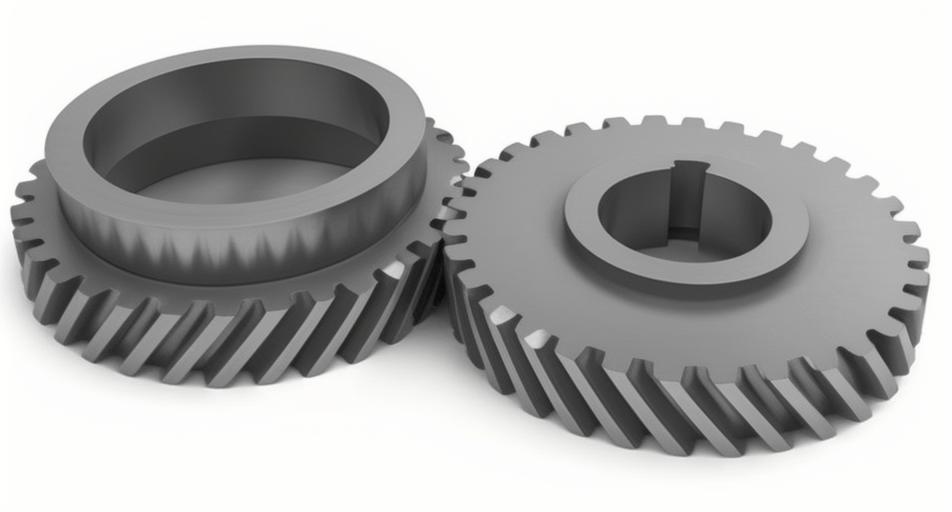
For helical gears, which are critical in automotive transmissions, industrial gearboxes, and aerospace applications, laser cladding offers a viable route not only for manufacturing high-performance new gears but also for the cost-effective repair and remanufacturing of worn or damaged ones, extending service life and reducing lifecycle costs.
2. Experimental Methodology and Material Selection
The experimental framework was designed to simulate the surface enhancement of a critical gear component. The substrate selected was a standard gear steel, 20CrMnTi, a low-carbon alloy steel known for its good hardenability, toughness, and core strength after carburizing and heat treatment. Its nominal composition includes Chromium and Manganese for hardenability, and Titanium for grain refinement. A machined sample representative of a gear tooth flank was utilized. Prior to cladding, the substrate surface was meticulously cleaned using a laser ablation system to remove oxides, oils, and contaminants, ensuring optimal bonding and minimizing defects.
The clad material chosen was an Fe65 self-fluxing alloy powder. The selection of an Fe-based system was strategic: it offers good compatibility (minimizing thermal expansion mismatch stresses) and wettability with the steel substrate, is economically favorable compared to Ni- or Co-based alloys, and can provide significant hardness enhancement. The nominal composition of Fe65 powder is given in Table 1.
| Element | C | B | Si | Cr | Fe |
|---|---|---|---|---|---|
| Fe65 | 2.0 – 4.0 | 1.5 – 2.5 | 3.0 – 6.0 | 2.0 – 3.5 | Balance |
The key elements play specific roles: Carbon (C) and Boron (B) are primary hardening agents, forming hard carbides and borides while also depressing the melting point and improving fluidity (self-fluxing behavior). Silicon (Si) enhances fluidity and acts as a deoxidizer. Chromium (Cr) contributes to solid solution strengthening and promotes the formation of chromium carbides, improving wear and corrosion resistance.
The cladding was performed using a fiber laser system with a maximum power of 1500 W (wavelength 1080 nm). A coaxial powder feeding nozzle was employed, delivering the powder directly into the laser melt pool under an argon shielding gas atmosphere to prevent oxidation. A series of single-track clads were produced by systematically varying the primary process parameters. Based on preliminary trials and literature, parameters leading to gross defects like cracking or severe porosity were eliminated. The focus of the subsequent analysis was on two distinct parameter sets that yielded visually sound tracks, as detailed in Table 2. The defocus distance was kept constant to maintain a specific beam spot size.
| Parameter Set | Laser Power (P), W | Powder Feed Rate (F), g/min | Scanning Speed (V), mm/s | Energy Density Approx. |
|---|---|---|---|---|
| A (Optimized) | 750 | 20 | 10 | Medium |
| B (High Power) | 1350 | 20 | 10 | High |
The linear energy density, a combined parameter, can be approximated as:
$$ E_l = \frac{P}{V} $$
For Set A: $$ E_{l,A} = \frac{750}{10} = 75 \, \text{J/mm} $$
For Set B: $$ E_{l,B} = \frac{1350}{10} = 135 \, \text{J/mm} $$
This significant difference in energy input is a critical variable influencing the melt pool thermodynamics and solidification kinetics.
Post-cladding, samples were sectioned transversely, mounted, ground, polished, and etched for metallographic examination using optical microscopy. Microhardness profiling was conducted from the clad surface down into the substrate using a Vickers indenter. Dry sliding wear tests were performed on both the clad layer and the untreated substrate under identical conditions (counterbody: GCr15 bearing steel, load: 20 N, duration: 60 min) to evaluate comparative tribological performance.
3. Results: Macro-Morphology and Microstructural Evolution
The macroscopic cross-sectional morphology of the clad tracks revealed smooth, semi-circular profiles with a distinct fusion line, indicating sound metallurgical bonding for both parameter sets. No macroscopic cracks or gross porosity were observed at this scale, validating the initial parameter screening.
The microstructural analysis, however, unveiled profound differences dictated by the thermal cycle imposed by the laser parameters. The microstructure of a laser clad typically varies along its depth due to thermal gradients (G) and solidification growth rates (R).
3.1. Clad Zone (CZ) Microstructure
In the upper region of the clad (nearest the surface), where heat extraction is primarily through conduction to the cooler clad material below and radiation/convection to the environment, the cooling rate is extremely high. This results in a very high undercooling, leading to a high nucleation density. Consequently, the microstructure here consisted of very fine, equiaxed grains. For Set A (750 W), this region exhibited a uniform, ultra-fine dispersion of what is interpreted as a mixture of metastable phases, including very fine ferrite and hard Fe-based compounds (carbides, borides). The limited energy input promoted rapid solidification, refining the microstructure.
For Set B (1350 W), while the surface also showed fine equiaxed grains, they were noticeably coarser than in Set A. The higher energy input increased the melt pool temperature and lifetime ($\tau_{pool} \propto P/V^2$), reducing the effective cooling rate. This provided more time for grain growth, leading to a less refined microstructure despite the same nominal solidification conditions at the very surface.
Moving to the mid-section of the clad, the cooling rate decreases as the thermal gradient lessens. The microstructure transitioned to a more directional cellular-dendritic structure. The cells/dendrites were finer and more closely spaced in Set A compared to the coarser, more developed dendrites in Set B. This can be modeled by considering the primary dendritic arm spacing ($\lambda_1$), which often scales inversely with the cooling rate ($\dot{T}$):
$$ \lambda_1 = k \dot{T}^{-n} $$
where \(k\) and \(n\) are material constants. The higher cooling rate in Set A results in a smaller $\lambda_1$.
3.2. Fusion Zone (FZ) and Interface Phenomena
The most critical region is the interface between the clad and the substrate, the fusion zone. Here, the heat flow is predominantly unidirectional into the cold substrate, creating a very high thermal gradient perpendicular to the interface (G is high, R is low initially). This condition favors planar front solidification at the very interface, which quickly breaks down into cellular and then columnar dendritic growth as constitutional undercooling increases. The growth direction of these columnar grains is typically epitaxial, following the crystallographic orientation of the substrate grains at the fusion line.
A key observation was the presence of a distinct, continuous “bright band” at the interface for Parameter Set A. This feature is often associated with a narrow zone of fine, planar or cellular solidification and/or the formation of a distinct interfacial phase. It signifies an optimal combination of energy input and melting, resulting in excellent wetting and a strong, defect-free metallurgical bond—a paramount requirement for coating integrity on highly stressed components like helical gears. This band was less pronounced or discontinuous in Set B, suggesting potentially different interfacial reactions or a wider, more mixed zone due to higher dilution.
3.3. Heat-Affected Zone (HAZ) of the Substrate
Adjacent to the fusion line lies the HAZ of the 20CrMnTi substrate. The peak temperatures here range from just below the solidus down to the Ac3 transformation temperature. The rapid heating and cooling cycle of laser cladding subjects this zone to an ultra-fast thermal cycle akin to a localized heat treatment. For the medium-carbon gear steel, this resulted in the formation of a refined microstructure of fine ferrite and pearlite, significantly finer than the original normalized or annealed structure of the substrate. This refinement occurs because the short thermal cycle prevents significant austenite grain growth during heating, and the subsequent fast cooling transforms this fine austenite into a fine aggregate of ferrite and carbide. The mechanical properties (toughness, strength) of this HAZ are thus often superior to those of the base material, which is beneficial as it avoids creating a soft, weak region next to the hard clad.
4. Analysis of Mechanical and Tribological Properties
4.1. Microhardness Profile
The microhardness traverse from the clad surface to the substrate provides a quantitative map of the property gradient induced by the process. The results are summarized graphically and in Table 3.
| Region / Parameter Set | Average Clad Zone Hardness (HV0.2) | Peak Hardness (HV0.2) | Substrate Hardness (HV0.2) | Hardness Ratio (Clad/Substrate) |
|---|---|---|---|---|
| Set A (750W) | ~900 HV | 955.6 HV | 419.7 HV | ~2.15 |
| Set B (1350W) | ~770 HV | 799.8 HV | 419.7 HV | ~1.85 |
The profile for Set A showed consistently high hardness values ranging from 845.3 HV to 955.6 HV within the clad zone. This significant enhancement—approximately 2.15 times the substrate hardness (419.7 HV)—is attributed to multiple strengthening mechanisms operative in the rapidly solidified Fe65 alloy:
- Fine Grain Strengthening (Hall-Petch Effect): The ultra-fine and equiaxed grains in the clad act as barriers to dislocation motion. The yield strength increase is given by: $$ \sigma_y = \sigma_0 + k_y d^{-1/2} $$ where \(d\) is the average grain diameter, and \(\sigma_0\) and \(k_y\) are material constants.
- Precipitation/Secondary Phase Strengthening: The high concentrations of C, B, and Cr lead to the in-situ formation of a high density of fine, hard carbides (e.g., M23C6, M7C3) and borides (e.g., Fe2B). These particles impede dislocation movement via the Orowan bowing mechanism.
- Solid Solution Strengthening: Elements like Cr and Si in solution distort the Fe lattice, creating stress fields that hinder dislocation glide.
The hardness in Set B, while still substantially higher than the substrate, was lower and more uniform across the clad layer. The higher energy input caused coarser microstructural features (larger grains, wider dendrite arms, potentially coarser precipitates) and likely higher dilution from the softer substrate, both of which contribute to a reduction in overall hardness. The hardness profile typically shows a steep gradient at the fusion line for both sets due to the change in composition and microstructure, followed by a slight increase in the refined HAZ before settling at the base metal hardness.
4.2. Wear Resistance Performance
The dry sliding wear tests provided compelling evidence for the surface enhancement potential for helical gears. The coefficient of friction (COF) versus time curves for the clad layer (Set A) and the untreated 20CrMnTi substrate revealed distinct behaviors. After a short run-in period, both materials reached a steady-state COF. The critical finding was that the average steady-state COF for the Fe65 clad layer was approximately 0.71, significantly lower than the 0.84 average for the substrate. This 15% reduction in friction is highly beneficial for improving mechanical efficiency and reducing heat generation in meshing helical gears.
More importantly, the wear loss, measured by mass change, was drastically different. The clad sample lost only 0.4 mg, whereas the substrate sample lost 1.6 mg—a fourfold increase in wear loss for the uncoated material. This demonstrates a dramatic improvement in wear resistance. The enhanced performance can be modeled conceptually by the Archard wear equation:
$$ V = K \frac{N \cdot s}{H} $$
where \(V\) is the wear volume, \(K\) is the wear coefficient, \(N\) is the normal load, \(s\) is the sliding distance, and \(H\) is the material hardness. The laser-clad layer acts by both significantly increasing the surface hardness \(H\) and reducing the wear coefficient \(K\) (due to the presence of hard phases and potentially beneficial tribo-oxides), leading to a multiplicative reduction in wear volume \(V\). This directly translates to increased resistance against pitting, scuffing, and abrasive wear on the flanks of helical gears.
5. Synthesis: Parameter Optimization for Helical Gear Application
The investigation conclusively demonstrates that laser cladding parameters are not merely process settings but are fundamental design variables that dictate the clad’s microstructure-property relationships. For the specific goal of enhancing the surface of helical gear steel (20CrMnTi) with Fe65 alloy, Parameter Set A (P=750W, F=20 g/min, V=10 mm/s) emerged as superior. The optimization rationale is synthesized in Table 4, linking parameters to microstructural drivers and final functional properties.
| Process Parameter | Influence on Melt Pool & Solidification | Microstructural Outcome | Resulting Property for Gears |
|---|---|---|---|
| Moderate Laser Power (750W) | Provides sufficient energy for melting without excessive heat buildup. Creates optimal G and R for fine solidification. | Fine equiaxed grains at top; refined cellular-dendritic structure; distinct, sound interfacial bond. | High hardness; strong adhesion to withstand tooth root bending and contact stresses. |
| Balanced Powder Feed Rate (20 g/min) | Matches energy input to maintain stable melt pool without unmelted powder or excessive dilution. | Consistent clad geometry and composition. Adequate hard phase formation. | Uniform property distribution across the gear tooth profile. |
| Moderate Scan Speed (10 mm/s) | Combines with power to give medium energy density (75 J/mm), enabling good fusion while limiting pool lifetime. | High cooling rates leading to fine microstructure and minimal grain growth. | Maximizes hardness via grain refinement and fine precipitation. |
| Optimal Defocus / Beam Size | Controls power density (W/cm²). A slightly defocused beam can provide a wider, more uniform thermal distribution. | Promotes wider, flatter clad tracks with uniform microstructure. | Enhances coverage and consistency for coating complex helical gear tooth geometry. |
The high-power set (B), while producing a clad layer, resulted in coarser microstructure, lower hardness, and a less distinct interface. For helical gears, where fatigue resistance (influenced by fine microstructure and compressive residual stresses) and wear resistance (directly correlated with hardness) are paramount, the finer microstructure and superior hardness of Set A are clearly preferable.
6. Conclusion and Future Perspectives
This comprehensive study validates laser cladding of Fe-based alloys as a highly effective strategy for the surface engineering of helical gear components. The process successfully deposits a metallurgically bonded, dense coating that fundamentally transforms the surface properties of the base gear steel. Through careful parameter optimization—specifically a laser power of 750 W, a powder feed rate of 20 g/min, and a scan speed of 10 mm/s—an Fe65 clad layer was produced featuring an excellent interfacial bond, a refined microstructure of fine ferritic and hard-phase constituents, and a microhardness exceeding 900 HV, more than double that of the 20CrMnTi substrate. Tribological assessments confirmed a substantial improvement, with the clad layer exhibiting both a lower coefficient of friction and a wear resistance four times greater than the untreated material.
The implications for helical gears are significant. This technology can be deployed to manufacture new, high-performance gears with extended service lives and higher power density capabilities. Perhaps even more impactful is its application in the sustainable remanufacturing of used or damaged helical gears, restoring them to a condition that may surpass their original specifications, thereby offering considerable economic and environmental benefits.
Future research avenues are plentiful. Investigations should focus on:
- Multi-track and multi-layer cladding to cover entire gear tooth profiles and build up significant wear-resistant volumes.
- In-depth residual stress analysis using techniques like X-ray diffraction, as compressive surface stresses are highly beneficial for contact fatigue resistance in helical gears.
- Bending and contact fatigue testing of actual laser-clad gear teeth to quantify the improvement in fundamental gear performance metrics under cyclic loading.
- Exploration of advanced clad materials, such as Fe-based metal matrix composites (MMCs) with ceramic reinforcements (e.g., WC, TiC) for even more extreme wear applications.
- Process simulation and modeling to predict melt pool dynamics, thermal history, and resulting microstructure for different gear geometries, enabling digital process optimization.
In conclusion, laser cladding stands as a potent and precise tool in the modern manufacturing and maintenance arsenal, offering a pathway to unlock new levels of performance and durability for the indispensable helical gear.