
The transmission of power within a final drive assembly is fundamentally achieved through gear meshing. Among various gear types, hypoid gears have found widespread application in automotive chassis systems due to their superior load-bearing capacity and excellent NVH (Noise, Vibration, and Harshness) performance. During the operation of the final drive, to ensure normal meshing transmission, a lubricant film must be formed between the engaging tooth flanks of the gears. This film is crucial to prevent the high temperatures generated between the teeth from leading to premature gear failure. While the oil film effectively mitigates the performance impact of this heat, a certain temperature rise during meshing is inevitable. Consequently, a specific clearance must be reserved during gear assembly to prevent gear seizure due to thermal expansion. This essential clearance is known as gear backlash or tooth side clearance.
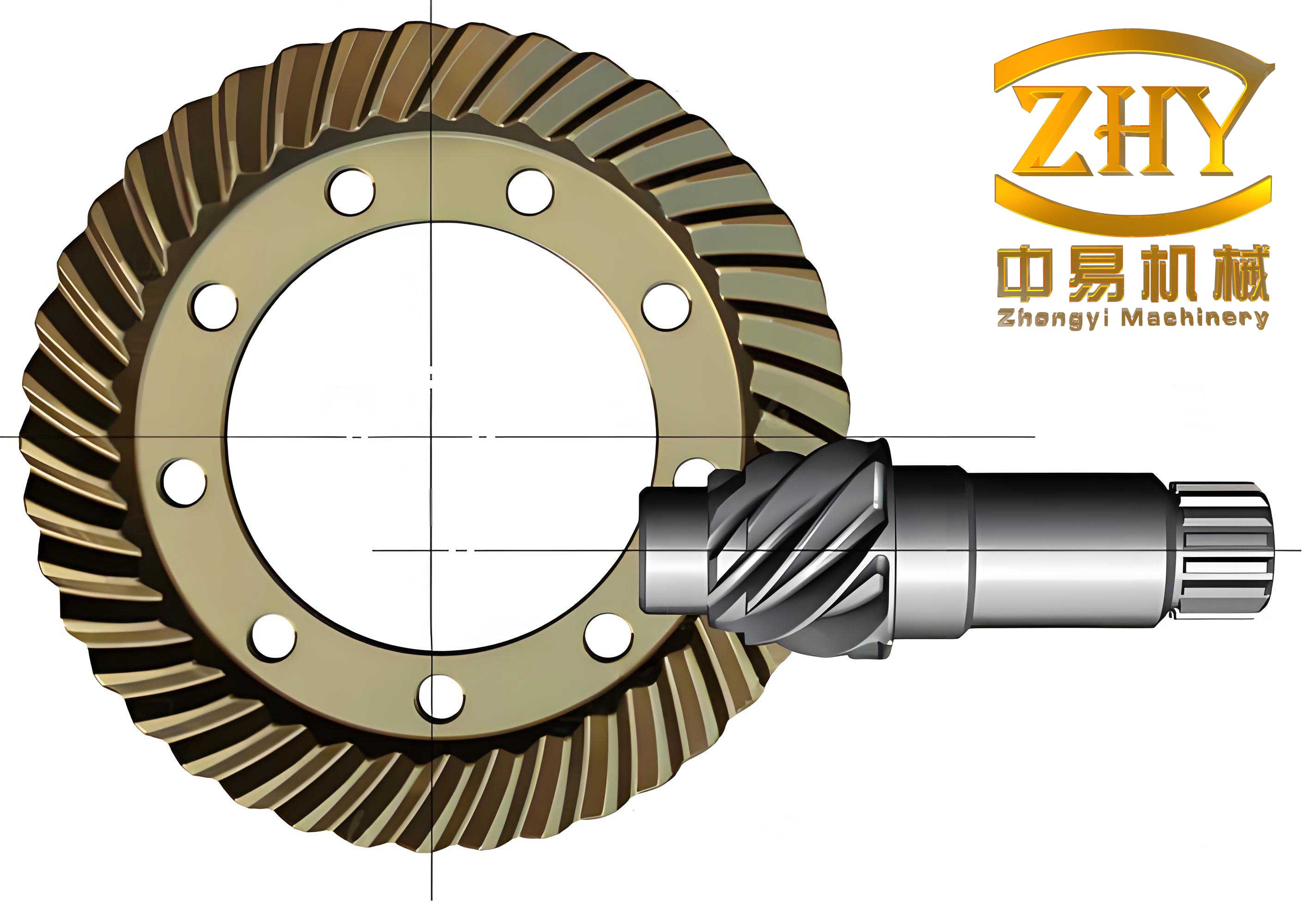
The existence of backlash is indispensable for the formation of the lubricant film between hypoid gears. However, excessive backlash can also induce impacts between the teeth, subsequently degrading the NVH performance of the gear transmission. Therefore, selecting an appropriate backlash value is a critical aspect of hypoid gear design and assembly. This article will delve into the methods for determining a reasonable and scientific backlash value by integrating theoretical forward design, reverse engineering considerations based on the manufacturing process, analysis of physical quality inspection data, and accounting for factors such as gear loading and thermal expansion deformation.
1. Definition and Fundamental Role of Backlash in Hypoid Gears
Backlash, in the context of hypoid gears, refers to the circumferential play between the non-driving flanks of a gear pair when the driving flanks are in contact. It is not a manufacturing error but a deliberately designed-in clearance. Its primary functions are twofold. First, it accommodates the necessary space for a continuous lubricant film, which separates the metal surfaces, reduces friction, and dissipates heat. Second, it provides clearance to compensate for dimensional changes caused by thermal expansion under operating conditions and to account for manufacturing tolerances, thereby preventing binding or seizure of the gear set. The relationship between the required minimum oil film thickness \( h_{min} \) and operating parameters is often described by elastohydrodynamic lubrication (EHL) theory, but the practical space for this film is governed by the backlash \( j \).
2. Theoretical Forward Design of Backlash for Hypoid Gears
To establish a precise theoretical baseline, this analysis focuses primarily on the major influencing factor of gear accuracy, assuming all other mating components in the final drive assembly are at their nominal dimensions. The gear accuracy requirement is specified as Grade 7 per the GB11365-89 standard (equivalent to AGMA or ISO standards).
2.1 Gleason C-AGE Software Calculation
Modern design of hypoid gears heavily relies on specialized software. Using the Gleason C-AGE computational software for theoretical gear design, the calculated backlash for the gear pair is determined to be in the range of 0.127 mm to 0.1778 mm. This value is derived from the basic gear geometry, intended contact pattern, and desired performance characteristics for the specific hypoid gear set.
2.2 Standard Backlash Selection Tables
Industry standards and handbooks provide general guidelines for backlash based on gear size. For hypoid gears, recommended backlash values often correlate with the pinion pitch diameter. The following table presents typical backlash ranges:
| Pinion Pitch Diameter Range (mm) | Minimum Backlash (mm) | Maximum Backlash (mm) |
|---|---|---|
| 25.4 ≤ D < 31.75 | 0.051 | 0.076 |
| 31.75 ≤ D < 38.1 | 0.046 | 0.066 |
| 38.1 ≤ D < 44.45 | 0.041 | 0.056 |
| 44.45 ≤ D < 50.8 | 0.036 | 0.046 |
| 50.8 ≤ D < 63.5 | 0.030 | 0.041 |
| 63.5 ≤ D < 76.2 | 0.025 | 0.033 |
| 76.2 ≤ D < 88.9 | 0.020 | 0.028 |
| 88.9 ≤ D < 101.6 | 0.018 | 0.023 |
| 101.6 ≤ D < 127.0 | 0.015 | 0.020 |
| 127.0 ≤ D < 152.4 | 0.013 | 0.018 |
For a hypoid gear with a pinion pitch diameter falling within the 127.0-152.4 mm range, the recommended backlash is 0.13-0.18 mm, which aligns perfectly with the Gleason C-AGE software output of 0.127-0.1778 mm. This forms our initial theoretical design target: \( j_{design} = 0.155 \pm 0.025 \) mm (mean ± tolerance).
3. Reverse Engineering Based on Manufacturing Factors
The theoretical design value assumes perfect components. In reality, manufacturing imperfections introduce variation. A critical step is to reverse-calculate the potential backlash variation based on allowable manufacturing tolerances.
3.1 Gear Accuracy and Pitch Error
The specified gear accuracy is Grade 7. Measurement of gear accuracy, typically via gear rolling testers or coordinate measuring machines (CMMs), yields values for key parameters like single pitch error \( f_{pt} \) and total cumulative pitch error \( F_p \). For a fixed center distance assembly, the cumulative pitch errors of both the hypoid pinion and gear are the primary manufacturing factors affecting backlash variation. The following table correlates accuracy grade with permissible pitch error:
| Accuracy Grade | Pinion Cumulative Pitch Error \( F_p \) (μm) | Gear Cumulative Pitch Error \( F_p \) (μm) |
|---|---|---|
| 4 | 12 | 18 |
| 5 | 20 | 28 |
| 6 | 32 | 45 |
| 7 | 45 | 63 |
| 8 | 63 | 90 |
Therefore, for Grade 7 hypoid gears:
$$ F_{p(pinion)} = 45 \, \mu m = 0.045 \, mm $$
$$ F_{p(gear)} = 63 \, \mu m = 0.063 \, mm $$
The total potential variation from pitch errors, using the worst-case (extreme) stack-up method, is:
$$ \Delta j_{pitch} = F_{p(pinion)} + F_{p(gear)} = 0.045 + 0.063 = 0.108 \, mm $$
This implies that, even if the assembly is set to the nominal mean backlash, the measured backlash could vary by ±0.108 mm simply due to the pitch errors of the hypoid gears themselves.
3.2 Determining Theoretical Backlash Tolerance Range
Combining the design intent with manufacturing variation provides a predicted total range. If the assembly is adjusted to the theoretical mean backlash \( j_{mean} = 0.155 \, mm \), the resultant range considering only gear pitch errors would be:
$$ j_{min\_theory} = j_{mean} – \Delta j_{pitch} = 0.155 – 0.108 = 0.047 \, mm $$
$$ j_{max\_theory} = j_{mean} + \Delta j_{pitch} = 0.155 + 0.108 = 0.263 \, mm $$
Thus, from a pure manufacturing tolerance perspective for the hypoid gears, a backlash range of 0.047 mm to 0.263 mm could be expected.
3.3 Analysis of Backlash Variation During Measurement
An often-overlooked factor is the non-integer gear ratio. Consider a hypoid gear set with a ratio of 43:11. The pinion has 11 teeth, and the gear has 43 teeth. After assembly, when the gear is rotated to measure backlash at a specific marked tooth, the pinion tooth it meshes with changes each time. It takes 11 full revolutions of the gear for the original pinion tooth to remesh with the original gear tooth. Since each tooth has unique micro-geometry errors, measuring backlash at different circumferential positions will yield different values. This inherent variation is a fundamental characteristic of hypoid gear sets with non-integer ratios and must be accounted for in quality control.
3.4 Analysis of On-site Manufacturing Data
Empirical data from production provides a reality check. Measurements from 50 final drive assemblies, taking 4 points around the circumference before and after a run-in test, show the following range (excerpt):
| Sample ID | State | Measured Backlash at Different Positions (mm) | |||
|---|---|---|---|---|---|
| 1 | Pre-test | 0.14 | 0.15 | 0.13 | 0.14 |
| Post-test | 0.16 | 0.16 | 0.15 | 0.17 | |
| 2 | Pre-test | 0.12 | 0.12 | 0.11 | 0.13 |
| Post-test | 0.15 | 0.13 | 0.13 | 0.16 | |
| 3 | Pre-test | 0.13 | 0.14 | 0.18 | 0.17 |
| Post-test | 0.17 | 0.16 | 0.20 | 0.18 | |
The overall observed backlash range from production data was 0.07 mm to 0.21 mm. This is narrower than the 0.047-0.263 mm theoretical worst-case range but demonstrates significant variation and aligns with the understanding that not all errors occur at their maximum simultaneously.
4. Accounting for Deformation Under Operational Conditions
A static backlash setting is insufficient. Hypoid gears deform under load and expand with temperature during operation. This effectively reduces the available clearance.
4.1 Deformation Due to Load (Gleason Separation Factor)
Gleason recommends a “separation factor” to account for the deflection of the gear teeth and supporting structure under load. A typical value is 0.00635 mm. This represents the amount the tooth contact separates under design load, effectively consuming backlash from the drive side.
4.2 Thermal Expansion Deformation
A rear drive axle typically operates between 70°C and 150°C. The coefficient of linear thermal expansion for steel, \( \alpha \), is approximately \( 11 \times 10^{-6} \, /^\circ C \). The change in dimension \( \Delta L \) over an original length \( L_0 \) for a temperature rise \( \Delta T \) is:
$$ \Delta L = \alpha \cdot L_0 \cdot \Delta T $$
For a gear tooth, considering both the working and non-working flanks, the effective radial expansion consuming backlash can be estimated. For a nominal operating temperature rise of 80°C (from 20°C ambient to 100°C) and a characteristic tooth dimension (e.g., distance from root to pitch line) of ~25 mm, the expansion per flank is:
$$ \Delta L_{thermal} \approx 11 \times 10^{-6} \times 25 \times 80 = 0.022 \, mm $$
Thus, thermal expansion can consume approximately 0.022 mm to 0.033 mm of clearance per flank depending on the actual operating temperature.
4.3 Total Operational Clearance Consumption
Under load and temperature, the total reduction in effective backlash comes from:
- Drive-side flank separation due to load: ~0.00635 mm.
- Thermal expansion of the working flank: ~0.022-0.033 mm.
- Thermal expansion of the non-working flank (critical to prevent tip interference during meshing): ~0.022-0.033 mm.
The total potential consumption \( \Delta j_{operational} \) is therefore:
$$ \Delta j_{operational\_min} = (0.00635 + 0.022) \times 2 \approx 0.0567 \, mm $$
$$ \Delta j_{operational\_max} = (0.00635 + 0.033) \times 2 \approx 0.0787 \, mm $$
A more conservative estimate focusing on the combined effect on a single flank gap yields a range of 0.067 mm to 0.107 mm. This is a critical finding: the assembled backlash for hypoid gears must be greater than approximately 0.10-0.11 mm to avoid the risk of negative clearance (interference) during operation, which would lead to rapid failure and high noise.
5. Synthesis: Determining the Final Assembly Backlash Specification
We now have four key data ranges to reconcile for our hypoid gear set:
- Theoretical Design Value: 0.127 – 0.1778 mm
- Manufacturing Tolerance Range (Grade 7 gears): 0.047 – 0.263 mm
- Observed Production Data Range: 0.07 – 0.21 mm
- Minimum Required Clearance (from operational deformation): >0.107 mm
The final specification must:
- Be a subset of the manufacturable range (2 & 3).
- Encompass the design intent (1) as closely as possible.
- Have a lower limit safely above the operational minimum (4).
- Have an upper limit that controls NVH performance.
A logical and scientifically derived assembly backlash specification that satisfies all conditions is: 0.11 mm to 0.20 mm.
| Criterion | Lower Limit (mm) | Upper Limit (mm) | Satisfied by 0.11-0.20 mm? |
|---|---|---|---|
| Design Intent | 0.127 | 0.178 | Partially (covers upper part) |
| Manufacturing (Theory) | 0.047 | 0.263 | Yes |
| Production Data | 0.07 | 0.21 | Yes |
| Operational Minimum | >0.107 | – | Yes (0.11 > 0.107) |
This range ensures the hypoid gears will not seize under load and temperature, allows for the cumulative tolerances of all components, meets practical manufacturing capabilities, and avoids setting unnecessarily tight tolerances that would increase cost and rejection rates.
6. The Critical Relationship Between Backlash and Meshing Noise in Hypoid Gears
The primary noise source in a final drive is the meshing action of the hypoid gears. This noise is predominantly caused by Transmission Error (TE), defined as the deviation of the actual angular position of the driven gear from its theoretical position for a given input angle. The formula for static transmission error \( \epsilon(\theta) \) is:
$$ \epsilon(\theta) = \theta_{gear\_actual} – \frac{\theta_{pinion}}{R} $$
where \( R \) is the gear ratio. Ideally, perfectly conjugate tooth profiles would yield zero TE and minimal noise. However, such perfect hypoid gears are unmanufacturable and impractical to assemble. Therefore, real hypoid gears are designed with a deliberate “mismatch” or ease-off, creating a localized contact pattern. This mismatch inherently includes a controlled amount of backlash.
Backlash is a component of the overall tooth surface mismatch. During operation, as torque reverses or the contact moves from the drive side to the coast side of the hypoid gear teeth, the presence of backlash can cause a momentary impact. This impact excites the gearbox structure, generating noise. An optimized backlash value minimizes this impact event while still providing the necessary functional clearance. If backlash is too large, the impact velocity increases, leading to higher noise levels. If backlash is too small or negative, severe meshing interference occurs, causing high-frequency squeal, accelerated wear, and potential catastrophic failure. Therefore, backlash is not just an assembly parameter but a key control variable directly linked to the NVH performance and durability of hypoid gear sets.
7. Conclusion
Determining the appropriate backlash for a hypoid gear set in a final drive assembly is a multidisciplinary challenge that intersects design theory, manufacturing precision, metrology, and system dynamics. It cannot be viewed in isolation but must be considered in conjunction with other critical parameters such as gear accuracy, bearing preload, housing stiffness, and contact pattern alignment. This investigation has outlined a comprehensive methodology that moves beyond simple look-up tables. By integrating forward design targets, reverse-engineering manufacturing capability through tolerance analysis, validating with real production data, and rigorously accounting for in-service deformations due to load and thermal expansion, a robust and scientifically grounded backlash specification can be derived. For the example hypoid gear set analyzed, the synthesized specification of 0.11 mm to 0.20 mm ensures reliable operation, prevents seizure, accommodates manufacturing realities, and contributes to controlled NVH performance. This systematic approach provides a framework for continuously improving backlash-related quality metrics and optimizing the design and assembly process for hypoid gears.