
The pursuit of higher power density, reliability, and efficiency in modern transmission systems for aerospace, automotive, and industrial applications has placed significant demands on gear design. Among various gear types, helical gears are extensively favored due to their superior performance characteristics, including smooth engagement, high load-carrying capacity, and reduced noise and vibration compared to spur gears. However, accurately predicting the power loss and efficiency of helical gears under high-speed and heavy-load conditions remains a complex challenge. Traditional efficiency calculation methods often rely on empirical formulas for friction coefficients and static load analysis, neglecting the intricate coupling between the system’s dynamic response and the transient tribological conditions at the gear mesh interface. This oversimplification can lead to significant inaccuracies in efficiency prediction, hindering optimal design.
This work addresses this critical gap by proposing a novel, integrated computational framework for determining the dynamic meshing efficiency of helical gears. The core innovation lies in an iterative coupling methodology that dynamically links the gear system’s vibrational response with a mixed elastohydrodynamic lubrication (EHL) model. Unlike conventional approaches that treat dynamic load, sliding velocity, and friction coefficient as independent inputs, our method recognizes and simulates their mutual interaction. We establish a friction-inclusive dynamic model for the helical gear pair, the solution of which provides time-varying dynamic mesh forces. These forces, along with kinematic data, are fed into a sophisticated mixed EHL model to calculate the instantaneous friction coefficient. This coefficient is then fed back into the dynamic model, and the process iterates until convergence, achieving a self-consistent solution that reflects the true operational state. Finally, a dynamic meshing efficiency model, incorporating these coupled time-varying parameters, is employed. This paper details the development of each sub-model, the iterative coupling algorithm, and presents a comprehensive case study analyzing the influence of coupled dynamics and friction on the efficiency of a high-speed, heavily-loaded helical gear transmission.
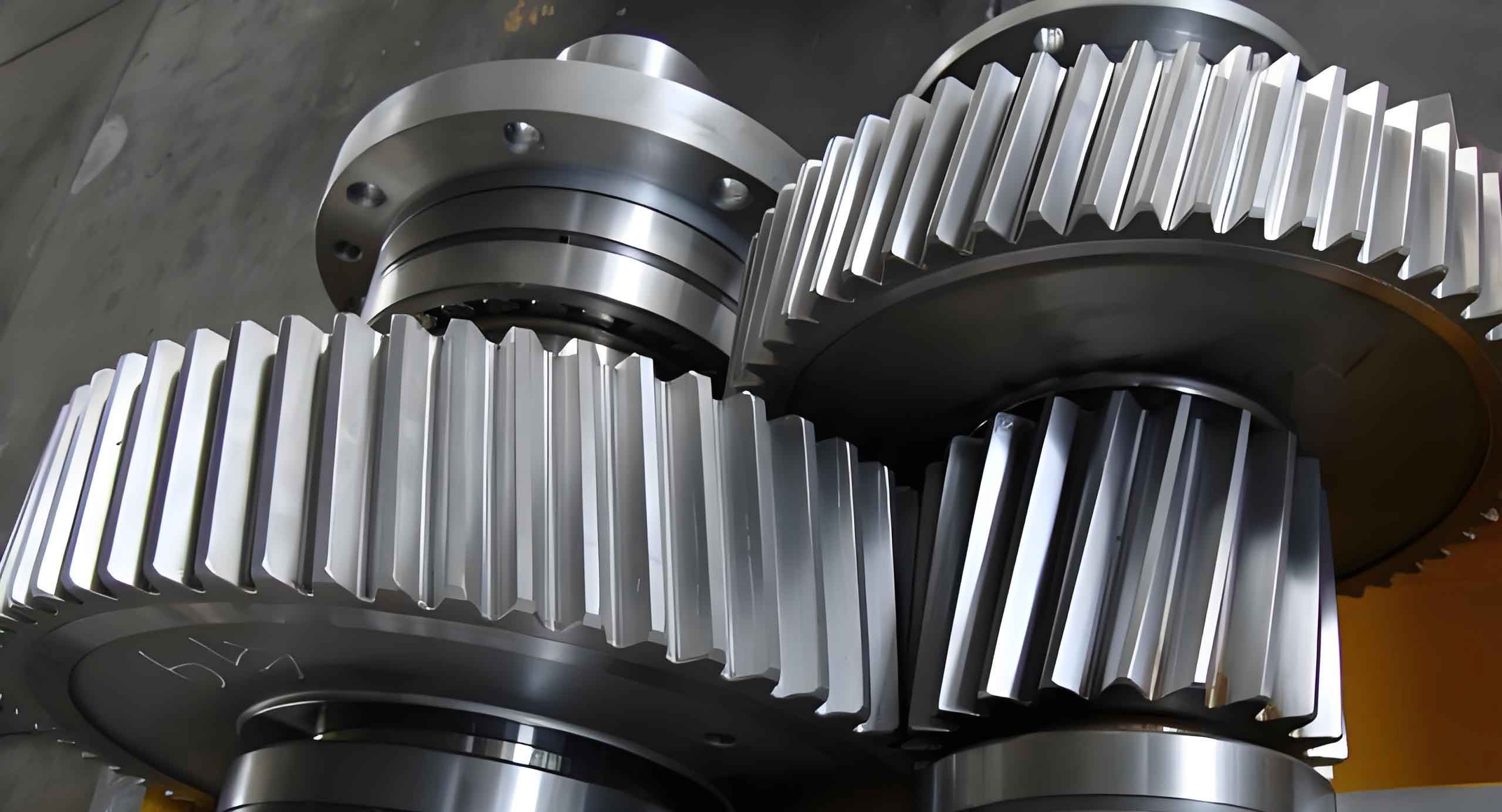
1. Friction-Excited Dynamic Model of a Helical Gear Pair
To capture the vibrational behavior influenced by mesh friction, a six-degree-of-freedom (6-DOF) lumped-parameter model is established for a parallel-axis helical gear pair. The model considers bending, torsional, and axial vibrations, incorporating key excitations such as time-varying mesh stiffness, transmission error, and crucially, the friction forces and moments at the mesh interface. The coordinate system is defined with translational displacements \(x, y, z\) and torsional displacement \(\theta\) for both the pinion (subscript 1) and gear (subscript 2).
The equations of motion are derived using Newton’s second law, considering the elastic deformation compatibility and the components of mesh and friction forces. The dynamic differential equations for the pinion and gear are given as follows:
For the Pinion:
$$
\begin{aligned}
& m_1 \ddot{x}_1 + c_{x1} \dot{x}_1 + k_{x1} x_1 – F_d \cos\beta \sin\psi_{12} – F_{f12} \cos\psi_{12} = 0 \\
& m_1 \ddot{y}_1 + c_{y1} \dot{y}_1 + k_{y1} y_1 – F_d \cos\beta \cos\psi_{12} + F_{f12} \sin\psi_{12} = 0 \\
& m_1 \ddot{z}_1 + c_{z1} \dot{z}_1 + k_{z1} z_1 – F_d \sin\beta = 0 \\
& \frac{I_1}{r_{b1}^2} \ddot{\theta}_1 + c_{\theta1} \dot{\theta}_1 + k_{\theta1} \theta_1 + F_d \cos\beta – \frac{M_{f12}}{r_{b1}} = \frac{T_1}{r_{b1}}
\end{aligned}
$$
For the Gear:
$$
\begin{aligned}
& m_2 \ddot{x}_2 + c_{x2} \dot{x}_2 + k_{x2} x_2 + F_d \cos\beta \sin\psi_{12} + F_{f12} \cos\psi_{12} = 0 \\
& m_2 \ddot{y}_2 + c_{y2} \dot{y}_2 + k_{y2} y_2 + F_d \cos\beta \cos\psi_{12} – F_{f12} \sin\psi_{12} = 0 \\
& m_2 \ddot{z}_2 + c_{z2} \dot{z}_2 + k_{z2} z_2 + F_d \sin\beta = 0 \\
& \frac{I_2}{r_{b2}^2} \ddot{\theta}_2 + c_{\theta2} \dot{\theta}_2 + k_{\theta2} \theta_2 + F_d \cos\beta – \frac{M_{f12}}{r_{b2}} = -\frac{T_2}{r_{b2}}
\end{aligned}
$$
Where:
- \(m_i, I_i\): mass and mass moment of inertia.
- \(c_{xi}, c_{yi}, c_{zi}, c_{\theta i}\): damping coefficients in translational and torsional directions.
- \(k_{xi}, k_{yi}, k_{zi}, k_{\theta i}\): stiffness coefficients in translational and torsional directions.
- \(F_d\): dynamic mesh force along the line of action.
- \(F_{f12}, M_{f12}\): friction force and friction moment at the mesh.
- \(\beta\): helix angle.
- \(\psi_{12}\): angle between the line of action projection and the y-axis.
- \(r_{bi}\): base circle radius.
- \(T_i\): input/output torque.
The dynamic mesh force \(F_d\) is a function of the gear pair’s relative displacement, damping, stiffness, and excitation error:
$$
F_d = k_{12}(t) \delta_{12} + c_{12} \dot{\delta}_{12}
$$
$$
\delta_{12} = \left[ (x_1 – x_2) \sin\psi_{12} – (y_1 – y_2) \cos\psi_{12} + (r_{b1}\theta_1 + r_{b2}\theta_2) \right] \cos\beta + (z_1 – z_2) \sin\beta – e_{12}(t)
$$
Here, \(k_{12}(t)\) is the time-varying mesh stiffness, \(c_{12}\) is the mesh damping (often expressed as \(c_{12}=2\xi\sqrt{k_{m} m_e}\), where \(k_m\) is average stiffness and \(m_e\) is equivalent mass), and \(e_{12}(t)\) is the static transmission error excitation.
The friction moment \(M_{f12}\) is critical and is calculated by integrating the contributions from all concurrent contact lines:
$$
M_{f12} = \sum_{j=1}^{n_{cl}} \int_{L_j} \text{sgn}(v_s(u)) \cdot \mu(u,t) \cdot \frac{F_d(t) \cdot r_{b1}}{L_{total}(t)} \, du
$$
Where \(\text{sgn}(v_s(u))\) is the sign function determined by the direction of sliding velocity at position \(u\) along the contact line \(L_j\), \(\mu(u,t)\) is the spatially and temporally varying friction coefficient from the lubrication model, and \(L_{total}(t)\) is the total instantaneous contact length. The calculation of \(L_{total}(t)\) for helical gears is detailed in the next section.
2. Mixed Elastohydrodynamic Lubrication (EHL) Model for Helical Gears
2.1 Contact Analysis and Time-Varying Contact Length
The contact geometry of helical gears is characterized by a sloping line of contact that moves across the face width. Unlike spur gears, multiple teeth are in contact simultaneously, leading to a time-varying total contact length. This parameter is fundamental for load distribution and friction calculation.
The single-pair contact length \(L(u)\) at a given mesh position parameterized by \(u\) (distance from the pitch point along the path of contact) is derived from the contact zone geometry. It can be segmented into left (\(B_L\)) and right (\(B_R\)) portions relative to the pitch point P:
$$
B_L(u) =
\begin{cases}
0, & B_{1P} + \varepsilon_{\beta} P_{bt} < u \leq \varepsilon_{\gamma} P_{bt} \\
u, & u \leq B_{1P} \\
B_{1P}, & B_{1P} < u \leq \varepsilon_{\beta} P_{bt} \\
B_{1P} + \varepsilon_{\beta} P_{bt} – u, & \varepsilon_{\beta} P_{bt} < u \leq B_{1P} + \varepsilon_{\gamma} P_{bt}
\end{cases}
$$
$$
B_R(u) =
\begin{cases}
0, & u \leq B_{1P} \\
u – B_{1P}, & B_{1P} < u \leq \varepsilon_{\alpha} P_{bt} \\
\varepsilon_{\alpha} P_{bt} – B_{1P}, & \varepsilon_{\alpha} P_{bt} < u \leq B_{1P} + \varepsilon_{\beta} P_{bt} \\
\varepsilon_{\gamma} P_{bt} – u, & B_{1P} + \varepsilon_{\beta} P_{bt} < u \leq \varepsilon_{\gamma} P_{bt}
\end{cases}
$$
Where:
- \(\varepsilon_{\alpha}, \varepsilon_{\beta}, \varepsilon_{\gamma}\): transverse, overlap, and total contact ratios.
- \(P_{bt}\): transverse base pitch.
- \(B_{1P} = \sqrt{r_{a1}^2 – r_{b1}^2} – r_1 \sin\alpha\): distance from the pinion tip to the pitch point.
The total contact length for one pair is then:
$$
L(u) = \frac{B_L(u) + B_R(u)}{\cos\beta}
$$
The total contact length at any time \(t\) is the sum of \(L(u)\) for all tooth pairs in contact.
2.2 Governing Equations for Mixed EHL
Under high-pressure conditions typical of gear contacts, the lubricant operates in an elastohydrodynamic regime, where its viscosity and density are strongly pressure-dependent. A transient, two-dimensional Reynolds equation governs the fluid film pressure \(p(x,y,t)\):
$$
\frac{\partial}{\partial x}\left( \frac{\rho h^3}{\eta} \frac{\partial p}{\partial x} \right) + \frac{\partial}{\partial y}\left( \frac{\rho h^3}{\eta} \frac{\partial p}{\partial y} \right) = 12 u_e \frac{\partial (\rho h)}{\partial x} + 12 \frac{\partial (\rho h)}{\partial t}
$$
Where:
- \(h\): film thickness.
- \(\eta\): lubricant viscosity (\(\eta = \eta_0 \exp\{ (\ln \eta_0 + 9.67)[(1 + p/p_0)^z – 1] \}\)).
- \(\rho\): lubricant density (\(\rho = \rho_0 (1 + A p)/(1 + B p)\)).
- \(u_e = (u_1 + u_2)/2\): entrainment velocity.
The film thickness equation accounts for gear geometry, elastic deformation \(v(x,y)\), and surface roughness \(s_1(x,y), s_2(x,y)\):
$$
h(x,y,t) = h_0(t) + \frac{x^2}{2R_x(t)} + \frac{y^2}{2R_y(t)} + v(x,y,t) + s_1(x,y) + s_2(x,y)
$$
The elastic deformation \(v\) is given by the Boussinesq integral:
$$
v(x,y,t) = \frac{2}{\pi E’} \iint_{\Omega} \frac{p(x’,y’,t)}{\sqrt{(x-x’)^2 + (y-y’)^2}} dx’ dy’
$$
where \(E’\) is the reduced elastic modulus.
The load balance equation ensures the integrated pressure supports the dynamic load per unit face width \(w_d(t)\) from the dynamic model:
$$
\iint_{\Omega} p(x,y,t) \, dx \, dy = w_d(t) = \frac{W_d(t)}{F}
$$
Here, \(W_d(t)\) is the total dynamic mesh force from the dynamic model for the gear pair, and \(F\) is the face width. This equation couples the tribological and dynamic models.
The shear stress \(\tau\) in the fluid film is:
$$
\tau = \pm \frac{h}{2} \frac{\partial p}{\partial x} + \frac{\eta (u_2 – u_1)}{h}
$$
The instantaneous friction coefficient \(\mu(t)\) is calculated by integrating the shear stress over the fluid region and adding the contribution from asperity contact in boundary lubrication zones, divided by the load:
$$
\mu(t) = \frac{\iint_{\Omega_c} \tau \, dx \, dy + \iint_{\Omega_b} \mu_b p \, dx \, dy}{w_d(t)}
$$
Where \(\Omega_c\) and \(\Omega_b\) denote the regions of fluid and boundary contact, respectively, and \(\mu_b\) is the boundary friction coefficient. This \(\mu(t)\) is fed back into the dynamic model to compute the friction force \(F_{f12}\).
3. Iterative Coupling Scheme and Dynamic Efficiency Calculation
The core of the proposed methodology is the iterative coupling between the dynamic model (DM) and the mixed EHL model. The algorithm proceeds as follows:
- Initialization: Solve the dynamic model without friction (\(F_{f12}=0, M_{f12}=0\)) to obtain an initial guess for the dynamic mesh force \(W_d^{(0)}(t)\) and kinematic data (sliding velocity \(v_s(u,t)\), entrainment velocity \(u_e(t)\), radii of curvature \(R(t)\)).
- EHL Solution: For each time step \(t\), input \(W_d^{(k)}(t)\) and kinematic data into the mixed EHL model. Solve the Reynolds, film thickness, and load balance equations to obtain the pressure distribution \(p(x,y,t)\) and the friction coefficient \(\mu^{(k)}(t)\).
- Friction Force Update: Calculate the mesh friction force \(F_{f12}^{(k)}(t)\) and moment \(M_{f12}^{(k)}(t)\) using \(\mu^{(k)}(t)\) and the integrated shear stress.
- Dynamic Model Re-solution: Solve the friction-inclusive dynamic model (Eqs. 1-5) with the updated \(F_{f12}^{(k)}(t)\) and \(M_{f12}^{(k)}(t)\) to obtain a new dynamic mesh force \(W_d^{(k+1)}(t)\).
- Convergence Check: Check if \(\| W_d^{(k+1)}(t) – W_d^{(k)}(t) \| / \| W_d^{(k)}(t) \| < \text{tolerance}\). If not converged, set \(k = k+1\) and return to step 2. If converged, proceed.
- Efficiency Calculation: Use the converged time histories of \(\mu(t)\), \(W_d(t)\), and \(v_s(u,t)\) to compute the instantaneous power loss and efficiency.
The instantaneous frictional power loss \(P_{loss}(t)\) for one mesh is calculated by integrating the product of friction force density and sliding velocity along all active contact lines \(L_j(t)\):
$$
P_{loss}(t) = \sum_{j=1}^{n_{cl}(t)} \int_{L_j(t)} \text{sgn}(v_s(u)) \cdot \mu(u,t) \cdot \frac{W_d(t)}{L_{total}(t)} \cdot |v_s(u,t)| \, du
$$
The average power loss over one mesh cycle \(T_m\) is:
$$
\overline{P}_{loss} = \frac{1}{T_m} \int_{0}^{T_m} P_{loss}(t) \, dt
$$
Finally, the dynamic meshing efficiency \(\eta\) is:
$$
\eta(t) = \left( 1 – \frac{P_{loss}(t)}{P_{in}(t)} \right) \times 100\%, \quad \overline{\eta} = \left( 1 – \frac{\overline{P}_{loss}}{\overline{P}_{in}} \right) \times 100\%
$$
where \(P_{in}(t) = T_1(t) \omega_1(t)\) is the input power.
4. Case Study: Analysis of a High-Speed Helical Gear Pair
To demonstrate the application and significance of the proposed coupled method, a case study of a high-speed, heavily-loaded helical gear pair is presented. The key geometric and operational parameters are listed in Table 1.
| Parameter | Pinion | Gear |
|---|---|---|
| Number of Teeth, \(z\) | 21 | 37 |
| Normal Module, \(m_n\) (mm) | 15 | 15 |
| Normal Pressure Angle, \(\alpha_n\) (°) | 20 | 20 |
| Helix Angle, \(\beta\) (°) | 20 | 20 |
| Face Width, \(F\) (mm) | 50 | 50 |
| Input Torque, \(T_1\) (Nm) | 50,000 | |
| Input Speed, \(n_1\) (rpm) | 5,000 | |
| Material | Steel (E=210 GPa, ν=0.3) | |
| Lubricant | ISO VG 100 | |
4.1 Coupled Dynamic and Tribological Results
The iterative coupling algorithm was implemented numerically. Figure 1 shows the converged, time-varying friction coefficient \(\mu(t)\) over one mesh cycle. A clear periodic pattern emerges, synchronized with the mesh frequency. The friction coefficient peaks near the start and end of single-tooth contact regions, where the sliding velocity is high and the lubricant film is thin due to high contact pressure and reduced entrainment velocity. It reaches a minimum near the pitch point, where sliding velocity reverses direction and theoretically passes through zero, leading to predominantly rolling contact and lower shear stress. The coupled solution shows significant fluctuations (range: ~0.02 to 0.05) compared to a constant empirical value, highlighting the transient nature of friction in helical gears.
Figure 2 compares the dynamic mesh force \(W_d(t)\) from the uncoupled model (solved with a constant friction coefficient) and the coupled model. The uncoupled model shows a predictable pattern modulated by the time-varying mesh stiffness. The coupled model, however, exhibits markedly different dynamic behavior. The amplitude of fluctuations increases, and the resonance characteristics are altered due to the energy dissipation and additional excitation provided by the time-varying friction force. The load fluctuates between approximately 2,445 N and 6,756 N in the coupled case, versus 3,274 N to 5,847 N in the uncoupled case. This demonstrates that friction dynamics significantly influence the vibrational load, which in turn affects the lubrication condition—a coupling that is captured only by the present method.
4.2 Dynamic Meshing Efficiency
Using the coupled time histories of \(\mu(t)\) and \(W_d(t)\), the instantaneous and average meshing efficiency were calculated. For comparison, efficiency was also computed using a standard empirical formula for friction coefficient (e.g., \(\mu_{emp} = 0.05\)) combined with the static load distribution.
The results are summarized in Table 2 and depicted in Figure 3.
| Method | Average Efficiency, \(\overline{\eta}\) (%) | Minimum Instantaneous Efficiency (%) | Maximum Instantaneous Efficiency (%) | Remarks |
|---|---|---|---|---|
| Proposed Coupled Method | 99.67 | 99.48 | 99.85 | Accounts for dynamic load and time-varying EHL friction. |
| Empirical Formula (Static Load) | 99.71 | ~99.65 | ~99.78 | Uses constant friction and assumes smooth load sharing. |
The proposed method yields an average efficiency of 99.67%. The instantaneous efficiency (Figure 3) shows pronounced fluctuations throughout the mesh cycle. The minimum efficiency (99.48%) occurs not at the pitch point but during periods of high sliding velocity and long contact lines, where frictional power loss is maximized. The maximum efficiency (99.85%) is observed near the pitch point due to minimal sliding. Notably, efficiency never reaches 100% due to other loss mechanisms like rolling friction, windage, and churning, which are not modeled here.
In contrast, the empirical method predicts a slightly higher average efficiency (99.71%) with a much smoother profile. It fails to capture the significant dips associated with the friction peaks at the mesh entry and exit, thus overestimating efficiency during those phases and underestimating the dynamic variability. The smoother trend is an artifact of ignoring the coupling between dynamics, load fluctuation, and transient lubrication.
5. Discussion and Conclusion
This study presents a comprehensive and novel methodology for calculating the dynamic meshing efficiency of helical gears. The key achievement is the development and implementation of an iterative coupling scheme that integrates a friction-excited multi-degree-of-freedom dynamic model with a transient mixed elastohydrodynamic lubrication model. This approach fundamentally addresses the limitation of traditional methods that treat gear dynamics and tribology as decoupled phenomena.
The analysis of a high-speed, high-torque helical gear pair leads to several important conclusions:
- Coupled Dynamics are Significant: The friction coefficient in lubricated helical gear contacts is highly transient, varying periodically with mesh cycles. Its coupling with the gear dynamics significantly alters the dynamic mesh force response, increasing the amplitude and modifying the frequency content compared to uncoupled models.
- Dynamic Efficiency is Variable: The meshing efficiency of helical gears is not a constant value but fluctuates dynamically within each mesh cycle. Our coupled method predicts an average efficiency of 99.67% with fluctuations between 99.48% and 99.85% for the studied case. These fluctuations are directly correlated with the variations in sliding velocity and contact length.
- Empirical Methods Lack Fidelity: While empirical formulas may provide a reasonable average efficiency estimate (99.71% here), they completely fail to capture the dynamic variations and the potentially critical instantaneous efficiency minima. This lack of fidelity can be detrimental for designs sensitive to thermal loads or for predicting precise energy consumption over a duty cycle.
- The Iterative Coupling is Essential: The proposed iterative feedback loop between dynamic load and friction coefficient is crucial for achieving a physically consistent solution. It ensures that the load used in the EHL analysis is the true dynamic load influenced by friction, and the friction coefficient reflects the actual pressure and film conditions generated by that load.
The presented methodology provides a powerful virtual prototyping tool for the design and optimization of efficient helical gear transmissions. It enables engineers to investigate the impact of design parameters (geometry, micro-geometry), operating conditions (speed, load), and lubricant properties on system dynamics, tribological performance, and ultimately, power loss. Future work will extend this model to include thermal effects, non-Newtonian lubricant behavior, and specific surface topography to further enhance its predictive accuracy for a broader range of helical gear applications.