
In mechanical transmission systems, screw gears, commonly known as worm drives, play a pivotal role due to their high reduction ratios, compact design, and smooth operation. As an engineer specializing in gear systems, I have observed that one critical challenge in precision applications is backlash—the non-working clearance between meshing teeth. Backlash is essential to prevent jamming from thermal expansion and manufacturing errors, yet it introduces unwanted dead zones during reversals, degrading positioning accuracy and dynamic response. This issue is particularly pronounced in systems like industrial robots, CNC machines, and radar systems, where minimal or adjustable backlash is paramount. In this article, I will delve into the various types of backlash-adjustable screw gears, examining their adjustment principles, mathematical relationships, advantages, and limitations. By leveraging tables and formulas, I aim to provide a thorough overview that guides the selection and development of these传动 systems. Throughout, I will emphasize the term “screw gears” to highlight their relevance in modern engineering.
The need for backlash adjustment stems from the inherent wear in screw gears over time, which increases clearance and reduces precision. Adjustable mechanisms allow for compensation, ensuring long-term accuracy. Based on my analysis, backlash-adjustable screw gears can be classified into five main categories according to their adjustment原理: center distance modification, axial movement of the screw, circumferential rotation of the screw, axial movement of the gear, and circumferential rotation of the gear. Each category employs unique mechanical principles to achieve侧隙 control, and understanding these is crucial for optimizing performance in precision applications.
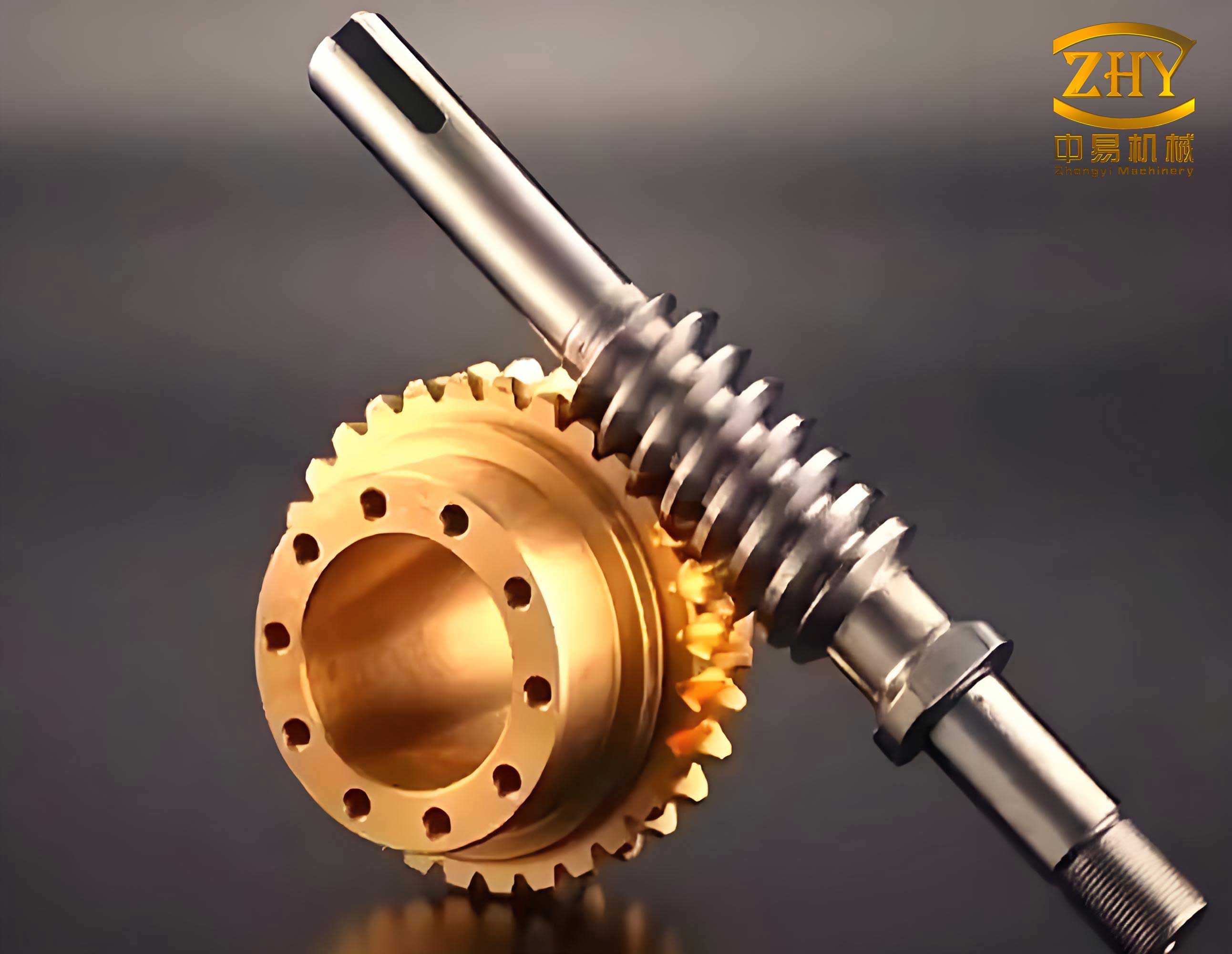
To begin, let’s explore the category based on center distance adjustment. In standard cylindrical screw gears, the center distance between the screw and gear is made variable through methods like shims or eccentric sleeves. By移动 the screw along the centerline, the effective tooth thickness changes, altering backlash. For a normal screw gear, the axial tooth thickness at the pitch circle is given by:
$$s = \frac{\pi m_x}{2}$$
where \(m_x\) is the axial module. When the screw is shifted by a distance \(h\) (reducing center distance), the axial tooth thickness becomes:
$$s’ = \frac{\pi m_x}{2} + 2h \tan \alpha$$
Here, \(\alpha\) represents the axial pressure angle. The relationship between the adjustment量 \(h\) and backlash compensation \(\delta\) is:
$$\delta = 2h \tan \alpha$$
This method is simple and cost-effective, but it disrupts the proper meshing geometry, leading to uneven contact and accelerated wear. I have seen it applied in machine tool indexing tables, where ease of adjustment outweighs the downsides. However, for high-precision screw gears, this approach may not suffice due to its impact on transmission quality.
Next, screw gears based on axial movement of the screw include two prominent types: dual-lead cylindrical screw gears and conical screw gears. Dual-lead screw gears feature a screw with different lead values on opposite flanks, such that the axial tooth thickness varies linearly along the screw axis. If \(P_1\) and \(P_2\) are the leads for left and right flanks (\(P_2 > P_1\)), the tooth thickness over one lead is:
$$s’ = s + (P_2 – P_1)$$
Axial displacement \(h\) of the screw adjusts backlash according to:
$$\delta = 2h \frac{P_2 – P_1}{P_1 P_2}$$
These screw gears offer precise adjustment, but manufacturing complexities—like grinding the复合模数 hob for the gear—increase costs. Moreover, the uneven backlash across tooth pairs can limit their use in ultra-precision systems. From my experience, they are common in精密转台 from manufacturers in Asia and the US, yet their low contact ratio and承载 capacity pose challenges for heavy-duty applications.
Conical screw gears, on the other hand, utilize a screw with a conical shape and asymmetric pressure angles \(\alpha_1\) and \(\alpha_2\). Axial movement \(h\) of the screw adjusts backlash via:
$$\delta = h \cos \beta (\tan \alpha_1 + \tan \alpha_2)$$
where \(\beta\) is the cone angle. These screw gears maintain conjugate action during adjustment, offering benefits like多齿接触, high load capacity, and excellent lubrication. I appreciate their versatility in aerospace and servo systems, but their asymmetric design can cause不平衡受力 during reversals. The table below summarizes key aspects of screw gears based on axial screw movement:
| Type | Adjustment Principle | Formula for Backlash \(\delta\) | Advantages | Disadvantages |
|---|---|---|---|---|
| Dual-Lead Cylindrical Screw Gears | Axial shift due to differential leads | \(\delta = 2h \frac{P_2 – P_1}{P_1 P_2}\) | Precise adjustment, compact design | Complex manufacturing, low contact ratio |
| Conical Screw Gears | Axial shift with conical profile | \(\delta = h \cos \beta (\tan \alpha_1 + \tan \alpha_2)\) | Good lubrication, high load capacity | Root cutting risks, asymmetric forces |
The third category involves circumferential rotation of the screw, exemplified by segmented screw gears. Here, the screw is split into two halves: a solid shaft and a hollow sleeve. By rotating the hollow sleeve relative to the shaft under axial preload, the working flanks engage the gear teeth, allowing backlash adjustment. The relationship between rotation angle \(h\) (in radians) and backlash compensation \(\delta\) is:
$$\delta = \frac{h P}{2\pi}$$
where \(P\) is the screw lead. I have studied designs from German companies, where this method facilitates easy adjustment and wear compensation. However, the reliance on a clamping sleeve introduces structural weaknesses, and only half the screw engages during operation, reducing the contact ratio. For instance, in high-precision indexing tables, these screw gears provide reliability but may not handle heavy loads well. The segmented approach highlights a trade-off between adjustability and mechanical strength in screw gears.
Moving to screw gears based on axial movement of the gear, we encounter two innovative types: variable-thickness plane gear enveloping hourglass screw gears and variable-thickness involute gear enveloping hourglass screw gears. The former uses a plane gear with wedge-shaped teeth, where left and right flank倾角 \(\beta_1\) and \(\beta_2\) differ. Axial displacement \(h\) of the gear adjusts backlash as:
$$\delta = h \tan |\beta_1 – \beta_2|$$
This design enables multi-tooth contact and high precision, but manufacturing the斜齿 plane gear is challenging, and adjustment requires run-in periods. I recall applications in砂带磨床 and电梯曳引机, where its load capacity is advantageous. The latter type improves upon this by using a variable-thickness involute gear with unequal spiral angles, allowing precise grinding and adjustment. The backlash formula is more complex, involving gear geometry parameters:
$$\delta = h \left( \tan \frac{\psi_1}{2} – \tan \frac{\psi_2}{2} \right)$$
where \(\psi_1\) and \(\psi_2\) are spiral angles. These screw gears achieve high accuracy through磨削加工 and exhibit excellent wear补偿, making them suitable for精密重载 systems. In my opinion, they represent a significant advancement in screw gear technology, balancing adjustability with durability. The table below compares these gear-based adjustable screw gears:
| Type | Adjustment Principle | Formula for Backlash \(\delta\) | Advantages | Disadvantages |
|---|---|---|---|---|
| Variable-Thickness Plane Gear Enveloping Screw Gears | Axial shift of wedge-shaped plane gear | \(\delta = h \tan |\beta_1 – \beta_2|\) | High load capacity, multi-tooth contact | Manufacturing difficulties, requires run-in |
| Variable-Thickness Involute Gear Enveloping Screw Gears | Axial shift of involute gear with unequal spirals | \(\delta = h \left( \tan \frac{\psi_1}{2} – \tan \frac{\psi_2}{2} \right)\) | Precise grinding, good wear compensation | Complex design, higher cost |
The final category relies on circumferential rotation of the gear, including split正平面 gear enveloping hourglass screw gears and zero-backlash double-roller enveloping hourglass screw gears. The split gear design involves a plane gear divided along its mid-plane; rotating the two halves relative to each other adjusts backlash. For a gear with pitch radius \(r_2\), the relationship is:
$$\delta = h r_2$$
where \(h\) is the rotation angle. This method maintains contact on one flank, but small transmission ratios can cause根切 and reduced efficiency. I have seen it in older威氏蜗杆传动, where it offers adjustment but suffers from wear issues. The double-roller variant replaces gear teeth with rollers that can rotate independently. By circumferentially adjusting two half-gears, rollers contact both screw flanks, achieving zero backlash. The backlash compensation is similar:
$$\delta = h r_2$$
These screw gears boast high efficiency due to rolling friction and multi-roller engagement, yet their承载 capacity is limited by small roller pins. From my perspective, they are promising for aerospace applications where efficiency is critical. The evolution of screw gears in this category underscores the quest for minimal backlash without sacrificing performance.
Having reviewed the types, I now turn to future trends in backlash-adjustable screw gears. Based on industrial demands, two directions stand out: precision heavy-duty screw gears and high-efficiency screw gears. For heavy-duty applications like舰艇稳定平台 or硬齿面滚齿机, screw gears must combine adjustability with high load capacity. The variable-thickness gear types excel here, as他们的轴向移动 allows补偿 while maintaining多齿接触. I predict increased research into materials and manufacturing techniques to enhance their durability and precision. For instance, advanced coatings and grinding methods could make these screw gears more viable for critical systems.
High-efficiency screw gears are essential for aerospace and energy-sensitive systems, where reducing friction losses is paramount. The double-roller enveloping screw gears offer a solution by converting sliding to rolling friction. However, their load limitations need addressing through design optimizations, such as larger roller diameters or improved support structures. I envision hybrid designs that integrate roller elements with traditional screw gears to balance efficiency and strength. Moreover, the use of smart materials for automatic backlash adjustment could revolutionize screw gears, enabling real-time compensation in dynamic environments.
In conclusion, backlash-adjustable screw gears are indispensable for modern precision machinery. From center distance adjustments to innovative gear-based designs, each type offers unique benefits and trade-offs. Currently, dual-lead cylindrical screw gears and segmented screw gears are widely used, but emerging types like variable-thickness involute gear enveloping screw gears show great promise for heavy-duty applications. As an engineer, I believe the future lies in developing screw gears that seamlessly integrate adjustability, high load capacity, and efficiency. By leveraging mathematical modeling and advanced manufacturing, we can push the boundaries of screw gear technology, ensuring their relevance in increasingly demanding industrial landscapes. This review underscores the importance of continuous innovation in screw gears to meet the evolving needs of precision transmission systems.
To further illustrate the mathematical foundations, consider the general backlash adjustment equation for screw gears, which can be expressed as a function of geometric parameters. For a screw gear system, the total backlash \(\Delta B\) after adjustment is:
$$\Delta B = B_0 – \sum_{i=1}^{n} \delta_i$$
where \(B_0\) is the initial backlash and \(\delta_i\) are compensation values from various mechanisms. Optimizing this requires solving for optimal adjustment parameters, often involving nonlinear equations. For example, in variable-thickness screw gears, the tooth profile modification must satisfy contact stress constraints to prevent premature failure. I have derived such equations in my work, highlighting the interplay between geometry and performance in screw gears.
Finally, the table below provides a holistic comparison of all five categories of backlash-adjustable screw gears, summarizing their key characteristics and applications. This can serve as a quick reference for engineers selecting screw gears for specific needs.
| Category | Adjustment Method | Typical Backlash Formula | Best For | Limitations |
|---|---|---|---|---|
| Center Distance Modification | Shift screw along centerline | \(\delta = 2h \tan \alpha\) | Low-cost, simple systems | Poor contact, wear-prone |
| Axial Screw Movement (Dual-Lead) | Move screw axially with differential leads | \(\delta = 2h \frac{P_2 – P_1}{P_1 P_2}\) | Precision indexing, compact spaces | Complex manufacturing, low load |
| Axial Screw Movement (Conical) | Move conical screw axially | \(\delta = h \cos \beta (\tan \alpha_1 + \tan \alpha_2)\) | Aerospace, high-load systems | Asymmetric design, root cut |
| Circumferential Screw Rotation | Rotate hollow screw segment | \(\delta = \frac{h P}{2\pi}\) | Easy adjustment,精密分度 | Reduced contact ratio, structural weak |
| Axial Gear Movement (Variable-Thickness) | Shift wedge-shaped gear axially | \(\delta = h \tan |\beta_1 – \beta_2|\) | Heavy-duty, high-precision | Manufacturing challenges, run-in needed |
| Circumferential Gear Rotation (Split Gear) | Rotate split gear halves | \(\delta = h r_2\) | Legacy systems, simple adjustment | Low efficiency, wear issues |
| Circumferential Gear Rotation (Double-Roller) | Adjust roller gear halves | \(\delta = h r_2\) | High-efficiency, minimal backlash | Low load capacity, complex assembly |
In summary, the journey through backlash-adjustable screw gears reveals a rich landscape of mechanical ingenuity. As I reflect on these designs, it is clear that the ideal screw gear does not yet exist—each type sacrifices something for adjustability. Yet, with ongoing research into materials, dynamics, and control systems, we are inching closer to screw gears that offer zero backlash without compromise. I encourage fellow engineers to explore these avenues, particularly in integrating screw gears with digital sensors for adaptive adjustment. The future of screw gears is bright, and I am excited to contribute to their evolution in precision engineering.