
In the realm of mechanical power transmission, the worm gear drive stands as a pivotal mechanism, renowned for its broad range of transmission ratios, compact structure, smooth operation, and low noise. As someone deeply involved in the study of mechanical systems, I have observed that these attributes make the worm gear drive indispensable not only in power transmission but also in precision rotational indexing applications, such as those found in industrial robots, CNC machine tools, and radar systems. However, a persistent challenge in worm gear drive applications is the presence of backlash—the gap between non-working tooth surfaces. While minimal backlash is necessary to prevent jamming due to manufacturing errors and thermal expansion and to accommodate lubrication, excessive or uncontrolled backlash leads to lost motion during reversals, degrading positional accuracy, dynamic response, and overall system stability. This is particularly critical in systems requiring frequent bidirectional motion or high precision. Consequently, the development of backlash-adjustable worm gear drives has become a focal point in advancing precision engineering. This review aims to delve into the various types of backlash-adjustable worm gear drives, examining their adjustment principles, characteristics, and future trajectories, all while emphasizing the enduring importance of the worm gear drive in modern machinery.
The fundamental issue with backlash in a worm gear drive is that it introduces an angular dead zone when the direction of rotation is reversed. Over time, wear on the tooth surfaces can exacerbate this backlash, further diminishing transmission accuracy and service life. Therefore, the ability to adjust and compensate for backlash is not merely a desirable feature but a necessity for high-performance systems. In my analysis, I categorize backlash-adjustable worm gear drives based on their underlying adjustment methodology. Each category employs a distinct mechanical principle to alter the meshing relationship between the worm and the gear, thereby controlling the side clearance. Understanding these principles is crucial for selecting the appropriate drive for a given application and for innovating new designs. Throughout this discussion, the term “worm gear drive” will be frequently referenced, as it is the core subject of our exploration.
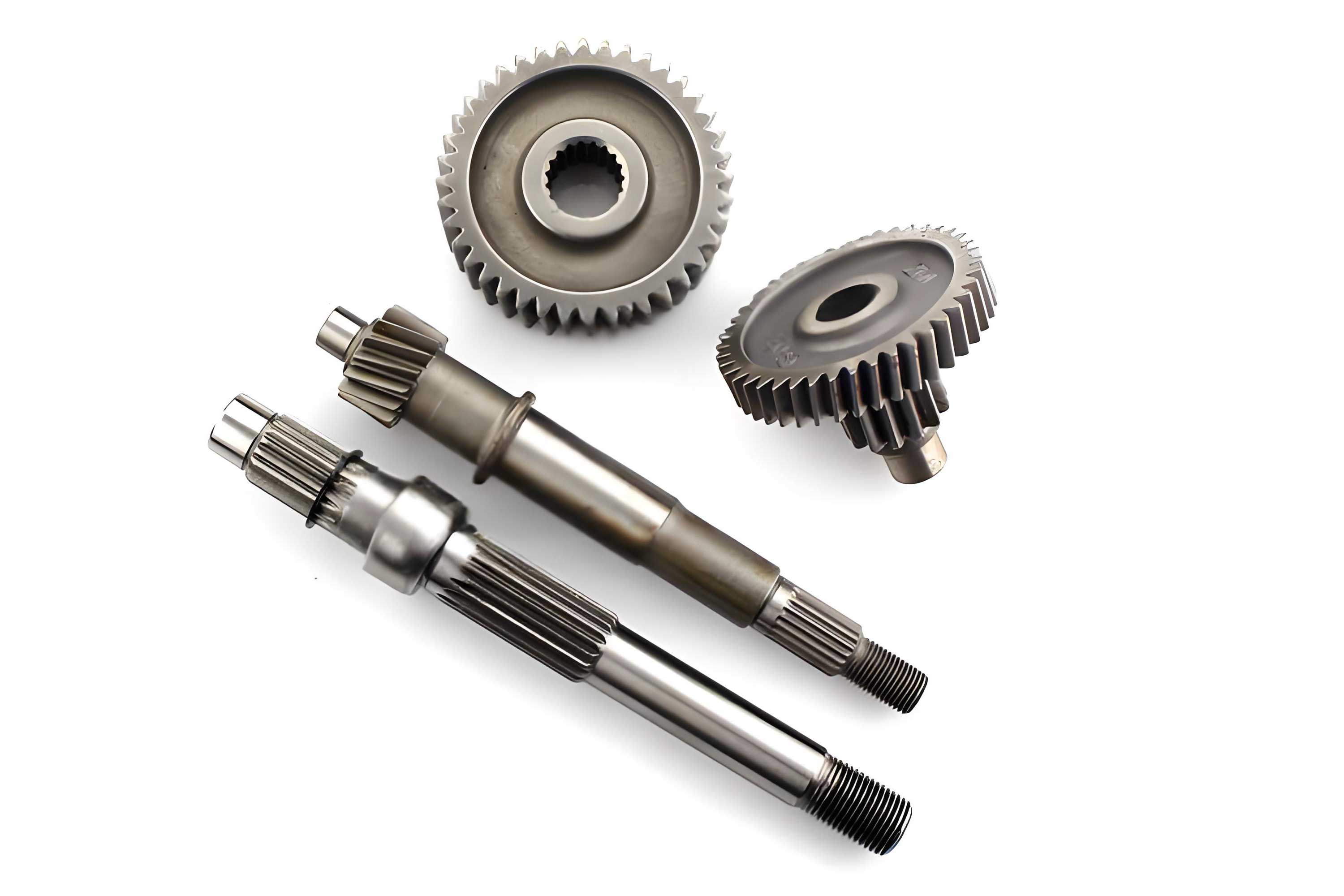
To set the stage, let us consider the basic geometry of a standard cylindrical worm gear drive. In its nominal state, the pitch circle of the worm coincides with its reference circle. The axial tooth thickness, denoted as \( s \), on the worm’s reference cylinder is given by:
$$ s = \frac{\pi m_x}{2} $$
where \( m_x \) is the axial module of the worm. Backlash adjustment often involves perturbing this nominal geometry to effectively increase the effective tooth thickness or alter the meshing position. The various methods to achieve this can be broadly classified into five groups: those based on center distance adjustment, worm axial displacement, worm circumferential rotation, gear axial displacement, and gear circumferential rotation. Each method has its unique kinematic and geometric implications, which I will explore in detail.
1. Backlash Adjustment via Center Distance Variation
The simplest approach to adjust backlash in a worm gear drive is to modify the center distance between the worm and the gear. In a standard cylindrical worm gear pair, the housing or bearing positions are designed to allow the worm to be shifted radially inward, effectively reducing the center distance by a amount \( h \). This radial movement causes the worm’s pitch circle to deviate from its reference circle. As a result, the effective axial tooth thickness of the worm engaging with the gear increases. The new effective tooth thickness \( s’ \) can be expressed as:
$$ s’ = \frac{\pi m_x}{2} + 2h \tan \alpha $$
where \( \alpha \) is the axial pressure angle of the worm. The relationship between the center distance reduction \( h \) and the resulting backlash compensation \( \delta \) is linear:
$$ \delta = 2h \tan \alpha $$
This implies that by controlling the shim thickness or using an eccentric bushing to set \( h \), one can directly control the backlash. From my perspective, the primary advantage of this method is its straightforwardness and low cost. The adjustment mechanism is simple to implement, often requiring only precision spacers or an adjustable mounting block. However, this simplicity comes at a significant cost: altering the center distance disrupts the theoretically correct conjugate meshing condition. The tooth contact pattern shifts, potentially leading to edge loading, increased stress concentration, and accelerated wear. The lubrication regime may also be adversely affected. Consequently, while this method finds use in some machine tool indexing tables where cost and simplicity are prioritized over ultimate precision and longevity, it is generally unsuitable for high-performance, durable worm gear drives. The inherent compromise in meshing quality limits its application to less demanding scenarios.
2. Backlash Adjustment via Worm Axial Displacement
A more sophisticated family of backlash-adjustable worm gear drives utilizes axial displacement of the worm to achieve adjustment without necessarily violating conjugate action. This category includes two prominent designs: the double-lead cylindrical worm gear drive and the spiroid (or cone) worm gear drive.
2.1 Double-Lead Cylindrical Worm Gear Drive
The double-lead worm is a clever design where the lead on the left flank (\( P_1 \)) and the right flank (\( P_2 \)) of the worm thread are intentionally made unequal, typically with \( P_2 > P_1 \). This results in a tooth thickness that varies linearly along the worm’s axis. Over one lead, the tooth thickness change is \( (P_2 – P_1) \). Therefore, the tooth thickness at any axial position \( z \) can be described as:
$$ s(z) = s_0 + (P_2 – P_1) \frac{z}{L} $$
where \( s_0 \) is the thickness at a reference point and \( L \) is a characteristic length. The worm gear, in contrast, has uniform tooth thickness. By axially displacing the worm by a distance \( h \), different portions of the worm’s varying tooth thickness engage with the gear, thereby adjusting the clearance. The backlash compensation \( \delta \) is related to the axial shift \( h \) by:
$$ \delta = 2h \frac{P_2 – P_1}{P_1 P_2} $$
or more commonly approximated as \( \delta \approx 2h (P_2 – P_1) / \bar{P}^2 \), where \( \bar{P} \) is an average lead. This design is prevalent in high-precision rotary tables from manufacturers in Japan, the United States, and Taiwan. In my assessment, its main virtue is that it allows for backlash adjustment without requiring movement of the heavy gear or altering the center distance, preserving the housing design. However, it has several drawbacks. Manufacturing the worm requires specialized grinding equipment capable of producing two different leads on the same thread. More critically, the matching worm gear hob must also be a composite, dual-lead design, making its fabrication and regrinding exceptionally difficult and costly. Furthermore, the gear is typically not grindable, limiting the final achievable accuracy. A fundamental kinematic issue is that the backlash is not uniform across all simultaneously engaged tooth pairs; only one or two pairs may have the precisely adjusted clearance, while others may exhibit larger or smaller gaps. This non-uniformity, coupled with a typically low contact ratio, results in reduced load capacity and makes the drive prone to wear. Thus, while suitable for precise motion transfer in indexing applications, the double-lead worm gear drive may struggle under heavy loads or continuous high-precision operation.
2.2 Spiroid (Cone) Worm Gear Drive
The spiroid worm gear drive features a worm shaped like a tapered cone, with its teeth machined on the conical surface. The key characteristic is that the pressure angles on the two flanks (\( \alpha_1 \) and \( \alpha_2 \)) are not equal. This asymmetry in the tooth profile allows for backlash adjustment through axial movement of the worm. The relationship between axial displacement \( h \) and backlash compensation \( \delta \) is:
$$ \delta = h \cos \beta (\tan \alpha_1 + \tan \alpha_2) $$
where \( \beta \) is the cone angle of the worm. This design offers several advantages that I find noteworthy. First, the adjustment maintains a true conjugate meshing relationship, preserving good contact patterns. Second, spiroid drives inherently have a high number of teeth in contact due to the conical engagement, leading to high load-carrying capacity. Third, the geometry often provides a favorable lubrication angle near 90°, enhancing oil film formation and reducing friction. Additionally, the gear can be made from hardened steel, offering a cost advantage over bronze gears common in other worm drives. These attributes have led to its adoption in aerospace actuation systems, servo controls, and astronomical instruments. However, the design is not without challenges. The gear tooth can be susceptible to undercutting, especially on the concave flank. The asymmetric pressure angles mean the drive behaves differently in forward and reverse loading, which must be accounted for in design. Despite these considerations, the spiroid worm gear drive represents a robust solution for applications requiring adjustable backlash, high load capacity, and reliable performance.
| Type | Adjustment Principle | Key Formula | Advantages | Disadvantages |
|---|---|---|---|---|
| Center Distance Adjustment | Radial shift of worm | $$ \delta = 2h \tan \alpha $$ | Simple, low cost, easy to implement | Poor meshing, accelerated wear, limited precision |
| Double-Lead Cylindrical | Axial shift of worm with unequal leads | $$ \delta \approx 2h \frac{P_2 – P_1}{\bar{P}^2} $$ | Precise adjustment, no center distance change | Complex manufacturing, non-uniform backlash, low contact ratio, high cost |
| Spiroid (Cone) | Axial shift of conical worm with asymmetric pressure angles | $$ \delta = h \cos \beta (\tan \alpha_1 + \tan \alpha_2) $$ | Maintains conjugate action, high load capacity, good lubrication | Potential undercut, asymmetric performance, complex design |
3. Backlash Adjustment via Worm Circumferential Rotation (Split Worm Design)
An innovative approach to backlash control involves splitting the worm axially into two segments: a solid worm shaft and a hollow worm sleeve. This is known as the split worm or segmented worm design. The worm gear’s tooth profile is specially modified to accommodate this split. The adjustment process involves applying an axial preload to the hollow sleeve while the worm shaft is fixed. The hollow sleeve is then rotated relative to the shaft, causing the working flanks of both segments to contact the gear teeth. Once the desired preload and minimal backlash are achieved, the two segments are locked together using a clamping sleeve or similar device. The backlash compensation \( \delta \) is related to the relative circumferential rotation \( \theta \) (in radians) of the hollow sleeve by:
$$ \delta = \frac{\theta}{2\pi} P $$
where \( P \) is the lead of the worm. Companies like OTT in Germany and Cone Drive in the USA have commercialized this concept for cylindrical and hourglass worm gear drives, respectively. In the OTT design for cylindrical worms, the worm shaft’s right flank and the hollow sleeve’s left flank are the working surfaces, effectively creating a preloaded anti-backlash condition for one direction of rotation. The non-working flanks have a larger pressure angle for strength. From my evaluation, the main appeal of this design is the ease of initial adjustment and readjustment for wear compensation. However, the structural integrity relies on the clamping connection between the two worm segments, which can be a weak point under high torque. Furthermore, since only one segment (either the shaft or the sleeve) is actively transmitting load in a given direction, the effective contact ratio is halved compared to a full worm, substantially reducing the drive’s load capacity. This makes the split worm gear drive more suitable for precision indexing applications with moderate loads rather than for high-power transmission.
4. Backlash Adjustment via Gear Axial Displacement
Instead of moving the worm, another strategy is to axially displace the gear. This approach is embodied in two advanced designs: the variable tooth thickness planar worm wheel enveloping hourglass worm drive and the variable tooth thickness involute gear enveloping hourglass worm drive.
4.1 Variable Tooth Thickness Planar Worm Wheel Enveloping Hourglass Worm Drive
This design, an evolution of the Wildhaber worm drive, employs a planar gear (worm wheel) whose tooth thickness varies axially. The gear is essentially a wedge, with the left and right flank inclination angles (\( \beta_1 \) and \( \beta_2 \)) being unequal. The hourglass worm is generated by enveloping the surface of this skewed planar gear. By axially shifting the gear, the entire set of teeth engages the worm at a different axial position, where the effective tooth thickness changes, thus adjusting the backlash uniformly across all contacting pairs. The relationship is:
$$ \delta = h | \tan \beta_1 – \tan \beta_2 | $$
where \( h \) is the axial displacement of the gear. This worm gear drive inherits the advantages of face worm gear drives: multiple tooth contact and high load capacity. Additionally, the axial adjustment provides a straightforward method for backlash control and wear compensation. I have observed its application in specialized machinery like multi-axis grinding machines and ship stabilizer platforms. However, a significant manufacturing hurdle exists: high-precision grinding of the helical teeth on the planar gear with two different flank angles is extremely challenging with conventional machine tools. Moreover, because axial displacement of a helical surface is not kinematically equivalent to a rotation (unlike with a true helical involute gear), the adjustment does not perfectly maintain the conjugate meshing; a running-in period is often required after adjustment to re-establish optimal contact. This limits its precision and ease of use.
4.2 Variable Tooth Thickness Involute Gear Enveloping Hourglass Worm Drive
To overcome the manufacturing and adjustment limitations of the planar gear design, a novel concept proposes using a variable tooth thickness involute gear as the worm wheel. In this worm gear drive, the wheel is a helical involute gear with different helix angles (\( \psi_1 \) and \( \psi_2 \)) on its two flanks, creating an axial wedge form. The hourglass worm is generated by enveloping this involute gear surface. The fundamental improvement lies in the properties of the involute helicoid. For a helical involute gear, an axial displacement is exactly equivalent to a rotation of the gear about its axis. Therefore, axially shifting the gear to adjust backlash or compensate for wear perfectly preserves the correct meshing geometry without the need for run-in. The backlash compensation \( \delta \) for a small axial shift \( h \) can be derived from the gear’s base helix angle \( \beta_b \):
$$ \delta \approx 2h \tan \beta_b \left( \frac{\tan \alpha_{t1}}{\tan \alpha_{t1} – \tan \alpha_{t2}} \right) $$
where \( \alpha_{t1} \) and \( \alpha_{t2} \) are the transverse pressure angles corresponding to the two flanks. This worm gear drive combines the benefits of a single-enveloping hourglass worm (high contact ratio and load capacity) with the manufacturability of an involute gear. The involute gear can be precision ground using standard gear grinding machines, and the worm can be finished by honing with a tool shaped like the gear. Furthermore, a material pairing of a hardened steel gear against a softer, grindable worm allows wear to be predominantly concentrated on the worm, which is then compensated by shifting the gear. In my view, this design represents a significant step forward for precision, heavy-duty applications requiring adjustable backlash. It effectively addresses the core conflict between high performance and manufacturability in specialized worm gear drives.
| Type | Adjustment Principle | Key Formula / Relationship | Advantages | Disadvantages |
|---|---|---|---|---|
| Split Worm Design | Circumferential rotation of split worm segments | $$ \delta = \frac{\theta}{2\pi} P $$ | Easy adjustment, good for indexing | Reduced load capacity, reliance on clamping mechanism |
| Variable Thickness Planar Wheel | Axial shift of wedge-shaped planar gear | $$ \delta = h | \tan \beta_1 – \tan \beta_2 | $$ | High load capacity, multiple tooth contact, uniform adjustment | Very difficult to manufacture precisely, requires run-in after adjustment |
| Variable Thickness Involute Gear | Axial shift of wedge-shaped involute gear | $$ \delta \approx 2h \tan \beta_b \left( \frac{\tan \alpha_{t1}}{\tan \alpha_{t1} – \tan \alpha_{t2}} \right) $$ | Precision grindable, maintains conjugate mesh after adjustment, high load capacity, wear compensation | Complex design and analysis, relatively new concept |
5. Backlash Adjustment via Gear Circumferential Rotation
The final category involves splitting the gear circumferentially and rotating the halves relative to each other.
5.1 Split Planar Gear (Wildhaber Worm Drive)
The classic Wildhaber worm drive uses a planar gear that is split along its central plane. The two halves can be rotated circumferentially relative to each other and then clamped. This rotation effectively increases the effective tooth thickness of the combined gear, taking up backlash against the enveloping hourglass worm. The backlash compensation \( \delta \) is directly proportional to the relative rotation angle \( \theta \) (in radians) of the gear halves:
$$ \delta = \theta r_2 $$
where \( r_2 \) is the pitch radius of the planar gear. Since the contact zone in a Wildhaber drive lies to one side of the central plane, splitting the gear does not inherently reduce the contact area. It retains the advantage of multiple tooth pairs in contact. However, I have noted several limitations. For small transmission ratios, the worm tooth can experience severe undercut. More critically, in the adjusted state, both flanks of the worm are in simultaneous contact with the two gear halves, which can lead to high friction, reduced efficiency, and increased wear. The mechanism for applying and maintaining the relative rotation (often using tangential screws) can be structurally less rigid and more cumbersome to adjust compared to axial displacement methods.
5.2 Zero-Backlash Double Roller Enveloping Worm Gear Drive
A unique and modern approach replaces the traditional gear teeth with two sets of rollers mounted on two separate gear halves. The hourglass worm is generated to envelope the paths of these rollers. The two gear halves, each holding one set of rollers, can be rotated circumferentially relative to each other to preload the rollers against both flanks of the worm thread, achieving near-zero backlash. The adjustment relationship is similar to the split planar gear:
$$ \delta = \theta r_2 $$
where \( r_2 \) is now the pitch radius of the roller assembly. This worm gear drive transforms sliding friction into rolling friction at the meshing interface, which dramatically increases mechanical efficiency—a paramount concern in aerospace and high-speed applications. It also maintains multiple-point contact. From my analysis, the primary drawback is the reduced load capacity stemming from the small diameter of the roller pins and their bearings, which limit the permissible Hertzian contact stress. Nevertheless, for applications where high efficiency and minimal backlash are critical, and loads are moderate, this innovative worm gear drive presents a compelling solution.
6. Future Trends in Backlash-Adjustable Worm Gear Drives
Reflecting on the evolution and current state of worm gear drive technology, I anticipate two dominant trajectories for future research and development in backlash-adjustable designs. These trends are driven by the escalating demands of advanced industrial and aerospace systems.
6.1 Precision Heavy-Duty Backlash-Adjustable Worm Gear Drives: Numerous applications, such as high-speed gear hobbing machines, elevator traction drives, naval weapon stabilizers, and radar positioning systems, demand worm gear drives that are not only precise and adjustable but also capable of transmitting significant power with high durability. Among the designs discussed, those based on gear axial displacement—specifically the variable tooth thickness planar and involute gear enveloping hourglass worm drives—show the most promise for this domain. Their inherent multiple-tooth engagement provides the necessary load capacity. The focus, therefore, will be on refining the manufacturing processes for these drives, particularly for the involute gear variant, to make high-precision production more economical and reliable. Advanced materials, heat treatments, and lubrication technologies will also be integrated to extend service life and maintain precision under heavy loads. The worm gear drive, in this context, evolves from a simple speed reducer to a core component of high-performance mechatronic systems.
6.2 High-Efficiency Backlash-Adjustable Worm Gear Drives: In aerospace actuation, satellite positioning mechanisms, and other energy-sensitive applications, transmission efficiency is as critical as precision. Traditional worm gear drives suffer from high sliding friction, leading to efficiencies often below 50% for certain ratios. The future here lies in designs that minimize sliding contact. The zero-backlash double roller enveloping worm gear drive is a prime candidate, as it replaces sliding with rolling friction. Research will likely focus on optimizing the roller profile, bearing design, and preload mechanisms to maximize efficiency while maintaining stiffness and load capacity. Alternative approaches may involve developing novel tooth geometries or surface coatings that drastically reduce the coefficient of friction in sliding contacts. The pursuit of a highly efficient, low-backlash worm gear drive will remain a vibrant and challenging area of tribological and mechanical design research.
7. Conclusion
In summary, the quest for precision and reliability in mechanical systems has propelled the development of various backlash-adjustable worm gear drives. Each design, from the simple center-distance adjustment to the sophisticated variable thickness involute gear enveloping drive, offers a unique set of trade-offs between adjustability, load capacity, manufacturing complexity, efficiency, and cost. Currently, the double-lead cylindrical and the split worm designs are widely employed in commercial precision indexing applications. However, for the demanding frontiers of heavy-duty precision and high efficiency, newer concepts based on axial gear displacement and roller-based engagement are poised to become the focus of future innovation. As an integral component in robotics, machine tools, aerospace, and defense systems, the worm gear drive will continue to be a subject of intense study. The ultimate goal is to achieve a worm gear drive that seamlessly combines zero backlash, high load capacity, exceptional efficiency, and robust durability—a goal that drives continuous advancement in this fundamental field of mechanical engineering.