
In modern transmission systems, the demand for rolling functional components with high load-bearing capacity, high speed, and high precision is continuously increasing. Among these, the planetary roller screw assembly has emerged as a pivotal helical transmission mechanism, gradually playing a crucial role in various applications such as aerospace flight control actuators, humanoid robot integrated joints, and precision machine tool feed systems. However, under prolonged high-speed and heavy-load conditions, significant heat accumulation occurs within the planetary roller screw assembly, leading to elevated internal temperatures, thermal deformation, degradation of lubrication performance, and even mechanical failure. This review aims to elucidate the thermal characteristic mechanisms based on the structural features of the planetary roller screw assembly, summarizing research progress in thermal source analysis, thermal characteristic analysis methods, temperature rise and thermo-mechanical coupling, thermal deformation, thermal error, and optimization strategies. Furthermore, future directions for thermal characteristic research in planetary roller screw assemblies are discussed, providing a reference for subsequent studies.
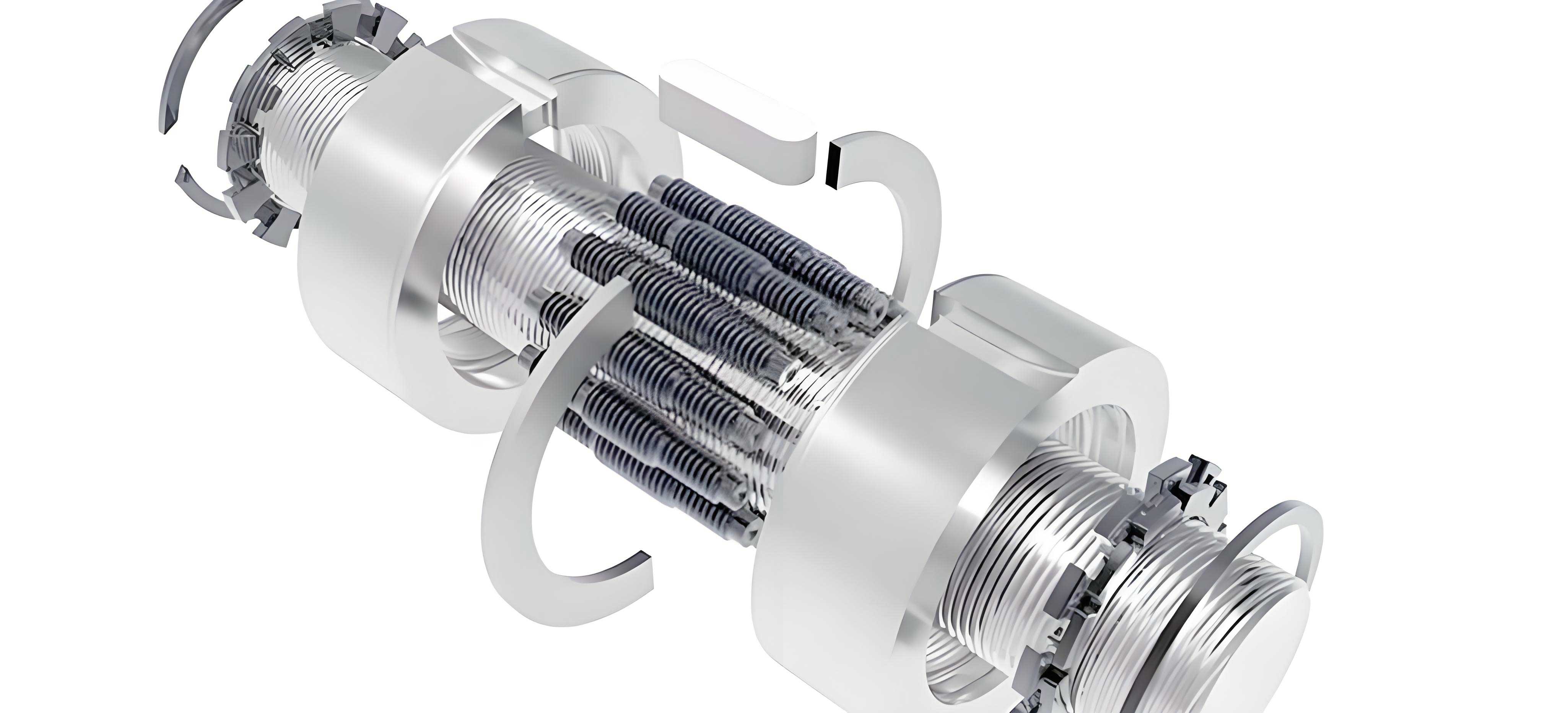
The planetary roller screw assembly operates through threaded meshing and gear engagement to convert linear motion into rotational motion, offering advantages such as high precision, large thrust, and compact design. Its thermal characteristics are intrinsically linked to its structural composition and operational principles. Typically, a standard planetary roller screw assembly consists of a screw, multiple rollers, a nut, a retainer, and an internal gear ring. The screw, often with multi-start threads, rotates about its axis, while the rollers, with single-start threads, engage with both the screw and the nut. The nut, also multi-threaded, translates linearly. The retainer ensures uniform distribution of rollers, and the internal gear ring meshes with the ends of the rollers to maintain parallelism and prevent skewing forces due to the helix angle. This multi-point contact configuration enhances load capacity but also contributes to frictional heat generation during operation.
Thermal characteristics in a planetary roller screw assembly arise primarily from internal friction and external environmental factors. Heat generated is partially dissipated through convection to the surrounding air and partially retained within the system, causing temperature rise. This thermal behavior triggers two critical issues: thermal expansion of components leading to deformation and positioning errors, and reduced lubrication efficacy accelerating wear. Both can compromise transmission accuracy and reliability, ultimately risking system failure. Understanding these mechanisms is essential for effective thermal management in planetary roller screw assemblies.
Thermal Source Analysis
Heat transfer in mechanical systems primarily occurs through conduction, convection, and radiation. For planetary roller screw assemblies, radiation is often negligible due to small surface temperature differences and low material emissivity. Thus, heat exchange is dominated by conduction and convection. The main heat sources in a planetary roller screw assembly include:
- Frictional Heat at Contact Interfaces: This encompasses friction between the screw-roller and nut-roller threaded teeth, pure rolling friction at roller ends and the retainer, and friction in supporting bearings (e.g., between rolling elements, inner/outer rings, and retainers).
- Motor Losses: When driven by servomotors, additional heat is generated from rotor eddy current losses, stator hysteresis and eddy current losses, copper losses in windings, and air friction losses due to high-speed rotation.
- Environmental Heat: External ambient conditions can also influence the thermal state of the planetary roller screw assembly.
The generated heat propagates through conduction to adjacent components, such as from bearing supports to the screw. Concurrently, convective heat transfer occurs between component surfaces (e.g., screw, nut, retainer) and the surrounding air, enhanced by forced convection due to screw rotation. The housing, being stationary, primarily experiences natural convection. Efficient thermal management in planetary roller screw assemblies requires quantifying these heat sources and their transmission paths.
Thermal Characteristic Analysis Methods
Research on thermal characteristics of planetary roller screw assemblies predominantly employs numerical simulations and experimental studies, grounded in heat transfer theory.
Numerical Simulation Approaches
With advancements in computational technology, numerical methods like the finite element method (FEM) and finite difference method (FDM) have become instrumental. For planetary roller screw assemblies, FEM is widely used to model temperature fields and thermal deformations.
Given the complexity of the planetary roller screw assembly, simplification is often necessary for FEM analysis. Non-engaged thread portions and minor features like fillets are removed, and due to near-axisymmetric structures, a sector model representing 1/N of the assembly (where N is the number of rollers) is typically analyzed. Boundary conditions, such as heat flux from friction, are derived from calculated friction torques. The model is then discretized, with refined meshes at contact regions, to perform steady-state, transient, or thermo-mechanical coupled analyses.
For instance, thermal boundary conditions can be applied to moving heat sources along the screw, enabling detailed simulation of transient temperature distribution and thermal deformation in both screw and nut. This approach aids in predicting performance under various operating conditions and optimizing design parameters for planetary roller screw assemblies.
Alternatively, the finite difference method, particularly through thermal network models, offers an efficient way to solve for temperature fields. The system is divided into temperature nodes connected by thermal resistances (conduction, contact, convection), forming a network. Solving the heat balance equations yields the temperature distribution. This method is effective for both steady-state and transient analyses, though node selection subjectivity may introduce prediction errors. Optimizing node placement and considering multiple configurations can enhance accuracy.
| Method | Description | Advantages | Limitations |
|---|---|---|---|
| Finite Element Method (FEM) | Uses discretized models to solve heat transfer equations; includes thermo-mechanical coupling. | Detailed local analysis; accommodates complex geometries. | Computationally intensive; requires model simplification. |
| Thermal Network Method | Represents system as nodes and resistances; solves heat balance equations. | Computationally efficient; suitable for system-level analysis. | Node selection subjectivity; may overlook detailed local effects. |
Key formulas in thermal analysis include heat generation from friction. For bearings in a planetary roller screw assembly, the heat generation rate \( Q_f \) is given by:
$$ Q_f = 1.047 \times 10^{-4} \cdot M_f \cdot n_f $$
where \( M_f \) is the bearing friction torque and \( n_f \) is the rotational speed. The total friction torque \( M_f \) comprises load-dependent and viscous components:
$$ M_f = M_1 + M_v $$
with \( M_1 = f_1 \cdot F_{\beta} \cdot d_m \) and \( M_v \) dependent on lubricant viscosity and speed. For the planetary roller screw assembly itself, heat generation \( H_{RN} \) from the screw-nut pair is:
$$ H_{RN} = \frac{M \cdot n_f}{9550} $$
where \( M \) is the total friction torque of the planetary roller screw assembly, accounting for contact sliding, roller spin, retainer friction, viscous effects, and preload. Motor heat generation \( H \) is derived from power losses:
$$ H = \frac{T_M \cdot n}{9550} (1 – \eta_1) $$
with \( T_M \) as output torque, \( n \) as speed, and \( \eta_1 \) as mechanical efficiency.
Experimental Research Methods
Experimental studies complement simulations by providing real-time temperature data under various operating conditions. Sensors, such as thermocouples or infrared thermal imagers, measure temperature fields on components like the screw, nut, and housing. Tests often vary parameters like axial load, screw speed, lubricant type, and cooling conditions (e.g., forced air or liquid cooling).
For example, thermal imaging of a planetary roller screw assembly after sustained loading can reveal temperature rises exceeding 100°C, highlighting critical hotspots. Experimental setups may include integrated performance test benches that monitor temperature, vibration, speed, and load simultaneously, enabling analysis of degradation patterns and thermal error compensation.
However, experiments are limited by spatial and temporal data points, making full-field characterization challenging. Thus, combining experimental validation with numerical models ensures comprehensive insights into the thermal behavior of planetary roller screw assemblies.
Temperature Rise and Thermo-Mechanical Coupling Analysis
Temperature rise in planetary roller screw assemblies is inevitable during operation, leading to non-uniform thermal expansion and subsequent thermo-mechanical coupling. This coupling involves interactions between thermal loads (from heat generation) and structural loads (e.g., axial forces), affecting stress distribution and deformation.
Thermo-mechanical analysis typically uses a one-way coupling approach: temperature fields from thermal analysis are imported as thermal loads into structural models to compute deformations. The governing equation for thermal deformation in a component, such as the screw, is:
$$ \Delta L = \alpha \cdot \Delta T \cdot L $$
where \( \alpha \) is the coefficient of thermal expansion, \( \Delta T \) is the temperature change, and \( L \) is the effective length. For a planetary roller screw assembly, this deformation can alter thread clearances, contact positions, and load distribution among rollers.
Finite element-based coupled models have been developed to simulate these effects. Studies show that temperature variations significantly influence load distribution, with increases in maximum load under higher temperatures. Moreover, considering dynamic thermal environments, lubrication states, and installation methods in coupling models can provide more accurate predictions for planetary roller screw assemblies operating under extreme conditions.
Research on thermo-mechanical coupling in planetary roller screw assemblies is still evolving. Most studies assume isotropic materials and ambient temperatures, neglecting extreme environments or anisotropic thermal properties. Future models should incorporate multi-physics couplings, such as fluid-structure interaction for lubricant effects, to better capture real-world behavior.
Thermal Deformation
Thermal deformation directly impacts the precision and longevity of planetary roller screw assemblies. As temperatures rise, components expand differentially due to material properties and geometry. The screw, being a slender shaft, is particularly susceptible, with elongation calculated as above. This elongation can cause misalignment, increased backlash, and altered preload, degrading transmission accuracy.
In addition to axial expansion, radial thermal gradients may develop, especially in large-diameter screws, leading to bending or warping. The nut and rollers also deform, affecting thread engagement and contact stresses. Comprehensive deformation analysis requires considering all components and their interactions within the planetary roller screw assembly.
Mitigating thermal deformation involves design optimizations, such as using materials with low thermal expansion coefficients, incorporating cooling systems, or applying thermal compensation techniques. For instance, hollow screws with internal cooling channels can reduce temperature rise and subsequent deformation in planetary roller screw assemblies.
Thermal Error and Optimization Methods
Thermal error, resulting from thermally induced deformations, is a major contributor to inaccuracy in precision systems, accounting for 40–70% of total errors in machining applications. For planetary roller screw assemblies, thermal error manifests as positional deviations in the nut travel, affecting positioning repeatability and system performance.
Thermal error management strategies fall into two categories: error prevention and error compensation. Prevention focuses on design and cooling to minimize heat generation or enhance dissipation. Compensation involves modeling thermal errors and actively correcting them via control systems.
Error compensation typically follows a workflow: data acquisition (temperature and error measurements), model development (e.g., using neural networks or regression algorithms), and real-time correction through CNC systems. Models like RBF neural networks or hybrid approaches have been applied to ball screw systems and can be adapted for planetary roller screw assemblies.
Optimization of thermal error in planetary roller screw assemblies is an area with limited research. Drawing from gear and ball screw studies, potential methods include:
- Structural Optimization: Modifying thread profiles, improving cooling designs (e.g., liquid cooling jackets), or selecting advanced lubricants to reduce friction and heat.
- Control Algorithms: Implementing adaptive compensation models that update based on real-time sensor data.
- Multi-Objective Optimization: Using genetic algorithms or particle swarm optimization to balance thermal performance with other design constraints.
For example, orthogonal experiments can optimize coating materials or cooling parameters to minimize thermal deformation in planetary roller screw assemblies. Integrating thermal error models with machine learning techniques, such as PSO-LSTM, may enhance prediction accuracy and compensation effectiveness.
| Technique | Application | Potential Benefit for Planetary Roller Screw Assembly |
|---|---|---|
| Finite Element Analysis with Optimization | Design parameter tuning for minimal thermal deformation | Optimized thread geometry and cooling channel layout |
| Thermal Network Model Calibration | Real-time temperature prediction and error estimation | Improved accuracy in transient thermal response |
| Hybrid Neural Network Models | Thermal error forecasting based on multi-sensor data | Enhanced compensation in varying operating conditions |
| Material and Coating Selection | Reducing friction and heat generation at contacts | Lower temperature rise and extended service life |
Formulas relevant to optimization include the wear prediction model, which can be integrated with thermal effects. For instance, the Archard wear model modified for thermal conditions:
$$ W = k \cdot \frac{F \cdot s}{H} \cdot f(T) $$
where \( W \) is wear volume, \( k \) is wear coefficient, \( F \) is load, \( s \) is sliding distance, \( H \) is hardness, and \( f(T) \) is a temperature-dependent function. Incorporating such models helps in predicting long-term performance degradation of planetary roller screw assemblies under thermal cycles.
Conclusions and Future Perspectives
The thermal characteristics of planetary roller screw assemblies are critical to their performance, especially in high-speed and heavy-duty applications. This review has outlined the mechanisms, analysis methods, and current research trends regarding temperature rise, thermo-mechanical coupling, deformation, and error optimization. Key insights include the importance of accurate thermal modeling through FEM or thermal networks, the need for experimental validation, and the potential of error compensation strategies.
Looking ahead, several directions warrant further investigation for planetary roller screw assemblies:
- Advanced Coupled Modeling: Developing comprehensive models that integrate extreme temperatures, dynamic thermal environments, lubrication effects, and multi-physics couplings (e.g., fluid-structure interaction) to better predict thermal behavior and load distribution.
- Realistic Simulation Enhancements: Creating finite element models that closely mimic actual operating conditions, including detailed thread geometries and transient heat sources, to reduce discrepancies between simulation and reality.
- Innovative Cooling and Design: Exploring novel cooling techniques (e.g., phase-change materials) and structural modifications (e.g., optimized thread shapes) to mitigate heat generation and deformation in planetary roller screw assemblies.
- Thermal Error Compensation: Adapting advanced machine learning algorithms for real-time error prediction and compensation, leveraging data from integrated sensor systems.
- Material and Lubricant Research: Investigating new materials with tailored thermal properties and high-performance lubricants to enhance thermal stability and reduce friction in planetary roller screw assemblies.
By addressing these areas, future research can significantly improve the thermal management, accuracy, and reliability of planetary roller screw assemblies, enabling their broader adoption in precision engineering fields. The continuous evolution of analysis tools and experimental methodologies will undoubtedly contribute to a deeper understanding and better control of thermal characteristics in these sophisticated mechanical systems.