
In the evolving landscape of mechanical engineering, the transition from soft to hardened tooth gear transmissions represents a significant leap in performance, durability, and precision. Hardened spur and pinion gear systems form the backbone of modern, high-demand machinery, enabling more compact designs, higher load capacities, and greater operational reliability. Their role is foundational in the trend towards larger-scale and more intelligent industrial equipment. This article presents a detailed, first-person exploration into the strength verification of a hardened involute spur gear pair, contrasting traditional analytical methods with advanced computational techniques. The primary focus is on a standard case-hardened, closed spur gear transmission. The initial design parameters are a nominal power of P = 20 kW, a pinion speed of n1 = 1000 rpm, a transmission ratio of i = 3.4, and an expected service life of 10 years with 250 working days annually. The drive is from an electric motor under steady load conditions, with non-reversing operation and symmetrical bearing support for the gears.
1. Traditional Theoretical Design and Calculation
The design methodology for a hardened spur and pinion gear set must account for its distinct failure modes. For gears with high surface hardness, the primary risk is often tooth breakage due to bending fatigue at the root, rather than surface pitting. Therefore, the established design protocol is to first size the gear based on bending strength and subsequently verify the sufficiency of the contact (pitting) strength.
1.1 Bending Fatigue Strength Design
The fundamental formula for designing the module based on root bending fatigue at the pinion is:
$$ m \ge \sqrt[3]{\frac{2 K T_1}{\phi_d z_1^2} \cdot Y_\epsilon \cdot \frac{Y_{Fa} Y_{Sa}}{[\sigma_F]}} $$
Where:
- \( m \): Module (mm)
- \( K \): Load factor (initially assumed as 1.8)
- \( T_1 \): Pinion torque (N·mm). Calculated as \( T_1 = 9.55 \times 10^6 \times \frac{P}{n_1} = 9.55 \times 10^6 \times \frac{20}{1000} = 191,000 \) N·mm.
- \( \phi_d \): Face width coefficient, taken as 0.8.
- \( z_1 \): Number of teeth on the pinion, selected as 20.
- \( Y_\epsilon \): Contact ratio factor for bending, taken as 0.7.
- \( Y_{Fa1} \): Form factor for the pinion (based on tooth geometry), taken as 2.8.
- \( Y_{Sa1} \): Stress correction factor for the pinion, taken as 1.56.
- \( [\sigma_F]_1 \): Allowable bending stress for the pinion material (40Cr, hardened), calculated as 392.31 MPa based on material endurance limits and safety factors.
Substituting these values into the design equation yields the minimum required module:
$$ m_t \ge \sqrt[3]{\frac{2 \times 1.8 \times 191000}{0.8 \times 20^2} \times 0.7 \times \frac{2.8 \times 1.56}{392.31}} \approx 2.56 \text{ mm} $$
Based on this calculation, the standard module \( m = 3 \) mm is selected. This defines the fundamental size scale of the spur and pinion gear set.
1.2 Contact Fatigue Strength Verification
With the module and pinion teeth defined, the pitch diameter of the pinion is \( d_1 = m z_1 = 3 \times 20 = 60 \) mm. The face width is \( b = \phi_d \cdot d_1 = 0.8 \times 60 = 48 \) mm. The gear teeth count is \( z_2 = i \cdot z_1 = 3.4 \times 20 = 68 \).
The contact stress is verified using the Hertzian contact formula:
$$ \sigma_H = Z_E Z_H Z_\epsilon \sqrt{ \frac{2 K T_1}{b d_1^2} \cdot \frac{u+1}{u} } \le [\sigma_H] $$
Where:
- \( Z_E \): Elasticity coefficient (189.8 \(\sqrt{\text{MPa}}\) for steel-steel contact).
- \( Z_H \): Zone factor (2.5 for standard pressure angle of 20°).
- \( Z_\epsilon \): Contact ratio factor for contact stress, taken as 0.88.
- \( K \): Refined load factor, recalculated to 1.76 based on known dimensions.
- \( u \): Gear ratio \( i = 3.4 \).
- \( [\sigma_H]_1 \): Allowable contact stress for the pinion, calculated as 979 MPa.
The verification calculation is performed:
$$ \sigma_H = 189.8 \times 2.5 \times 0.88 \times \sqrt{ \frac{2 \times 1.76 \times 191000}{48 \times 60^2} \times \frac{3.4+1}{3.4} } \approx 958.0 \text{ MPa} $$
Since \( \sigma_H (958.0 \text{ MPa}) \le [\sigma_H]_1 (979 \text{ MPa}) \), the contact strength is deemed sufficient according to the traditional theory. The complete dimensions of the designed hardened spur and pinion gear pair are summarized below.
| Parameter & Symbol | Pinion (Driver) | Gear (Driven) |
|---|---|---|
| Module, \( m \) | 3 mm | |
| Number of Teeth, \( z \) | 20 | 68 |
| Pressure Angle, \( \alpha \) | 20° | |
| Pitch Diameter, \( d \) | 60 mm | 204 mm |
| Base Diameter, \( d_b \) | 56.382 mm | 191.697 mm |
| Addendum Diameter, \( d_a \) | 66 mm | 210 mm |
| Dedendum Diameter, \( d_f \) | 52.5 mm | 196.5 mm |
| Circular Pitch, \( p \) | 9.425 mm | |
| Tooth Thickness, \( s \) | 4.712 mm | |
| Center Distance, \( a \) | 132 mm | |
| Face Width, \( B \) | 48 mm | 43 mm |
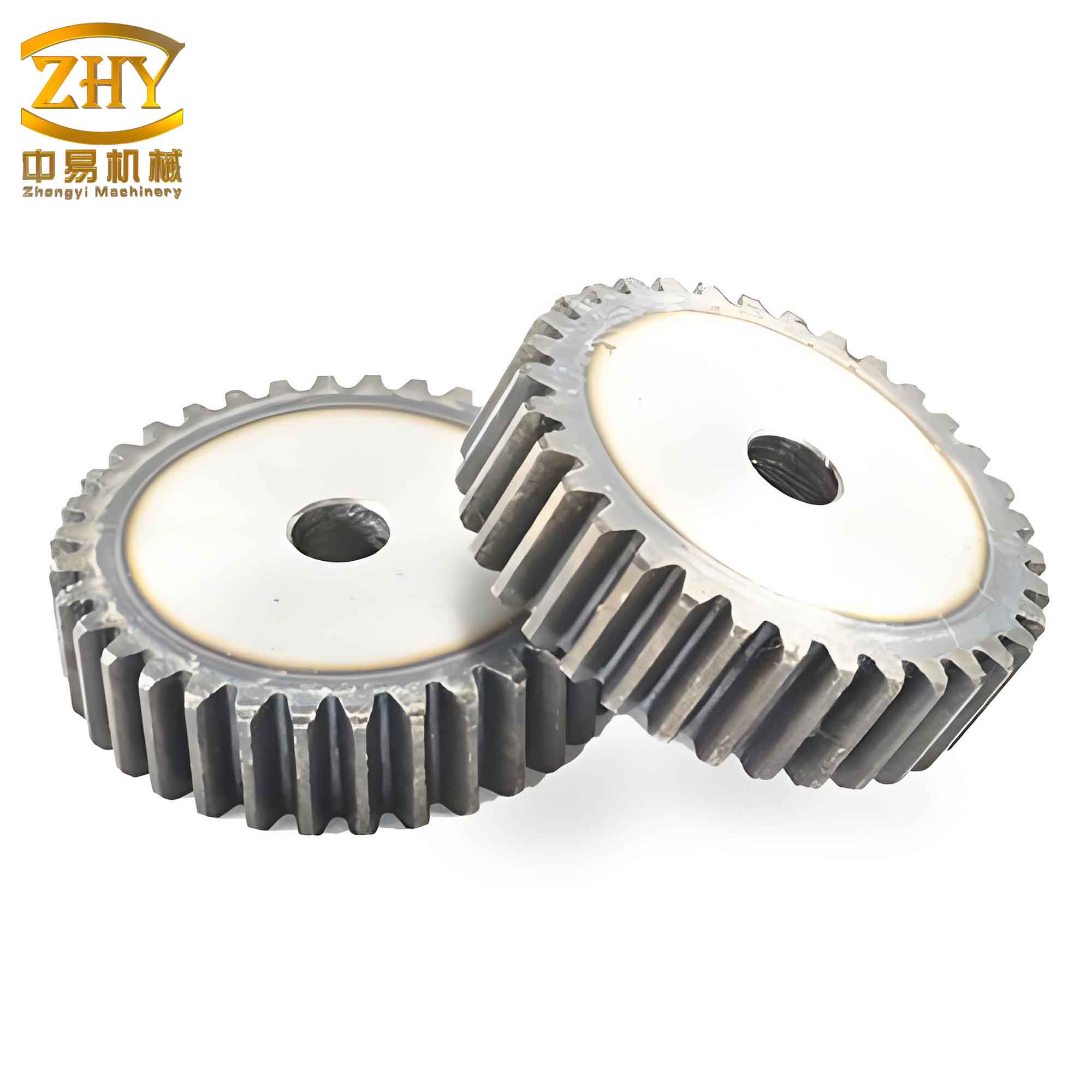
2. Three-Dimensional Modeling of the Involute Spur and Pinion Gear Pair
To facilitate a detailed finite element analysis (FEA), an accurate three-dimensional digital model of the spur and pinion gear transmission is essential. SolidWorks, a leading CAD software, was employed for this task due to its robust modeling capabilities and seamless interoperability with analysis tools.
The modeling process began with the generation of the precise involute tooth profile. Using the base circle diameter \( d_b \), a true involute curve was sketched on the front plane for a single tooth space of the pinion. This profile was then mirrored and trimmed to form the boundaries for one complete tooth. This tooth geometry, representing the core of the spur gear design, was then extruded to the specified face width. Finally, the circular pattern feature was used to replicate this tooth around the pinion’s circumference, creating the full pinion model. An identical process, using the gear’s parameters, was followed to model the driven gear.
The two components were then assembled in SolidWorks’ assembly environment. The gears were mated concentrically and positioned so that their theoretical pitch circles were tangent, ensuring correct center distance. The rotational orientation was adjusted to simulate a single-point contact start position for a subsequent static analysis. The assembly’s “Interference Check” tool confirmed no geometric overlaps, validating the model for export and finite element analysis.
3. Finite Element Analysis of the Hardened Spur and Pinion Gear Set
The assembled 3D model was exported and imported into Abaqus/CAE, a powerful commercial finite element analysis software, for a detailed static structural analysis. The goal was to obtain high-fidelity stress distributions, particularly the contact stress at the meshing interface and the bending stress at the tooth root, and to compare these with the theoretically calculated values.
3.1 Model Setup and Material Properties
A Cartesian coordinate system was established with its origin at the center of the pinion. The X-axis pointed radially from the pinion towards the gear, the Y-axis pointed vertically upwards, and the Z-axis followed the right-hand rule, defining the pinion’s positive rotation direction as counter-clockwise. Both the pinion and gear were assigned the properties of hardened 40Cr steel: a density of 7850 kg/m³, a Young’s Modulus \( E = 2.06 \times 10^5 \) MPa, and a Poisson’s ratio \( \nu = 0.3 \).
3.2 Contact Definition and Mesh Generation
A critical step in simulating gear meshing is defining the contact interaction. A general contact algorithm with a surface-to-surface discretization was used. The contact property defined a “hard” normal contact behavior (preventing penetration) and a tangential behavior with a friction coefficient of 0.1. The pinion tooth flanks were designated as the master surface, and the corresponding gear tooth flanks as the slave surface.
Mesh generation significantly impacts both accuracy and computational cost. The C3D8R element (an 8-node linear brick element with reduced integration and hourglass control) was selected for its efficiency in contact problems. A strategic meshing approach was adopted: the regions around the tooth flanks and roots, where high stress gradients are expected, were seeded with a fine mesh. The gear bodies and hubs were meshed more coarsely. This hybrid approach ensures result accuracy in critical areas while maintaining reasonable solve times. The pinion’s active teeth had a local seed size of 2.4, its body 4.0; the gear’s teeth had a seed size of 3.0, and its body 4.0.
3.3 Boundary Conditions, Loads, and Analysis
To simulate a static torque load, a reference point (RP-1) was created at the center of the pinion and coupled kinematically to its inner bore surface, effectively treating the pinion as a rigid body for load application. All translational degrees of freedom (U1, U2, U3) and two rotational ones (UR1, UR2) of RP-1 were constrained. Only rotation about the Z-axis (UR3) was permitted. The gear’s inner bore was fully constrained in all six degrees of freedom (U1=U2=U3=UR1=UR2=UR3=0), simulating a fixed, reactionary state.
A pure moment (torque) was applied to RP-1 on the pinion. The magnitude was the nominal torque \( T_1 = 191,000 \) N·mm. This represents the input driving load on the spur and pinion gear system. A static general step was created, and the analysis job was submitted for solution.
3.4 Finite Element Analysis Results
The post-processing phase in Abaqus revealed detailed stress contours not available through analytical methods.
Contact Stress (Pitting Resistance): The contour plot of contact pressure (CPRESS) showed the elliptical contact patch characteristic of Hertzian contact. The maximum contact stress value extracted from the FEA was approximately 634.9 MPa. This stress concentration was located near the pitch line and lower flank of the pinion tooth, which is a typical high-stress region during single-tooth-pair contact.
Bending Stress (Tooth Strength): The von Mises equivalent stress contour plot was used to evaluate root bending stress. The maximum value was found to be approximately 342.7 MPa, located at the root fillet of the pinion tooth on the loaded side. This is the critical location for bending fatigue crack initiation in a spur and pinion gear system.
| Stress Type | Theoretical Calculated Value | FEA Result (Maximum) | Allowable Stress | Comment |
|---|---|---|---|---|
| Contact Stress, \( \sigma_H \) | 958.0 MPa | ~634.9 MPa | 979 MPa | FEA result is significantly lower. |
| Bending Stress, \( \sigma_F \) | Designed to ~392 MPa | ~342.7 MPa | 392 MPa | FEA result is close to, but under, the allowable limit. |
4. Discussion and Proposed Optimization Philosophy
The comparison between the traditional design calculations and the finite element analysis yields insightful and critical observations regarding the design of hardened spur and pinion gear transmissions.
The most striking discrepancy lies in the contact stress. The theoretical Hertz formula predicted a stress of 958.0 MPa, very close to the allowable 979 MPa, suggesting a design with minimal contact safety margin. However, the FEA returned a maximum contact stress of only 634.9 MPa, indicating a substantial and perhaps excessive reserve in pitting resistance for this specific spur and pinion gear configuration under the analyzed load case.
Conversely, for bending stress, the situation is different. The design was sized to operate near the allowable bending stress limit (~392 MPa). The FEA result of 342.7 MPa, while under the limit, is in a much closer numerical proximity to the failure threshold than the contact stress is to its threshold. This highlights that the bending strength is the governing and limiting factor in this design, with a relatively smaller safety margin.
This outcome aligns perfectly with the documented failure modes of hardened spur and pinion gears. Their high surface hardness effectively resists pitting, but the core toughness may not proportionally increase, making tooth bending fracture the predominant failure mechanism. The traditional “design for bending, check for contact” methodology is validated in its sequence. However, the results reveal an inefficiency: the design is overly conservative in contact strength while being critically balanced in bending strength. For a truly optimal hardened spur and pinion gear transmission, both failure modes should have comparably balanced safety factors, maximizing material utilization and minimizing size and weight.
Therefore, this analysis proposes a refined optimization philosophy: For hardened spur and pinion gear sets, the design process should aim for a balanced load-capacity utilization between bending and contact fatigue. Instead of simply satisfying the contact check after a bending-driven design, an iterative or system-based approach should be used to adjust parameters (such as profile shift coefficients, face width, or material grade selection) to bring the calculated safety factors for bending \( (S_F = [\sigma_F] / \sigma_F) \) and pitting \( (S_H = ([\sigma_H] / \sigma_H)^2) \) closer together. The objective function could be to minimize the difference \( |S_F – S_H| \) or to maximize a weighted combination of both, subject to geometric and manufacturing constraints.
This can be framed as a design optimization problem:
$$ \text{Minimize: } f(\mathbf{x}) = | S_F(\mathbf{x}) – S_H(\mathbf{x}) | $$
$$ \text{Subject to: } S_F(\mathbf{x}) \ge S_{F,min}, \quad S_H(\mathbf{x}) \ge S_{H,min}, \quad g_j(\mathbf{x}) \le 0 $$
where \( \mathbf{x} \) is the vector of design variables (e.g., module, tooth count, profile shift, face width), and \( g_j(\mathbf{x}) \) represent other constraints like minimum tooth tip thickness, no undercutting, or space limitations. Advanced FEA, as demonstrated, serves as the crucial tool for validating and refining the stress predictions from analytical formulas during this optimization cycle, especially for complex geometries or load cases.
5. Conclusion
This work successfully conducted a comprehensive strength analysis of a hardened involute spur and pinion gear transmission. The process began with a complete traditional theoretical design according to established gear standards, which sized the gear set based on bending fatigue and verified its contact fatigue resistance. A precise three-dimensional model of this spur and pinion gear pair was then created and subjected to a static finite element analysis using Abaqus software.
The FEA provided detailed visualizations and quantitative data for both contact and bending stress states, which were compared against the analytical results. The key finding was the confirmation of the design paradigm for hardened gears: bending strength is the dominant design driver. More importantly, the significant disparity between the theoretical and FEA contact stress results, coupled with the close proximity of the bending stress to its allowable limit, exposed a potential imbalance in the design’s utilization of material capacity.
This imbalance forms the basis for a proposed optimization direction. Future design work on hardened spur and pinion gear systems should strive for a more equitable distribution of safety factors against bending and pitting failures. By employing iterative computational techniques that integrate refined analytical models with finite element verification, engineers can develop stronger, lighter, and more efficient spur and pinion gear transmissions that fully leverage the advantages of hardened gear technology. This approach ensures that every component of the gear system contributes optimally to the overall performance and reliability of the mechanical drive.