
My research focuses on the meshing characteristics of spiral gears, also known as crossed helical gears. These gears are fundamental for transmitting motion and power between non-parallel, non-intersecting (skew) axes in three-dimensional space. The unique advantage of spiral gears lies in their ability to accommodate virtually any shaft angle with relative manufacturing simplicity and cost-effectiveness compared to other spatial gear types like hypoid or worm gears. However, they are traditionally considered suitable only for low-speed, light-load applications due to their inherent point contact and significant sliding velocities, leading to concerns about wear and load capacity. This perception, I believe, stems from insufficient and non-systematic research. My work aims to challenge this notion through rigorous theoretical modeling, comprehensive parametric analysis, computer-aided simulation, and experimental validation, ultimately providing a foundation for improving their design and expanding their application.
The core of my investigation involves three common configurations of spiral gear pairs: pairs with helical gears of the same hand (e.g., both right-handed), pairs with helical gears of opposite hands, and pairs consisting of one spur gear and one helical gear. For each configuration, I developed a dedicated mathematical model for Tooth Contact Analysis (TCA).
The modeling philosophy was to directly formulate the tooth surface equations and then assemble the gear pair within appropriately defined coordinate systems. A right-handed Cartesian coordinate system was established for each gear and for the fixed space. The tooth surface of a helical gear, an involute helicoid, can be generated by a straight line performing a screw motion. In the coordinate system attached to gear i, its surface Σ(i) can be represented using the circular vector function e(θ) and the axial vector k.
For a right-handed helical gear, the surface equation is:
$$ \mathbf{r}^{(1)}(u_1, \theta_1) = \mathbf{e}(\theta_1) \cdot r_{b1} (\cos \xi_1 + \xi_1 \sin \xi_1) + \mathbf{\bar{e}}(\theta_1) \cdot r_{b1} (\sin \xi_1 – \xi_1 \cos \xi_1) + \mathbf{k} \cdot p_1 \xi_1 $$
where $u_1$ is the surface parameter (related to the helix), $\theta_1$ is the angular parameter, $r_{b1}$ is the base radius, $p_1$ is the helix parameter ($p_1 = r_{b1} \tan \beta_{b1}$), and $\xi_1 = u_1 / r_{b1} + \theta_1$.
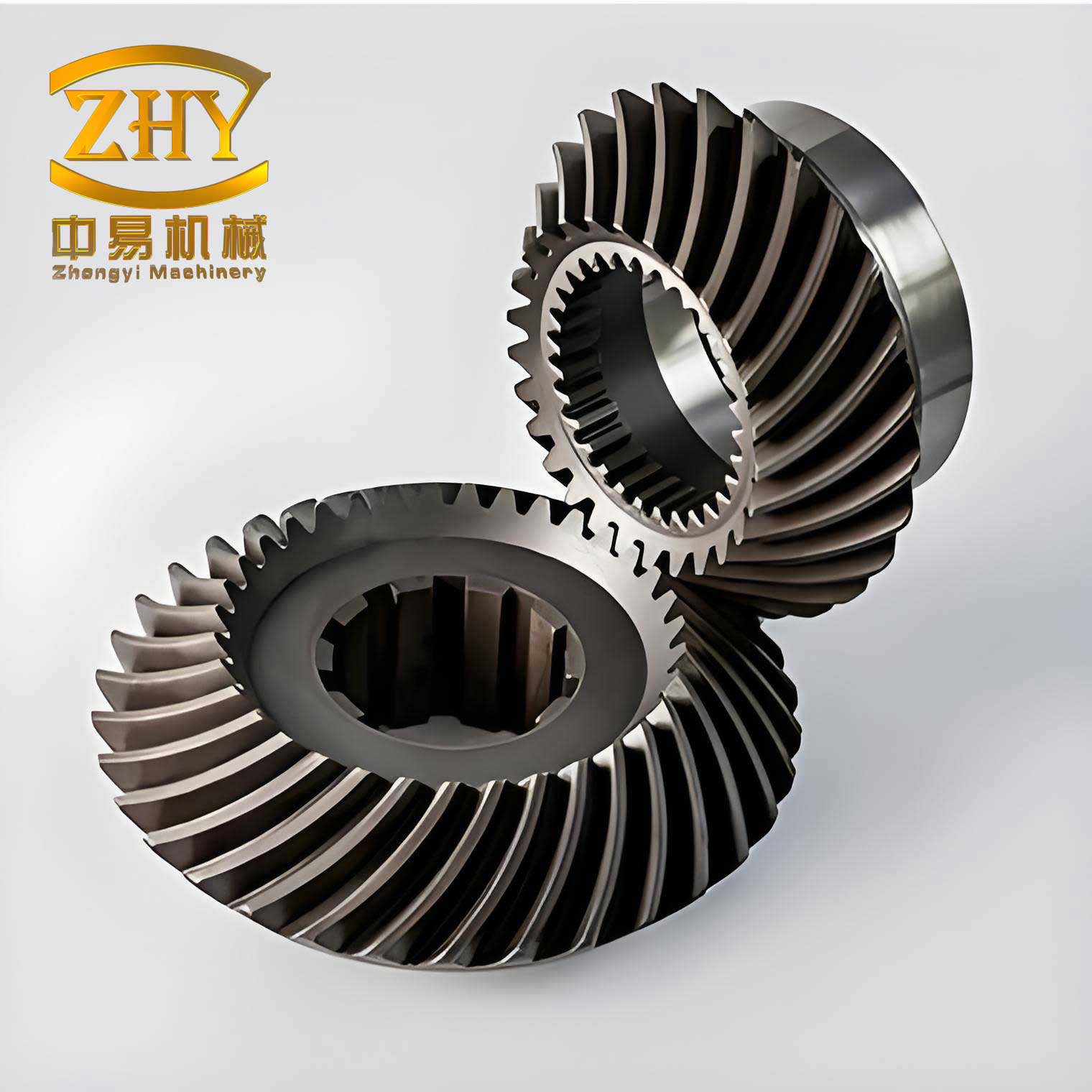
Using transformation matrices derived from the shaft angle Σ and the rotational parameters $\phi_1$ and $\phi_2$, the equations for both gear surfaces are expressed in the fixed coordinate system. The unit normal vectors $\mathbf{n}^{(1)}$ and $\mathbf{n}^{(2)}$ are derived through differential geometry. The condition for contact at a point is the coincidence of position vectors and the collinearity (with consideration for direction) of the unit normals:
$$ \mathbf{r}_f^{(1)}(u_1, \theta_1, \phi_1) = \mathbf{r}_f^{(2)}(u_2, \theta_2, \phi_2) $$
$$ \mathbf{n}_f^{(1)}(u_1, \theta_1, \phi_1) = \pm \mathbf{n}_f^{(2)}(u_2, \theta_2, \phi_2) $$
This yields a system of six scalar equations. By exploiting the properties of the involute helicoid, I was able to solve this system analytically instead of iteratively. Given a surface parameter for the first gear, the corresponding parameters for the second gear and the rotation angles are determined explicitly, precisely defining a contact point.
The relative velocity $\mathbf{v}^{(12)}$ at the contact point, crucial for analyzing wear and lubrication, is calculated from the kinematics:
$$ \mathbf{v}^{(12)} = \mathbf{v}_f^{(1)} – \mathbf{v}_f^{(2)} = \boldsymbol{\omega}^{(12)} \times \mathbf{r}_f^{(1)} – (\boldsymbol{\omega}^{(1)} \times \mathbf{a}) $$
where $\boldsymbol{\omega}^{(12)} = \boldsymbol{\omega}^{(1)} – \boldsymbol{\omega}^{(2)}$ is the relative angular velocity and $\mathbf{a}$ is the center distance vector.
A key outcome of TCA is the contact ellipse, representing the instantaneous area of contact under load. Its size and orientation depend on the relative curvature of the surfaces. I calculated the principal curvatures and directions for each surface. The relative principal curvatures $k_{\mathrm{I}}^{(12)}$ and $k_{\mathrm{II}}^{(12)}$ between the two surfaces are found using the Euler-Savary and Bertrand formulas for normal curvature and geodesic torsion along arbitrary directions. The major semi-axis $a$ of the contact ellipse is given by:
$$ a = \sqrt{ \frac{w}{|\Delta k_{\mathrm{max}}|} } $$
where $w$ is a constant related to the approach under load, and $\Delta k_{\mathrm{max}}$ is the larger absolute value of the two relative principal curvatures. The orientation of the contact ellipse is given by the corresponding relative principal direction.
I implemented these models in C programming language. The program calculates the path of contact on the tooth flank (contact trace), the instantaneous contact ellipse parameters (length, orientation) for points along this trace, and the relative velocity vector. From these results, I generated two primary graphical outputs: the bearing pattern (showing the superposition of contact ellipses across the tooth flank) and the relative velocity map (showing the magnitude and direction of sliding across the flank). These graphics became the primary tools for my parametric study.
I systematically investigated the influence of basic design parameters on the meshing performance of spiral gears. The key parameters are: shaft angle Σ, helix angles β₁ and β₂ (where Σ = |β₁ ± β₂| depending on hand combination), number of teeth z₁ and z₂, module mn, normal pressure angle αn, and face width. The effects are summarized below.
| Parameter | Effect on Contact Ellipse (Bearing Pattern) | Effect on Relative Sliding Velocity |
|---|---|---|
| Helix Angles (β₁, β₂) | Primarily affect the inclination of the contact trace. A larger pinion helix angle β₁ makes the trace more oblique, improving overlap ratio. In large-Σ designs, it also affects ellipse size and orientation. | For small Σ, distribution has minor effect on magnitude but changes direction. For large Σ, it significantly affects both magnitude and direction. |
| Pinion Tooth Number (z₁) | Increasing z₁ increases the length of the contact ellipse major axis, effectively enlarging the contact area. | Increases the magnitude of sliding velocity. |
| Shaft Angle (Σ) | Larger Σ leads to a more oblique contact trace but shortens the contact ellipse major axis, reducing the potential contact area. | Larger Σ generally results in significantly higher sliding velocity magnitudes. |
| Gear Ratio (i₁₂) | Larger ratio leads to a longer contact ellipse major axis, favoring a larger contact area. | Has minimal effect on both magnitude and direction of sliding velocity. |
| Normal Pressure Angle (αn) | A smaller αn results in a longer contact ellipse and a less steep contact trace. | Has negligible effect on sliding velocity. |
| Normal Module (mn) | Increases ellipse size proportionally, but as tooth height also increases, the relative coverage of the tooth flank remains similar. | Increases the magnitude of sliding velocity proportionally, but does not alter its direction field. |
Based on this analysis, I derived guidelines for selecting spiral gear parameters to optimize performance:
- For Small Shaft Angles (Σ from a few degrees to ~40°):
- For Σ < ~15°: Use a spur-pinion/helical-gear combination. The contact pattern is a straight line across the face, the contact ellipse is relatively long, sliding is moderate, and the bearing pattern is very insensitive to alignment errors. Axial force exists only on the helical gear.
- For 15° < Σ < 40°: Use helical gears of opposite hands. This yields a long contact ellipse, an oblique contact trace for good overlap, and relatively low sliding velocities. The axial forces oppose each other to some degree.
- For Large Shaft Angles (Σ > 40° up to 90°): Use helical gears of the same hand. To counteract the natural tendency for a small contact ellipse and high sliding, assign a larger helix angle to the pinion (β₁ > β₂ if possible). If manufacturing simplicity is paramount, set β₁ = β₂ = Σ/2. For the common case of Σ = 90°, this equal assignment is typical. To further improve the bearing pattern, increasing z₁ or reducing αn can be effective, albeit with trade-offs in size or strength.
My study also showed that spiral gears are generally insensitive to center distance errors. Sensitivity to shaft angle error is more pronounced in small-Σ designs, especially for same-hand helical pairs, where the contact zone shifts significantly along the face width. The spur/helical combination exhibits the least sensitivity.
To visualize the theory, I performed 3D computer simulations. Using the derived surface equations and a calculated contact point, I rendered the two tooth surfaces of a spiral gear pair in space using OpenGL. The rendering clearly shows the surfaces coming into point contact, and a local zoom reveals an elliptical region of near-contact, representing the instantaneous contact ellipse. Furthermore, I plotted the 3D vector field of the relative velocity along the path of contact, providing an intuitive spatial understanding of the sliding motion.
I also derived the equations for the normal section of the tooth surfaces at the contact point. By plotting these normal section curves, I could visually demonstrate their tangency at the contact point, offering another perspective on the contact conditions. The shape and curvature of these curves near the contact point correlate with the size of the contact ellipse; flatter curves indicate better contact conditions.
Theoretical findings require experimental validation. I designed and commissioned a test rig consisting of a motor, a speed reducer, and a magnetic powder brake for loading. Three shaft angles (15°, 45°, 90°) were tested, covering both small and large angles. The test gears were manufactured with parameters from my study (mn=4 mm, etc.).
The experimental procedure involved running-in the gear pairs under light load, applying a marking compound (prussian blue) to the teeth, and then running the gears to generate a visible bearing pattern. This pattern was transferred to paper via tape (a “smear print”). The table below compares a subset of the theoretical bearing patterns with the experimental smear prints.
| Configuration (Σ, β₁, β₂) | Theoretical Bearing Pattern | Experimental Smear Print |
|---|---|---|
| Σ=15°, Spur (β₁=0°), Helical (β₂=15°) | A straight, face-wide contact trace near the center of the tooth height. | The print shows a clear, straight, face-wide marking band, closely matching the predicted location and shape. |
| Σ=45°, Helical (β₁=30°), Helical (β₂=15°), Opposite Hands | An obliquely oriented, elongated contact zone. | The print shows an oblique marking pattern, confirming the predicted inclination and extent. |
| Σ=90°, Helical (β₁=45°), Helical (β₂=45°), Same Hand | A highly oblique, relatively compact contact zone. | The print shows a distinct oblique band, validating the model for the large shaft angle case. |
The strong correlation between the theoretical and experimental contact patterns confirms the accuracy of my mathematical models and the validity of the TCA methodology. The experiments also qualitatively confirmed the insensitivity to center distance errors and the shifting of the pattern with shaft angle error.
In conclusion, my research on spiral gears provides substantial new insights and practical tools:
- Refuted the Low-Capability Misconception: I demonstrated that with proper design—especially for small shaft angles using spur/helical or opposite-hand helical configurations—spiral gears can achieve favorable bearing patterns, low sliding, and good error sensitivity, making them suitable for transmitting significant power, not just motion.
- Developed a Practical TCA Method: I established a straightforward modeling approach based on direct surface equations and coordinate assembly, bypassing complex tool-centric generation theory. This method is applicable to any gear pair where surfaces can be explicitly written.
- Provided Design Guidelines: Through systematic parametric study, I established clear rules for selecting helix angles, pressure angle, and tooth numbers to optimize contact performance for any given shaft angle and ratio.
- Validated Theory with Experiment: The close match between computer-generated bearing patterns and physical test results provides strong evidence for the correctness of the entire analytical framework.
For future work, I recommend integrating tooth modification (e.g., tip and root relief, crowning) into the model to further optimize load distribution and stress. A detailed study on friction, wear, and elastohydrodynamic lubrication specific to the contact conditions in spiral gears would be invaluable for predicting life and refining material selection. Finally, investigating the dynamic behavior and noise characteristics of optimally designed spiral gear pairs would be a logical next step toward their broader adoption in precision machinery.