
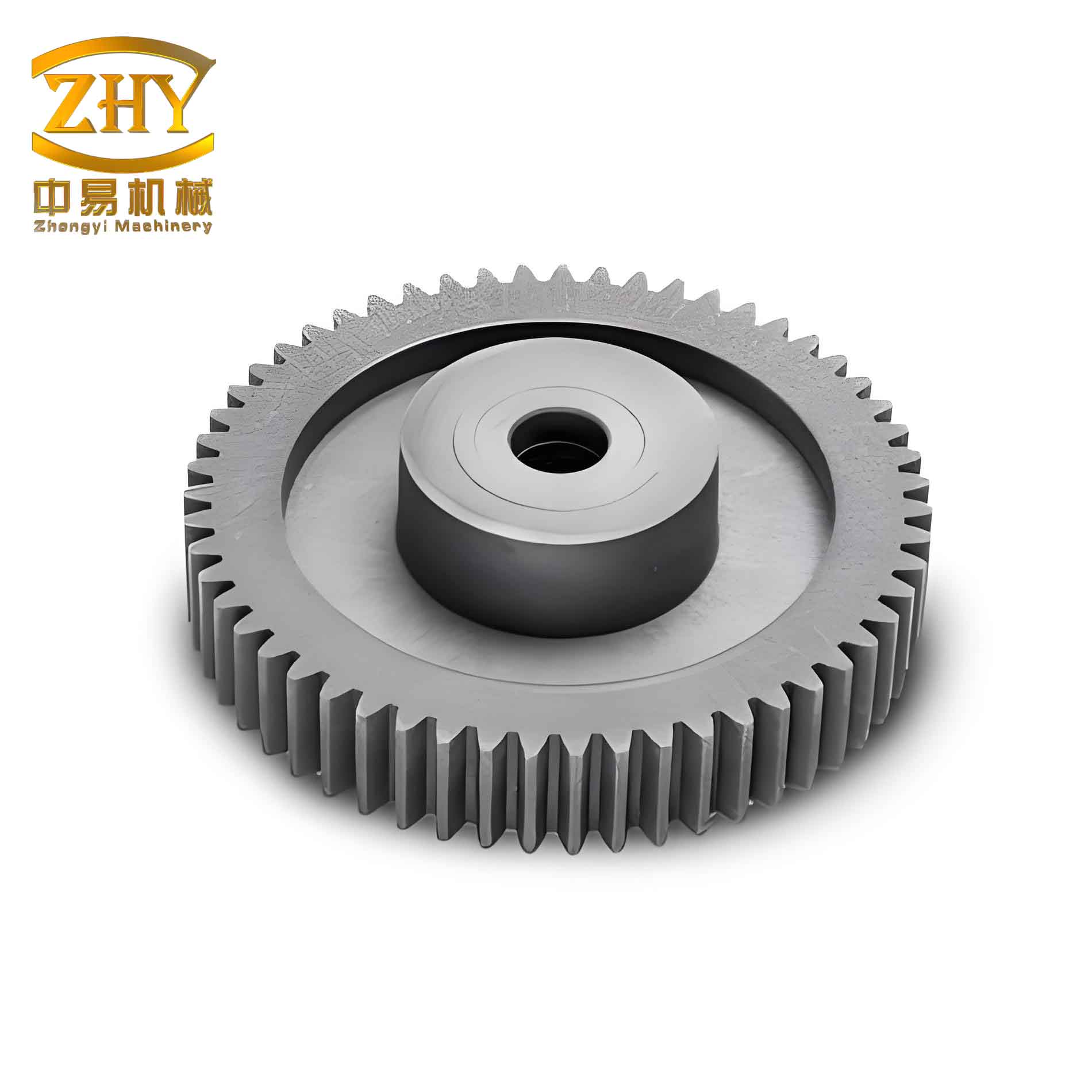
The quest for higher performance, greater efficiency, and more economical manufacturing in power transmission systems perpetually drives innovation in gear design. Among the family of power transmission elements, cylindrical gears—including spur, helical, and herringbone types—are the most ubiquitous. Each variant presents a specific set of compromises. Spur cylindrical gears are simple to manufacture and inspect but suffer from a low contact ratio, leading to increased noise and vibration under load. Helical cylindrical gears offer smoother operation due to a gradual engagement of tooth surfaces, significantly improving the contact ratio and reducing dynamic loads. However, this comes at the cost of introducing an axial force, necessitating more complex thrust-bearing arrangements within the gearbox. Herringbone cylindrical gears, essentially a mirrored pair of helical gears, cancel out the axial forces while retaining smooth meshing characteristics. Yet, their manufacturing is intricate, often requiring a central groove for tool run-out, which reduces the usable face width and complicates the machining process.
This study introduces a novel geometry for cylindrical gears designed to address several of these limitations simultaneously. The proposed gear features teeth whose traces in the axial direction follow a cycloidal curve, as opposed to the straight line of a spur gear or the helix of a helical gear. This fundamental geometrical shift unlocks a unique combination of operational advantages and, more importantly, enables a highly efficient continuous-index machining method. The core innovation lies not just in the static geometry but in the kinematic generation process that allows for non-stop cutting, dramatically boosting production rates compared to conventional逐齿分度 (tooth-by-tooth indexing) methods used for complex tooth lines. This paper will systematically explore the geometrical foundation, mathematical modeling, and manufacturing philosophy of these cycloidal cylindrical gears.
Geometrical Generation and Mathematical Foundation
The design of the novel gear begins with its generating rack, a conceptual tool whose envelope forms the gear tooth surface. The profile of this rack in the tooth length direction is a cycloid.
Cycloidal Rack Profile Generation
Consider a circle \( C \) of radius \( R_b \) and a fixed point \( M \) located at a distance \( R_t \) from the circle’s center \( O_0 \). Let this circle roll without slipping along a straight line \( P \), which represents the pitch line of the imaginary rack. The point \( M \), fixed relative to the rolling circle, traces out a curtate cycloid. The coordinate systems are defined as follows: \( S_0(O_0, X_0, Y_0) \) is fixed with its origin at the center of the rolling circle at the start. \( S_t(O_t, X_t, Y_t) \) is attached to the rolling circle. As the circle rolls through an angle \( \theta \), the translation of its center is \( L_1 = \theta R_b \).
The position vector of point \( M \) in \( S_t \) is constant:
$$
\mathbf{r}^t = \begin{pmatrix} 0 \\ -R_t \\ 1 \end{pmatrix}
$$
Using the homogeneous coordinate transformation matrix \( \mathbf{M}_{0t} \) from \( S_t \) to \( S_0 \), the cycloid’s equation in \( S_0 \) is derived:
$$
\mathbf{M}_{0t} = \begin{bmatrix}
\cos \theta & -\sin \theta & 0 & -\theta R_b \\
\sin \theta & \cos \theta & 0 & -R_b \\
0 & 0 & 1 & 0 \\
0 & 0 & 0 & 1
\end{bmatrix}, \quad \mathbf{r}^0 = \mathbf{M}_{0t} \cdot \mathbf{r}^t
$$
This yields the parametric equations for the cycloid:
$$
\begin{cases}
X_0 = R_b \theta – R_t \sin \theta \\
Y_0 = -R_t \cos \theta
\end{cases}
$$
For convenience in subsequent gear generation, the coordinate system is translated to the midpoint of the rack tooth, denoted as \( S_1(O_1, X_1, Y_1) \). The transformed cycloid equation becomes:
$$
\begin{cases}
X_1 = R_b \theta – R_t \sin \theta + L_2 \\
Y_1 = R_b – R_t \cos \theta
\end{cases}
\tag{1}
$$
where \( L_2 = R_b / \tan[\arcsin(R_b/R_t)] – R_b \arccos(R_b/R_t) \) is a constant offset ensuring symmetry.
Mathematical Model of the Generating Rack and Meshing Theory
The three-dimensional surface of the generating rack, \( \Sigma_1 \), is formed by sweeping the cycloidal profile along the \( Z_1 \)-axis while linearly varying the effective radius \( R_t \) according to the desired pressure angle \( \alpha \). Introducing the parameter \( u \) to represent the \( Z_1 \)-coordinate, the rack tooth surface is defined by:
$$
\mathbf{r}_1(u, \theta) = \begin{pmatrix}
R_b \theta – (R_t + u \tan \alpha) \sin \theta + L_2 \\
R_b – (R_t + u \tan \alpha) \cos \theta \\
u
\end{pmatrix}
\tag{2}
$$
The generation of the conjugate gear tooth surface \( \Sigma_2 \) follows the fundamental principle of gear meshing. In the fixed reference frame \( S_f \), the rack translates with a velocity corresponding to the gear’s rotation. The condition for continuous contact (conjugacy) between the rack surface \( \Sigma_1 \) and the generated gear surface \( \Sigma_2 \) is that their relative velocity at the point of contact is orthogonal to the common surface normal vector. This is expressed by the equation of meshing:
$$
\mathbf{v}_{12}^{(f)} \cdot \mathbf{n}^{(f)} = 0
\tag{3}
$$
where \( \mathbf{v}_{12}^{(f)} \) is the relative velocity vector and \( \mathbf{n}^{(f)} \) is the common unit normal at the contact point in frame \( S_f \).
The rack surface in the fixed frame \( S_f \), after a translation \( L = r_p \phi \) (where \( r_p \) is the gear’s pitch radius and \( \phi \) is its rotation angle), is given by:
$$
\mathbf{r}_f(u, \theta, \phi) = \begin{pmatrix}
R_b \theta – (R_t + u \tan \alpha) \sin \theta + L_2 + r_p \phi \\
R_b – (R_t + u \tan \alpha) \cos \theta \\
u
\end{pmatrix}
\tag{4}
$$
The normal vector \( \mathbf{n}^{(f)} \) is computed from the partial derivatives of \( \mathbf{r}_f \). The relative velocity \( \mathbf{v}_{12}^{(f)} \) at a point on the rack surface, considering the gear’s angular velocity \( \boldsymbol{\omega} = (0, 1, 0)^T \), is \( \mathbf{v}_{12}^{(f)} = \boldsymbol{\omega} \times \mathbf{r}_f \). Substituting these into Eq. (3) yields the meshing function, which establishes a relationship between the surface parameters \( u \), \( \theta \), and the motion parameter \( \phi \):
$$
\begin{aligned}
&\big[-\sin \theta \tan^3 \alpha – \sin \theta \tan \alpha \big] u^2 + \\
&\big[ \tan^2 \alpha (L_2 + r_p \phi + R_b \theta – R_t \sin \theta) – R_t \sin \theta – \tan^2 \alpha \sin \theta (R_t – R_b \cos \theta) \big] u + \\
&\tan \alpha (R_t – R_b \cos \theta)(L_2 + r_p \phi + R_b \theta – R_t \sin \theta) = 0
\end{aligned}
\tag{5}
$$
This quadratic equation in \( u \) can be solved for \( u = u(\theta, \phi) \), representing the \( u \)-coordinate of the contact line on the rack surface for a given gear rotation angle \( \phi \) and cycloid parameter \( \theta \).
The locus of contact points in the fixed frame, known as the line of action, is found by substituting \( u(\theta, \phi) \) back into Eq. (4):
$$
\mathbf{r}_f = \mathbf{r}_f(u(\theta, \phi), \theta, \phi)
\tag{6}
$$
Finally, the gear tooth surface \( \Sigma_2 \) in the gear coordinate system \( S_2 \) is obtained by applying the inverse rotational transformation \( \mathbf{M}_{2f}(\phi) \) to the line of action:
$$
\mathbf{r}_2(\theta, \phi) = \mathbf{M}_{2f}(\phi) \cdot \mathbf{r}_f(u(\theta, \phi), \theta, \phi)
\tag{7}
$$
This mathematical framework fully defines the geometry of the novel cycloidal cylindrical gear. It is important to note that the generated tooth profile is not an involute but a complex curve derived from the cycloidal rack, governed by the generalized Camus theorem which ensures the conjugacy of gears generated by the same rack.
Three-Dimensional Modeling and Instance Demonstration
To validate the mathematical model and visualize the gear geometry, a specific case study is presented. A pair of meshing cylindrical gears and their common generating rack are modeled. The primary parameters for the gear pair are listed in the table below.
| Parameter | Gear 1 | Gear 2 | Generating Rack |
|---|---|---|---|
| Number of Teeth, \( z \) | 30 | 20 | – |
| Module, \( m_n \) (mm) | 5 | 5 | 5 |
| Pressure Angle, \( \alpha \) (°) | 20 | 20 | 20 |
| Reference Helix Angle, \( \beta \) (°) | 16.2 | 16.2 | 16.2 |
| Center Distance, \( a \) (mm) | 125 | 125 | – |
| Addendum Coefficient | 1 | 1 | 1.25 |
| Dedendum Coefficient | 1.25 | 1.25 | 1.35 |
| Pitch Diameter, \( d_p \) (mm) | 150 | 100 | – |
| Face Width, \( b \) (mm) | 50 | 52 | 60 |
The cycloid parameters \( R_b \) and \( R_t \) are determined based on the desired nominal helix angle, face width, and considerations for tool design (avoiding interference). For this example, the values are chosen as shown below.
| Parameter | Symbol | Value / Range |
|---|---|---|
| Base Circle Radius | \( R_b \) | 30 mm |
| Trace Point Radius | \( R_t \) | 105 mm |
| Rack Parameter \( u \) | \( u \) | -7 mm to 7 mm |
| Cycloid Parameter \( \theta \) | \( \theta \) | 52° to 92° |
| Motion Parameter \( \phi \) | \( \phi \) | -25° to 25° |
The modeling process involves the following computational steps:
- Discretization: The parameter spaces for \( u \), \( \theta \), and \( \phi \) are discretized into fine grids.
- Point Cloud Generation: For the rack, Eq. (2) is evaluated directly over the \( (u, \theta) \) grid. For the gear, Eqs. (5), (6), and (7) are solved iteratively to generate a point cloud \( \mathbf{r}_2(\theta, \phi) \) representing the tooth surface.
- Surface Fitting: The generated point clouds are imported into CAD software (e.g., SolidWorks). Spline surfaces are fitted through these points to create accurate 3D models of the rack tooth and the gear tooth.
- Solid Model Creation: The surfaces are used to perform Boolean operations (extrusions, cuts) on blank cylinders to create the complete solid models of the rack cutter and the two gears.
The resulting virtual assembly demonstrates successful meshing of the conjugate gear pair with their generating rack, visually confirming the correctness of the derived mathematical model. The distinct curvilinear tooth alignment of these cylindrical gears is clearly observable.
High-Efficiency Manufacturing: Principle and Tooling Design
The most significant practical advantage of the proposed cycloidal cylindrical gears is their compatibility with a continuous-index milling process, which offers a dramatic leap in production efficiency compared to conventional gear milling or hobbing for non-straight teeth.
Tooling: The Disc Milling Cutter
The gear is machined using a custom-designed disc milling cutter. This cutter is not a form cutter but a generating tool. Its key components are:
- Tool Body (Disc): A rigid steel disc serving as the carrier for the cutting inserts.
- Replaceable Cutting Inserts: Indexable carbide inserts are mounted on the disc’s periphery. Crucially, there are two sets of inserts:
- Inner Inserts: Generate one flank of the gear tooth.
- Outer Inserts: Generate the opposite flank.
The inserts have a straight cutting edge with a specific pressure angle \( \alpha \).
- Adjustment Mechanism: The inserts are mounted on adjustable holders allowing for precise radial (\( d_r \)) and circumferential (\( d_c \)) positioning. This adjustability is key to the tool’s versatility.
The geometric design of the cutter is summarized by the following parameters, which link the tool to the gear geometry:
| Parameter | Symbol | Description / Relation to Gear Design |
|---|---|---|
| Disc Diameter | \( D_d \) | Governs the swing radius and machine requirements. Must be larger than the gear diameter plus allowances. |
| Hub Diameter | \( D_e \) | Provides mounting interface to the machine spindle. |
| Disc Thickness | \( H_d \) | Must accommodate the insert holders and adjusted positions. |
| Number of Inserts | \( Z_b \) | Affects surface finish and chip load. Must be distributed evenly. |
| Insert Pressure Angle | \( \alpha \) | Equal to the generating rack pressure angle (e.g., 20°). |
| Radial Adjustment | \( d_r \) | Allows setting the correct tool profile radius relative to the cycloid’s \( R_t \). |
| Circumferential Adjustment | \( d_c \) | Sets the phase between inner and outer inserts to achieve the correct tooth thickness. |
As the disc cutter rotates, the cutting edges of the inserts collectively sweep out the surface of the imaginary generating rack described by Eq. (2). A single standardized disc body can be used to machine cylindrical gears of the same module by simply adjusting the insert positions or changing the insert type, promoting tooling economy and standardization.
The Continuous-Index Milling Process
The machining process simulates the kinematic relationship between the generating rack and the workpiece gear. The cutting motion involves three synchronized axes:
- Cutter Rotation (\( \omega_c \)): The disc cutter spins at a constant high speed for efficient material removal.
- Workpiece Rotation (\( \omega_w \)): The gear blank rotates continuously about its axis.
- Axial Feed (\( v_f \)): The cutter or the workpiece feeds along the gear’s axis to cover the entire face width.
The essence of the continuous-index method is the fixed, timed relationship between \( \omega_c \) and \( \omega_w \). Their ratio is determined by the geometry of the generating cycloid and the gear’s pitch circle, ensuring the kinematic equivalent of a rack rolling without slip on a gear pitch circle. The fundamental relationship is:
$$
\frac{\omega_w}{\omega_c} = \frac{R_b}{r_p}
\tag{8}
$$
where \( R_b \) is the base circle radius of the cycloid (from the rack generation) and \( r_p \) is the pitch radius of the workpiece gear. This synchronized rotation, combined with the axial feed, generates the precise cycloidal tooth alignment across the entire gear face in one continuous operation. There is no need to stop, index, and engage for each tooth as required in traditional methods for curved-tooth cylindrical gears (e.g., some forms of herringbone or double-helical gears). This non-stop cutting action is the source of the substantial gain in machining efficiency.
The process parameters for machining a specific gear can be tabulated as follows:
| Workpiece Parameter | Symbol / Value | Derived Machining Parameter | Calculation / Value |
|---|---|---|---|
| Module, \( m_n = 5 \) mm | \( m_n \) | Insert Type / Setting | Selected for 5 mm module |
| Number of Teeth, \( z = 30 \) | \( z \) | Cutter-Workpiece Gear Ratio | \( \omega_w / \omega_c = R_b / r_p \) |
| Pitch Radius, \( r_p = 75 \) mm | \( r_p \) | \( = 30 / 75 = 0.4 \) | |
| Face Width, \( b = 50 \) mm | \( b \) | Axial Feed Rate, \( v_f \) | Optimized based on material and finish |
| Cycloid Base Radius, \( R_b = 30 \) mm | \( R_b \) | Disc Cutter Radial Setting, \( d_r \) | Set to match \( R_t = 105 \) mm |
Advantages, Limitations, and Concluding Remarks
The proposed cycloidal cylindrical gear presents a compelling alternative within the family of parallel-axis gears. Its advantages can be categorized into performance, manufacturability, and economic aspects.
Performance Advantages:
Compared to spur cylindrical gears, the cycloidal design offers a higher and variable contact ratio along the tooth trace, leading to smoother transmission, lower noise, and reduced dynamic loads. Unlike helical cylindrical gears, it generates no net axial force, eliminating the need for thrust bearings and simplifying housing design. Relative to herringbone cylindrical gears, it utilizes the full face width effectively without a non-functional central groove, potentially offering greater load capacity for a given size and weight.
Manufacturing and Economic Advantages:
The primary innovation is the continuous-index milling capability. This method, enabled by the specific cycloidal geometry, allows for dramatic reductions in machining cycle times compared to逐齿分度 (tooth-by-tooth) methods. The tooling system is highly versatile and standardized. A single disc cutter body can be adapted to machine different modules of cylindrical gears by changing the adjustable inserts, reducing tooling inventory costs. The process is inherently suitable for modern CNC machining centers, facilitating automation.
Limitations and Future Work:
The design is not without constraints. The most significant limitation concerns the machining of very large-diameter gears (e.g., >1 meter). For such gears, the required disc cutter diameter to avoid interference might become impractically large, suggesting that alternative finishing methods like CNC grinding might need to be developed for this specific geometry. Furthermore, detailed studies on the bending and contact strength, precise optimization of the cycloid parameters (\( R_b, R_t \)) for specific load cases, lubrication characteristics of the complex tooth surface, and extensive noise-vibration-harshness (NVH) testing are essential future research directions to fully validate and deploy this technology.
In conclusion, this study has established a complete theoretical and methodological foundation for a novel type of cylindrical gear. By integrating a cycloidal tooth alignment with a generating rack model, we have derived the precise mathematical definition of the gear tooth surface. More importantly, we have demonstrated a symbiotic link between this unique geometry and a highly efficient continuous manufacturing process. This work provides a new paradigm for designing and producing high-performance cylindrical gears, emphasizing that advanced performance and high manufacturability can be achieved concurrently through innovative geometrical synthesis.