
In the field of mechanical engineering, the accurate transmission of power between non-parallel and non-intersecting shafts is a critical challenge, particularly in automotive, aerospace, and industrial applications. Among the various solutions, hyperboloid gears, often referred to as hypoid gears, have emerged as a preferred choice due to their ability to provide smooth torque transfer with high efficiency and compact design. However, the complex geometry of hyperboloid gears poses significant difficulties in their design, analysis, and manufacturing. Traditional approaches rely heavily on experimental methods and empirical formulas for stress analysis, which can lead to conservative designs, increased costs, and time-consuming iterations. As a researcher immersed in this domain, I have long sought a more precise and computational approach to model hyperboloid gears, enabling advanced simulations such as finite element analysis (FEA) for contact and bending stress evaluation. This paper presents a comprehensive mathematical modeling method for HFT (Hypoid Formate) hyperboloid gears, based on the Gleason machine tool system, which automates the calculation of tooth surface coordinates and facilitates the creation of accurate 3D models. The core of this work lies in developing a robust algorithm that transforms machine parameters and gear blank data into a detailed tooth surface representation, addressing the limitations of previous studies that often lacked direct linkages to actual machine structures or reliable initial value estimations for nonlinear equation solving. By leveraging MATLAB for numerical computations and integrating results into CAD software like CATIA, I aim to provide a practical tool for engineers and designers working with hyperboloid gears, ultimately enhancing the reliability and performance of gear systems. The methodology detailed here not only bridges the gap between theoretical modeling and real-world manufacturing but also opens avenues for optimization and dynamic analysis of hyperboloid gears, contributing to the broader goal of advancing gear technology.
Hyperboloid gears are characterized by their curved tooth surfaces and offset axes, which allow for high torque capacity and reduced noise compared to other gear types. The HFT manufacturing process, widely used in industry, involves generating the pinion via a cradle-type machine while forming the gear through a non-generative method. This process relies on a series of intricate machine settings and tool geometries, making the derivation of tooth surface equations highly nonlinear and computationally intensive. In my experience, one of the primary hurdles in modeling hyperboloid gears is the absence of explicit formulas for tooth surface coordinates; instead, they must be implicitly solved through coordinate transformations and meshing conditions. Previous research, including works by Litvin and others, has laid foundational theories for gear geometry, but practical implementation often falters due to ambiguities in machine parameter mapping and numerical instability. Therefore, in this work, I focus on establishing a clear mathematical framework that mirrors the actual Gleason 116 machine tool, incorporating key elements such as the cutter head, cradle, eccentric, tilt, and swivel mechanisms. The goal is to create a model that accurately reflects the manufacturing process, enabling the extraction of tooth surface points for 3D reconstruction. This approach is particularly valuable for hyperboloid gears, as it supports finite element-based stress analysis, which has been largely impractical due to the lack of precise geometric data. By detailing the coordinate transformations, meshing equations, and solution strategies, I hope to demystify the modeling process and provide a reproducible method for the engineering community.
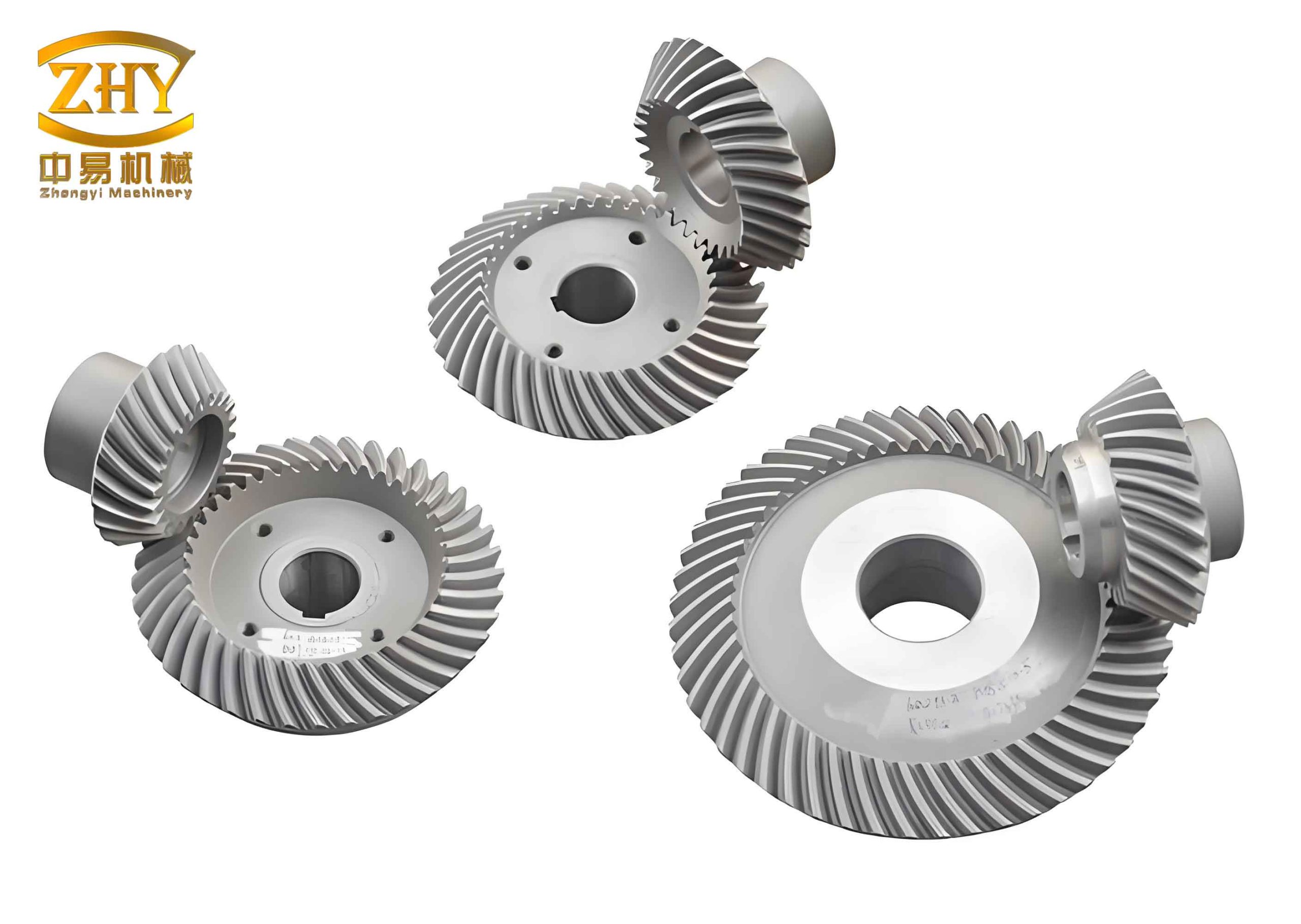
The foundation of modeling hyperboloid gears lies in understanding the cutter geometry and its motion relative to the gear blank. In the Gleason system, the cutter head rotates about its axis to generate a surface of revolution, known as the generating surface, which envelopes the tooth profile during machining. For HFT hyperboloid gears, the pinion is typically cut using a circular cutter with straight or curved blades, each contributing to distinct tooth surfaces—convex and concave sides. I begin by defining the cutter coordinate system \( S_t \), where the cutter surface is parameterized. For a straight blade, the generating cone surface \( \Sigma_p^{(a)} \) can be represented by the vector \( \mathbf{r}_p^{(a)}(s_p, \theta_p) \), where \( s_p \) is the radial distance along the blade and \( \theta_p \) is the rotational angle around the cutter axis. The equation is:
$$
\mathbf{r}_p^{(a)}(s_p, \theta_p) =
\begin{bmatrix}
(R_p – \text{sgn}(\alpha_p) s_p \sin \alpha_p) \cos \theta_p \\
(R_p – \text{sgn}(\alpha_p) s_p \sin \alpha_p) \sin \theta_p \\
– s_p \cos \alpha_p
\end{bmatrix},
$$
where \( R_p \) is the cutter point radius, \( \alpha_p \) is the blade pressure angle, and \( \text{sgn}(\alpha_p) \) is +1 for convex sides and -1 for concave sides of hyperboloid gears. The unit normal vector \( \mathbf{n}_p^{(a)} \) to this surface is derived from partial derivatives and is essential for subsequent meshing conditions. This formulation captures the basic geometry of the cutter, but the real complexity arises when this surface undergoes a series of coordinate transformations to emulate the machine tool movements. These transformations are critical for accurately modeling hyperboloid gears, as they account for the spatial relationships between the cutter, cradle, and workpiece.
To simulate the machining process, I establish a chain of coordinate systems from the cutter to the gear blank, reflecting the kinematic structure of the Gleason 116 machine. The machine comprises several adjustable components: the cradle, eccentric, cutter tilt, cutter swivel, and workpiece settings, each contributing to the final tooth form of hyperboloid gears. The transformation matrix \( \mathbf{M}_{ct} \) from the cutter coordinate system \( S_t \) to the cradle coordinate system \( S_c \) incorporates parameters such as cradle angle \( \phi_c \), eccentric angle \( \phi_e \), swivel angle \( \phi_s \), and tilt angle \( \phi_t \). This matrix is given by:
$$
\mathbf{M}_{ct} =
\begin{bmatrix}
a_{11} & a_{12} & a_{13} & a_{14} \\
a_{21} & a_{22} & a_{23} & a_{24} \\
a_{31} & a_{32} & a_{33} & a_{34} \\
0 & 0 & 0 & 1
\end{bmatrix},
$$
where the elements \( a_{ij} \) are functions of the machine parameters and a constant machine length \( l = 222.25/2 \) mm for the Gleason 116. For instance, \( a_{11} = \cos \tau (\cos^2 \varepsilon \cos \phi_t + \sin^2 \varepsilon) – \sin \tau \cos \varepsilon \sin \phi_t \), with \( \tau = \phi_c + \phi_e + \phi_s \) and \( \varepsilon = 15^\circ \) as the wedge angle. This detailed matrix ensures that the model aligns with the physical machine, a step often glossed over in prior studies on hyperboloid gears. Next, the cradle system rotates relative to the machine reference frame \( S_m \) by an angle \( \psi_c \), leading to the transformation matrix \( \mathbf{M}_{mt}(\psi_c) = \mathbf{M}_{mc}(\psi_c) \mathbf{M}_{ct} \), where \( \mathbf{M}_{mc} \) represents a rotation about the cradle axis. These transformations collectively define the generating surface in the machine coordinate system, setting the stage for the meshing analysis with the gear blank.
The workpiece coordinate system \( S_w \) is linked to the machine through a series of adjustments: machine root angle \( \gamma_m \), sliding base distance \( X_B \), horizontal offset \( E_m \), vertical offset \( X_p \), and roll ratio \( m_{wc} \). The overall transformation from the cutter to the workpiece is \( \mathbf{M}_{wc}(\psi_c) = \mathbf{M}_{wo} \mathbf{M}_{op} \mathbf{M}_{pr} \mathbf{M}_{rs} \mathbf{M}_{sm} \mathbf{M}_{mc}(\psi_c) \), where each matrix accounts for a specific machine setting. For example, \( \mathbf{M}_{sm} \) handles the sliding base, \( \mathbf{M}_{rs} \) applies the machine root angle, and \( \mathbf{M}_{pr} \) incorporates the horizontal offset. The roll ratio \( m_{wc} \) relates the cradle rotation \( \psi_c \) to the workpiece rotation \( \psi \) via \( \psi = m_{wc} \psi_c \), simulating the generating motion essential for hyperboloid gears. This comprehensive transformation chain is pivotal, as it translates the cutter geometry into the gear blank space, allowing the tooth surface points to be computed as the envelope of the generating surface. I emphasize that accurately modeling hyperboloid gears requires meticulous attention to these parameters, as small deviations can lead to significant errors in tooth geometry, affecting performance and stress distribution.
With the coordinate transformations established, the next step is to derive the meshing condition that defines the tooth surface of hyperboloid gears. During machining, the generating surface and the gear blank are in continuous tangency, meaning their relative velocity lies in the common tangent plane. This condition is expressed as \( f_1^{(m)} = \mathbf{n}_m \cdot \mathbf{v}_{m}^{cw} = 0 \), where \( \mathbf{n}_m \) is the unit normal vector of the generating surface in the machine coordinate system, and \( \mathbf{v}_{m}^{cw} \) is the relative velocity between the cradle and the workpiece. The relative velocity is computed from the angular velocities of the cradle and workpiece, along with their position vectors. Specifically, \( \mathbf{v}_{m}^{cw} = (\boldsymbol{\omega}_m^{(c)} – \boldsymbol{\omega}_m^{(w)}) \times \mathbf{r}_m + \boldsymbol{\omega}_m^{(w)} \times \mathbf{R}_m \), where \( \boldsymbol{\omega}_m^{(c)} = [0, 0, -m_{cw}]^T \) and \( \boldsymbol{\omega}_m^{(w)} = [-\cos \gamma_m, 0, \sin \gamma_m]^T \) for hyperboloid gears. The vector \( \mathbf{R}_m = [0, -E_m, X_B]^T \) represents the offset between axes. This meshing equation is nonlinear and must be solved in conjunction with geometric constraints from the gear blank to determine the tooth surface coordinates.
The gear blank geometry provides additional equations to solve for the unknown parameters \( s_p \), \( \theta_p \), and \( \psi_c \). I define a coordinate system on the gear blank where points are projected onto the axial-radial plane. Let \( x_A \) and \( R_A \) be the axial and radial coordinates of a point on the tooth surface of hyperboloid gears. The distance from this point to the pitch cone generator is \( l_p = \cos \gamma_p x_A + \sin \gamma_p R_A \), where \( \gamma_p \) is the pitch cone angle. A normalized length parameter \( \xi_1 \) is introduced:
$$
\xi_1 = 1 – \frac{AO}{FW} + \frac{l_p}{FW},
$$
where \( AO \) is the outer cone distance and \( FW \) is the face width. This parameter ranges from -1 at the toe (small end) to +1 at the heel (large end) of hyperboloid gears, with \( \xi_1 = 0 \) at the midpoint. Thus, a second equation is \( f_2 = \xi_1 – \xi_0 = 0 \), where \( \xi_0 \) is a specified value along the tooth length. For points on the tooth tip (top land), a third equation arises from the face cone geometry: \( f_3^{(F)} = \tan \gamma_F (x_A + x_{pf}) – R_A = 0 \), where \( \gamma_F \) is the face cone angle and \( x_{pf} \) is the distance from the face cone apex to the pitch cone apex. These equations, combined with the meshing condition, form a system that can be solved numerically for tooth surface points of hyperboloid gears. However, the nonlinear nature demands careful selection of initial values to ensure convergence, a challenge that has hindered previous modeling attempts.
To address the initial value problem, I propose an estimation method based on the gear machining theory for hyperboloid gears. At the meshing midpoint, where the tooth contact typically occurs, I approximate the parameters by simplifying the machine settings: set horizontal offset \( E_m = 0 \), vertical offset \( X_p = 0 \), sliding base \( X_B = 0 \), and machine root angle \( \gamma_m = \gamma_R \) (root cone angle). Under these conditions, the cutter and gear blank positions can be visualized geometrically. For a right-hand hyperboloid gear, the estimated values are:
$$
\theta_p^* = \frac{\pi}{2} – \beta + q_0, \quad s_p^* = \frac{AM \sin(\Delta_2)}{\cos \alpha_p}, \quad \psi_c^* = 0,
$$
where \( \beta \) is the mean spiral angle, \( q_0 = \phi_c + \frac{\phi_e}{2} – \frac{\pi}{2} \) is the initial radial cutter angle, \( AM \) is the mean cone distance, and \( \Delta_2 \) is the dedendum angle. For left-hand hyperboloid gears, \( \theta_p^* = \frac{3\pi}{2} + \beta – q_0 \). These estimates serve as starting points for solving the nonlinear equations. I then define an objective function \( F = (f_1^{(m)})^2 + (f_2^{(M)})^2 + (f_3^{(F)})^2 \), where \( f_2^{(M)} \) is evaluated at the midpoint (\( \xi_0 = 0 \)), and use numerical optimization techniques, such as simulated annealing in MATLAB, to find the precise midpoint coordinates. This approach robustly initializes the solution process for hyperboloid gears, overcoming the convergence issues that plague traditional methods.
Once the midpoint is determined, I compute the range of the parameter \( s_p \) for each \( \xi_0 \) along the tooth length of hyperboloid gears. For a given \( \xi_0 \), the maximum \( s_p^{\text{max}} \) corresponds to the tooth tip, found by solving \( f_1^{(m)} = 0 \), \( f_2 = 0 \), and \( f_3^{(F)} = 0 \) simultaneously using the midpoint as an initial guess. The minimum \( s_p^{\text{min}} \) is set by the cutter geometry, typically \( s_p^{\text{min}} = \rho_f (1 – \sin \alpha_p)/\cos \alpha_p \) for the fillet start, where \( \rho_f \) is the tip radius. With these bounds, I discretize the tooth surface into a grid of points \( (\xi_0^i, s_p^j) \), where \( i = 1, \dots, N \) and \( j = 1, \dots, M \), with \( N \) and \( M \) being the number of points along the length and height directions, respectively. For each point, the equations \( f_1^{(m)} = 0 \) and \( f_2 = 0 \) are solved numerically (e.g., using MATLAB’s fsolve function) to obtain \( \theta_p \), \( \psi_c \), and the corresponding coordinates in the workpiece system. This yields a point cloud representing the tooth surface of hyperboloid gears, which can be exported for 3D modeling.
To automate this process, I developed a MATLAB program named SURFACE, which implements the entire methodology for hyperboloid gears. The program flow is as follows: input machine parameters and gear blank data; compute the midpoint estimates; determine \( s_p^{\text{max}} \) for each \( \xi_0 \); solve for tooth surface points across the grid; and output coordinates in a format compatible with CAD software. The program handles both convex and concave sides of hyperboloid gears by adjusting the sign of \( \alpha_p \) and other side-specific parameters. This tool significantly reduces the manual effort required for modeling hyperboloid gears and ensures consistency and accuracy. Table 1 summarizes key gear blank parameters used in the program for hyperboloid gears, while Table 2 lists typical machine settings for the Gleason 116 system. These tables highlight the complexity and interdependence of parameters in hyperboloid gear manufacturing.
| Parameter | Pinion | Gear |
|---|---|---|
| Hand of spiral | Left | Right |
| Number of teeth | 8 | 43 |
| Outer cone distance (mm) | 150.69 | 151.26 |
| Mean cone distance (mm) | 128.32 | 130.75 |
| Addendum (mm) | 9.00 | 1.59 |
| Dedendum (mm) | 3.17 | 10.45 |
| Pitch cone angle (°) | 12.55 | 77.22 |
| Face cone angle (°) | 16.07 | 77.85 |
| Root cone angle (°) | 11.93 | 73.55 |
| Mean spiral angle (°) | 45.05 | 33.82 |
| Parameter | Pinion Convex Side | Pinion Concave Side | Gear Convex Side | Gear Concave Side |
|---|---|---|---|---|
| Pressure angle (°) | 29 | 16 | 25 | 20 |
| Cutter diameter (mm) | 234.95 | 224.79 | — | 228.60 |
| Machine root angle (°) | 356.67 | 357.00 | — | 75.00 |
| Horizontal offset (mm) | WITH 24.04 | WITH 20.20 | — | 79.06 |
| Vertical offset (mm) | DOWN 26.48 | DOWN 23.31 | — | 83.96 |
| Cradle angle (°) | 126.27 | 125.92 | — | — |
| Tilt angle (°) | 54.20 | 55.35 | — | — |
| Swivel angle (°) | 261.25 | 256.37 | — | — |
| Roll ratio | 5.3608 | 5.2441 | — | — |
To validate the modeling method for hyperboloid gears, I applied it to a case study of an automotive drive axle hypoid gear set. Using the parameters from Tables 1 and 2, the SURFACE program computed tooth surface coordinates for both the pinion and gear of the hyperboloid gears. The point clouds were imported into CATIA, where surfaces were reconstructed using lofting and filling operations. The surfaces were then rotated according to the tooth counts to form solid 3D models, as shown in the rendered image. The convex and concave sides of the hyperboloid gears were generated separately and assembled to create a complete gear pair. The resulting models exhibited the characteristic curved teeth and offset axes of hyperboloid gears, confirming the accuracy of the mathematical approach.
For quantitative validation, I compared the modeled tooth surfaces with physical measurements from a manufactured hyperboloid gear set. Using a 3D optical scanning system (ATOS II), I captured point cloud data from the actual gears. The deviation between the modeled and measured surfaces was analyzed, revealing errors mostly within ±0.02 mm across the active tooth flanks of the hyperboloid gears. Slightly larger discrepancies occurred at the edges, likely due to manufacturing modifications such as tip relief or root fillet adjustments, which are common in hyperboloid gears to optimize contact patterns and reduce stress concentrations. This level of accuracy demonstrates that the modeling method reliably captures the essential geometry of hyperboloid gears, making it suitable for engineering applications like FEA. For instance, the 3D models can be meshed and subjected to load simulations to predict contact pressures and bending stresses, tasks that were previously infeasible without precise geometric data for hyperboloid gears.
The mathematical framework presented here offers several advantages for hyperboloid gears. First, it establishes a direct correspondence between machine tool parameters and tooth surface coordinates, bridging the gap between design and manufacturing for hyperboloid gears. Second, the initial value estimation based on midpoint geometry ensures robust numerical solutions, a critical improvement over ad-hoc guessing methods. Third, the automation via MATLAB allows for rapid generation of 3D models, facilitating iterative design and analysis of hyperboloid gears. Moreover, the method can be extended to other gear types, such as spiral bevel gears, by adjusting the coordinate transformations and parameters. In practice, this approach enables engineers to optimize hyperboloid gears for noise, efficiency, and durability by simulating various machine settings and tooth modifications before physical prototyping, reducing development time and cost.
In conclusion, from my perspective as a researcher, this work provides a comprehensive and practical method for 3D mathematical modeling of HFT hyperboloid gears. By detailing the coordinate transformations, meshing equations, and numerical solution strategies, I have addressed key challenges in hyperboloid gear modeling, such as initial value estimation and parameter mapping. The resulting SURFACE program automates tooth coordinate calculation, enabling the creation of accurate 3D models for finite element analysis and other simulations. The validation against measured data confirms the method’s reliability for hyperboloid gears. Future work could focus on integrating this model with dynamic simulation software to study vibration and noise characteristics of hyperboloid gears, or on incorporating manufacturing errors to assess their impact on performance. Ultimately, I believe that advances in computational modeling, as demonstrated here for hyperboloid gears, will drive innovation in gear design and manufacturing, leading to more efficient and reliable power transmission systems across industries.