
In modern mechanical transmission systems, gears play a pivotal role in motion transfer, serving as fundamental components across industries such as automotive, aerospace, and heavy machinery. The precision of gears directly influences the performance and reliability of high-tech equipment, including multi-axis CNC systems and intelligent robotics. Gear profile grinding is a critical finishing process that enhances gear accuracy by 1–2 levels, effectively eliminating distortions induced by heat treatment. However, traditional gear grinding methods face challenges in balancing accuracy and efficiency, particularly in wheel dressing. Issues like grinding cracks often arise from inadequate wheel profile precision, leading to surface defects. This paper addresses these limitations by proposing a novel approach that integrates B-spline curve fitting with a differential evolution algorithm to optimize the CNC dressing process for form grinding wheels, ensuring high precision in gear profile grinding.
Form grinding employs a profiled wheel whose contour directly determines the final gear tooth geometry. During gear grinding, wheel wear, metal adhesion, and pore clogging necessitate frequent dressing to maintain accuracy. Conventional CNC dressing discretizes complex curves into linear or circular segments, introducing discontinuities and waveform distortions that compromise topological integrity. This not only limits gear grinding precision but also complicates programming and increases computational load. In contrast, B-spline curves offer superior smoothness and flexibility, enabling arbitrary complexity through control points and knot vectors without structural redefinition. By leveraging B-spline fitting, our method facilitates efficient wheel dressing via spline interpolation in CNC systems, eliminating the need for piecewise linear approximations and mitigating grinding cracks risks.
The mathematical foundation begins with modeling the involute tooth profile of a spur gear. For a gear with module $m$, tooth count $z$, pressure angle $\alpha$, and other parameters, the base circle radius $r_b$ is calculated as:
$$r_b = \frac{m z}{2} \cos \alpha$$
The tooth profile coordinates are derived using parametric equations. For any point on the involute, the radius $r_y$ ranges from the root radius $r_f$ to the tip radius $r_a$. The pressure angle $\alpha_y$ at radius $r_y$ is:
$$\alpha_y = \arccos \left( \frac{r_b}{r_y} \right)$$
The involute function $\theta_y = \text{inv} \alpha_y = \tan \alpha_y – \alpha_y$ defines the tooth geometry. Coordinates $(x_y, y_y)$ are computed as:
$$x_y = r_y \sin \eta_y, \quad y_y = r_y \cos \eta_y$$
where $\eta_y$ is the slot center half-angle at radius $r_y$. Discrete points are generated by sampling $r_y$ uniformly between $r_f$ and $r_a$. For a gear with parameters listed in Table 1, 50 points are derived to represent the involute profile.
| Parameter | Symbol | Value |
|---|---|---|
| Module | $m$ | 9 mm |
| Number of Teeth | $z$ | 60 |
| Pressure Angle | $\alpha$ | 20° |
| Addendum Coefficient | $h_a^*$ | 1 |
| Dedendum Coefficient | $c^*$ | 0.25 |
| Tip Radius | $r_a$ | 279.00 mm |
| Root Radius | $r_f$ | 258.75 mm |
B-spline curves are employed to fit the discrete points of the wheel profile. A B-spline curve $C(u)$ of degree $k$ is defined as:
$$C(u) = \sum_{i=0}^{n} P_i N_{i,k}(u)$$
where $P_i$ are control points, $N_{i,k}(u)$ are basis functions, and $u$ is the parameter. The knot vector $U = [u_0, u_1, \dots, u_m]$ is determined using average parameterization. Feature points are selected based on maximum bow height error to capture geometric characteristics. For a set of points $\{P_e\}$, chord length parameterization assigns parameters as:
$$u_0 = 0, \quad u_e = u_{e-1} + \frac{|P_e – P_{e-1}|}{d}, \quad d = \sum_{e=1}^{n} |P_e – P_{e-1}|$$
The knot vector is then computed as:
$$u_g = \frac{1}{k} \sum_{i=g}^{g+k-1} u_i \quad \text{for } g = 1, 2, \dots, n-k$$
Control points are obtained by solving the linear system $P_e = \sum_{i=0}^{n} P_i N_{i,k}(u_e)$. To minimize fitting error, a differential evolution algorithm optimizes the Euclidean distance between discrete points and the reconstructed curve. The objective function is:
$$\min \sum_{j=1}^{N} \left\| Q_j – C(u_j) \right\|^2$$
where $Q_j$ are data points. The algorithm evolves populations of knot vectors and control points to achieve global optimization, reducing the risk of grinding cracks by ensuring precise wheel profile alignment.
Simulation in MATLAB demonstrates the method’s efficacy. Starting with 50 discrete points from the involute profile, initial feature points are identified via maximum bow height error. B-spline fitting with six feature points yields a curve that closely matches the original data. The fitting error is computed as:
$$\epsilon_{\text{max}} = \max_j \left\| Q_j – C(u_j) \right\|$$
Results show $\epsilon_{\text{max}} = 8.7159 \times 10^{-8}$ mm, well below the threshold of $0.0001$ mm. This high precision is critical in gear profile grinding to prevent grinding cracks and ensure surface integrity. The complete wheel profile, including involute and root transition curves, is reconstructed as shown in the simulation.
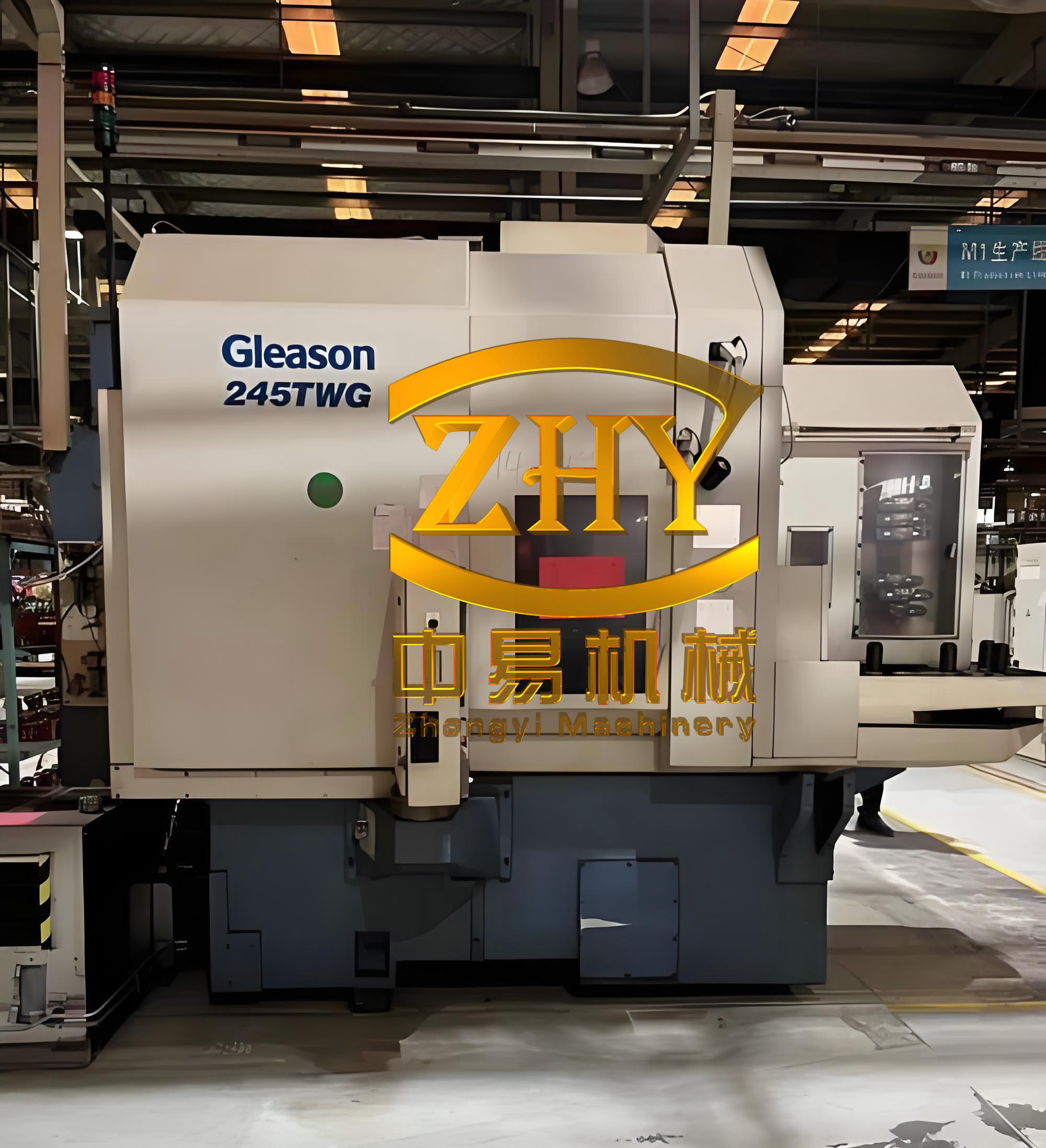
In practical gear grinding applications, this method translates to enhanced CNC dressing. The B-spline curve data are converted into tool paths in CAM software, enabling high-accuracy wheel profiling on CNC machines. A case study involving a spur gear with $m=9$ mm and $z=60$ validates the approach. The dressed wheel successfully grinds gears with minimal deviation, reducing the incidence of grinding cracks and improving overall gear quality. The integration of B-spline fitting with differential evolution optimizes both accuracy and computational efficiency, advancing intelligent CNC dressing systems for gear profile grinding.
In conclusion, the fusion of B-spline curves and differential evolution algorithm presents a robust solution for CNC form grinding wheel dressing. By reducing control points and minimizing fitting errors, this method achieves sub-micron precision, mitigating issues like grinding cracks in gear profile grinding. Future work will focus on real-time adaptive dressing and integration with IoT for predictive maintenance in industrial gear grinding processes.