
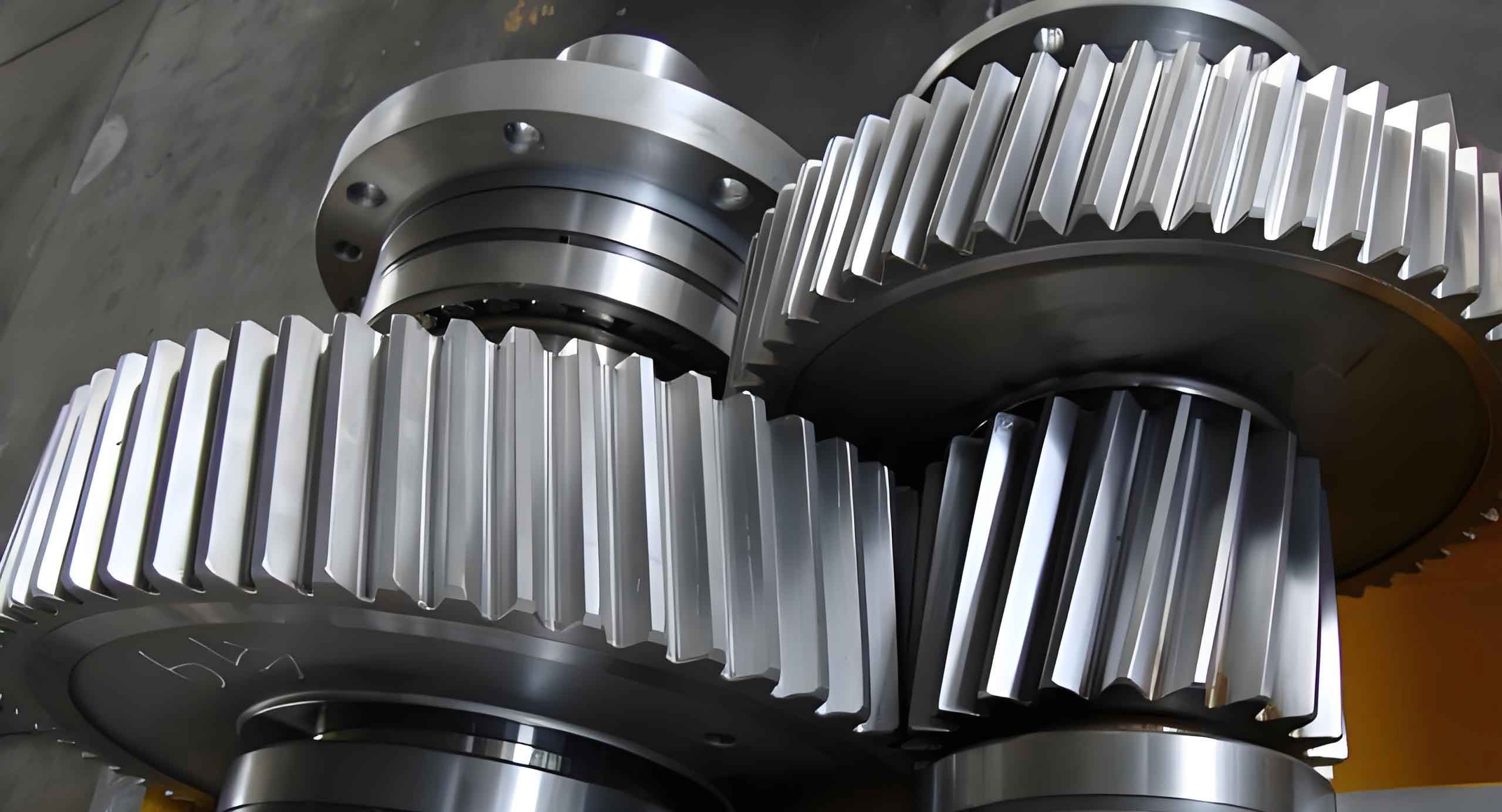
The precise calculation of contact stress in helical gear transmissions is a cornerstone of reliable mechanical design, directly influencing gear life, noise generation, and resistance to failure modes such as pitting and spalling. While modern manufacturing achieves high tooth surface accuracy, assembly errors—such as those in center distance, spatial axis misalignment, and in-plane axis angular deviation—are often unavoidable in practical applications. These errors fundamentally alter the contact conditions between mating gear teeth. A particularly critical consequence is edge contact, which frequently occurs during the entry and exit phases of the meshing cycle. This phenomenon displaces the initial contact point from the center of the theoretical contact line, resulting in an incomplete, elongated contact ellipse on the tooth flank. This deviation from ideal line contact or complete elliptical contact presents a significant challenge for accurate stress prediction.
Traditional methods for analyzing gear contact stress exhibit limitations under these non-ideal conditions. The classic Hertzian contact theory, while powerful, requires a complete elliptical contact area to calculate principal curvatures and semi-axis dimensions, making it inapplicable for incomplete contact ellipses. International standards like ISO 6336 provide valuable design-level stress estimates but do not reveal the fluctuating maximum contact stress at each discrete meshing position throughout the engagement cycle. Finite Element Analysis (FEA), though highly accurate, demands substantial computational resources, fine meshing, and significant time investment, especially when analyzing multiple load cases and meshing positions, hindering its efficiency for iterative design and analysis.
To bridge this gap, this article develops and elaborates on a robust hybrid analytical methodology that synergistically combines Hertzian theory with the Winkler elastic foundation model. This approach is specifically designed to accurately and efficiently calculate the maximum contact stress for helical gear pairs operating with assembly errors. We will focus on the case of an in-plane axis angular error (shaft parallelism error) as a representative example, though the underlying principles possess general applicability. The method leverages the results of unloaded Tooth Contact Analysis (TCA) and Loaded Tooth Contact Analysis (LTCA) to determine key parameters, enabling precise stress calculation whether the contact ellipse is complete or truncated due to edge contact.
Fundamentals of Tooth Contact Analysis for Helical Gears with Errors
The foundation of any contact stress calculation is the precise identification of the contact point and path under load. For a helical gear pair with assembly errors, the theoretical line contact degenerates into a point contact. The initial unloaded contact point for each angular position of the gears must first be found through Tooth Contact Analysis (TCA).
Consider a helical gear pair where the pinion and gear are represented in their own moving coordinate systems, \(O_p\) and \(O_g\), respectively. The tooth surface of the pinion can be expressed parametrically as \(\mathbf{R}^p(u_p, l_p)\), and that of the gear as \(\mathbf{R}^g(u_g, l_g)\). Their corresponding unit normal vectors are \(\mathbf{n}^p(u_p, l_p)\) and \(\mathbf{n}^g(u_g, l_g)\), calculated from the partial derivatives of the surface equations:
$$
\mathbf{n}^p(u_p, l_p) = \frac{\partial \mathbf{R}^p / \partial u_p \times \partial \mathbf{R}^p / \partial l_p}{|\partial \mathbf{R}^p / \partial u_p \times \partial \mathbf{R}^p / \partial l_p|}, \quad \mathbf{n}^g(u_g, l_g) = \frac{\partial \mathbf{R}^g / \partial u_g \times \partial \mathbf{R}^g / \partial l_g}{|\partial \mathbf{R}^g / \partial u_g \times \partial \mathbf{R}^g / \partial l_g|}
$$
To simulate assembly, an error coordinate system \(O_e\) is introduced. For an in-plane angular error \(\varphi_e\), it is applied to the gear. The transformation from the gear coordinate system \(O_g\) to the fixed global system \(O_f\) involves a rotation matrix \(\mathbf{M}_{fe}(\varphi_g)\) and the error matrix \(\mathbf{M}_{eg}\). The pinion transforms via \(\mathbf{M}_{fp}(\varphi_p)\). The condition for continuous tangency between the two surfaces, when expressed in the global coordinate system, leads to the classic TCA equations:
$$
\begin{aligned}
\mathbf{M}_{fp}(\varphi_p) \mathbf{R}^p(u_p, l_p) &= \mathbf{M}_{fe}(\varphi_g) \mathbf{M}_{eg} \mathbf{R}^g(u_g, l_g) \\
\mathbf{L}_{fp}(\varphi_p) \mathbf{n}^p(u_p, l_p) &= \mathbf{L}_{fe}(\varphi_g) \mathbf{L}_{eg} \mathbf{n}^g(u_g, l_g)
\end{aligned}
$$
Here, \(\mathbf{L}\) matrices are the \(3 \times 3\) rotational sub-matrices extracted from the corresponding \(4 \times 4\) transformation matrices \(\mathbf{M}\). This system contains five independent equations with six unknowns (\(\varphi_p, \varphi_g, u_p, l_p, u_g, l_g\)). By prescribing the pinion rotation angle \(\varphi_p\) as the input parameter and solving the system iteratively, the corresponding gear rotation \(\varphi_g\) and the coordinates of the instantaneous point of contact on both tooth flanks are obtained for that meshing position. Repeating this process over a full mesh cycle generates the contact path or “bearing pattern” on the tooth surface.
The Hybrid Analytical Methodology for Contact Stress
Under load, the initial point contact predicted by TCA expands into a small, elongated contact ellipse. For a helical gear with assembly error, this ellipse is often truncated at the tooth edges. The core idea of the hybrid method is to apply the most suitable model based on the geometry of this loaded contact patch:
- Hertzian Theory for Complete Elliptical Contact: Applied when the initial contact point lies at the center of a complete contact ellipse.
- Winkler Elastic Foundation Model for Incomplete/Edge Contact: Applied when edge contact truncates the ellipse, making Hertzian theory invalid.
The overall computational workflow is systematic, as illustrated below, integrating TCA, LTCA, and the conditional application of the two stress models.
Step 1: Loaded Tooth Contact Analysis (LTCA)
LTCA determines how the total transmitted load is distributed among the concurrent tooth pairs in contact and along the contact line/ellipse on each tooth. For a helical gear pair with an error, the contact on a single tooth pair is simplified to be distributed along the major axis of the contact ellipse. The problem is formulated as a nonlinear contact problem seeking the minimum total deformation energy, subject to compatibility and equilibrium constraints.
The deformation compatibility condition along the potential contact line (the ellipse’s major axis) is:
$$
\mathbf{W} = -\mathbf{F}_{pg}\mathbf{p} + \mathbf{Z} + \mathbf{d}
$$
where \(\mathbf{W}\) is the initial geometric separation (from TCA), \(\mathbf{F}_{pg}\) is the combined flexibility matrix of the pinion and gear teeth, \(\mathbf{p}\) is the vector of discrete loads at points along the contact line, \(\mathbf{Z}\) is the constant approach (rigid body displacement) of the two gears under load, and \(\mathbf{d}\) is the final contact gap (zero at contacting points, positive at separated points).
The force equilibrium condition is:
$$
\sum_{i=1}^{n} p_i = P = \frac{T}{R_b \cos \beta_b}
$$
where \(P\) is the total normal load on the tooth pair, \(T\) is the applied torque, \(R_b\) is the base circle radius, and \(\beta_b\) is the base helix angle. This optimization problem, with constraints \(p_i \ge 0\) and \(d_i \ge 0\), is efficiently solved using a modified simplex method. The solution yields the load distribution vector \(\mathbf{p}\) and identifies which discrete points are in actual contact (\(d_i=0\)). The load sharing factor \(L_j\) for the \(j\)-th meshing position is then:
$$
L_j = \frac{\sum_{i=1}^{n} p_{ji}}{P}
$$
Step 2: Conditional Stress Calculation
Based on the LTCA results, the geometry of the contact ellipse at the \(j\)-th meshing position is examined. A key check is whether the initial contact point \(O(x_0, y_0)\) is equidistant from the two ends \(A(x_1, y_1)\) and \(B(x_2, y_2)\) of the contact ellipse’s major axis in the projection plane:
$$
S_1 = \sqrt{(x_1 – x_0)^2 + (y_1 – y_0)^2}, \quad S_2 = \sqrt{(x_2 – x_0)^2 + (y_2 – y_0)^2}
$$
If \(S_1 = S_2\), the contact is centered and a complete ellipse is assumed. If \(S_1 \ne S_2\), edge contact is occurring, resulting in a truncated ellipse.
Case A: Hertzian Stress for Complete Elliptical Contact
When the contact ellipse is complete, the maximum contact pressure \(\sigma_j\) at the \(j\)-th meshing position is given by the Hertzian formula:
$$
\sigma_j = \frac{3L_j P}{2\pi a_j b_j}
$$
The semi-major (\(a_j\)) and semi-minor (\(b_j\)) axes of the contact ellipse are calculated as:
$$
\begin{aligned}
A_j &= \frac{1}{2}(k_{j11} + k_{j12} + k_{j21} + k_{j22}) \\
B_j &= \frac{1}{2}\sqrt{(k_{j11} – k_{j12})^2 + (k_{j21} – k_{j22})^2 + 2(k_{j11} – k_{j12})(k_{j21} – k_{j22})\cos(2\phi_j)} \\
a_j &= \alpha_j \sqrt[3]{\frac{3L_j P}{4A_j} \left( \frac{1-\nu_1^2}{E_1} + \frac{1-\nu_2^2}{E_2} \right)} \\
b_j &= \beta_j \sqrt[3]{\frac{3L_j P}{4A_j} \left( \frac{1-\nu_1^2}{E_1} + \frac{1-\nu_2^2}{E_2} \right)}
\end{aligned}
$$
Here, \(k_{j11}, k_{j12}\) are the principal curvatures of the pinion surface at the contact point, \(k_{j21}, k_{j22}\) are those of the gear surface, and \(\phi_j\) is the angle between their principal directions. \(E_1, E_2\) and \(\nu_1, \nu_2\) are the Young’s moduli and Poisson’s ratios of the pinion and gear materials, respectively. The coefficients \(\alpha_j\) and \(\beta_j\) are functions of the ratio \(B_j/A_j\) and are obtained from standard Hertzian tables or empirical relations.
Case B: Winkler Model Stress for Incomplete/Edge Contact
For truncated ellipses, the Winkler (elastic foundation) model is employed. It assumes the contacting tooth can be modeled as a rigid base covered by a layer of independent, closely spaced linear springs. The contact pressure at any point is proportional only to the local deflection at that point, with no shear interaction between adjacent springs. While a simplification, it is effective for the long, narrow contact patches characteristic of edge contact in helical gear.
The contact stress at the initial contact point is:
$$
\sigma_j = k_j \delta_j
$$
where \(\delta_j\) is the total normal elastic deformation at the point, and \(k_j\) is the foundation stiffness or pressure required to produce a unit deflection at that specific point on the tooth flank.
- Calculating \(k_j\): The stiffness \(k_j\) is derived from the local geometry (principal curvatures) using an inverse Hertzian approach. For a hypothetical unit deflection \(\delta=1\), the required pressure \(P^*\) and corresponding contact ellipse dimensions \(a_j, b_j\) are related. The foundational stiffness can be approximated by:
$$
k_j \approx \frac{3P^*}{2\pi a_j b_j}
$$
where \(a_j\) and \(b_j\) are calculated from the principal curvatures as in the Hertzian case, but for the specific condition of unit deformation.
- Calculating \(\delta_j\): The deformation \(\delta_j\) is obtained from the LTCA results. It is the sum of the contributions from all discrete loads \(p_{ji}\) acting along the contact line, weighted by the compliance influence coefficients \(\omega_{jm}\) from the flexibility matrix \(\mathbf{F}_{pg}\):
$$
\delta_j = \sum_{i=1}^{n} \omega_{ji} p_{ji}
$$
Here, \(\omega_{ji}\) represents the deformation at point \(j\) due to a unit load at point \(i\). Substituting \(k_j\) and \(\delta_j\) into \(\sigma_j = k_j \delta_j\) gives the maximum contact stress for the edge-contact meshing position.
Application and Comparative Analysis
To demonstrate the hybrid method, consider a helical gear pair with the parameters listed in Table 1, incorporating an in-plane axis angular error of 10 arc-seconds.
| Parameter | Value |
|---|---|
| Module | 4 mm |
| Number of Teeth (Pinion/Gear) | 25 / 50 |
| Face Width | 30 mm |
| Pressure Angle | 20° |
| Helix Angle | 16° |
| In-Plane Axis Error | 10″ |
| Young’s Modulus (Both) | 210 GPa |
| Poisson’s Ratio (Both) | 0.3 |
The meshing cycle is discretized into 23 positions. TCA simulation for this gear pair reveals that a significant portion of the contact path lies near the edges of the tooth, indicating prevalent edge-contact conditions, especially at the entry and exit phases of meshing.
The load distribution factor \(L_j\) across these 23 positions follows a pattern characteristic of helical gears with a theoretical contact ratio greater than 2. It is lower in the central region (three-tooth contact zone) and higher at the transitions (two-tooth contact zones).
Applying the hybrid analytical method for various input torques (100, 400, 700, and 1000 Nm) yields the maximum contact stress curves shown in Figure 1 below (conceptual representation). The curves exhibit a distinct “saddle” or concave shape. This shape results from two combined effects: 1) Stress concentration at the tooth edges during the entry and exit meshing positions where contact is truncated, and 2) The variation of the load-sharing factor \(L_j\), which amplifies or attenuates the edge-stress effect. The left peak (entry) is typically higher than the right peak (exit) because the load-sharing factor is often greater at entry, and the contact ellipse may be smaller. The maximum contact stress values increase non-linearly with applied torque, with a diminishing rate of increase.
Validation with Finite Element Analysis
To validate the hybrid method, a detailed 3D Finite Element Model (FEM) of a five-tooth segment for both pinion and gear was constructed using ANSYS software. The model employed over 420,000 eight-node hexahedral elements and established surface-to-surface contact elements between the mating flanks. The analysis simulated the same 23 meshing positions under identical load cases.
A comparison of the contact stress results from the hybrid method and the FEM reveals a strong correlation. The stress curves follow nearly identical trends. The relative error between the two methods across all load cases and meshing positions remains within approximately 6.8%. This minor discrepancy can be attributed to the inherent simplifications in the Winkler model (neglecting shear coupling) and the practical challenge of isolating the pure local stiffness \(k_j\) in the analytical calculation. Nevertheless, the agreement confirms the reliability and accuracy of the proposed hybrid analytical method.
Computational Efficiency
A critical advantage of the hybrid analytical method is its computational efficiency. The following table compares the resource consumption for analyzing the full set of 23 meshing positions under multiple loads.
| Method | Total Computation Time | Memory Usage |
|---|---|---|
| Hybrid Analytical Method | ~5.4 minutes | ~735 MB |
| Finite Element Analysis (ANSYS) | ~208.6 minutes | ~11,025 MB |
The hybrid method is approximately **38.7 times faster** and requires about **15 times less memory** than the high-fidelity FEM approach for this specific analysis. This dramatic difference stems from the fact that once the TCA and LTCA (flexibility matrix) are solved, the hybrid method can compute stresses for any load almost instantaneously through simple algebraic and tabulated operations. In contrast, FEM must resolve the nonlinear contact problem from scratch for each load and each discrete gear rotation angle.
Conclusion
This article has presented a comprehensive hybrid analytical framework for calculating the contact stress in helical gear pairs operating with assembly errors. The method intelligently combines Hertzian contact theory for centered, complete elliptical contacts with the Winkler elastic foundation model for edge-contact conditions resulting in truncated ellipses. By integrating results from rigorous Tooth Contact Analysis (TCA) and Loaded Tooth Contact Analysis (LTCA), the approach accurately determines the load distribution and the appropriate stress calculation model for each meshing position.
The analysis of a helical gear with an in-plane axis error demonstrates that the hybrid method successfully captures the complex stress fluctuations during meshing, notably the concave-shaped stress curve resulting from edge-contact stress concentrations modulated by the load-sharing cycle. Validation against detailed Finite Element Analysis confirms the method’s accuracy, with maximum relative errors well below 7%.
Most significantly, the hybrid analytical method achieves this accuracy with a drastic improvement in computational efficiency—being orders of magnitude faster and less memory-intensive than 3D FEA. This makes it an exceptionally powerful tool for the iterative design, sensitivity analysis, and performance evaluation of helical gear drives where assembly errors are a practical concern. The methodology, rooted in gear geometry, contact mechanics, and elastic foundation theory, is general and can be effectively extended to other types of assembly errors, such as center distance variations and spatial axis misalignments, in both parallel-axis and crossed-axis helical gear configurations.