
In the field of power transmission component analysis and reverse engineering, the task of measuring or “mapping” an individual helical spur gear presents a significant challenge distinct from measuring a mating pair. When a pair of helical spur gears is available, the center distance, backlash, and proper meshing provide rich, interdependent data that allows for the accurate back-calculation of key geometric parameters. However, in practical scenarios—such as when a single gear from a set requires replacement, or during the analysis of legacy machinery—we are often confronted with a solitary helical spur gear devoid of its mate or any original technical documentation. Traditional measurement guides predominantly address paired gears, leaving a gap in practical methodology for the single-gear case. Based on extensive practical experience in this domain, I have developed and refined a systematic procedure for the measurement of a single helical spur gear. This article details this methodology, focusing on the accurate determination of the pivotal reference diameter helix angle and the profile shift coefficient, which serve as the foundation for calculating all other manufacturing parameters.
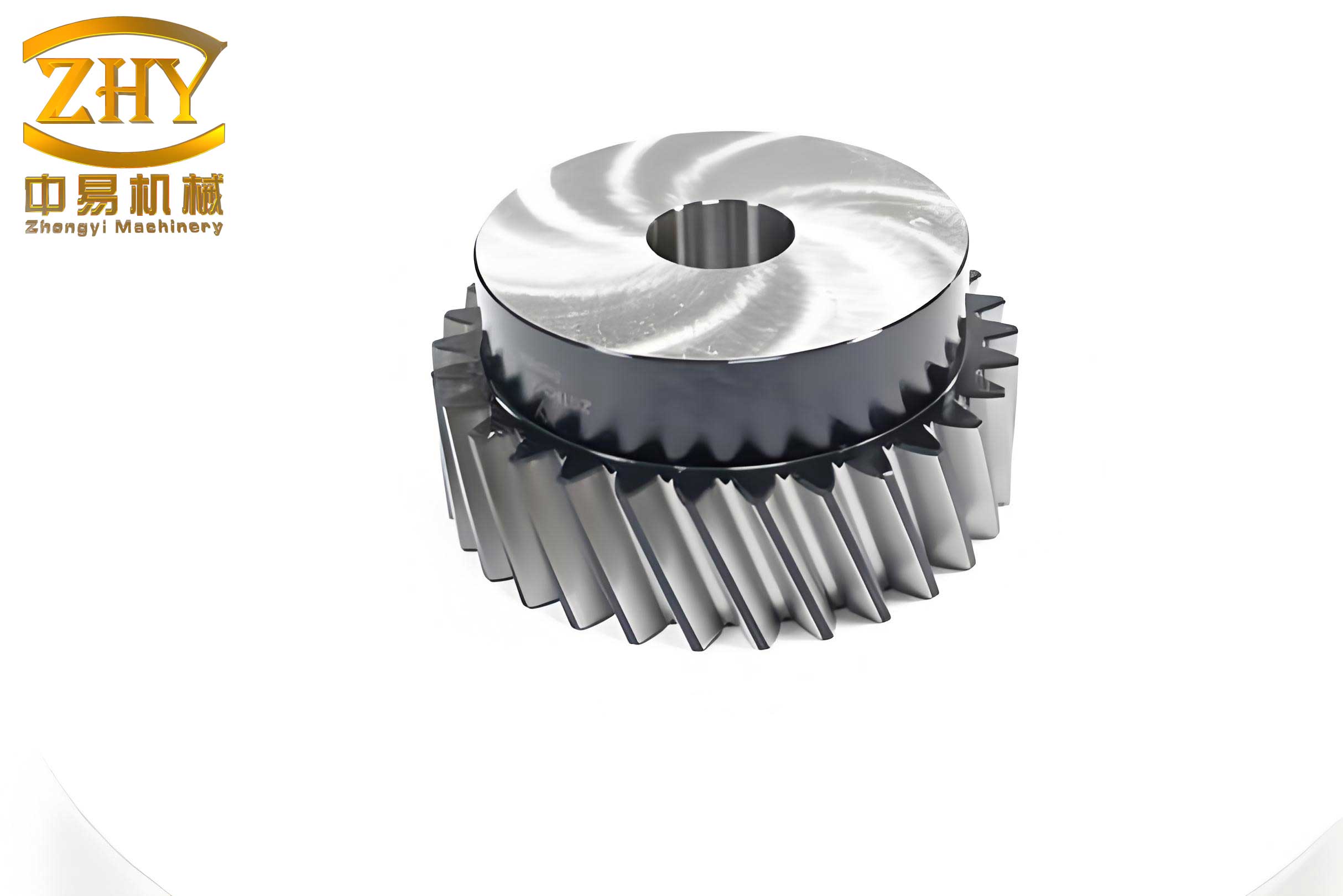
The Core Challenge: Isolating the Reference Diameter Helix Angle
The helix angle is the defining characteristic of helical spur gears, dictating their smooth, gradual engagement and superior load-carrying capacity compared to straight-cut gears. However, the angle measured directly on the gear’s physical body is not the theoretically crucial reference diameter helix angle (β). Instead, common physical measurement techniques, such as the roll impression or chordal measurement methods, yield the tip diameter helix angle (βa). Substituting βa for β in calculations is a common source of inaccuracy, especially if the tip diameter has been altered by wear, chamfering, or manufacturing tolerances. Therefore, the primary objective is to derive β from physically measurable quantities.
The initial step involves obtaining a reliable average value for the tip diameter helix angle (βa). Using the roll impression method on the gear’s outer cylindrical surface, multiple impressions should be taken at different locations around the circumference to account for local variations and measurement error. The helix angles from these impressions are measured and averaged to produce a single, more robust value for βa. Let this measured average be denoted as βa_m.
Simultaneously, the actual tip diameter (da) must be measured as accurately as possible using precision calipers or micrometers, taking multiple readings to average out errors of out-of-roundness.
Theoretical Derivation: From Tip Angle to Reference Angle
The geometric relationship between the tip diameter and the reference diameter is key. Consider the development (unwrapping) of a single turn of the helix on both the tip cylinder and the reference cylinder.
For any cylindrical helix, the lead (L)—the axial distance for one complete revolution—is constant. From the developed right triangle on the tip cylinder, we have:
$$ \tan(\beta_a) = \frac{\pi \cdot d_a}{L} $$
From the developed triangle on the reference (pitch) cylinder, we have:
$$ \tan(\beta) = \frac{\pi \cdot d}{L} $$
Where \( d \) is the reference diameter. Since the lead L is identical in both equations, we can equate the expressions for L:
$$ L = \frac{\pi \cdot d_a}{\tan(\beta_a)} = \frac{\pi \cdot d}{\tan(\beta)} $$
Solving for the reference diameter helix angle β, we get the fundamental formula:
$$ \tan(\beta) = \frac{d}{d_a} \cdot \tan(\beta_a) $$
This equation is powerful but contains the unknown reference diameter \( d \). For a standard helical spur gear, the reference diameter is related to the normal module (mn), number of teeth (z), and helix angle: \( d = \frac{m_n \cdot z}{\cos(\beta)} \). However, mn itself is often unknown at this stage. We resolve this by first determining the likely normal module through direct measurement of the normal base pitch or by comparing the measured gear tooth profile with standard rack profiles. Once a candidate normal module (mn) is identified, and with the measured tip diameter (da) and tip helix angle (βa_m), we can employ an iterative or direct solving approach.
The reference diameter can also be expressed in terms of the tip diameter and the addendum: \( d = d_a – 2 \cdot h_a \), where \( h_a \) is the addendum. For a standard gear, \( h_a = m_n \). For a profile-shifted gear, \( h_a = m_n \cdot (1 + x) \), where x is the profile shift coefficient. This leads us to the second critical parameter.
Determination of the Profile Shift Coefficient (x)
The tip diameter of a helical spur gear is often susceptible to damage, wear, or intentional chamfering. For a more reliable calculation of the profile shift, the root diameter (df) is a preferable measurement, as it is generally better protected during service. The fundamental equation relating the root diameter is:
$$ d_f = d – 2 \cdot h_f $$
Where \( h_f \) is the dedendum, typically calculated as \( h_f = m_n \cdot (c^* + 1 – x) \). Here, \( c^* \) is the bottom clearance coefficient (standard value is often 0.25). The reference diameter \( d \) is \( \frac{m_n \cdot z}{\cos(\beta)} \). Substituting these into the equation for df:
$$ d_f = \frac{m_n \cdot z}{\cos(\beta)} – 2 \cdot m_n \cdot (c^* + 1 – x) $$
We can now solve this equation for the profile shift coefficient (x):
$$ x = \frac{ \frac{m_n \cdot z}{\cos(\beta)} – d_f}{2 \cdot m_n} – c^* + 1 $$
Alternatively, rearranged for clarity:
$$ x = \frac{z}{2 \cos(\beta)} – \frac{d_f}{2 m_n} – c^* + 1 $$
Where:
\( d_f \) = Measured root diameter
\( m_n \) = Assumed normal module (from tooth size measurement)
\( z \) = Number of teeth (counted)
\( \beta \) = Reference diameter helix angle (calculated from the previous section)
\( c^* \) = Assumed bottom clearance coefficient (e.g., 0.25)
This formula provides a direct calculation for x based on the measured root diameter and the previously determined helix angle β. A calculated value of x significantly different from zero confirms the helical spur gear is profile-shifted.
Comprehensive Measurement and Calculation Procedure
The following table outlines the sequential steps for measuring an individual helical spur gear:
| Step | Action | Measurement/Input | Purpose |
|---|---|---|---|
| 1 | Count Teeth | z = (Integer count) | Basic gear parameter. |
| 2 | Measure Tip Diameter | da (average of multiple caliper readings) | Key outer dimension. |
| 3 | Measure Root Diameter | df (average of multiple readings, using pins if necessary) | More reliable for shift calculation. |
| 4 | Determine Normal Module (mn) | Measure normal base pitch pbn via pins or profile projector. mn ≈ pbn / π. Or, compare tooth to standard rack templates. | Establishes the fundamental tooth size scale. |
| 5 | Measure Tip Helix Angle | βa_m (average from multiple roll impressions) | Raw input for helix calculation. |
| 6 | Calculate Reference Helix Angle (β) | Solve \( \tan(\beta) = \frac{m_n \cdot z}{d_a \cdot \cos(\beta)} \cdot \tan(\beta_{a_m}) \) iteratively, or use: \( \beta = \arctan\left( \frac{m_n \cdot z}{d_a} \cdot \tan(\beta_{a_m}) \cdot \frac{1}{\cos(\beta)} \right) \). An initial guess β ≈ βa_m works. | Core step to find the true working helix angle of the helical spur gear. |
| 7 | Calculate Profile Shift (x) | Apply formula: \( x = \frac{z}{2 \cos(\beta)} – \frac{d_f}{2 m_n} – c^* + 1 \) | Determines the modification from the standard tooth form. |
| 8 | Calculate Reference Diameter | \( d = \frac{m_n \cdot z}{\cos(\beta)} \) | Verification against theoretical geometry. |
| 9 | Calculate Other Parameters | Axial Pitch: \( p_x = \frac{\pi \cdot m_n}{\sin(\beta)} \), Lead: \( L = \frac{\pi \cdot d}{\tan(\beta)} \), etc. | Complete the manufacturing data set for the helical spur gear. |
Detailed Measurement Example and Analysis
To illustrate the method, let’s consider a practical case study of measuring an unidentified helical spur gear.
1. Direct Measurements:
– Number of teeth, z: 42
– Measured Tip Diameter, da: 124.85 mm
– Measured Root Diameter, df: 114.45 mm
– Normal Module Determination: Through comparison with gear tooth callipers and reference to standard values, the normal module was identified as mn = 2.75 mm.
– Tip Helix Angle Measurements (via roll impression): A series of seven readings were taken: 18.5°, 18.7°, 18.4°, 18.6°, 18.8°, 18.5°, 18.6°. The average is calculated as:
$$ \beta_{a_m} = \frac{18.5 + 18.7 + 18.4 + 18.6 + 18.8 + 18.5 + 18.6}{7} \approx 18.59^\circ $$
2. Calculation of Reference Diameter Helix Angle (β):
We use the relationship \( \tan(\beta) = \frac{d}{d_a} \cdot \tan(\beta_{a_m}) \), with \( d = \frac{m_n z}{\cos(\beta)} \).
This requires iteration. We start with an initial guess β0 = βa_m = 18.59°.
Iteration 1:
d1 = (2.75 * 42) / cos(18.59°) ≈ 115.5 / 0.9478 ≈ 121.88 mm.
tan(β1) = (121.88 / 124.85) * tan(18.59°) ≈ 0.9762 * 0.3365 ≈ 0.3285.
β1 = arctan(0.3285) ≈ 18.19°.
Iteration 2 (using β1=18.19°):
d2 = 115.5 / cos(18.19°) ≈ 115.5 / 0.9498 ≈ 121.61 mm.
tan(β2) = (121.61 / 124.85) * 0.3365 ≈ 0.9741 * 0.3365 ≈ 0.3278.
β2 = arctan(0.3278) ≈ 18.15°.
Iteration 3 (using β2=18.15°):
d3 = 115.5 / cos(18.15°) ≈ 115.5 / 0.9501 ≈ 121.57 mm.
tan(β3) = (121.57 / 124.85) * 0.3365 ≈ 0.9737 * 0.3365 ≈ 0.3276.
β3 = arctan(0.3276) ≈ 18.14°.
The value converges. Thus, the calculated reference diameter helix angle is β ≈ 18.14°.
3. Calculation of Profile Shift Coefficient (x):
Using the formula \( x = \frac{z}{2 \cos(\beta)} – \frac{d_f}{2 m_n} – c^* + 1 \), with c* = 0.25.
$$ x = \frac{42}{2 \cdot \cos(18.14^\circ)} – \frac{114.45}{2 \cdot 2.75} – 0.25 + 1 $$
$$ x = \frac{42}{2 \cdot 0.9503} – \frac{114.45}{5.5} + 0.75 $$
$$ x = \frac{42}{1.9006} – 20.8091 + 0.75 $$
$$ x = 22.100 – 20.8091 + 0.75 $$
$$ x \approx 2.041 $$
4. Summary of Calculated Parameters for the Helical Spur Gear:
| Parameter | Symbol | Calculated Value |
|---|---|---|
| Normal Module | mn | 2.75 mm |
| Number of Teeth | z | 42 |
| Reference Helix Angle | β | 18.14° |
| Profile Shift Coefficient | x | +2.041 |
| Reference Diameter | d | ~121.57 mm |
| Calculated Tip Diameter* | da_calc | d + 2*mn(1+x) = 121.57 + 5.5*(3.041) ≈ 138.30 mm |
*Note: The significant discrepancy between the calculated tip diameter (138.30 mm) and the measured one (124.85 mm) strongly suggests the measured gear’s tips are heavily worn, chamfered, or were originally manufactured to a non-standard addendum. This validates the decision to use the root diameter for shift calculation.
Error Discussion and Methodology Assessment
The accuracy of this method for measuring helical spur gears hinges on the precision of the initial physical measurements and the validity of the assumed standard parameters (mn, c*). The following table analyzes potential error sources:
| Error Source | Effect on β | Effect on x | Mitigation Strategy |
|---|---|---|---|
| Inaccurate βa_m measurement | Direct, proportional error. A 0.5° error in βa_m can cause a ~0.3-0.4° error in β. | Indirect error via β’s influence on the cos(β) term in the x formula. | Take numerous roll impressions (>5) around the circumference and average. Use precise goniometers or optical projection. |
| Inaccurate da measurement | Inversely proportional error. Affects the d/da ratio in the β calculation. | Minor indirect effect. | Measure diameter in multiple planes and orientations; use three-point micrometers for worn gears. |
| Inaccurate df measurement | No direct effect. | Direct, significant effect. The formula for x is highly sensitive to df. | Use precision pin/ball measurement over wires for a more accurate virtual df determination, especially for low-tooth-count helical spur gears. |
| Wrong assumption of mn | Significant error, as mn is in the numerator of the d calculation. | Significant error, as mn is in the denominator of a term for x. | Critical to determine mn via base pitch measurement, not just tooth thickness. Compare with multiple standard module racks. |
| Wrong assumption of c* | No effect. | Direct, 1:1 offset error. Assuming c*=0.25 when actual is 0.3 causes x to be off by -0.05. | If possible, inspect the mating gear’s tip clearance. Otherwise, standard values (0.25, 0.3) must be assumed and noted. |
Conclusion: Application and Limitations
The presented methodology provides a structured, calculation-based framework for the practical challenge of measuring a single helical spur gear. Its principal advantage lies in decoupling the critical reference diameter helix angle from the potentially unreliable tip diameter measurement. By deriving β from the fundamental relationship between lead and diameter, the method inherently corrects for discrepancies in the actual tip diameter, whether from wear, damage, or initial manufacturing intent. This offers a more reliable foundation than simply using the measured tip helix angle as the reference angle.
Subsequently, by strategically using the generally better-preserved root diameter to calculate the profile shift coefficient, the method taps into a more robust data point, leading to a credible determination of the tooth profile modification. Once β and x are established with reasonable confidence, the complete geometric and manufacturing specification for the helical spur gear can be reconstructed using standard gear geometry formulas, enabling reproduction, analysis, or the search for a compatible replacement.
The primary limitation of this approach is its dependence on the accuracy of the initial empirical measurements (βa_m, da, df) and the correct identification of the normal module. Errors in these inputs propagate through the calculations. Furthermore, it assumes the gear follows standard fundamental rack parameters for addendum and dedendum coefficients outside of the profile shift. Therefore, while highly effective for reverse-engineering commercial, non-precision, or legacy helical spur gears for maintenance and repair purposes, this method is not suitable for certifying or analyzing high-precision aerospace or instrumentation gears, where direct metrology of the involute profile and lead is required. Nevertheless, for the vast majority of industrial scenarios involving a lone helical spur gear, this systematic procedure offers a viable and logical path from physical artifact to actionable engineering data.