
In the analysis and design of power transmission systems, cylindrical gears serve as fundamental components. A critical parameter governing their dynamic behavior, noise emission, and fatigue life is the mesh stiffness. Traditionally, mesh stiffness has been treated as a time-varying yet quasi-static parameter, calculated without considering the dynamic state of the gear body itself during operation. However, in high-speed applications, such as those found in aerospace, turbo-machinery, or advanced electric vehicles, the influence of the driving speed and its consequent centrifugal effect becomes significant and cannot be neglected. The rotation induces a centrifugal force field that stiffens the gear structure, altering its deformation response under load and, consequently, the effective stiffness perceived at the meshing teeth. This paper develops a novel analytical-computational algorithm, grounded in rotor dynamics principles, to accurately predict the dynamic mesh stiffness of spur cylindrical gears by explicitly incorporating the centrifugal effect.
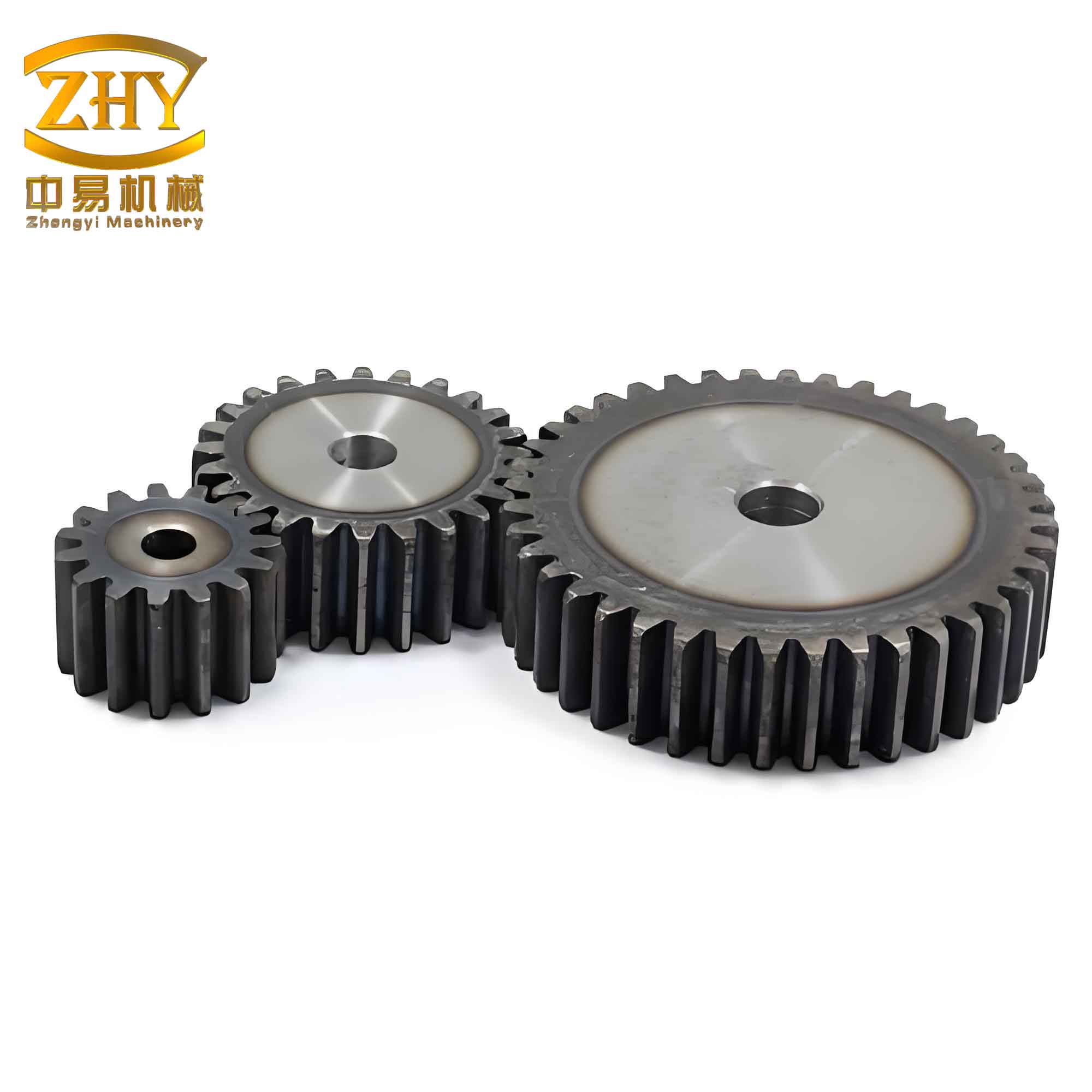
The core challenge addressed here is the coupled nature of the problem: the mesh stiffness is an excitation source for dynamics, while the dynamic state (rotational speed) modifies the stiffness itself. To resolve this, we model the gear tooth as a Euler-Bernoulli beam attached to a rotating rigid hub. The governing equations of motion for the flexible gear body are derived using Hamilton’s principle, leading to a system that includes mass, damping, elastic stiffness, and crucially, a centrifugal stiffness matrix proportional to the square of the driving speed.
The kinetic energy \( T_i \) of a rotating gear segment accounts for both translational and rotational inertia. Considering a point on a deformed tooth, its velocity vector \( \dot{\mathbf{P}}_T \) in the inertial frame is derived from its position, which includes both rigid-body rotation and elastic deflections \( u \) and \( v \). The kinetic energy is then:
$$ T_i = \frac{1}{2} \rho \int \dot{\mathbf{P}}_T \cdot \dot{\mathbf{P}}_T dV $$
where \( \rho \) is the material density and \( dV \) is the volume element. The potential energy \( U \) is based on the nonlinear axial strain \( \epsilon_{xx} \) in the beam, which includes coupling terms between axial and transverse displacements:
$$ \epsilon_{xx} = u’ + \frac{1}{2}\left[ (u’)^2 + (v’)^2 \right] $$
$$ U = \frac{1}{2} \int E \epsilon_{xx}^2 dV $$
Here, \( E \) is the Elastic modulus, and the prime \( (‘) \) denotes a derivative with respect to the axial coordinate \( x \). Applying Hamilton’s principle, \( \delta \int (U – T) dt = 0 \), yields the system’s equation of motion:
$$ (\mathbf{M}_t + \mathbf{M}_r)\ddot{\mathbf{X}} + (\mathbf{C}_r + \mathbf{C}_p)\dot{\mathbf{X}} + (\mathbf{K}_e + \mathbf{K}_v)\mathbf{X} = \mathbf{F} + \mathbf{F}_v $$
The matrices in this equation represent distinct physical influences:
- \( \mathbf{M}_t \): Translational mass matrix.
- \( \mathbf{M}_r \): Rotational inertia mass matrix.
- \( \mathbf{C}_r \): Rayleigh damping matrix, \( \mathbf{C}_r = \alpha \mathbf{M} + \beta \mathbf{K} \).
- \( \mathbf{C}_p \): Gyroscopic damping matrix, arising from the rotation.
- \( \mathbf{K}_e \): Conventional elastic stiffness matrix.
- \( \mathbf{K}_v \): Centrifugal stiffness matrix, a function of driving speed \( \dot{\theta}^2 \).
- \( \mathbf{F}_v \): Nodal centrifugal force vector.
- \( \mathbf{F} \): External meshing force vector.
The explicit form of the elemental centrifugal stiffness matrix \( \mathbf{K}_v \) highlights its direct dependency on speed:
$$ \mathbf{K}_v = \frac{\rho A \Delta L \dot{\theta}^2}{210} \begin{bmatrix}
-70 & 0 & 0 & -35 & 0 & 0\\
0 & K^v_{22} & K^v_{23} & 0 & K^v_{25} & K^v_{26}\\
0 & K^v_{23} & K^v_{33} & 0 & -K^v_{26} & K^v_{36}\\
-35 & 0 & 0 & -70 & 0 & 0\\
0 & K^v_{25} & -K^v_{26} & 0 & K^v_{22} & -K^v_{23}\\
0 & K^v_{26} & K^v_{36} & 0 & -K^v_{23} & K^v_{36}
\end{bmatrix} $$
where \( A \) is the cross-sectional area, \( \Delta L \) is the element length, and the terms \( K^v_{ij} \) are functions of area \( A \) and moment of inertia \( I \). The centrifugal force vector for an element is:
$$ \mathbf{F}_v = – \frac{\rho A \Delta L \dot{\theta}^2}{2} \left( L + \frac{\Delta L}{3}, 0, 0, L + \frac{2\Delta L}{3}, 0, 0 \right)^T $$
The algorithm for calculating the dynamic mesh stiffness proceeds as follows. The meshing action is simulated by moving a unit force along the path of contact from the start to the end of engagement on a single tooth. For each discrete meshing point \( i \), the local meshing angle \( \beta_i \) and velocity \( v_i \) are calculated. The time step \( \Delta t_i \) for the dynamic analysis is determined by the time needed for the force to travel between successive contact points. The system’s equation of motion is solved incrementally using the Newmark-beta integration scheme, with the initial conditions for each step provided by the final state of the previous step. This yields the dynamic displacement vector \( \mathbf{X}_i \) for each meshing position, inclusive of the centrifugal effect. The single-tooth dynamic stiffness \( k_{pi} \) (for the pinion) is then computed from the elastic deflection components \( \Delta x_{i,x} \) and \( \Delta x_{i,y} \) at the force application point:
$$ k_{pi} = \frac{F_i}{ \Delta x_{i,x} \cos(\pi/2 – \beta_i) + \Delta x_{i,y} \cos \beta_i } $$
The same procedure is applied to the gear wheel to obtain \( k_{gi} \). The total dynamic mesh stiffness for a gear pair in single-tooth contact is the series combination:
$$ k_{ms} = \frac{k_{pi} k_{gi}}{k_{pi} + k_{gi}} $$
For double-tooth contact regions, the total stiffness is the sum of the stiffnesses from the two simultaneously engaged tooth pairs.
The proposed method was validated against established finite element analysis (FEA) under quasi-static conditions (\( \dot{\theta}_p = 0.01 \) rpm). The calculated single-tooth stiffness showed excellent agreement with static FEA results. A comparison at a moderate speed of 300 rpm revealed that while the mean stiffness values were consistent, the new algorithm predicted larger fluctuations around the mean, attributed to the dynamic coupling and centrifugal effect which standard FEA often neglects in transient dynamics.
The model was applied to a standard spur gear pair. The parameters of the analyzed cylindrical gears are summarized below:
| Parameter | Pinion | Gear |
|---|---|---|
| Number of Teeth | 27 | 41 |
| Module (mm) | 2.5 | |
| Face Width (mm) | 10 | |
| Pressure Angle (°) | 20 | |
| Elastic Modulus, E (GPa) | 207 | |
| Density, ρ (kg/m³) | 7850 | |
The influence of driving speed was investigated comprehensively. The results confirm a strong centrifugal effect. As the rotational speed increases, the mean value of the dynamic mesh stiffness rises—a phenomenon known as centrifugal hardening. Simultaneously, the amplitude of stiffness fluctuation within a mesh cycle also increases. This is because the reduced time interval between successive loading points at higher speeds prevents the complete recovery of tooth deflection from the previous contact, leading to a cumulative dynamic response. The effect is more pronounced in the double-tooth contact zone due to the greater overall system compliance and energy present.
Furthermore, the centrifugal effect significantly impacts the system’s natural frequencies. Campbell diagrams were constructed for both the pinion and gear, considering two cases: with only the translational mass matrix, and with both translational and rotational inertia matrices. The diagrams reveal that certain modal frequencies split and increase with speed (centrifugal stiffening), while others remain relatively constant. A critical observation was the occurrence of a frequency veering phenomenon near 12,790 rpm when rotational inertia was included, indicating strong modal coupling induced by high-speed rotation. The first few natural frequencies from the proposed algorithm were validated against FEA modal analysis for a non-rotating gear, showing errors below 5%, as seen in the table below.
| Mode | Pinion Natural Frequency (Hz) – Proposed Method | Pinion Natural Frequency (Hz) – FEA | Error (%) |
|---|---|---|---|
| 1 | 35,850 | 36,158 | 0.85 |
| 2 | 44,731 | 43,880 | 1.93 |
| 3 | 120,102 | 126,220 | 4.87 |
| 4 | 132,534 | 134,160 | 1.21 |
| 5 | 138,663 | 146,614 | 5.42 |
The study also investigated the role of gear material properties on the dynamic mesh stiffness under the centrifugal effect. Four common materials were analyzed: a hard aluminum alloy, cast iron, ceramic, and carbon fiber nylon. Their key properties are listed below.
| Material | Elastic Modulus, E (GPa) | Density, ρ (kg/m³) | Specific Modulus (E/ρ) (m) |
|---|---|---|---|
| Hard Aluminum Alloy | 70 | 2700 | 2.59e7 |
| Cast Iron | 207 | 7890 | 2.62e7 |
| Carbon Fiber Nylon | 230 | 1760 | 13.07e7 |
| Ceramic | 410 | 3150 | 13.02e7 |
The growth rate (increase in mean stiffness) and volatility rate (amplitude of fluctuation) of the dynamic mesh stiffness were evaluated across a range of speeds. The results demonstrate that:
1. Both growth and volatility rates increase monotonically with driving speed for all materials.
2. The aluminum alloy exhibits the highest growth rate due to its low elastic modulus, which makes it more susceptible to geometric stiffening from centrifugal forces.
3. While cast iron and carbon fiber nylon have similar elastic moduli, cast iron shows a higher growth rate because of its significantly greater density, which amplifies the centrifugal forces.
4. Materials with a high specific modulus (like carbon fiber nylon and ceramics) demonstrate superior stability, showing relatively lower stiffness volatility at high speeds. This makes them excellent candidates for high-speed cylindrical gears where vibration suppression is critical.
The inclusion of the rotational inertia mass matrix \( \mathbf{M}_r \) was found to be essential for accuracy at high speeds. The table below compares the stiffness growth rate for different materials at various speeds, calculated with only the translational mass matrix \( \mathbf{M}_t \) versus with both \( \mathbf{M}_t \) and \( \mathbf{M}_r \). The discrepancy grows with speed, confirming that the rotational inertia effect is non-negligible in high-speed gear dynamics.
| Mass Matrix Used | Material | Growth Rate @ 2000 rpm (%) | Growth Rate @ 6000 rpm (%) | Growth Rate @ 10000 rpm (%) |
|---|---|---|---|---|
| M_t only | Hard Aluminum Alloy | 14.31 | 50.24 | 70.10 |
| M_t + M_r | Hard Aluminum Alloy | 15.71 | 53.85 | 86.50 |
| M_t only | Cast Iron | 12.78 | 46.77 | 65.57 |
| M_t + M_r | Cast Iron | 13.45 | 49.93 | 69.02 |
| M_t only | Ceramic | 3.39 | 21.73 | 38.26 |
| M_t + M_r | Ceramic | 3.83 | 24.60 | 47.10 |
| M_t only | Carbon Fiber Nylon | 3.30 | 20.34 | 36.56 |
| M_t + M_r | Carbon Fiber Nylon | 3.30 | 21.74 | 37.71 |
In conclusion, the developed computational framework provides a physically accurate and efficient method for determining the dynamic mesh stiffness of spur cylindrical gears, fully accounting for the centrifugal effect. The key findings are:
1. The dynamic mesh stiffness exhibits centrifugal hardening and increased fluctuation amplitude with higher driving speeds, effects that are most pronounced in double-tooth contact regions.
2. The model predicts critical dynamic phenomena such as frequency veering, which are essential for analyzing high-speed gear stability.
3. Material selection has a profound impact. A high elastic modulus effectively mitigates the centrifugal stiffening effect, while a low density minimizes the driving force behind it. Materials with a high specific modulus offer the best dynamic performance for high-speed cylindrical gears.
4. For high-fidelity analysis, especially at elevated speeds, the inclusion of both translational and rotational inertia terms in the mass matrix is necessary.
This work establishes a foundation for more realistic dynamic modeling of gear systems, enabling better prediction of vibration and noise, and informing the optimal design of high-speed cylindrical gears for advanced mechanical transmission applications.