
In the field of mechanical transmission, spur gears are among the most commonly used components due to their simplicity and efficiency. However, in practical applications, factors such as installation errors and load-induced deformations often lead to issues like impact loads, vibrations, and noise during operation. To mitigate these problems, tooth surface modification is employed to alter the geometric shape of the gear teeth, thereby enhancing the performance of gear systems. Traditional modification methods include profile modification, lead modification, and comprehensive modification that combines both. While these approaches have shown effectiveness, they often rely on specific functions like linear, parabolic, or arc curves, which can limit flexibility and continuity. For instance, linear modifications may result in discontinuous first derivatives, and parabolic modifications may have discontinuous second derivatives, potentially degrading meshing performance. To address these limitations, we propose a novel tooth surface design for spur gears using a double spline curve modification method. This method employs spline curves to define both the tooth profile and lead direction, offering greater flexibility, higher-order continuity, and a more generic model that encompasses traditional modification curves as special cases. In this article, we present the mathematical modeling, finite element analysis (FEA) comparisons, and experimental validation of this approach, demonstrating its superiority over conventional comprehensive modification methods for spur gears.
The design of spur gears with double spline modification begins with understanding the generation of gear tooth surfaces. Typically, spur gears are manufactured via processes like grinding, where a grinding wheel’s profile and motion trajectory determine the final tooth geometry. In standard spur gear production, the grinding wheel profile matches the standard tooth profile, and its motion is parallel to the gear axis. For modification, we alter both the grinding wheel profile and its radial feed trajectory using spline curves. This allows for controlled deviations from the standard tooth surface, enabling customized modifications that improve meshing behavior. The core idea is to represent the modified tooth profile and lead lines as spline curves, which are defined by control points and their offsets. This provides a versatile framework where design variables can be easily adjusted to optimize performance, ensuring that the entire tooth surface achieves higher-order continuity, such as second-order continuity when using quartic basis functions. This is particularly beneficial for spur gears, as it reduces stress concentrations and enhances load distribution.
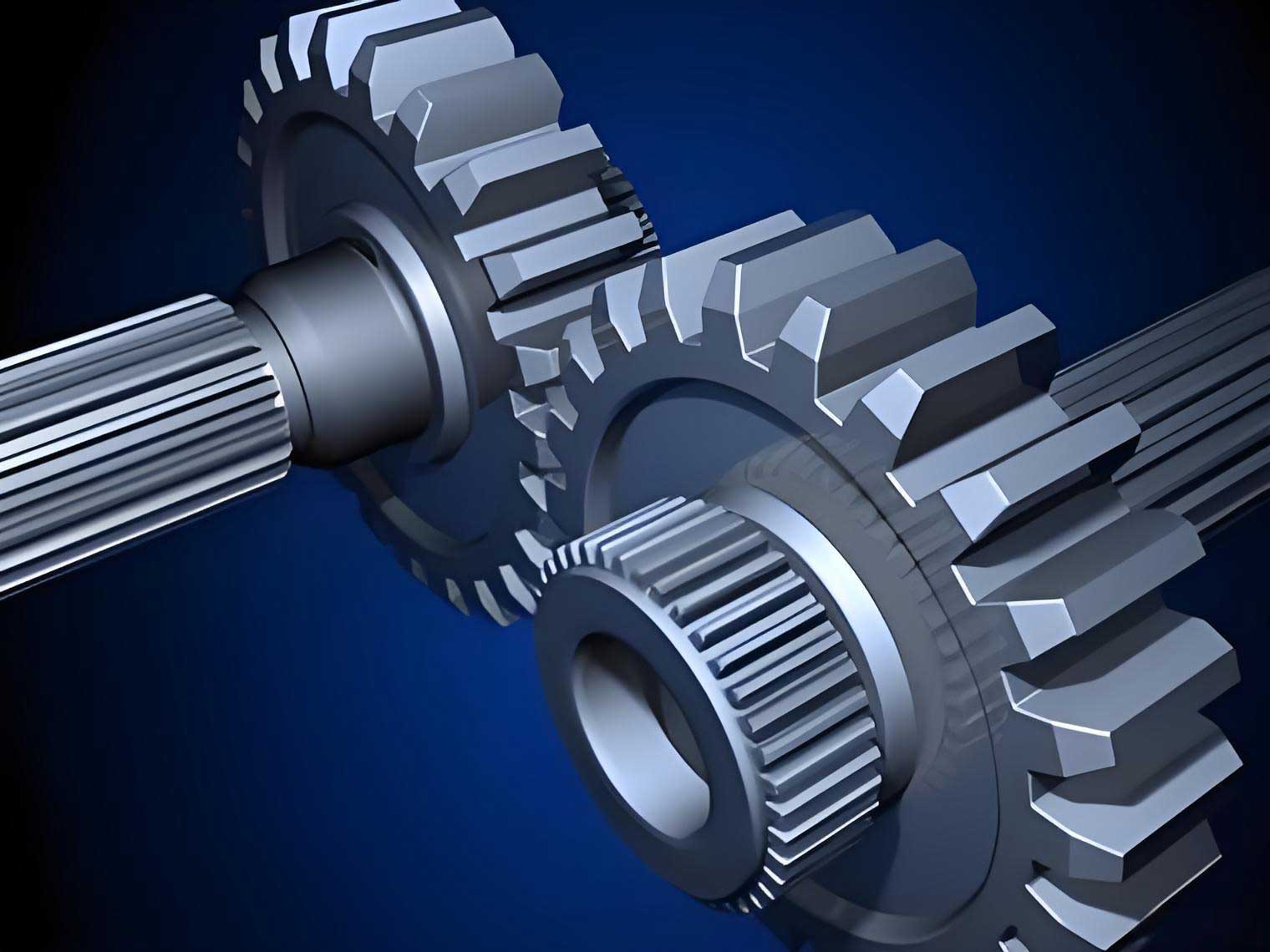
To establish the mathematical foundation, we first derive the standard tooth profile of spur gears based on a rack cutter model. The rack cutter profile consists of three segments: a straight line at the tip, a circular arc at the corner, and the involute segment. Using coordinate transformations and meshing equations, the gear tooth surface equations in the gear coordinate system \( S_g \) can be obtained. For the straight line segment \( AB \), the surface equation and unit normal vector are given by:
$$ \mathbf{r}_{AB}^g(l_1) = \begin{bmatrix} l_1 \cos \phi_1 + (x – h_{fc}) \sin \phi_1 – r_{pg} (\phi_1 \cos \phi_1 – \sin \phi_1) \\ -l_1 \sin \phi_1 + (x – h_{fc}) \cos \phi_1 + r_{pg} (\phi_1 \sin \phi_1 + \cos \phi_1) \\ 0 \end{bmatrix}, \quad \mathbf{n}_{AB}^g(l_1) = \begin{bmatrix} \sin \phi_1 \\ \cos \phi_1 \\ 0 \end{bmatrix} $$
where \( c\phi_1 = \cos \phi_1 \), \( s\phi_1 = \sin \phi_1 \), \( \phi_1 = l_1 / r_{pg} \), and \( l_1 \in [0, a] \). Here, \( a = p/4 – \rho / \cos \alpha – (h_{fc} – \rho) \tan \alpha \), with \( \alpha \) as the pressure angle, \( p \) as the pitch, \( x \) as the radial shift, \( \rho \) as the tip radius, \( h_{fc} \) as the addendum height, and \( r_{pg} \) as the pitch radius. For the circular arc segment \( BC \), the equations are:
$$ \mathbf{r}_{BC}^g(l_2) = \begin{bmatrix} (a + \rho \cos l_2) \cos \phi_2 + (-b + \rho \sin l_2) \sin \phi_2 – r_{pg} (\phi_2 \cos \phi_2 – \sin \phi_2) \\ -(a + \rho \cos l_2) \sin \phi_2 + (-b + \rho \sin l_2) \cos \phi_2 + r_{pg} (\phi_2 \sin \phi_2 + \cos \phi_2) \\ 0 \end{bmatrix}, \quad \mathbf{n}_{BC}^g(l_2) = \begin{bmatrix} \cos(l_2 – \phi_2) \\ \sin(l_2 – \phi_2) \\ 0 \end{bmatrix} $$
where \( b = h_{fc} – \rho – x \), \( \phi_2 = \frac{a \sin l_2 + b \cos l_2}{r_{pg} \sin l_2} \), and \( l_2 \in \left[ \frac{3}{2}\pi, 2\pi – \alpha \right] \). For the involute segment \( CD \), we have:
$$ \mathbf{r}_{CD}^g(l_3) = \begin{bmatrix} l_3 \cos \phi_3 + \left( (l_3 – p/4) \cot \alpha + x \right) \sin \phi_3 – r_{pg} (\phi_3 \cos \phi_3 – \sin \phi_3) \\ -l_3 \sin \phi_3 + \left( (l_3 – p/4) \cot \alpha + x \right) \cos \phi_3 + r_{pg} (\phi_3 \sin \phi_3 + \cos \phi_3) \\ 0 \end{bmatrix}, \quad \mathbf{n}_{CD}^g(l_3) = \begin{bmatrix} -\cos(\alpha + \phi_3) \\ \sin(\alpha + \phi_3) \\ 0 \end{bmatrix} $$
with \( \phi_3 = \frac{(l_3 – p/4) \cot^2 \alpha + x \cot \alpha + l_3}{r_{pg}} \) and \( l_3 \in [p/4 – (h_{fc} – \rho) \tan \alpha – \rho \sin \alpha \tan \alpha, p/4 + h_{ac} \tan \alpha] \), where \( h_{ac} \) is the dedendum height. These equations form the basis for the standard spur gear tooth surface, which we modify using spline curves.
The double spline modification method involves defining two spline curves: one for the tooth profile and another for the lead direction. For the tooth profile spline, we discretize the standard tooth profile into sample points, typically seven points \( P_1 \) to \( P_7 \), distributed along the tooth height from the base circle radius \( r_b \) to the tip circle radius \( r_a \). Points \( P_1 \) to \( P_4 \) are equally spaced between \( r_b \) and an intermediate radius \( r_s \), while points \( P_4 \) to \( P_7 \) are equally spaced between \( r_s \) and \( r_a \). Each sample point is offset along its normal vector by a specified amount \( \Delta p \). The offsets are interpolated using a Bézier curve to define a continuous offset function \( \Delta p(r_h) \), where \( r_h \) is the radial distance from the gear axis. This allows for smooth transitions and higher-order continuity. For instance, using a cubic Bézier curve for segments \( P_1 \)-\( P_4 \) and \( P_4 \)-\( P_7 \), the offset function can be expressed as:
For \( r_h \in [r_b, r_s] \): $$ \Delta p(r_h) = (-\Delta p_1 + 3\Delta p_2 – 3\Delta p_3 + \Delta p_4) \left( \frac{r_h – r_b}{r_s – r_b} \right)^3 + (3\Delta p_1 – 6\Delta p_2 + 3\Delta p_3) \left( \frac{r_h – r_b}{r_s – r_b} \right)^2 + (-3\Delta p_1 + 3\Delta p_2) \left( \frac{r_h – r_b}{r_s – r_b} \right) + \Delta p_1 $$
For \( r_h \in [r_s, r_a] \): $$ \Delta p(r_h) = (-\Delta p_4 + 3\Delta p_5 – 3\Delta p_6 + \Delta p_7) \left( \frac{r_a – r_h}{r_a – r_s} \right)^3 + (3\Delta p_4 – 6\Delta p_5 + 3\Delta p_6) \left( \frac{r_a – r_h}{r_a – r_s} \right)^2 + (-3\Delta p_4 + 3\Delta p_5) \left( \frac{r_a – r_h}{r_a – r_s} \right) + \Delta p_4 $$
The modified tooth profile curve coordinates \( \mathbf{C}_p(r_h) = [x_p, y_p, 0]^T \) are then given by:
$$ \mathbf{C}_p(r_h) = \begin{bmatrix} x_g \mp \Delta p \cdot n_{CDgx} \\ y_g – \Delta p \cdot n_{CDgy} \\ 0 \end{bmatrix} $$
where \( (x_g, y_g) \) are coordinates of the standard tooth profile, \( n_{CDgx} \) and \( n_{CDgy} \) are components of the unit normal vector, and the signs depend on the left or right flank of the spur gears. Similarly, for the lead spline curve, we discretize the standard lead line along the tooth width \( F \) into seven sample points \( P_1 \) to \( P_7 \), equally spaced from the front face \( z_g = 0 \) to the back face \( z_g = F \). Each point is offset along the \( y_g \)-direction by an amount \( \Delta l \), and these offsets are interpolated using another Bézier curve to define \( \Delta l(f) \), where \( f \) is the coordinate along the tooth width. The lead spline curve coordinates \( \mathbf{C}_l(f) = [0, y_l, z_l]^T \) are:
$$ \mathbf{C}_l(f) = \begin{bmatrix} 0 \\ \pm \Delta l \\ f \end{bmatrix} $$
with the offset function for segments derived similarly. For example, for \( f \in [0, F/2] \):
$$ \Delta l(f) = \frac{8}{F^3} (-\Delta l_1 + 3\Delta l_2 – 3\Delta l_3 + \Delta l_4) f^3 + \frac{4}{F^2} (3\Delta l_1 – 6\Delta l_2 + 3\Delta l_3) f^2 + \frac{2}{F} (-3\Delta l_1 + 3\Delta l_2) f + \Delta l_1 $$
And for \( f \in [F/2, F] \):
$$ \Delta l(f) = \frac{8}{F^3} (-\Delta l_4 + 3\Delta l_5 – 3\Delta l_6 + \Delta l_7) f^3 + \frac{4}{F^2} (3\Delta l_4 – 6\Delta l_5 + 3\Delta l_6) f^2 + \frac{2}{F} (-3\Delta l_4 + 3\Delta l_5) f + \Delta l_4 $$
The modified tooth surface for spur gears is then generated by sweeping the tooth profile spline curve along the lead spline curve. Mathematically, the surface equation \( \mathbf{r}(l_3, f) \) in the gear coordinate system is:
$$ \mathbf{r}(l_3, f) = \begin{bmatrix} x_g \mp \Delta p \cdot n_{CDgx} \\ y_g – \Delta p \cdot n_{CDgy} \pm \Delta l(f) \\ f \end{bmatrix} $$
This parametric representation allows for flexible design adjustments by varying the control point offsets \( \Delta p_i \) and \( \Delta l_i \). The use of spline curves ensures that the tooth surface of spur gears has continuous derivatives up to the desired order, which is crucial for reducing stress concentrations and improving meshing performance. In practice, this model can be implemented in CAD software to generate 3D models for analysis and manufacturing.
To evaluate the performance of spur gears with double spline modification, we conducted finite element analysis (FEA) comparing it with traditional comprehensive modification, specifically double parabolic modification, which is widely used in industry. The gear pair parameters are summarized in Table 1. We focused on varying the offset \( \Delta p_6 \) of the tooth profile spline to explore its impact on meshing behavior, while keeping other parameters consistent with traditional modification for fair comparison.
| Parameter | Driver Gear | Driven Gear |
|---|---|---|
| Number of Teeth | 29 | 49 |
| Module (mm) | 3 | 3 |
| Pressure Angle (°) | 25 | 25 |
| Face Width (mm) | 20 | 20 |
| Traditional Modification (μm) | Max: 29.2 (Profile: 21.4, Lead: 7.8) | Max: 29.2 (Profile: 21.4, Lead: 7.8) |
| Double Spline Boundary Values (μm) | Max: 29.2; Profile: P4 at 89.476 mm, P5: 2.4, P6: variable, P7: 21.4; Lead: 7.8 | Max: 29.2; Profile: P4 at 149.673 mm, P5: 2.4, P6: variable, P7: 21.4; Lead: 7.8 |
We considered three values for \( \Delta p_6 \): 5 μm, 9.5 μm (reference value equivalent to parabolic modification), and 15 μm. The FEA results for transmission error (TE), static transmission error spectrum, and mesh stiffness are presented. Transmission error curves, which indicate deviations from ideal motion transfer, are shown in Figure 1 (though not displayed here, described in text). For spur gears with double spline modification, as \( \Delta p_6 \) increases, the TE curves become smoother with reduced amplitude fluctuations. Specifically, at \( \Delta p_6 = 15 \mu m \), the TE curve is notably flatter compared to the traditional modification at \( \Delta p_6 = 9.5 \mu m \), suggesting improved vibration and noise characteristics. This highlights the flexibility of the double spline method in optimizing spur gears for better performance.
The static transmission error spectrum amplitudes for different \( \Delta p_6 \) values are summarized in Table 2. The spectrum analysis reveals that as \( \Delta p_6 \) increases, the amplitudes at the first and second harmonics decrease significantly. This reduction indicates lower vibration levels, demonstrating the advantage of double spline modification over traditional methods for spur gears.
| Harmonic Order | \( \Delta p_6 = 5 \mu m \) (μm) | \( \Delta p_6 = 9.5 \mu m \) (μm) | \( \Delta p_6 = 15 \mu m \) (μm) |
|---|---|---|---|
| 1 | 0.9263 | 0.4514 | 0.3364 |
| 2 | 0.8400 | 0.6133 | 0.3107 |
| 3 | 0.2554 | 0.2704 | 0.2265 |
| 4 | 0.0866 | 0.0037 | 0.0845 |
| 5 | 0.1124 | 0.0908 | 0.0165 |
| 6 | 0.0105 | 0.0493 | 0.0513 |
| 7 | 0.0394 | 0.0094 | 0.0367 |
| 8 | 0.0117 | 0.0259 | 0.0025 |
Mesh stiffness curves, which reflect the resistance to deformation under load, are also analyzed. As shown in Figure 2 (described in text), the peak-to-peak values of mesh stiffness decrease with increasing \( \Delta p_6 \). For \( \Delta p_6 = 15 \mu m \), the mesh stiffness curve is smoother and has a lower amplitude compared to the traditional modification, indicating enhanced transmission stability for spur gears. This is attributed to the better load distribution achieved through the double spline modification, which reduces edge effects and stress concentrations. The ability to adjust control points like \( \Delta p_6 \) provides designers with a powerful tool to tailor spur gears for specific applications, surpassing the limitations of fixed parabolic or linear modifications.
To validate the practical feasibility of the double spline modification method for spur gears, we conducted machining and measurement experiments. A spur gear pair with parameters from Table 1 and \( \Delta p_6 = 15 \mu m \) was manufactured using a CNC gear grinding machine. The gears were then inspected on a gear measurement center to evaluate profile errors. The results, shown in Table 3, indicate that the profile accuracy meets high standards, with the driver gear achieving Grade 4 and the driven gear Grade 3 according to GB/T 10095.1-2008. This confirms that the double spline modification can be effectively implemented in real-world production of spur gears.
| Gear | Maximum Profile Slope Error (μm) | Total Profile Error (μm) | Profile Form Error (μm) | Accuracy Grade |
|---|---|---|---|---|
| Driver | 3.4 | 5.0 | 3.3 | 4 |
| Driven | 1.3 | 2.9 | 2.5 | 3 |
In conclusion, the double spline modification method offers a significant advancement in the design of spur gears. By utilizing spline curves for both tooth profile and lead modifications, it provides a generic, flexible, and high-continuity approach that overcomes the limitations of traditional methods. The mathematical model allows for precise control through adjustable parameters, enabling optimization of meshing performance. FEA comparisons demonstrate that spur gears with double spline modification exhibit smoother transmission error curves, reduced vibration amplitudes, and improved mesh stiffness compared to traditional comprehensive modification. Experimental validation confirms the manufacturability and accuracy of this method. Therefore, the double spline modification is a promising technology for developing high-performance spur gears in various industrial applications. Future work could explore the application of this method to helical gears or other gear types, as well as dynamic analysis under varying load conditions to further enhance the design of spur gears.
The advantages of double spline modification for spur gears can be summarized in several key points. First, it allows for higher-order continuity across the entire tooth surface, which minimizes stress concentrations and improves fatigue life. Second, the use of spline curves provides a unified framework that encompasses traditional modification curves as special cases, simplifying the design process. Third, the increased number of control variables enables finer adjustments to optimize performance for specific operating conditions. This is particularly important for spur gears used in high-precision applications such as robotics, aerospace, and automotive systems. Additionally, the method facilitates digital manufacturing through CAD/CAM integration, reducing prototyping time and costs. As industries demand more efficient and quieter gear systems, the double spline modification method for spur gears represents a step forward in meeting these challenges.
From a mathematical perspective, the double spline modification can be extended using higher-degree basis functions for even greater continuity. For example, using quartic B-spline curves ensures second-order continuity (C²), which is beneficial for reducing impact forces during meshing of spur gears. The general form of a B-spline curve of degree \( k \) is given by:
$$ \mathbf{C}(u) = \sum_{i=0}^{n} \mathbf{P}_i N_{i,k}(u) $$
where \( \mathbf{P}_i \) are control points, \( N_{i,k}(u) \) are the B-spline basis functions defined on a knot vector, and \( u \) is the parameter. By adapting this to tooth profile and lead modifications, designers can achieve custom modifications for spur gears with precise control over curvature and smoothness. This mathematical flexibility is a key advantage over fixed-function modifications.
In terms of implementation, the double spline modification method for spur gears can be integrated into existing gear design software. By providing a library of spline curves and optimization algorithms, designers can automatically determine optimal control point offsets based on load cases, material properties, and desired performance metrics. This automation reduces the trial-and-error approach often associated with gear modification, saving time and resources. Furthermore, the method supports sustainability goals by enabling lighter and more durable spur gears, which contribute to energy efficiency in mechanical systems.
Looking ahead, research could focus on coupling the double spline modification with advanced manufacturing techniques such as additive manufacturing for spur gears. This would allow for complex tooth geometries that are difficult to achieve with traditional methods, opening new possibilities for lightweight and high-strength gear designs. Additionally, real-time monitoring and adaptive control during machining could ensure that the designed spline curves are accurately reproduced, further enhancing the quality of spur gears. As the industry moves toward Industry 4.0, such digital twin approaches will become increasingly important for spur gear production.
In summary, the double spline modification method represents a paradigm shift in the design of spur gears. By leveraging the power of spline curves, it offers unparalleled flexibility, continuity, and performance optimization. The successful validation through FEA and experiments underscores its practicality and effectiveness. As spur gears continue to be fundamental components in machinery, adopting advanced modification methods like this will drive innovation and improve overall system reliability. We encourage gear designers and manufacturers to explore this method to unlock the full potential of spur gears in their applications.