
In the field of gear transmission, cone-differential drives represent a spatial planetary mechanism capable of achieving multi-tooth engagement. These drives offer unique advantages such as simple structure, high transmission ratio, efficiency, and load capacity, making them increasingly applied in various industries in recent years. This type of transmission utilizes offset internal straight bevel gears for speed reduction, but the tooth surface geometry and machining methods have long remained unresolved. The internal straight bevel gears, when expanded on the back cone, equate to internal cylindrical gears with concave tooth profiles. Conventional straight bevel gears are typically machined using existing machine tools based on the “flat-top generating gear” principle, which only produces convex teeth. To address this, we have delved into the meshing theory of this gear pair and propose a novel machining approach: the large gear (internal straight bevel gear) is formed via planing, while the small gear (external straight bevel gear) is generated with crowning corrections. This method is grounded in second-order tooth surface generation theory, where the internal straight bevel gear employs a planar tooth surface Σ₂, and the small gear tooth surface Σ₁ is modified into a crowned shape to achieve localized area contact with Σ₂—theoretically point contact—ensuring ideal second-order meshing parameters at a specified reference point for optimal transmission performance and meshing quality. This article, based on second-order tooth surface generation theory, explores a new method for machining internal straight bevel gear pairs using ordinary bevel gear planers. Through machine adjustments, we can control both the position and the shape and size of the contact pattern.
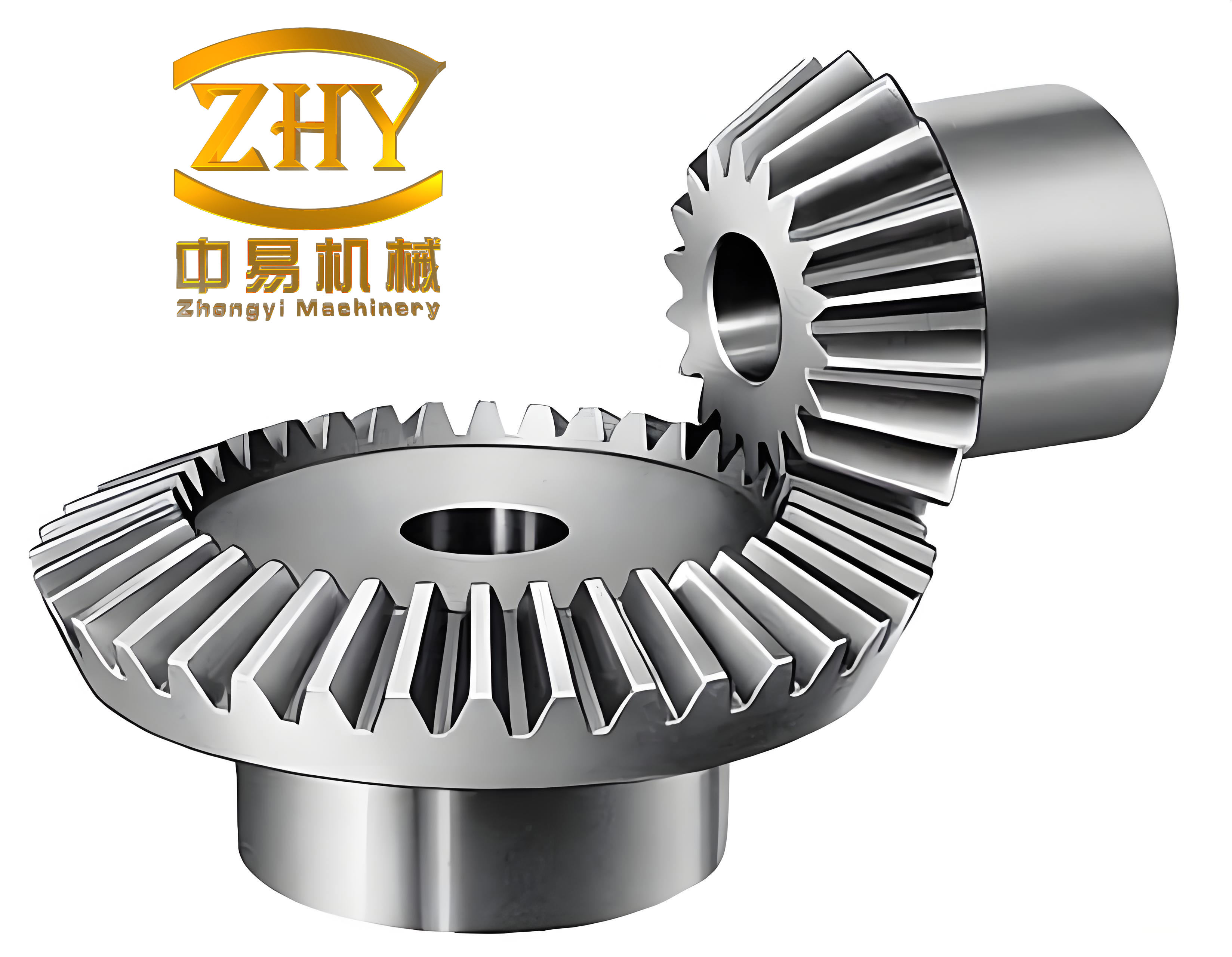
Straight bevel gears are crucial components in many mechanical systems, and their precise machining is essential for efficient power transmission. The offset cone-differential drive relies heavily on the accurate fabrication of these straight bevel gears to achieve its promised benefits. In this work, we focus on the internal straight bevel gear pair, which presents distinct challenges due to its concave tooth form. Our proposed method aims to overcome these challenges by integrating forming and generating techniques, ensuring that the gears exhibit desirable contact characteristics under load.
Meshing Principles for Internal Straight Bevel Gears
The meshing of straight bevel gears can be analyzed using spatial engagement theory. For an internal straight bevel gear pair with a small tooth difference, the equivalent cylindrical gears on the back cone are internal gears, leading to concave convex interactions. The fundamental equation of meshing is derived from the condition that the common normal at the contact point must intersect the line of centers. For straight bevel gears, this translates to specific relationships between the pitch cone angles and tooth profiles. We start by defining coordinate systems: let $S_f$ be the fixed coordinate system attached to the machine, $S_1$ and $S_2$ be coordinate systems attached to the small and large straight bevel gears respectively, and $S_c$ be the coordinate system of the generating gear. The tooth surface of the generating gear, represented as a tool surface, is a plane formed by the planing tool’s cutting edge. Its vector equation in $S_c$ is:
$$ \mathbf{r}_c = \mathbf{r}_c(u, v) = u\mathbf{i}_c + v\mathbf{j}_c + 0\mathbf{k}_c $$
where $u$ and $v$ are parameters on the plane. Transforming this to $S_2$ gives the tooth surface equation for the large internal straight bevel gear:
$$ \mathbf{r}_2 = \mathbf{M}_{2c} \cdot \mathbf{r}_c $$
Here, $\mathbf{M}_{2c}$ is the transformation matrix from $S_c$ to $S_2$. For a planar tooth surface, this results in a simple form, indicating that the large gear has a planar tooth surface, which is a收缩齿内锥齿轮 (contracted tooth internal straight bevel gear). This simplification facilitates forming machining.
Proposed Machining Method for Straight Bevel Gears
Our new machining method bifurcates the process for the two gears. The large internal straight bevel gear is produced via form planing, eliminating the generating motion between the imaginary generating gear and the workpiece. This is feasible because its tooth surface is planar. For the small external straight bevel gear, we use generating planing with crowning corrections based on second-order theory. The key steps are:
- Form Planing of Large Internal Straight Bevel Gear: On a bevel gear planer, the摇台 (cradle) generating motion is disabled. The tool’s cutting edge, moving reciprocally, forms the planar tooth surface directly. The machine setup parameters are fixed to achieve the desired pitch cone angle and tooth depth.
- Generating with Crowning for Small External Straight Bevel Gear: Using the flat-top generating gear principle, the small gear is cut with modifications to its machine settings to introduce crowning along the tooth length. This involves adjustments in wheel position,床位 (bed distance), and tool tilt.
This approach ensures that the pair of straight bevel gears engages with localized contact, reducing sensitivity to misalignment and deformation.
Second-Order Tooth Surface Generation Theory
To achieve high-quality meshing, we employ second-order tooth surface generation theory. This theory allows us to control the contact ellipse’s orientation and size at the reference point. For the pair of straight bevel gears, we define three independent second-order parameters at the reference point $P$ on the tooth surface:
- $i’$: The rate of change of the instantaneous transmission ratio with respect to time.
- $\psi$: The angle between the tangent to the contact path and the pitch cone tooth line.
- $a$: The projection of the instantaneous contact ellipse length along the tooth length direction.
These parameters uniquely determine the curvature characteristics of the tooth surface. From the meshing condition, the relative velocity $\mathbf{v}^{(12)}$ at $P$ must satisfy:
$$ \mathbf{n} \cdot \mathbf{v}^{(12)} = 0 $$
where $\mathbf{n}$ is the unit normal. The second-order parameters relate to the induced normal curvature $\kappa_n^{(12)}$ and geodesic torsion $\tau_g^{(12)}$. Specifically, for the reference point on the pitch cone tooth line, we have:
$$ \kappa_n^{(12)} = \frac{(\mathbf{v}^{(12)})^T \cdot \mathbf{K} \cdot \mathbf{v}^{(12)}}{\|\mathbf{v}^{(12)}\|^2} $$
Here, $\mathbf{K}$ is the curvature matrix. Given the planar surface of the large straight bevel gear, its curvatures are zero, simplifying the calculation for the small gear’s crowned surface. We set target values for $i’$, $\psi$, and $a$ to derive the required machine adjustments.
Crowning Correction for Small Straight Bevel Gears
Crowning is introduced to the small straight bevel gear to localize contact and improve load distribution. In conventional planing, crowning is achieved by altering the generating pitch cone, causing the process pitch cone apex to not coincide with the work pitch cone apex. The key adjustment parameters, illustrated in Figure 1 (conceptual), are:
- $\Delta A$: Apex change amount, which controls the crowning magnitude. Typically, $\Delta A = k \cdot R_m$, where $k$ is the crowning coefficient (0.001 to 0.003) and $R_m$ is the mean cone distance.
- $\Delta \delta_1$: Change in pitch cone angle.
- $\Delta X_b$: Bed distance adjustment.
- $\Delta X_p$: Axial wheel position adjustment.
- $\Delta E$: Tool tangential displacement.
- $\alpha_t$: Tool pressure angle adjustment.
The mathematical derivation involves coordinate transformations. Let $S_0$ be the fixed machine coordinate system with origin $O$ on the cradle axis, and $S_{0c}$ be the moving system attached to the tool. The tool surface, a plane, is represented in $S_{0c}$ as:
$$ \mathbf{r}_{0c} = \mathbf{r}_{0c}(s, q) = s\mathbf{i}_{0c} + q\mathbf{j}_{0c} $$
where $s$ is the parameter along the tooth length and $q$ along the tooth height. Transforming to $S_0$ and then to the workpiece system $S_1$ yields the crowned tooth surface equation. After adjustments, the surface in $S_1$ is:
$$ \mathbf{r}_1 = \mathbf{M}_{10} \cdot \mathbf{M}_{0c} \cdot \mathbf{r}_{0c} $$
The transformation matrices incorporate the adjustment parameters. For instance, the rotation matrix due to $\Delta \delta_1$ and translation due to $\Delta X_b$ and $\Delta X_p$. The detailed equations are complex, but essential for setting the machine.
To summarize the adjustments, we present the following table that correlates the crowning parameters with machine settings for straight bevel gears:
| Adjustment Parameter | Symbol | Typical Range | Effect on Straight Bevel Gears |
|---|---|---|---|
| Apex Change | $\Delta A$ | 0.1–0.3 mm | Increases crowning magnitude; larger $\Delta A$ gives more curved tooth flank. |
| Pitch Cone Angle Change | $\Delta \delta_1$ | $\Delta A / R_m$ radians | Alters the effective pitch cone for generating. |
| Bed Distance | $\Delta X_b$ | Negative for retreat (mm) | Shifts workpiece axially; affects tooth thickness and crowning. |
| Axial Wheel Position | $\Delta X_p$ | Negative for retreat (mm) | Adjusts the wheel location relative to cradle. |
| Tool Tangential Displacement | $\Delta E$ | $\Delta A \cdot \tan \alpha$ mm | Moves tool radially; influences profile curvature. |
| Tool Installation Angle | $\alpha_t$ | $\alpha + \Delta \delta_1$ degrees | Sets tool angle to match modified pitch cone. |
These adjustments ensure that the small straight bevel gear obtains the desired crowned profile, which mates properly with the planar surface of the internal straight bevel gear.
Numerical Calculation Example
To illustrate, we provide a numerical example for machining a pair of straight bevel gears with an offset cone-differential drive. The gear parameters are:
- Number of teeth: $z_2 = 30$ (large internal straight bevel gear), $z_1 = 28$ (small external straight bevel gear)
- Shaft angle: $\Sigma = 90^\circ$
- Pitch diameter: $d_2 = 150$ mm, $d_1 = 140$ mm
- Pitch cone angles: $\delta_1 = \arctan(z_1 / z_2) \approx 43.0^\circ$, $\delta_2 = 90^\circ – \delta_1 \approx 47.0^\circ$
- Module: $m = 5$ mm
- Face width: $b = 30$ mm
- Mean cone distance: $R_m = \frac{d_1}{2 \sin \delta_1} \approx 102.5$ mm
We aim for a crowning amount $\Delta C$ of about 0.02 mm (typical for straight bevel gears, where $\Delta C \approx 0.004m$). Choose crowning coefficient $k = 0.002$. Then:
$$ \Delta A = k \cdot R_m = 0.002 \times 102.5 = 0.205 \text{ mm} $$
Next, calculate the adjustment values:
- $\Delta \delta_1 = \frac{\Delta A}{R_m} = \frac{0.205}{102.5} \approx 0.002 \text{ rad} \approx 0.114^\circ$
- Roll ratio correction: $i_g = \frac{z_1}{z_2} \cdot \frac{\sin \delta_2}{\sin \delta_1} \approx 0.933$, adjusted for $\Delta \delta_1$.
- $\Delta X_b = -\Delta A \cdot \cot \delta_1 \approx -0.205 \times \cot 43.0^\circ \approx -0.220 \text{ mm}$ (bed retreats).
- $\Delta X_p = \Delta X_b \cdot \sin \delta_1 \approx -0.220 \times \sin 43.0^\circ \approx -0.150 \text{ mm}$.
- Tool pressure angle $\alpha = 20^\circ$, so $\Delta E = \Delta A \cdot \tan \alpha = 0.205 \times \tan 20^\circ \approx 0.075 \text{ mm}$.
- $\alpha_t = \alpha + \Delta \delta_1 \approx 20.114^\circ$.
These settings will produce a crowned tooth surface on the small straight bevel gear. The contact pattern can be predicted using the second-order parameters. For instance, set $i’ = 0.01 \text{ s}^{-1}$, $\psi = 30^\circ$, and $a = 5 \text{ mm}$. Then, from the meshing equations, we can verify the induced curvatures.
The crowning along the tooth length, $\Delta C(x)$, at a distance $x$ from the midpoint is approximately:
$$ \Delta C(x) = \frac{\Delta A}{R_m} \cdot x^2 $$
For $x = b/2 = 15$ mm, $\Delta C(15) = \frac{0.205}{102.5} \times 15^2 \approx 0.045 \text{ mm}$, which is acceptable.
To further elucidate, below is a table summarizing the calculated adjustments for this pair of straight bevel gears:
| Parameter | Symbol | Value | Unit |
|---|---|---|---|
| Apex Change | $\Delta A$ | 0.205 | mm |
| Pitch Cone Angle Change | $\Delta \delta_1$ | 0.114 | ° |
| Bed Distance Adjustment | $\Delta X_b$ | -0.220 | mm |
| Axial Wheel Position | $\Delta X_p$ | -0.150 | mm |
| Tool Tangential Displacement | $\Delta E$ | 0.075 | mm |
| Tool Installation Angle | $\alpha_t$ | 20.114 | ° |
| Crowning Amount at End | $\Delta C(b/2)$ | 0.045 | mm |
These calculations demonstrate the practicality of our method for straight bevel gears. The adjustments are within typical machine capabilities, ensuring feasible implementation.
Discussion on Meshing Quality
The proposed machining method for straight bevel gears enhances meshing quality by design. The crowning correction on the small straight bevel gear ensures localized contact, which tolerates minor misalignments and thermal deformations. The second-order control allows us to shape the contact ellipse favorably. For straight bevel gears, the contact ratio and stress distribution are critical. Our method aims to achieve a contact pattern centered on the tooth flank, avoiding edge loading. The theoretical point contact spreads under load due to elasticity, forming an ellipse. The size and orientation of this ellipse for straight bevel gears are governed by the relative curvatures, which we tailor via machine adjustments.
Moreover, the forming of the internal straight bevel gear simplifies its production, as no generating motion is needed. This reduces machine complexity and time. However, it requires precise tool grinding to match the planar surface. The tool geometry for straight bevel gears must account for the pitch cone angle and pressure angle. We recommend using carbide tools for durability.
In practice, after machining, the pair of straight bevel gears should be tested on a gear roll tester to verify the contact pattern. Adjustments can be fine-tuned iteratively. Our experience suggests that for straight bevel gears in offset cone-differential drives, this method yields a contact pattern that is 60-70% of the face width under light load, which is ideal.
Conclusion
We have presented a new machining method for straight bevel gears used in offset cone-differential drives. This method combines form planing for the internal straight bevel gear and generating planing with crowning corrections for the external straight bevel gear, based on second-order tooth surface generation theory. By adjusting machine parameters such as apex change, bed distance, and tool displacement, we can control the crowning and meshing characteristics of the straight bevel gears. The numerical example illustrates the calculation of these adjustments, demonstrating feasibility. This approach addresses the historical challenge of machining concave tooth profiles for internal straight bevel gears and promotes better contact quality, reduced sensitivity to errors, and improved performance. Future work includes experimental validation and optimization for mass production of straight bevel gears. Overall, this method advances the manufacturing technology for straight bevel gears, particularly in specialized applications like cone-differential drives.