
Gear shaving stands as a crucial finishing process in gear manufacturing, primarily employed to enhance the accuracy and surface quality of pre-cut gears before hardening. The evolution of gear shaving methods has been driven by the perpetual industrial goals of improving precision, efficiency, and expanding process capabilities. My exploration into advanced gear shaving techniques has led to the development of a novel tool concept: the Dual-Blade Gear Shaving Cutter. This tool synthesizes the theoretical advantages of different shaving methodologies while aiming to overcome their practical limitations, particularly in the challenging domain of post-hardening gear finishing.
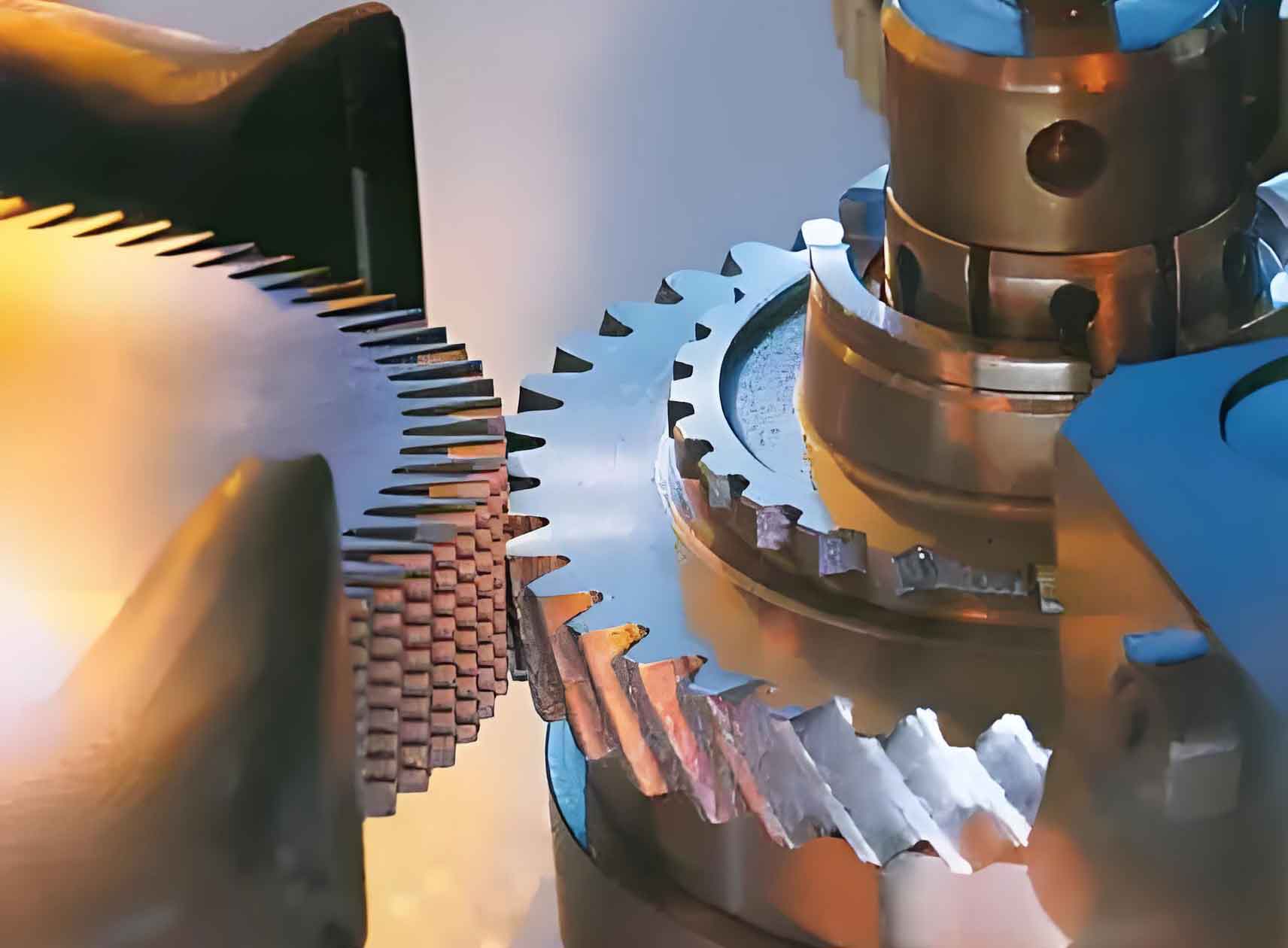
The most established method is the conventional longitudinal gear shaving process. In this method, the gear shaving cutter, essentially a high-precision helical gear with cutting edges, meshes with the workpiece gear at a crossed-axes angle. The workpiece executes a reciprocating axial feed along its axis while being driven by the rotating cutter. The fundamental kinematic principle is that of a crossed helical gear pair in tight mesh, generating a relative sliding velocity at the point of contact which facilitates the cutting action. While simple and capable of processing wide face-width gears with a relatively narrow cutter, longitudinal gear shaving is characterized by point contact between the cutter and workpiece tooth flanks at any given instant. This point-contact nature leads to several inherent drawbacks: concentrated and uneven wear on the cutter teeth, lower productivity due to the long stroke required, and the well-documented phenomenon of profile crowning or “mid-profile concavity” on the finished gear. Correcting this concavity necessitates complex and non-standard modifications to the cutter’s involute profile.
Subsequent developments introduced diagonal and tangential gear shaving, which alter the feed direction relative to the workpiece axis to improve efficiency and tool wear distribution to some extent. However, the longitudinal method remains prevalent due to its operational simplicity and compatibility with standard machine tools and cutters.
A significant leap was made with the advent of the radial gear shaving method. In this process, the gear shaving cutter and the workpiece gear are also in crossed-axis mesh, but the cutter feeds directly along the radial direction toward the workpiece center, with little to no axial feed. The key theoretical advantage is that, at any instant, the tooth surfaces are in line contact rather than point contact. This results in more uniform load distribution, significantly improved cutter life, a drastic reduction in cycle time (often to just a few seconds), enhanced ability to correct lead errors, and the mitigation of mid-profile concavity. Despite these compelling advantages, radial gear shaving faces a major practical hurdle: the theoretical tooth flank of the required radial shaving cutter is not a simple involute helicoid but a complex, variable-parameter surface—a collection of involute helicoids with continuously changing base diameters and helical parameters. Manufacturing and regrinding such a dedicated, non-standard cutter profile is exceedingly difficult and costly. Furthermore, standard longitudinal shaving machines are not suitable for this method, necessitating specialized equipment.
Therefore, a gap exists between the practical simplicity of longitudinal gear shaving tools and the superior kinematic performance of the radial gear shaving principle. My work focuses on bridging this gap by proposing a hybrid solution. This led to the conceptualization of the Dual-Blade Gear Shaving Cutter. The core idea is to extract not the entire complex flank, but specific, strategically chosen profile lines from the theoretical tooth surface of a radial shaving cutter. These lines serve as the cutting edges. By then employing the longitudinal gear shaving motion combined with the workpiece’s helical self-generation motion, the entire gear tooth flank can be generated. This approach promises the line-contact benefits of radial shaving for a significant portion of the cutting cycle while utilizing a cutter that can be manufactured and reground using standard methods for involute gears.
The fundamental principle of the dual-blade gear shaving cutter is rooted in spatial gearing theory and the concept of helical surface self-generation. Consider the meshing condition for a pure radial gear shaving process, where the workpiece gear has only one rotational degree of freedom relative to the cutter. The basic spatial meshing condition, or the equation of contact, states that the relative velocity vector at the point of contact must lie in the common tangent plane, i.e., it must be perpendicular to the common normal vector. For a gear with a helical tooth surface (including a spur gear as a special case with zero helix angle), its tooth surface $\Sigma_g$ can be represented in parametric form. When this surface undergoes a self-generating motion—an axial translation coupled with a proportional rotation—it recreates itself. This self-generation motion is exactly what is provided by the axial feed and inherent rotation in a longitudinal gear shaving setup.
The theoretical cutting edge profile for the dual-blade cutter is derived as a specific cross-section of the theoretical tooth surface of the conjugate radial shaving cutter. This conjugate surface $\Sigma_c$ is determined by solving the meshing equations for the single-degree-of-freedom radial shaving process. The derivation begins with the equation for the gear tooth flank. For a helical gear, a point on the left-hand flank in a coordinate system attached to the gear can be described by:
$$
\begin{aligned}
x_g &= r_b \cos(\mu + \theta) + r_b \theta \sin(\beta_b) \sin(\mu + \theta) \\
y_g &= r_b \sin(\mu + \theta) – r_b \theta \sin(\beta_b) \cos(\mu + \theta) \\
z_g &= r_b \theta \cos(\beta_b)
\end{aligned}
$$
where $r_b$ is the base circle radius, $\beta_b$ is the base helix angle, $\mu$ is the involute start angle, and $\theta$ is the involute roll angle.
The general meshing equation for spatial gearing is $\vec{n} \cdot \vec{v}^{(gc)} = 0$, where $\vec{n}$ is the common normal and $\vec{v}^{(gc)}$ is the relative velocity. For the radial shaving condition with a fixed center distance $a$ and shaft angle $\Sigma$, and considering the self-generation condition of the workpiece surface, the specific meshing equation for generating the conjugate cutter surface $\Sigma_c$ is obtained. For a spur gear workpiece ($\beta_b = 0$), this equation simplifies. The conjugate radial shaving cutter surface coordinates $(x_c, y_c, z_c)$ are then found through the coordinate transformation from the gear system to the cutter system, involving the rotation angles $\phi_g$ and $\phi_c$ of the gear and cutter, respectively, which are linked by the gear ratio.
The dual-blade profile is defined by taking a constant cross-section of this theoretical surface, i.e., by setting $z_c = \text{constant}$. This constant defines the axial position of the blade on the cutter tooth. Combining this condition with the meshing equation yields a relationship between the gear surface parameters and the rotation angle at the moment of engagement for points lying on the desired blade. By solving this system, the precise coordinates of the theoretical blade profile in the cutter’s transverse plane are calculated. Typically, two such profiles are defined on a single tooth, symmetrically displaced from the mid-plane.
To verify the manufacturability of this theoretical profile, a computational analysis was performed. The coordinates of the theoretical blade profile were calculated for various gear parameters. A key question was whether this complex profile could be approximated with sufficient accuracy by a standard involute curve, which would make grinding vastly simpler. The results from numerical fitting showed that for a given blade position, the profile is extremely close to an involute. The deviation between the theoretical dual-blade profile and its best-fit involute was found to be on the order of $10^{-4}$ mm, which is negligible compared to the allowable profile error for a precision shaving cutter (e.g., below 0.003 mm for a Class A cutter). This critical finding confirms that the actual cutting edges of the dual-blade shaving cutter can be simple, standard involutes with specific base circle radii and helix angles.
The practical grinding of these involute edges can be accomplished on standard tool-grinding equipment, such as a gear grinder based on the rack-and-pinion generation principle. To establish the grinding parameters, the conjugate “imaginary rack” profile that would generate the desired involute on the cutter must be determined. This is a planar meshing problem. Using the theorem of gearing (the normal at the point of contact must pass through the pitch point), the transverse coordinates $(x_t, y_t)$ of the theoretical blade are transformed into the corresponding profile of the imaginary rack. The relationship is derived from the condition that during generation, the cutter rotates by an angle $\phi_c$ such that the normal at the profile point passes through the instantaneous center of rotation (pitch point).
Let $P(x_t, y_t)$ be a point on the cutter’s transverse profile with a normal having direction cosines $n_x$ and $n_y$. The required rotation angle $\phi_c$ for this point to be in contact with the rack is:
$$
\phi_c = \arctan\left(\frac{y_t – x_t \cdot (n_y/n_x)}{r_p’}\right) – \arctan\left(\frac{n_y}{n_x}\right)
$$
where $r_p’$ is the pitch radius of the cutter during the rack-generation grinding process. The corresponding coordinates $(X_r, Y_r)$ of the conjugate point on the imaginary rack are then:
$$
\begin{aligned}
X_r &= x_t \cos \phi_c – y_t \sin \phi_c + r_p’ \phi_c \\
Y_r &= x_t \sin \phi_c + y_t \cos \phi_c – r_p’
\end{aligned}
$$
This yields the theoretical rack profile. In practice, a large-diameter grinding wheel, approximating a plane, is used to grind the cutter. The wheel is set at the rack’s pressure angle. The actual grinding setup involves optimizing the wheel’s position (tilt and offset) to best approximate the two imaginary rack profiles corresponding to the two blades on a single tooth space. This is formulated as a least-squares optimization problem to minimize the total normal deviation between the desired rack profiles and the line cut by the grinding wheel plane in the respective sections.
The optimization variables are the wheel orientation angles and the axial positions of the grinding sections. The objective function $F$ to be minimized is the sum of squared normal errors at sampled points:
$$
F(\alpha, \delta_1, \delta_2) = \sum_{i} \left[ \Delta n_{1i}^2 + \Delta n_{2i}^2 \right]
$$
where $\Delta n_{1i} = Y_{r1i} – (X_{r1i} \tan \alpha + \delta_1)$ and $\Delta n_{2i} = Y_{r2i} – (-X_{r2i} \tan \alpha + \delta_2)$, with $\alpha$ as the effective pressure angle of the wheel plane and $\delta_1, \delta_2$ as intercept constants.
Computational results for example gears confirm the feasibility. For instance, when shaving a spur gear (module 3 mm, 30 teeth, pressure angle 20°) with a dual-blade cutter (blade separation 10 mm, shaft angle 15°), the maximum normal error after optimization was approximately 0.0012 mm. For a helical gear (module 3 mm, 30 teeth, helix angle 15°, pressure angle 20°, shaft angle 10°), the maximum error was about 0.0016 mm. These values are well within the tolerance for precision shaving cutter grinding, demonstrating that standard grinding methods are entirely adequate for manufacturing the dual-blade shaving cutter.
The operational advantages of the dual-blade gear shaving cutter in a longitudinal gear shaving process are significant. Unlike a conventional shaving cutter which has continuous cutting edges and operates under point contact, the dual-blade cutter engages the workpiece with two distinct, axially separated lines of contact (the blades) on each flank. Analysis of the contact conditions reveals that for approximately 80% of the meshing cycle, the gear tooth is in simultaneous contact with both blades on the opposing cutter tooth. This two-point contact provides superior guidance and stability during the gear shaving process, reducing tendencies for chatter and improving lead accuracy. It also contributes to a more uniform distribution of the cutting load, helping to alleviate the mid-profile concavity issue associated with traditional point-contact gear shaving.
Furthermore, while not achieving full line contact like a true radial shaving cutter, the two-line engagement offers a substantial improvement over single-point contact. It embodies the continuous cutting principle sought after in other advanced methods like “turn-shaving” but avoids the extreme complexity and speed differential challenges associated with manufacturing turn-shaving tools. Perhaps the most transformative potential lies in the tool’s construction and material application. The cutter can be designed as an assembly where the individual tooth segments (inserts) containing the two precision-ground involute blades are mounted onto a reusable body. This modular design allows for easy replacement of worn inserts. Crucially, it enables the use of advanced tool materials that are difficult or impossible to implement in a monolithic, complex-shaped cutter. Inserts can be made from premium powdered metallurgy high-speed steel (PM-HSS), hard coatings, or even solid carbide and other ultra-hard materials like cubic boron nitride (CBN) or polycrystalline diamond (PCD) blanks, onto which the involute profile is ground.
This material capability opens the door to using the gear shaving process for finishing hardened gears. Hard gear shaving, as opposed to grinding, offers potential benefits in terms of higher productivity, better surface integrity (compressive residual stresses), and no risk of thermal damage like grinding burns. The dual-blade shaving cutter, with its simple involute profile amenable to grinding on standard machines and its potential for carbide construction, presents a viable and efficient solution for post-hardening precision finishing, potentially complementing or replacing gear grinding in many applications.
The following table summarizes a comparison between the traditional longitudinal method, the radial method, and the proposed dual-blade gear shaving cutter approach:
| Feature | Longitudinal Gear Shaving | Radial Gear Shaving | Dual-Blade Gear Shaving |
|---|---|---|---|
| Contact Type | Point contact | Theoretical line contact | Predominantly two-point contact |
| Cutting Edges | Full involute helicoid | Complex, variable-parameter surface | Two discrete, standard involute profiles |
| Tool Manufacturing | Simple (standard involute grinding) | Very complex and expensive | Simple (standard involute grinding) |
| Process Efficiency | Lower (long axial stroke) | Very high (short radial feed) | High (longitudinal stroke, but improved stock removal) |
| Guidance & Stability | Lower (single point) | High (full line) | High (dual-point) |
| Mid-Profile Error | Prone to concavity | Minimized | Reduced |
| Machine Tool | Standard shaving machine | Specialized radial shaving machine | Standard shaving machine |
| Hard Gear Shaving Potential | Low (HSS material limitation) | Low (complex tool material issue) | High (modular, carbide-compatible) |
In conclusion, the dual-blade gear shaving cutter represents a synergistic innovation in gear finishing technology. It successfully integrates the kinematic benefits of multi-point contact derived from radial gear shaving theory with the practical manufacturability of standard longitudinal shaving tools. My analysis confirms that its theoretical cutting edges can be accurately realized as simple involutes, allowing for straightforward production and regrinding on conventional equipment. When applied in a standard longitudinal gear shaving setup, it provides enhanced guidance, improved load distribution, and higher process stability compared to conventional point-contact gear shaving. Its modular design philosophy unlocks the possibility of employing ultra-hard tool materials, making it a promising candidate for the productive and precise finishing of hardened gears, thereby potentially expanding the scope of the gear shaving process into new and demanding applications. The development of this tool concept underscores the value of hybridizing theoretical principles to create practical solutions for advanced manufacturing challenges.